SYRACUSE, N.Y. (AP) — Syracuse University hired Bryan Blair as its athletic director on Thursday, at a time the ACC school is searching to regain relevance and with its once-proud men’s basketball program in transition.
The 40-year-old Blair takes over after spending the past four years holding the same job at Toledo, where in 2022 he was nation’s youngest AD. And Syracuse is counting on Blair’s youth and familiarity with the NCAA’s changing revenue landscape to guide Orange athletics into the future.
“Bryan Blair is the athletics leader for this moment and for the future of Syracuse University,” Syracuse chancellor-elect Michael Haynie said in a release. “He is a fierce competitor who knows how to build winning programs, a visionary who approaches the business of college athletics with genuine creativity and ingenuity.”
Blair replaces John Wildhack, who had previously announced he is retiring in July following a 10-year tenure.
One of Wildhack’s final decisions was firing men’s basketball coach Adrian Autry on Wednesday. Autry was fired after three largely unsuccessful seasons in which he struggled in replacing Jim Boeheim.
The Orange endured consecutive seasons with losing records for the first time since 1968-69. And they’ve now gone five seasons without earning an NCAA Tournament berth for a program that was once a March Madness fixture, with Syracuse winning the title in 2003.
Syracuse’s football team also took a step back with a 3-9 finish in coach Fran Brown’s second season, and a year after going 10-3.
At Toledo, Blair oversaw an athletic department that combined for 16 Mid-American Conference titles in four years — more than the Rockets won over their previous decade. They included a football championship and two bowl victories.
On the business side, fundraising at Toledo increased by 282% under Blair. And he was credited for establishing what was described as “a sophisticated NIL ecosystem” by securing national partnerships with Powerade and an auto-lease arrangement for women’s basketball.
“The opportunity to lead Orange athletics at this moment is incredibly exciting because the potential ahead is extraordinary,” Blair said. “The best days of Syracuse athletics are ahead of us.”
Blair previously served as deputy AD and COO at Washington State, and also had stops at Rice and South Carolina, where he worked closely with women’s basketball coach Dawn Staley. He attended law school at South Carolina, and has a degree in history from Wofford College, where he played football.
AP college sports: https://apnews.com/hub/college-sports

FILE - The Carrier Dome is seen at Syracuse University on Sept. 21, 2015, Syracuse, N.Y. (AP Photo/Mike Groll, File)
SEOUL, South Korea (AP) — The U.S. military says a KC-135 refueling aircraft supporting operations against Iran crashed in western Iraq, killing at least four of its six crew members.
The U.S. Central Command, which oversees the Middle East, said the crash followed an unspecified incident involving two aircraft in “friendly airspace,” and that the other plane landed safely.
Here’s what is known so far about the tanker, which is the fourth publicly acknowledged U.S. aircraft to crash during the war against Iran:
The KC-135 Stratotanker is a U.S. Air Force aircraft used to refuel other planes in midair, allowing them to travel longer distances and maintain operations longer without landing. The plane is also used to transport wounded personnel during medical evacuations or conduct surveillance missions, according to military experts.
Based on the same design as the Boeing 707 passenger plane, the tanker has been in service for more than 60 years, supporting the U.S. Air Force, Navy and Marine Corps as well as allied aircraft, according to an Air Force description. The aging plane is set to be gradually phased out as more of the next-generation KC-46A Pegasus tankers enter service.
Despite upgrades over the years, the KC-135s' age has fueled concern about their reliability and durability.
“The last of these planes were produced in the 1960s,” said Yang Uk, a security expert at South Korea’s Asan Institute for Policy Studies. He added that the transition to the KC-46A has progressed more slowly than expected.
According to the Congressional Research Service, the Air Force last year had 376 KC-135s, including 151 on active duty, 163 in the Air National Guard and 62 in the Air Force Reserve.
A basic KC-135 crew has three people: a pilot, co-pilot and boom operator. Nurses and medical technicians are added in aeromedical evacuation missions.
Refueling typically happens at the back of the plane, where the boom operator is located. A fuel boom is lowered to connect with fighters, bombers or other aircraft. On many of the planes, the boom operator works lying face down while looking out of a window on the underside of the plane.
Some KC-135s can also refuel planes from pods on their wings. The tankers also have room to carry cargo or passengers if needed.
Refueling tankers could play an increasingly important role if the Iran war drags on, as U.S. aircraft may need to fly longer missions to pursue Iranian forces retreating deeper into the country, said Yang.
The U.S. Central Command said four of the six crewmembers on board the crashed KC-135 have been confirmed dead and that rescue efforts are continuing. It said the circumstances of the crash are under investigation but that the loss of the aircraft was “not due to hostile or friendly fire.”
A U.S. official, who also spoke on condition of anonymity to discuss the developing situation, said the other plane involved was also a KC-135. Yechiel Leiter, the Israeli ambassador to the U.S., wrote on X that the other plane landed safely in Israel.
Yang said it would be rare for a refueling tanker to be downed by enemy fire because such operations are usually conducted in the rear of combat zones.
The crash came after three U.S. F-15E fighter jets were mistakenly downed last week by friendly Kuwaiti fire.
KC-135s have previously been involved in several fatal accidents. The most recent occurred on May 3, 2013, when a KC-135R crashed after takeoff south of Chaldovar, Kyrgyzstan, while supporting the war in Afghanistan.
In that crash, the crew experienced problems with the plane’s rudder, according to a U.S. Air Force investigation. While they struggled to stabilize the plane, the tail section broke away and the plane exploded midair, killing all three crewmembers onboard.
The most serious mid-air collision involving the plane happened in 1966, when a B-52 bomber carrying nuclear bombs struck a tanker near Palomares, Spain.
The accident caused the tanker to crash, killing four onboard. The disaster led to an extensive decontamination effort to clean up nuclear material dispersed when conventional explosives in the hydrogen bombs detonated after hitting the ground.
Schreck reported from Bangkok. AP writers Ben Finley and Konstantin Toropin in Washington contributed.
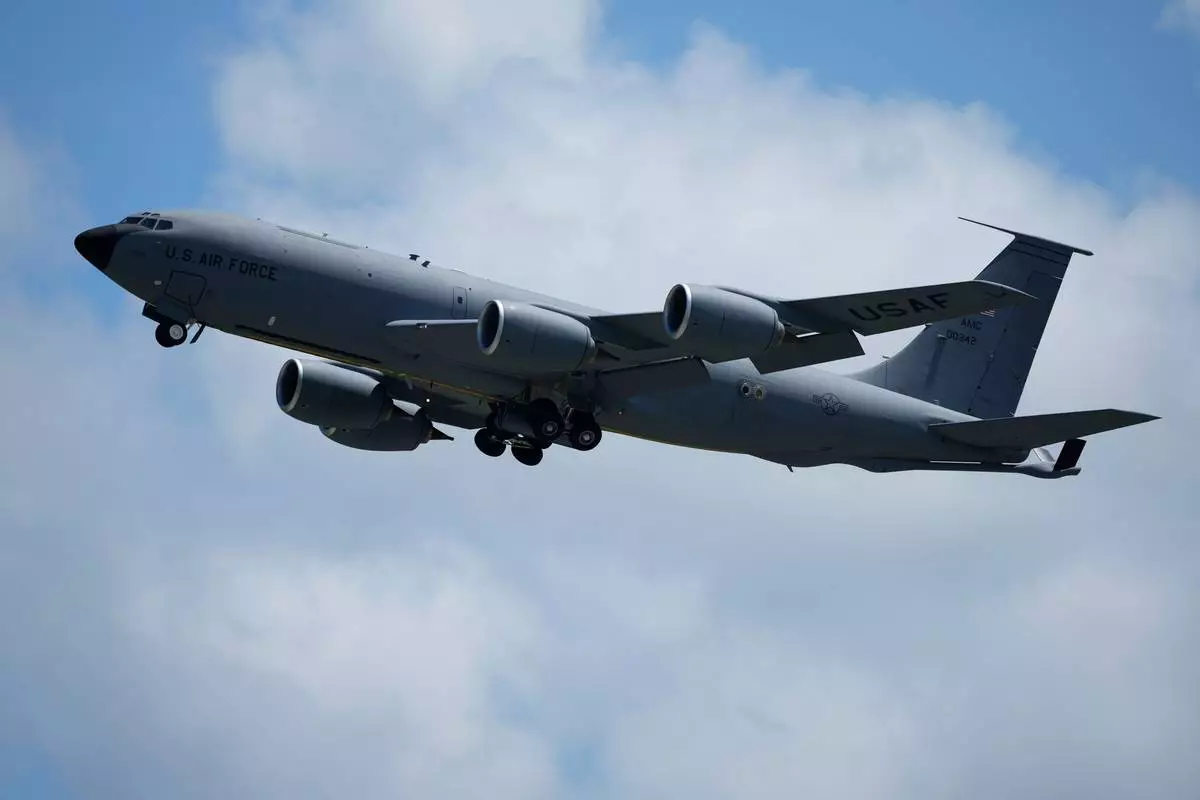
FILE - A U.S. Air Force KC-135 Stratotanker refueling tanker aircraft takes off from the Kadena Air Base airfield in Kadena town, west of Okinawa, southern Japan, Wednesday, Aug. 30, 2023. (AP Photo/Hiro Komae, File)
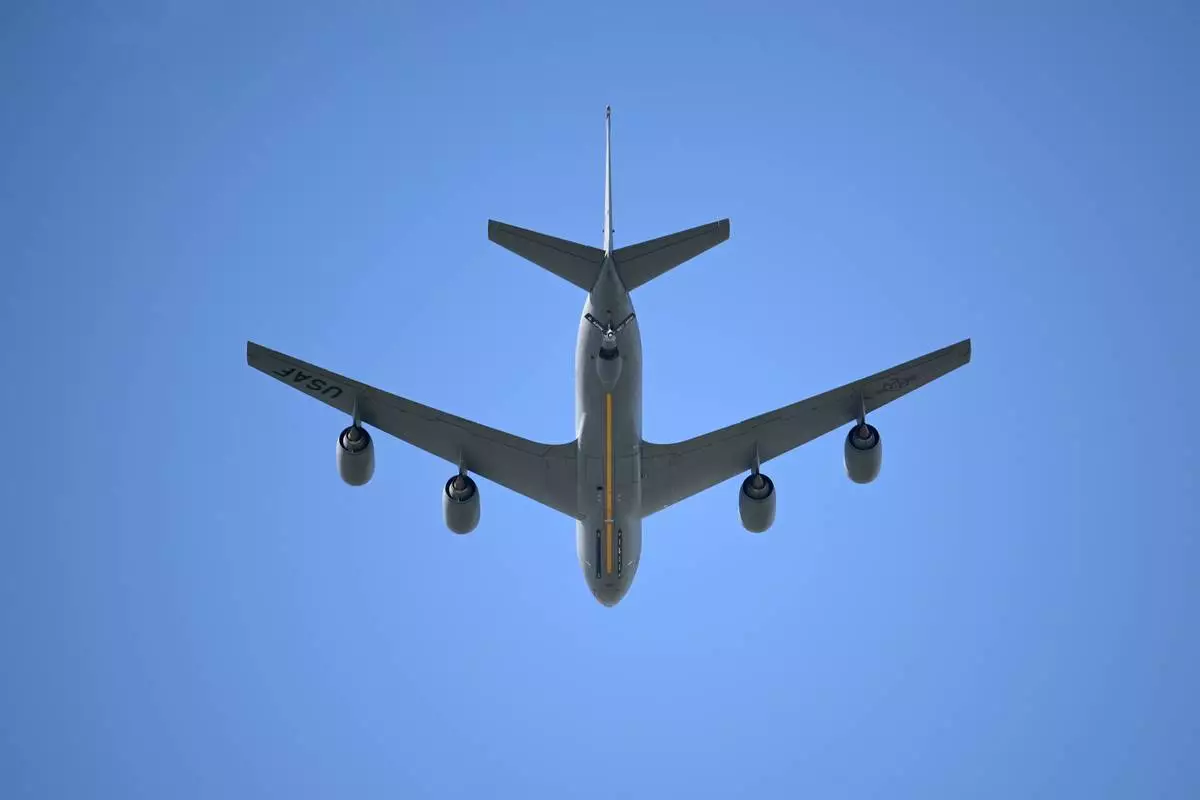
FILE - A U.S. Air Force KC-135 Stratotanker aerial refueling aircraft performs a flyover during the national anthem before an NCAA college football game between Central Florida and Georgia Tech, Sept. 24, 2022, in Orlando, Fla. (AP Photo/Phelan M. Ebenhack, File)