Valerie Fayzullina expresses a hopeful sense of wonder as she stands near a wire sculpture of a soccer player, in the shadows of eight new apartment high-rises and a freshly finished stadium that will host stars as big as Cristiano Ronaldo this month.
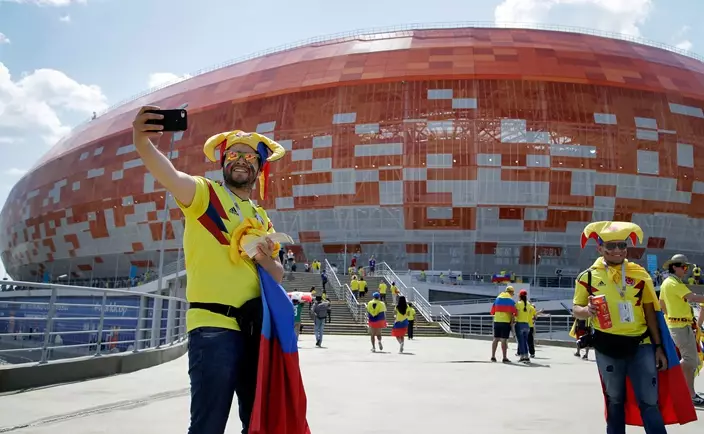
Fans take pictures in front of the stadium prior to the group H match between Colombia and Japan at the 2018 soccer World Cup in the Mordavia Arena in Saransk, Russia, Tuesday, June 19, 2018. (AP Photo/Mark Baker)
Like many Saransk residents, Fayzullina was incredulous upon learning the World Cup was coming to her quiet, obscure community 400 miles east of Moscow in rolling hills where white puffs of pollen from poplar trees create the illusion of summer snow flurries.
Click to Gallery
Fans take pictures in front of the stadium prior to the group H match between Colombia and Japan at the 2018 soccer World Cup in the Mordavia Arena in Saransk, Russia, Tuesday, June 19, 2018. (AP Photo/Mark Baker)
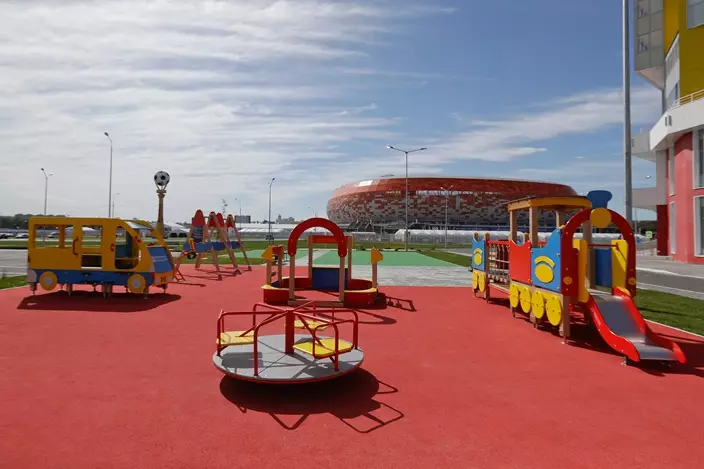
In this picture taken Friday, June 15, 2018, a children playground is backdropped by the Mordovia Arena during the 2018 soccer World Cup in Saransk, Russia. (AP Photo/Gregorio Borgia)
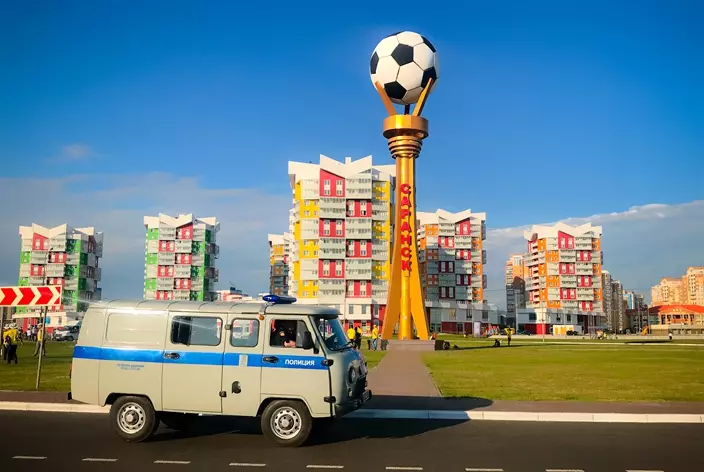
A police van drives near brightly colored apartment buildings, near the Mordavia Arena, one of the stadiums where matches of the 2018 soccer World Cup are played, in Saransk, Russia, Tuesday, June 19, 2018.(AP Photo/Vadim Ghirda)
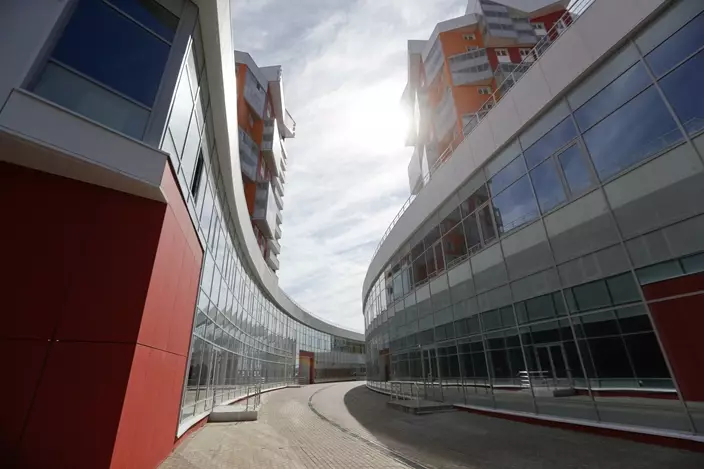
In this picture taken Friday, June 15, 2018, new buildings are pictured near the Mordovia Arena during the 2018 soccer World Cup in Saransk, Russia. (AP Photo/Gregorio Borgia)
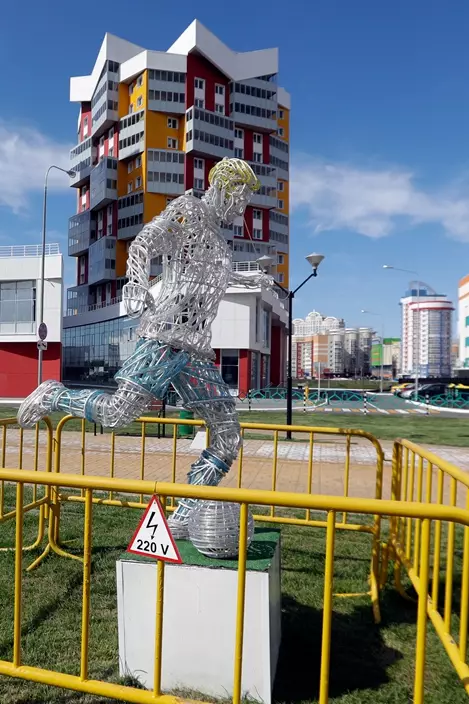
In this picture taken Friday, June 15, 2018, a sculpture of a soccer player made with electric wires stands in front of new buildings near the Mordovia Arena during the 2018 soccer World Cup in Saransk, Russia. (AP Photo/Gregorio Borgia)
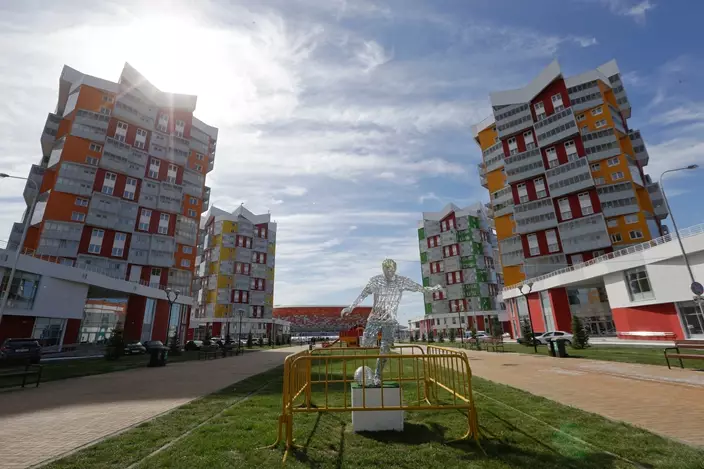
In this picture taken Friday, June 15, 2018, new buildings are backdropped by the the Mordovia Arena during the 2018 soccer World Cup in Saransk, Russia. (AP Photo/Gregorio Borgia)
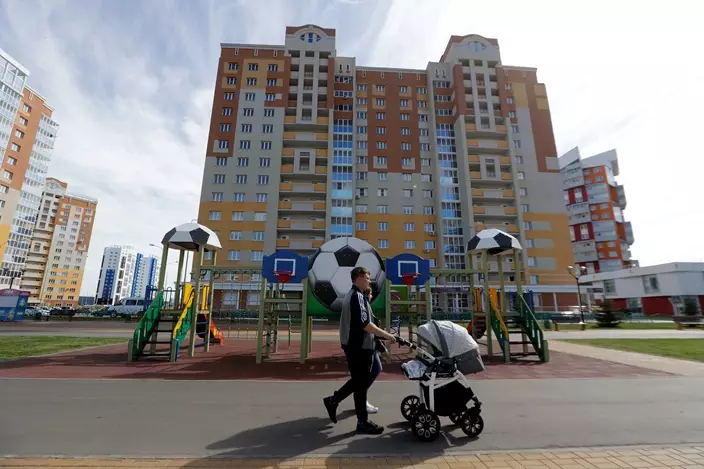
In this picture taken Friday, June 15, 2018 a couple push a baby trolley past new buildings near the Mordovia Arena during the 2018 soccer World Cup in Saransk, Russia. (AP Photo/Gregorio Borgia)
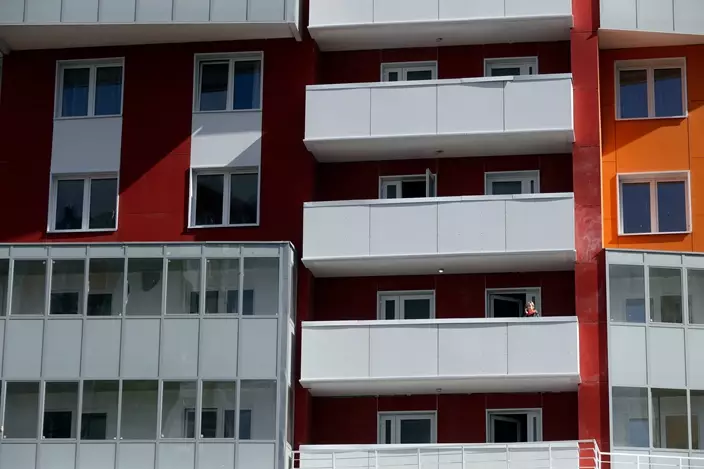
In this picture taken Friday, June 15, 2018, a woman stands on a balcony of s new building near the Mordovia Arena during the 2018 soccer World Cup in Saransk, Russia. (AP Photo/Gregorio Borgia)
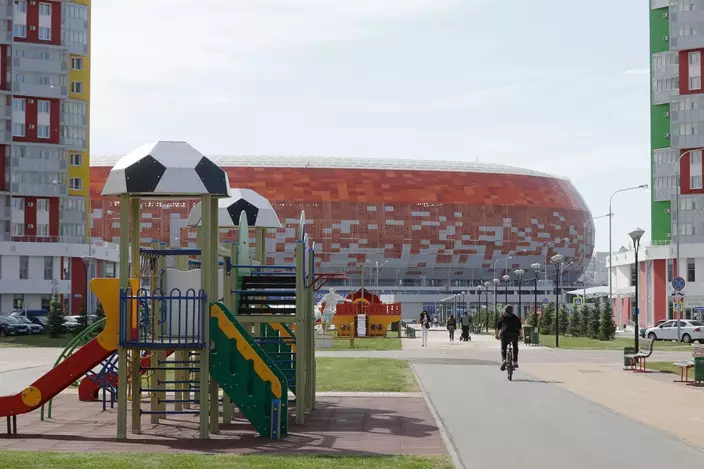
In this picture taken Friday, June 15, 2018, a children playground and new buildings are backdropped by the Mordovia Arena during the 2018 soccer World Cup in Saransk, Russia. (AP Photo/Gregorio Borgia)
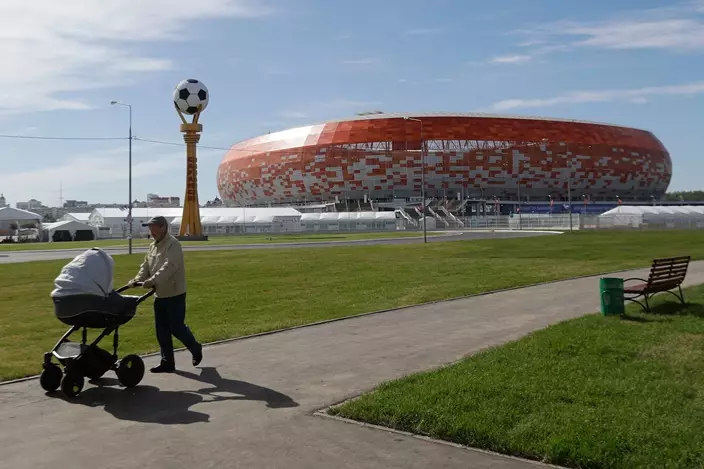
In this picture taken Friday, June 15, 2018, a man pushes a baby trolley as walks past the Mordovia Arena during the 2018 soccer World Cup in Saransk, Russia. (AP Photo/Gregorio Borgia)

In this picture taken Friday, June 15, 2018, a huge soccer ball sits over a column adorned with the writing of Sransk near the Mordovia Arena during the 2018 soccer World Cup in Saransk, Russia. (AP Photo/Gregorio Borgia)
In this picture taken Friday, June 15, 2018, a children playground is backdropped by the Mordovia Arena during the 2018 soccer World Cup in Saransk, Russia. (AP Photo/Gregorio Borgia)
She's delighted by the transformation of her once anonymous town into a more urbane-looking locale and wants to believe that all the work done in the past half-decade will have a lasting effect on the city of 300,000.
"Knowing how my city was — like, the state of my city back then — I'm like, 'We're not ready,'" Fayzullina, who'll soon turn 24, said in English, recalling the announcement in 2012 that Saransk would be among 11 Russian cities hosting soccer's global tournament. "I was quite skeptical."
A police van drives near brightly colored apartment buildings, near the Mordavia Arena, one of the stadiums where matches of the 2018 soccer World Cup are played, in Saransk, Russia, Tuesday, June 19, 2018.(AP Photo/Vadim Ghirda)
Ultimately, the new buildings forming the Tavla complex next to the stadium are supposed to house permanent residents in around 900 apartments. They are expected to sell for about $72 per square foot, said development general manager Igor Sinichkin. But first, the buildings are being used temporarily as hotels or short-term rentals for those in Saransk for the World Cup. Most of the guests work in security; air traffic control and customs for the unusual spike in inbound flights; international media; or with FIFA. Some fans stay there, too.
In this picture taken Friday, June 15, 2018, new buildings are pictured near the Mordovia Arena during the 2018 soccer World Cup in Saransk, Russia. (AP Photo/Gregorio Borgia)
"If you had seen the city, it was so small. Like this whole place, all this area, was rural," Fayzullina said, sweep her arms toward the land across the Insar River from the historical center of town. "And now, like six years later, we have all these huge buildings."
Saransk is the least populated — and arguably least known — 2018 World Cup host city. There was virtually no tourist industry before the World Cup, and if not for the four temporary hotels in the Tavla complex, there would be a room shortage around match days.
In this picture taken Friday, June 15, 2018, a sculpture of a soccer player made with electric wires stands in front of new buildings near the Mordovia Arena during the 2018 soccer World Cup in Saransk, Russia. (AP Photo/Gregorio Borgia)
The development cost about $80 million, said project manager Katerina Yakushkina. The exterior facades of the 14- to 16-floor structures have a modern look, with jutting angles highlighted by contrasting colors schemes of orange, red, green, yellow, white and metallic gray. A new school and shopping center have been built in conjunction with the development. Parents already take their children to playgrounds there. There are plans for a water park.
In this picture taken Friday, June 15, 2018, new buildings are backdropped by the the Mordovia Arena during the 2018 soccer World Cup in Saransk, Russia. (AP Photo/Gregorio Borgia)
Asked whether she thought people around the world had heard of Saransk before it became a World Cup host, Yakushkina quipped, "Even in Moscow, nobody knew where Saransk was."
"Hedgehogs and elk were walking around in the streets," the 35-year-old said. "Now it's an advanced kind of city.
"Basically, this will become a new kind of downtown."
In the past half-decade, hundreds of millions of dollars have gone into building up Saransk, which has no history of industry, but does have a university and a legacy of producing world-class athletes in track and field, boxing and wrestling. Movie buffs also might recall actor Gerard Depardieu settled here — legally speaking — when he changed citizenship to avoid higher taxes in his native France.
In this picture taken Friday, June 15, 2018 a couple push a baby trolley past new buildings near the Mordovia Arena during the 2018 soccer World Cup in Saransk, Russia. (AP Photo/Gregorio Borgia)
In addition to the stadium and buildings nearby, there are also some new hotels, including a Sheraton, closer to the city center, which emanates from the gold-domed, hilltop Cathedral of St. Theodore Ushakov. Numerous buildings have been renovated, or fixed up cosmetically, to help Saransk look polished for its international debut.
In this picture taken Friday, June 15, 2018, a woman stands on a balcony of s new building near the Mordovia Arena during the 2018 soccer World Cup in Saransk, Russia. (AP Photo/Gregorio Borgia)
A study by Moody's has concluded the Russian region of Mordovia, of which Saransk is the capital, benefited more from World Cup-related investment, proportionally speaking, than any other host region.
The 44,000-seat Mordovia Arena, which is expected to be reduced in size after the tournament to accommodate a local second-division club, cost about $250 million. The new airport cost a reported $44 million and the train station $6.3 million.
In this picture taken Friday, June 15, 2018, a children playground and new buildings are backdropped by the Mordovia Arena during the 2018 soccer World Cup in Saransk, Russia. (AP Photo/Gregorio Borgia)
The beneficiaries include people like Alexander Averyanov, a 30-year-old with a thin frame, light brown hair and the confidence to speak his mind — even in English. He landed two management jobs in new hotel restaurants — one in the city center and another next to the stadium.
But Averyanov is anxious about what will happen after Panama plays Tunisia in the final World Cup game here on June 28.
In this picture taken Friday, June 15, 2018, a man pushes a baby trolley as walks past the Mordovia Arena during the 2018 soccer World Cup in Saransk, Russia. (AP Photo/Gregorio Borgia)
"The World Cup changed the city a lot," said Averyanov. "Nobody knows for real what will be after.
"Almost all jobs are temporary. Pay didn't grow a lot. The infrastructure needs a lot of money for maintenance. I'm a bit pessimistic — because it is Russia."
Less pessimistic is Sinichkin as he sits in a new restaurant where the perimeter of the dining room is lined with plush booths that look more like sofas. During World Cup games played elsewhere, the restaurant fills with fans watching the action on an expansive wall-mounted TV. The restaurant is slated to remain when the hotel closes for the conversion to permanent residences.
In this picture taken Friday, June 15, 2018, a huge soccer ball sits over a column adorned with the writing of Sransk near the Mordovia Arena during the 2018 soccer World Cup in Saransk, Russia. (AP Photo/Gregorio Borgia)
"This is a unique project in Russia," Sinichkin said. "This will be the World Cup legacy. It will be for ordinary people and improve the welfare of the city.
"The most important thing," he added, perhaps only half joking, "is that Cristiano Ronaldo will be here."