For $1,000, the premium Galaxy Note 9 is a superb phone that showcases the best Samsung has to offer.
It's also the phone most of you won't need. That's because you can get many of the same features in Samsung's Galaxy S9 for a few hundred dollars less.
Click to Gallery
FILE- In this Aug. 7, 2018, file photo, the Samsung Galaxy Note 9 is shown in New York. For $1,000, the Galaxy Note 9 is a superb phone that’s the best Samsung has to offer. But for a few hundred dollars less, the Galaxy S9 offers many of the features the Note 9 is now getting, including zippy speeds and camera improvements. (AP PhotoRichard Drew, File)
This combo shows photos of Central Park in New York on Sunday, Aug 19, 2018. Starting at the top left and going clockwise, the phones used are Samsung’s Galaxy Note 9, Samsung’s Galaxy S9, Google’s Pixel 2 XL and Apple’s iPhone X. (AP PhotoNick Jesdanun)
FILE- In this Aug. 7, 2018, file photo the Samsung Galaxy Note 9 is shown in New York. For $1,000, the Galaxy Note 9 is a superb phone that’s the best Samsung has to offer. (AP PhotoRichard Drew, File)
FILE- In this Aug. 7, 2018, file photo the Samsung Galaxy Note 9 is shown in New York. For $1,000, the Galaxy Note 9 is a superb phone that’s the best Samsung has to offer. (AP PhotoRichard Drew, File)
The Note 9, available Friday, is the Android smartphone for those who want the latest and the greatest. There's a larger battery, with a 21 percent boost over last year's Note 8 model. The Note 9 gets 128 gigabytes of storage, double what's in the S9 and Apple's iPhones. And of course, a large screen.

FILE- In this Aug. 7, 2018, file photo, the Samsung Galaxy Note 9 is shown in New York. For $1,000, the Galaxy Note 9 is a superb phone that’s the best Samsung has to offer. But for a few hundred dollars less, the Galaxy S9 offers many of the features the Note 9 is now getting, including zippy speeds and camera improvements. (AP PhotoRichard Drew, File)
But there's not much "wow" beyond that. Smartphone innovation has slowed down in recent years. It's more noticeable with Samsung because the company spreads out those innovations between two major smartphones each year. One phone inevitably plays catch up with the other every six months.
So now we find that the Note 9 is getting the zippy processor and cellular speeds the S9 phones first offered earlier this year. It's also getting the S9's dual-aperture camera for better low-light shots as well as its gimmicky, but super-fun, ability to take video with super-slow motion.
And the S9 starts at just $720 through T-Mobile, and about $800 through Verizon, AT&T and Sprint. A Plus version that's closer in size to the Note 9 costs $840 to $930.

This combo shows photos of Central Park in New York on Sunday, Aug 19, 2018. Starting at the top left and going clockwise, the phones used are Samsung’s Galaxy Note 9, Samsung’s Galaxy S9, Google’s Pixel 2 XL and Apple’s iPhone X. (AP PhotoNick Jesdanun)
True, the Note 9 offers a little more wowness. Its camera uses artificial intelligence to optimize colors and lighting for what you're trying to shoot, be it food, a sunset or flowers. Many low-light shots were even better than what the S9 produced, even though both share the second aperture designed to let in more light when needed.
Of course, you're likely to see this feature in the S10 in about six months.
That brings us to one of the Note's remaining distinctive features, its stylus. It's useful for handwriting notes and signing documents on the screen. Now, it can control digital slideshows and music playback, too. The new stylus gets Bluetooth to double as a remote control. Selfies won't look as awkward when you don't have to reach for the on-screen button; just press the pen to snap the shutter.
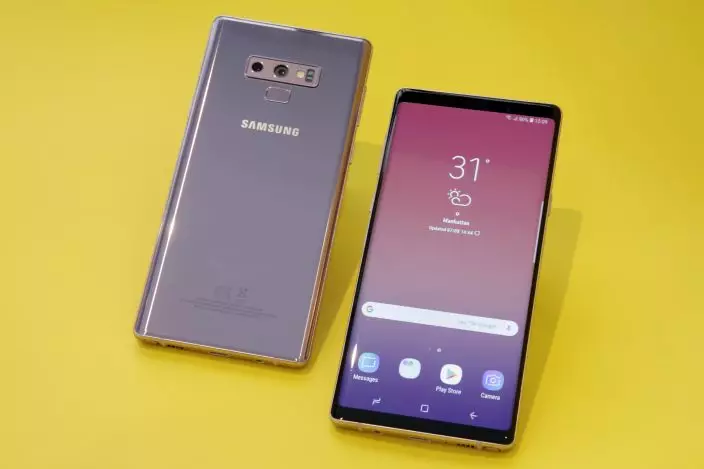
FILE- In this Aug. 7, 2018, file photo the Samsung Galaxy Note 9 is shown in New York. For $1,000, the Galaxy Note 9 is a superb phone that’s the best Samsung has to offer. (AP PhotoRichard Drew, File)
Unfortunately, there isn't a lot the remote feature can do yet. It's a promising feature — but could remain mostly a promise if app developers don't take advantage of it.
Many past Samsung features failed to gain traction because app developers couldn't be bothered to make the tweaks needed. For instance, Air View was supposed to offer pop-up previews just by pointing to an email and calendar entry, but it mostly worked only with Samsung's home-grown apps.
More recently, there's Bixby, Samsung's own digital assistant. While Samsung has worked directly with some services, including Uber and Spotify, on integrations, developers have largely prioritized Amazon's Alexa and the Google Assistant. It comes down to a chicken-or-egg problem: People need to see compelling capabilities to use a feature; developers need to see a strong base of users to spend the time developing compelling capabilities.
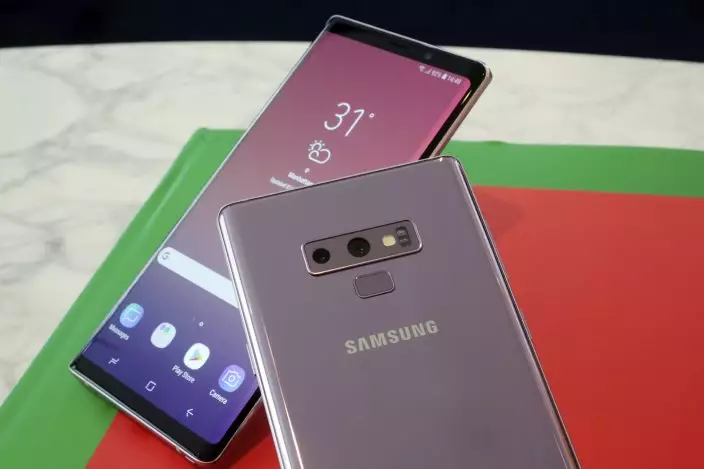
FILE- In this Aug. 7, 2018, file photo the Samsung Galaxy Note 9 is shown in New York. For $1,000, the Galaxy Note 9 is a superb phone that’s the best Samsung has to offer. (AP PhotoRichard Drew, File)
The stylus remains the Note's signature feature, with or without extensive remote capabilities. No doubt the new edition will appeal to die-hard Samsung fans, hard-core gamers and on-the-go executives who are on their phones constantly and need the battery and storage boost. Though the Note 9 uses the same processor as the S9, it has a new cooling system designed to let you use those faster speeds longer.
But if you're not someone who needs all that power, you ought to take a second look at the cheaper, six-month-old S9.
WASHINGTON (AP) — In a remarkable rebuke of Republican leadership, the House passed legislation Thursday that would extend expired health care subsidies for those who get coverage through the Affordable Care Act as 17 renegade GOP lawmakers joined every Democrat in support.
The tally, 230-196, signified growing political concern over Americans' health care costs. Forcing the issue to a vote came about after a handful of Republicans signed on to a so-called “discharge petition” to unlock debate, bypassing objections from House Speaker Mike Johnson. The bill now goes to the Senate, where pressure is building for a bipartisan compromise.
Together, the rare political coalitions are rushing to resolve the standoff over the enhanced tax credits that were put in place during the COVID-19 crisis but expired late last year after no agreement was reached during the government shutdown.
“The affordability crisis is not a ‘hoax,’ it is very real — despite what Donald Trump has had to say,” said House Democratic Leader Hakeem Jeffries, invoking the president's remarks.
“Democrats made clear before the government was shut down that we were in this affordability fight until we win this affordability fight,” he said. “Today we have an opportunity to take a meaningful step forward.”
Ahead of voting, the nonpartisan Congressional Budget Office estimated that the bill, which would provide a three-year extension of the subsidy, would increase the nation's deficit by about $80.6 billion over the decade. At the same time, it would increase the number of people with health insurance by 100,000 this year, 3 million in 2027, 4 million in 2028 and 1.1 million in 2029, the CBO said.
Johnson, R-La., worked for months to prevent this situation. His office argued Thursday that the federal health care funding from the COVID-19 era is rife with fraud and urged a no vote.
On the floor, Republicans also argued that the lawmakers should be focused on lowering health insurance costs for the broader population, not just those enrolled in ACA plans.
“Only 7% of the population relies on Obamacare marketplace plans. This chamber should be about helping 100% of Americans,” said Rep. Jason Smith, the Republican chairman of the House Ways and Means Committee.
While the momentum from the vote shows the growing support for the tax breaks that have helped some 22 million Americans have access to health insurance, the Senate would be under no requirement to take up the House bill and has already rejected it once before.
Instead, a small group of senators from both parties has been working on an alternative plan that could find support in both chambers and become law. Senate Majority Leader John Thune, R-S.D., said that for any plan to find support in his chamber, it will need to have income limits to ensure that the financial aid is focused on those who most need the help. He and other Republicans also want to ensure that beneficiaries would have to at least pay a nominal amount for their coverage.
Finally, Thune said there would need to be some expansion of health savings accounts, which allow people to save money and withdraw it tax-free as long as the money is spent on qualified medical expenses.
GOP Sen. Bernie Moreno of Ohio, a leader in the group of about a dozen senators, said they hope to deliver a framework next week. He and others met with House colleagues on options.
Sen. Jeanne Shaheen, D-N.H., who is part of the negotiations, said there is agreement on addressing fraud in health care.
“We recognize that we have millions of people in this country who are going to lose — are losing, have lost — their health insurance because they can’t afford the premiums,” Shaheen said. “And so we’re trying to see if we can’t get to some agreement that’s going to help, and the sooner we can do that, the better.”
Trump has pushed Republicans to send money directly to Americans for health savings accounts so they can bypass the federal government and handle insurance on their own. Democrats largely reject this idea as insufficient for covering the high costs of health care.
The action by Republicans to force a vote has been an affront to Johnson and his leadership team, who essentially lost control of what comes to the House floor as the Republican lawmakers joined Democrats for the workaround.
After last year’s government shutdown failed to resolve the issue, Johnson had discussed allowing more politically vulnerable GOP lawmakers a chance to vote on another health care bill that would temporarily extend the subsidies while also adding changes.
But after days of discussions, Johnson and the GOP leadership sided with the more conservative wing, which has assailed the subsidies as propping up ACA, which they consider a failed government program. He offered a modest proposal of health care reforms that was approved, but has stalled.
It was then that rank-and-file lawmakers took matters into their own hands, as many of their constituents faced soaring health insurance premiums beginning this month.
Republican Reps. Brian Fitzpatrick, Robert Bresnahan and Ryan Mackenzie, all from Pennsylvania, and Mike Lawler of New York, signed the Democrats’ petition, pushing it to the magic number of 218 needed to force a House vote. All four represent key swing districts whose races will help determine which party takes charge of the House next year.
Jeffries said in a celebratory press conference afterward that Thune should bring the Democratic bill to the Senate floor for an immediate vote.
What started as a long shot effort by Democrats to offer a discharge petition has become a political vindication of the Democrats’ government shutdown strategy as they fought to preserve the health care funds.
Democrats are making clear that the higher health insurance costs many Americans are facing will be a political centerpiece of their efforts to retake the majority in the House and Senate in the fall elections.
Trump, during a lengthy speech this week to House GOP lawmakers, encouraged his party to take control of the health care debate — an issue that has stymied Republicans since he tried, and failed, to repeal Obamacare during his first term.
Associated Press writers Matt Brown and Steven Sloan contributed to this report.
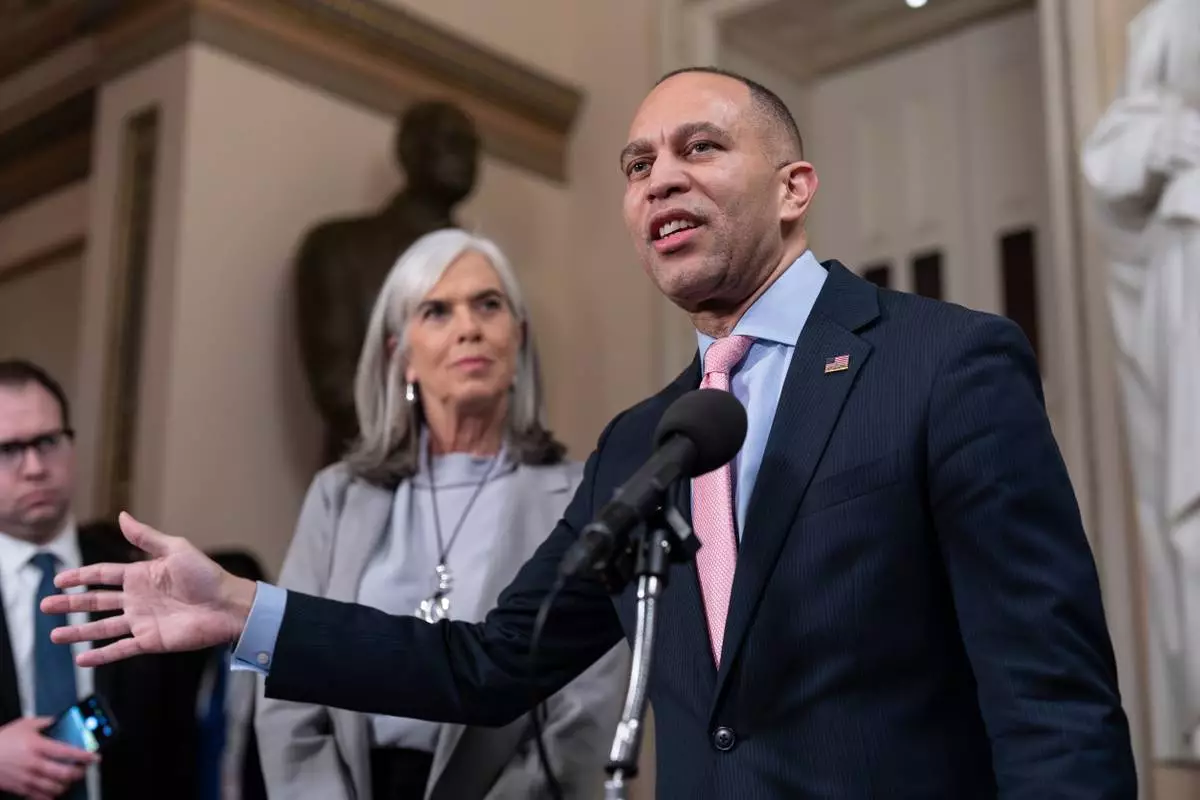
House Minority Leader Hakeem Jeffries, D-N.Y., joined by Rep. Katherine Clark, D-Mass., left, speaks to reporters just after the House passed legislation that extends expired health care subsidies for those who get coverage through the Affordable Care Act, at the Capitol in Washington, Thursday, Jan. 8, 2026. (AP Photo/J. Scott Applewhite)
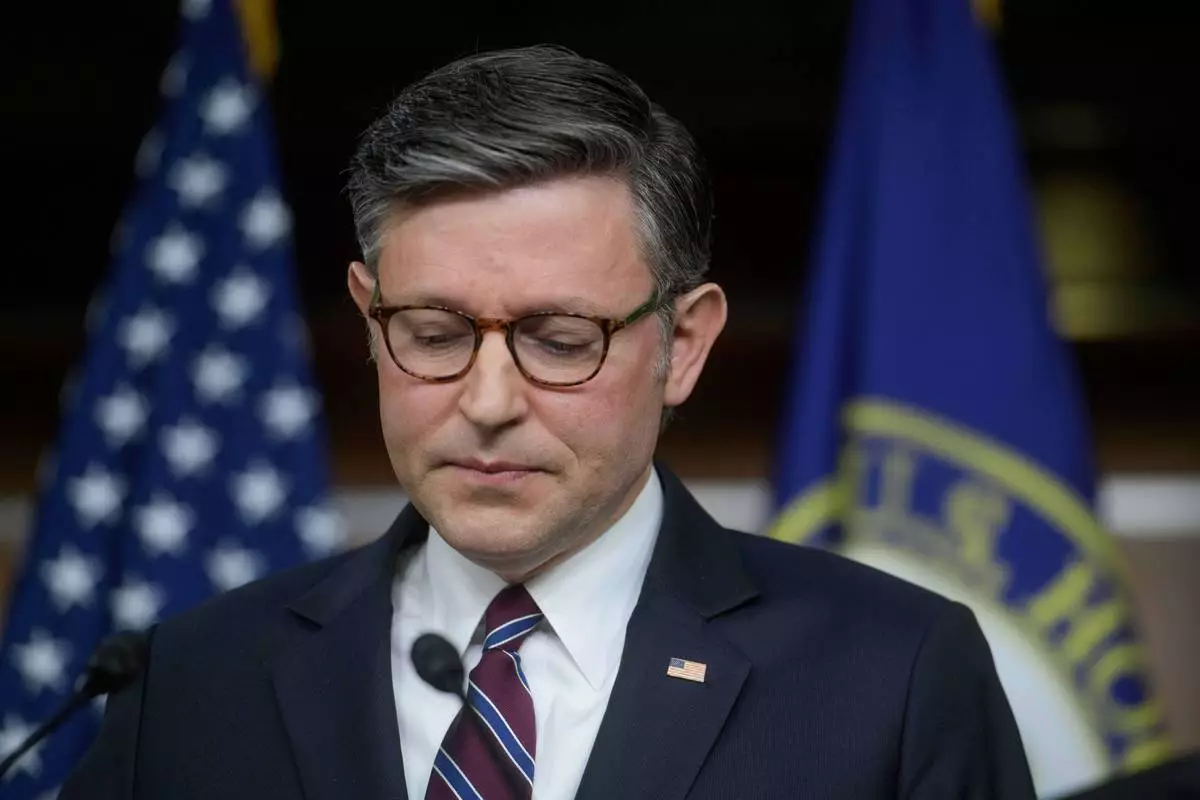
Speaker of the House Mike Johnson, R-La., speaks during a news conference at the Capitol, Wednesday, Jan. 7, 2026, in Washington. (AP Photo/Rod Lamkey, Jr.)
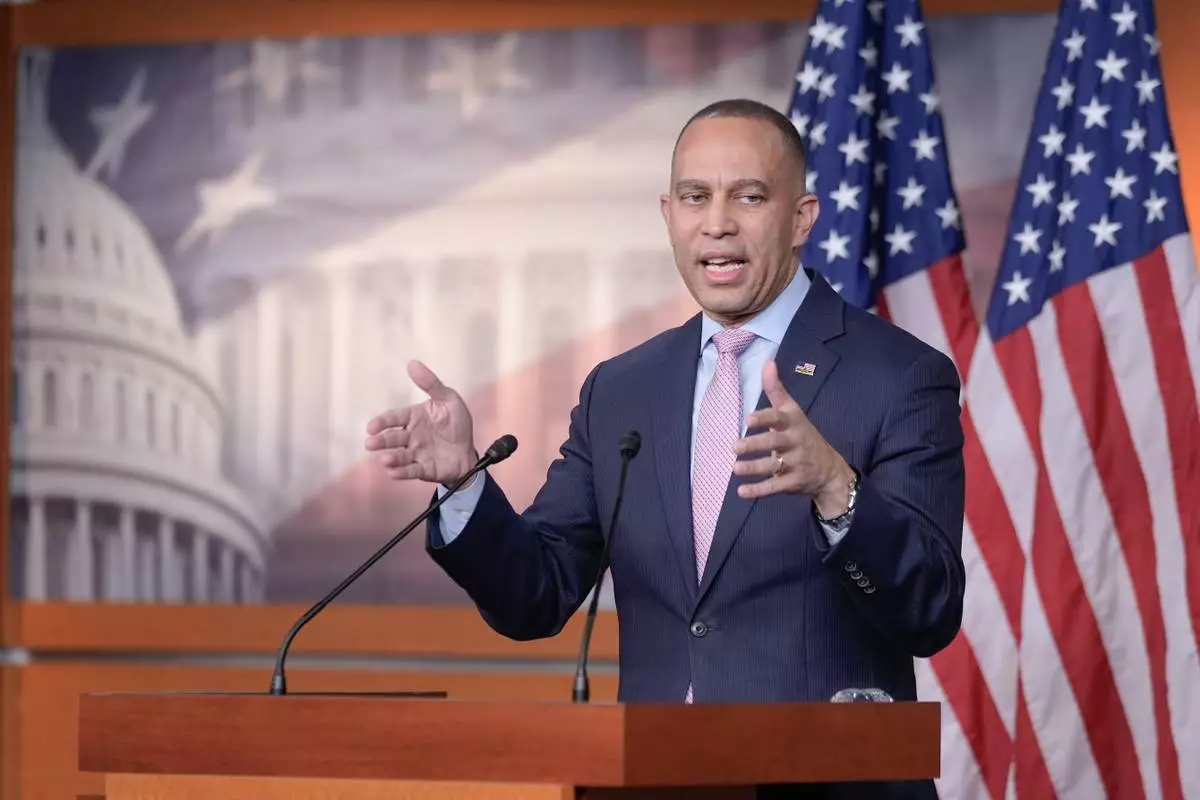
House Minority Leader Hakeem Jeffries, D-N.Y., speaks during a news conference on Capitol Hill, Monday, Jan. 5, 2026, in Washington. (AP Photo/Mariam Zuhaib)