The most surprising thing about the fact that Congolese hospitals detain patients who fail to pay their bills is that it's no secret: Administrators, doctors and nurses openly discuss it, and the patients are held in plain sight.
An Associated Press investigation found that only one of more than 20 hospitals and clinics visited in the copper-mining metropolis of Lubumbashi did not routinely imprison patients. Though government officials condemn the illegal practice, and say they stop it when they can, a Ministry of Health official in Kinshasa noted that "health officials cannot be everywhere."
Click to Gallery
Kimenua Ngoie, 22, sits on her hospital bed at the Katuba Reference Hospital in Lubumbashi, Democratic Republic of the Congo on Monday, Aug. 13, 2018. Ngoie, who lost her baby at birth following a C-section, has been effectively imprisoned by the hospital for the past there month, unable to pay the $360 costs of her operation. An Associated Press investigation found that of more than 20 hospitals and clinics visited in Lubumbashi, all but one detain patients, an illegal practice according to the Congolese penal code. (AP PhotoJerome Delay)
Kimenua Ngoie, 22, sits on her hospital bed at the Katuba Reference Hospital in Lubumbashi, Democratic Republic of the Congo on Monday, Aug. 13, 2018. Ngoie, who lost her baby at birth following a C-section, has been effectively imprisoned by the hospital for the past there month, unable to pay the $360 costs of her operation. An Associated Press investigation found that of more than 20 hospitals and clinics visited in Lubumbashi, all but one detain patients, an illegal practice according to the Congolese penal code. (AP PhotoJerome Delay)
Gabriel Mutamba lies on his hospital bed at the Katuba Reference Hospital in Lubumbashi, Democratic Republic of the Congo on Monday, Aug. 13, 2018. Mutamba, in his 80s, was first brought to the hospital in 2017 by a church group that found him with a broken leg. Though doctors fixed his leg in surgery, he subsequently developed other problems. While he's now stable enough to leave, he's also racked up a substantial bill and hospital officials have so far refused to discharge him. One of the hospital's cleaning women took pity on Mutamba and occasionally brings him food but otherwise, he has few visitors and no family offering to help clear his bill. (AP PhotoJerome Delay)
This Tuesday, Aug. 14, 2018 photo shows hospital beds at the Masaidiano Health Center in Lubumbashi, Democratic Republic of the Congo. An Associated Press investigation found that of more than 20 hospitals and clinics visited in Lubumbashi, all but one detain patients, an illegal practice according to the Congolese penal code. Many hospitals lack running water and regular electricity and bed shortages are often so severe that two patients must squeeze onto a single mattress. (AP PhotoJerome Delay)
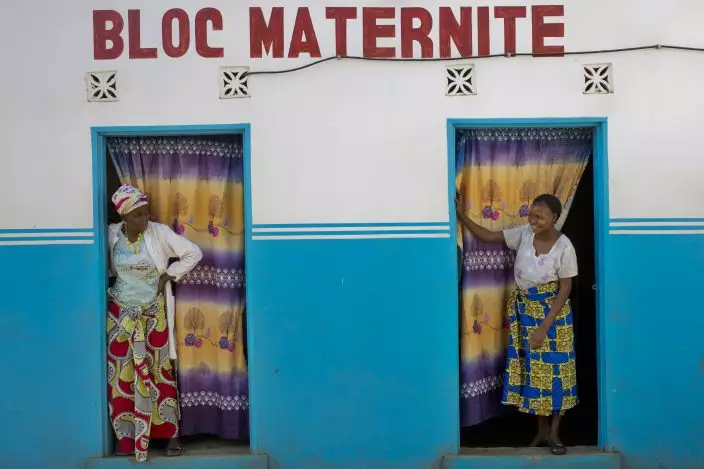
This Tuesday, Aug. 14, 2018 photo shows laundry hanging to dry outside a room used as a maternity ward at the Masaidiano Health Center in Lubumbashi, Democratic Republic of the Congo. An Associated Press investigation found that of more than 20 hospitals and clinics visited in Lubumbashi, all but one detain patients who cannot pay their bills. While some hospitals detain patients for weeks or months before giving up, the AP found one patient trapped for more than a year and obtained documentation on another person held for about two years. (AP PhotoJerome Delay)
Karena Anny, 30, holds her baby at the Masaidiano Health Center in Lubumbashi, Democratic Republic of the Congo on Tuesday, Aug. 14, 2018. Anny has been detained at the hospital for a month, unable to pay the $400 cost of her cesarian delivery. (AP PhotoJerome Delay)
This Tuesday, Aug. 14, 2018 photo shows the entrance of the Masaidizi Health Center, which was recently built by the United Nations in Lubumbashi, Democratic Republic of the Congo. The health compound's four buildings are painted in white and U.N. blue, although the hospital is now run by the Congolese ministry of health and receives no ongoing U.N. support. (AP PhotoJerome Delay)
Toussain Kanyimb Nawej shows goods left as collateral by patients unable to pay their bills at the Katuba Reference Hospital in Lubumbashi, Democratic Republic of the Congo on Wednesday, Aug. 15, 2018. Hospital data obtained by The Associated Press in Congo suggest imprisonment is common in both public and private facilities, including those that receive free drugs for AIDS, malaria and reproductive health care from U.S. partners including Columbia University in New York, USAID, and the U.S. President's Emergency Plan for AIDS Relief, or PEPFAR. (AP PhotoJerome Delay)
Alice Kabuya, 20, right, looks at a clinic employee at the Masaidizi Health Center in Lubumbashi, Democratic Republic of the Congo on Tuesday, Aug. 14, 2018. Kabuya gave birth to her daughter at the facility but is unable to pay the $150 medical bill. She said the clinic's doors were locked every afternoon and that she could not walk more than about 10 feet outside before being reprimanded by nurses. (AP PhotoJerome Delay)
Alice Kabuya, 20, stands in the Masaidizi Health Center in Lubumbashi, Democratic Republic of the Congo on Tuesday, Aug. 14, 2018. She gave birth to her daughter at the facility and cannot pay the $150 medical bill. Her jobless husband is trying to gather the funds so she had their daughter can be released. (AP PhotoJerome Delay)
Alice Kabuya, 20, holds her week-old daughter at the Masaidizi Health Center in Lubumbashi, Democratic Republic of the Congo on Tuesday, Aug. 14, 2018. Kabuya is unable to pay the $150 medical bill and her jobless husband is trying to gather the funds so she had their daughter can be released. Kabuya said most days she only drinks tea because food is only sporadically provided by the hospital. (AP PhotoJerome Delay)
A set of keys hangs from a door lock inside the Masaidizi Health Center in Lubumbashi, Democratic Republic of the Congo on Tuesday, Aug. 14, 2018. An Associated Press investigation focused in Congo's second city, the copper-mining metropolis of Lubumbashi, discovered that of more than 20 hospitals and clinics visited, all but one detain patients unable to pay their bills. The practice is illegal according to the Congolese penal code. (AP PhotoJerome Delay)
Ado Ntanga, 23, holds her son, Adrielle Nyembwe, 3, who was admitted to the Medicare Policlinic with Sickle Cell Anemia in Lubumbashi, Democratic Republic of the Congo on Wednesday, Aug. 15, 2018. They have both been detained for over a month, unable to pay the $850 medical bill for Adrielle. (AP PhotoJerome Delay)
A child plays under a sign reading, "health center built with funding from Taiwan World Vision Funds" at the Mama Wa Mapendo clinic in Lubumbashi, Democratic Republic of the Congo on Tuesday, Aug. 14, 2018. An Associated Press investigation focused in Congo's second city, the copper-mining metropolis of Lubumbashi, discovered that of more than 20 hospitals and clinics visited, all but one detain patients unable to pay their bills. The practice is illegal according to the Congolese penal code. (AP PhotoJerome Delay)
A patient stands in a doorway at the Katuba Reference Hospital in Lubumbashi, Democratic Republic of the Congo on Monday, Aug. 13, 2018. Across Africa, hospital detentions have been flagged as a problem here and in other countries including Cameroon, Mali, Uganda, South Africa, Zimbabwe. (AP PhotoJerome Delay)
The only ones who claim they don't know what's happening in Congo, it seems, are more than a dozen major health donors and agencies who invest billions of dollars in the country and have major operations there — including the European Union, UNICEF, the International Committee of the Red Cross, PATH, Save the Children, the U.S. Agency for International Development and World Vision. They all told the AP they had no knowledge of patient detentions or insufficient information to act.
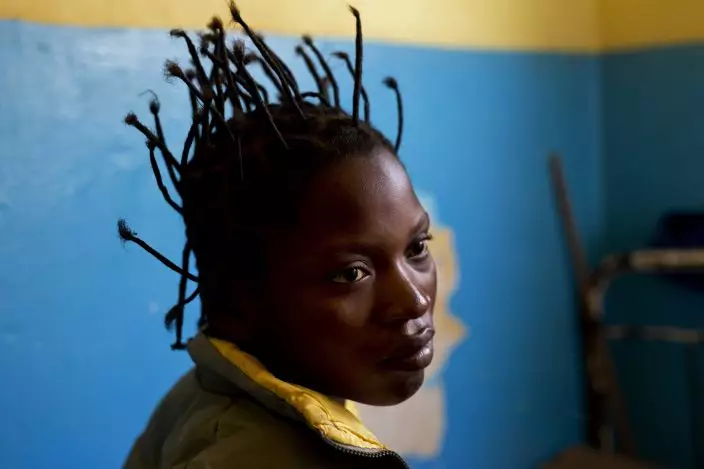
Kimenua Ngoie, 22, sits on her hospital bed at the Katuba Reference Hospital in Lubumbashi, Democratic Republic of the Congo on Monday, Aug. 13, 2018. Ngoie, who lost her baby at birth following a C-section, has been effectively imprisoned by the hospital for the past there month, unable to pay the $360 costs of her operation. An Associated Press investigation found that of more than 20 hospitals and clinics visited in Lubumbashi, all but one detain patients, an illegal practice according to the Congolese penal code. (AP PhotoJerome Delay)
EDITOR'S NOTE — Second of two stories on hospital detentions.
But such imprisonment practices would be obvious to anyone who follows a long, dark corridor at the Katuba Reference Hospital to a grimy, roach-infested room that houses the hospital's longest-staying residents: Kimenua Ngoie, who has been there for nearly four months since losing her first baby in a complicated cesarean section and Gabriel Mutamba, in his 80s, who arrived with a broken leg more than a year ago.
Though Ngoie and Mutamba are now healthy enough to be discharged, they have been effectively imprisoned because they cannot pay. Ngoie's bill stands at $360 while Mutamba's is $1,477.
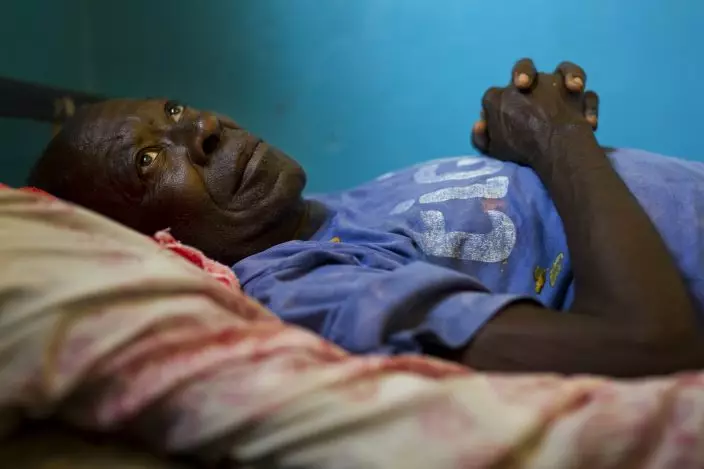
Gabriel Mutamba lies on his hospital bed at the Katuba Reference Hospital in Lubumbashi, Democratic Republic of the Congo on Monday, Aug. 13, 2018. Mutamba, in his 80s, was first brought to the hospital in 2017 by a church group that found him with a broken leg. Though doctors fixed his leg in surgery, he subsequently developed other problems. While he's now stable enough to leave, he's also racked up a substantial bill and hospital officials have so far refused to discharge him. One of the hospital's cleaning women took pity on Mutamba and occasionally brings him food but otherwise, he has few visitors and no family offering to help clear his bill. (AP PhotoJerome Delay)
"There is a God so I'm not afraid to give birth again," said Ngoie, 22. "But my deepest desire right now is just to leave the hospital."
Such detentions are not unusual, in Congo, across much of Africa or in places ranging from the Philippines to Bolivia.
"When we detain patients, this is not something that is unique to our hospital," said Leedy Nyembo-Mugalu, administrator of the Katuba Reference Hospital. "This happens everywhere."
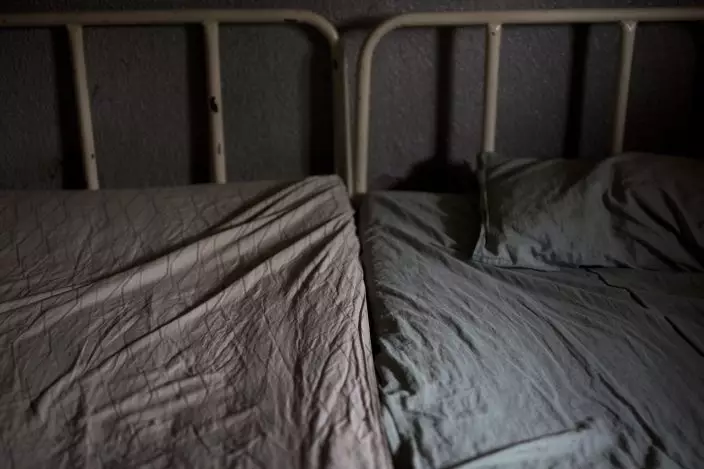
This Tuesday, Aug. 14, 2018 photo shows hospital beds at the Masaidiano Health Center in Lubumbashi, Democratic Republic of the Congo. An Associated Press investigation found that of more than 20 hospitals and clinics visited in Lubumbashi, all but one detain patients, an illegal practice according to the Congolese penal code. Many hospitals lack running water and regular electricity and bed shortages are often so severe that two patients must squeeze onto a single mattress. (AP PhotoJerome Delay)
For the hospitals, holding patients is mostly an act of financial desperation. Most lack basic drugs, running water and regular electricity. Bed shortages are often so severe that two patients must squeeze onto a single mattress. At the Katuba Reference Hospital, sterilizing surgical tools means placing them in a pot of boiling water.
"It's very hard when we have to detain somebody, but we have to recuperate the costs of the products we use, or else we can't treat other patients," said Dr. Veronique Kashala at the Centre Medicale de la Victoire.
Kashala recalled a baby girl who was held for a month this spring after being treated for meningitis, when her family failed to pay $63.
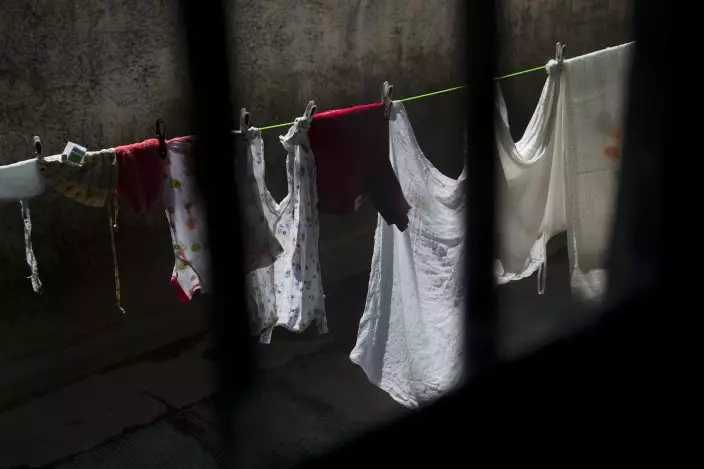
This Tuesday, Aug. 14, 2018 photo shows laundry hanging to dry outside a room used as a maternity ward at the Masaidiano Health Center in Lubumbashi, Democratic Republic of the Congo. An Associated Press investigation found that of more than 20 hospitals and clinics visited in Lubumbashi, all but one detain patients who cannot pay their bills. While some hospitals detain patients for weeks or months before giving up, the AP found one patient trapped for more than a year and obtained documentation on another person held for about two years. (AP PhotoJerome Delay)
The infant's parents finally brought in their pastor, who contributed about $50. That was enough to convince the clinic to release her.
Mike Ahern, Congo field coordinator for the International Rescue Committee, was touring a Goma hospital with which the IRC was partnering when he saw about a half-dozen women sitting on the ground in a room that had bed frames, but no mattresses. He asked why they were on the floor.
"The response was very simple: 'We make them sit on the floor to encourage them to pay'," he recalled, adding that one woman had been there more than a month and all of them owed between $50 and $200.
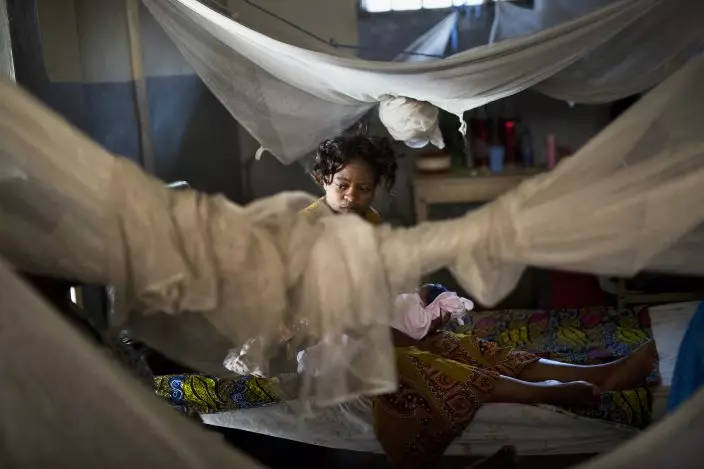
Karena Anny, 30, holds her baby at the Masaidiano Health Center in Lubumbashi, Democratic Republic of the Congo on Tuesday, Aug. 14, 2018. Anny has been detained at the hospital for a month, unable to pay the $400 cost of her cesarian delivery. (AP PhotoJerome Delay)
Ahern arranged for the IRC to pay to get the women released, within the confines of its project. It was, he said, "only a Band-Aid solution"; once IRC left, the problem would inevitably resurface.
Given how brazenly transparent hospitals are about imprisoning patients in Congo, it is difficult believe that international agencies in Congo could be unaware of patient detentions.
At Lubumbashi's Sendwe Hospital, Columbia University's ICAP and other partners run an AIDS program funded by the U.S. President's Emergency Plan for AIDS Relief (known as PEPFAR). The program is housed in a separate, recently built unit on the hospital grounds — just a short walk away from the hospital's maternity center. There, seven women who couldn't pay their delivery charges were being detained with their babies in early August in a ward with gaping holes in the ceiling.
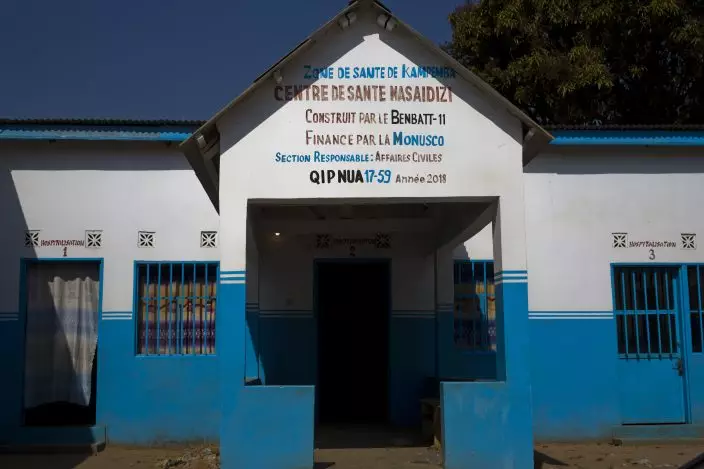
This Tuesday, Aug. 14, 2018 photo shows the entrance of the Masaidizi Health Center, which was recently built by the United Nations in Lubumbashi, Democratic Republic of the Congo. The health compound's four buildings are painted in white and U.N. blue, although the hospital is now run by the Congolese ministry of health and receives no ongoing U.N. support. (AP PhotoJerome Delay)
Dr. Juliana Soares Linn, ICAP's principal investigator in Congo, said the program had been working in the country on AIDS since 2010 and has "very close relationships" with hospital directors. She declined to comment on whether ICAP had ever seen patient detentions in Congo; PEPFAR, which has invested about a half a billion dollars in Congo's health system since 2004, also declined comment.
At Lubumbashi's Hopital General de Reference Kenya, where stickers showed that many of the computers, printers and even office fans were paid for by USAID, administrator Aimerance Kapapa said some detained patients sweep hallways, mop corridors or mow the grass to offset their debt.
A spokesman for USAID, speaking only on condition of anonymity, would only say the agency was working to ensure that "unexpected (health) costs do not cause undue financial burden on families." The agency did not respond to questions about whether it was aware of hospital detention practices in Congo or elsewhere.
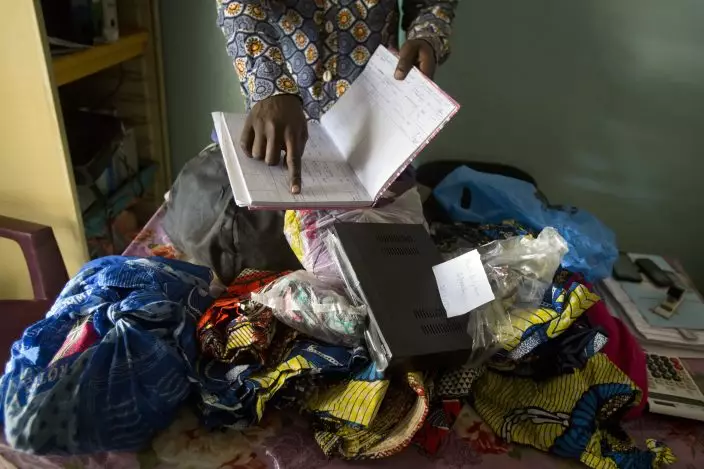
Toussain Kanyimb Nawej shows goods left as collateral by patients unable to pay their bills at the Katuba Reference Hospital in Lubumbashi, Democratic Republic of the Congo on Wednesday, Aug. 15, 2018. Hospital data obtained by The Associated Press in Congo suggest imprisonment is common in both public and private facilities, including those that receive free drugs for AIDS, malaria and reproductive health care from U.S. partners including Columbia University in New York, USAID, and the U.S. President's Emergency Plan for AIDS Relief, or PEPFAR. (AP PhotoJerome Delay)
Some organizations, such as the Global Fund, make grants contingent on countries upholding certain standards. The fund has invested about $1.5 billion in Congo, mostly for programs for HIV, tuberculosis and malaria, including hospitals and health centers, and its contracts specify that medical detentions "are to be used only as a last resort."
Nicolas Farcy, who runs the fund's Congo portfolio, says fund staffers have never encountered hospital detentions.
Karen Cowgill, an assistant professor at the University of Washington who has studied patient detentions in Congo, said external agencies should at least acknowledge publicly that patient detentions occur, so that the issue can be addressed by the wider community.
Alice Kabuya, 20, right, looks at a clinic employee at the Masaidizi Health Center in Lubumbashi, Democratic Republic of the Congo on Tuesday, Aug. 14, 2018. Kabuya gave birth to her daughter at the facility but is unable to pay the $150 medical bill. She said the clinic's doors were locked every afternoon and that she could not walk more than about 10 feet outside before being reprimanded by nurses. (AP PhotoJerome Delay)
The donors, she said, tend to stick to specific programs, like those for AIDS, rather than investing in general health care. "It's really tough because donors are worried about their funds disappearing in a broken system, so they just focus on how their particular program is working," she said.
Robert Yates, a health policy expert at the British think tank, Chatham House, said the World Health Organization could at the very least issue a resolution condemning the practice; the agency issued 16 such statements at their annual meeting this year, including some on snake bites and rheumatic fever.
"As part of their drive for universal health care, WHO could sit down all the health ministers and say we publicly commit to ensuring we're not illegally locking up people in our health facilities," he said. "As uncomfortable as this might be for everyone, the U.N., governments and donors need to confront this issue as a human rights abuse and then actively monitor this so that it can be officially banned and ended."
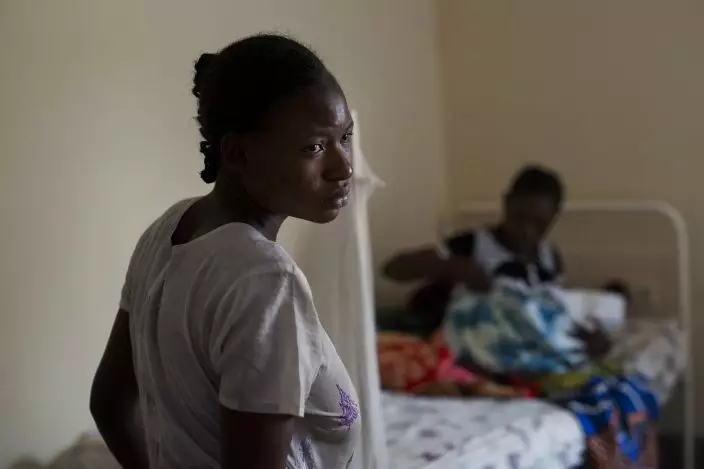
Alice Kabuya, 20, stands in the Masaidizi Health Center in Lubumbashi, Democratic Republic of the Congo on Tuesday, Aug. 14, 2018. She gave birth to her daughter at the facility and cannot pay the $150 medical bill. Her jobless husband is trying to gather the funds so she had their daughter can be released. (AP PhotoJerome Delay)
But it is admittedly challenging for such institutions to ensure that hospitals like the Centre de Sante Masaidizi — a facility built and paid for by the United Nations — are sufficiently funded so they can operate without holding patients for ransom, as they effectively did with Alice Kabeya, a young mother detained there with her newborn daughter in August. She said the clinic's doors were locked every afternoon and that she could not walk more than about 10 feet outside without being reprimanded by nurses.
Administrators at the Polyclinique Medicare said they would have to shut their doors if patients like 3-year-old Adrielle Nyembwe didn't pay. The boy was being held at the central Lubumbashi clinic in August after being treated for sickle-cell anemia. He had been medically cleared to be released, but had an outstanding bill of $850.
"Nobody in our family has the money to pay," said Adrielle's 23-year-old mother, Ado Ntanga, cradling him in her arms. "I hope we can find someone to help us soon. Because if it's up to the hospital, we will never be free."
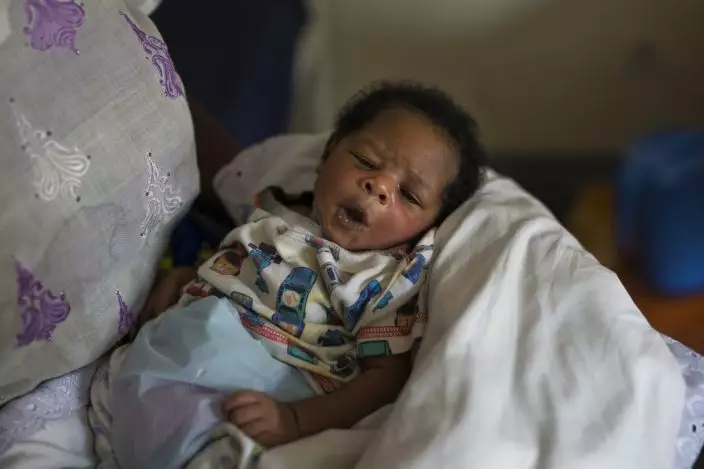
Alice Kabuya, 20, holds her week-old daughter at the Masaidizi Health Center in Lubumbashi, Democratic Republic of the Congo on Tuesday, Aug. 14, 2018. Kabuya is unable to pay the $150 medical bill and her jobless husband is trying to gather the funds so she had their daughter can be released. Kabuya said most days she only drinks tea because food is only sporadically provided by the hospital. (AP PhotoJerome Delay)
More than two months later, Adrielle is still being detained at the clinic.
For some, the fear that a hospital stay might be interminable seems very real. At Sendwe Hospital, Lubumbashi's biggest public institution, a few surgical patients were detained for five to six years, according to Abel Ntambue, a Congolese doctor at the University of Lubumbashi. Ntambue said the patients lacked the means to pay for their treatment and that Sendwe eventually released them when they needed the space.
At the Polyclinique Goschen, medical director Dr. Disashi Tshimpuki described the case of a former soldier who was detained for nearly two years. Both of his legs had been amputated after he developed gangrene; his family had paid only a fraction of the $9,290 bill.
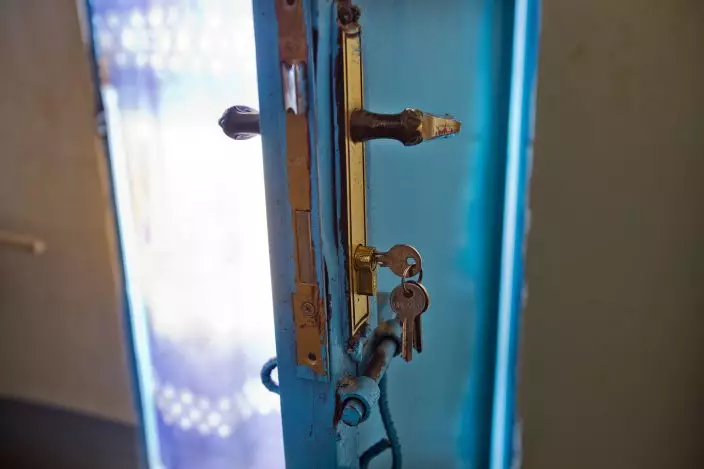
A set of keys hangs from a door lock inside the Masaidizi Health Center in Lubumbashi, Democratic Republic of the Congo on Tuesday, Aug. 14, 2018. An Associated Press investigation focused in Congo's second city, the copper-mining metropolis of Lubumbashi, discovered that of more than 20 hospitals and clinics visited, all but one detain patients unable to pay their bills. The practice is illegal according to the Congolese penal code. (AP PhotoJerome Delay)
"At first, he had a lot of family that came to visit him," Tshimpuko said, "but then they deserted him."
Online:
A selection of the hospital detention records obtained by the AP:
https://www.documentcloud.org/search/projectid:41082-Hospital-Hostages
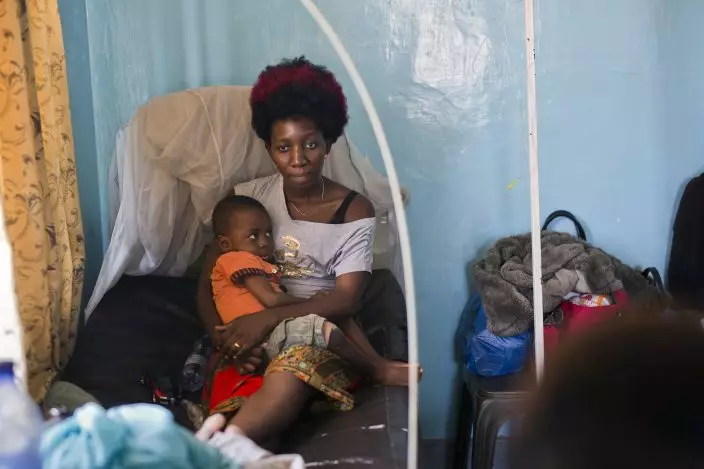
Ado Ntanga, 23, holds her son, Adrielle Nyembwe, 3, who was admitted to the Medicare Policlinic with Sickle Cell Anemia in Lubumbashi, Democratic Republic of the Congo on Wednesday, Aug. 15, 2018. They have both been detained for over a month, unable to pay the $850 medical bill for Adrielle. (AP PhotoJerome Delay)
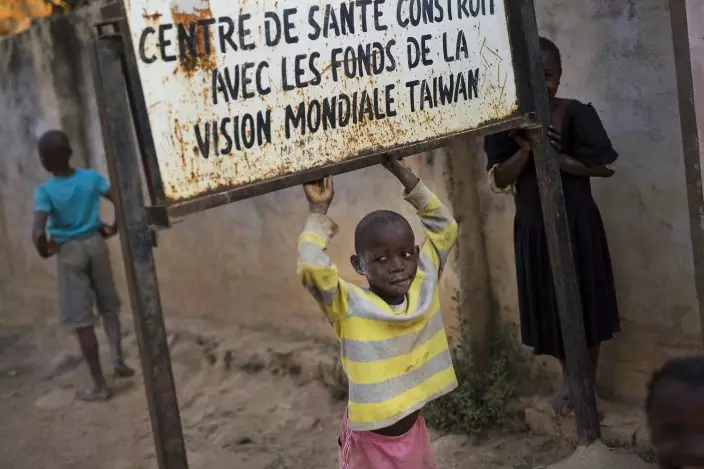
A child plays under a sign reading, "health center built with funding from Taiwan World Vision Funds" at the Mama Wa Mapendo clinic in Lubumbashi, Democratic Republic of the Congo on Tuesday, Aug. 14, 2018. An Associated Press investigation focused in Congo's second city, the copper-mining metropolis of Lubumbashi, discovered that of more than 20 hospitals and clinics visited, all but one detain patients unable to pay their bills. The practice is illegal according to the Congolese penal code. (AP PhotoJerome Delay)
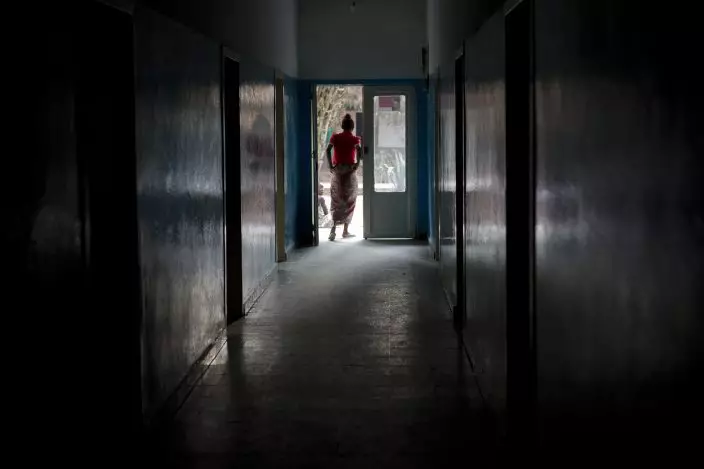
A patient stands in a doorway at the Katuba Reference Hospital in Lubumbashi, Democratic Republic of the Congo on Monday, Aug. 13, 2018. Across Africa, hospital detentions have been flagged as a problem here and in other countries including Cameroon, Mali, Uganda, South Africa, Zimbabwe. (AP PhotoJerome Delay)
The United Arab Emirates announced Tuesday that it will leave OPEC effective May 1, stripping the oil cartel of one of its largest producers. While the announcement doesn’t change anything regarding the blockage of the Strait of Hormuz, it could help lower oil prices after the war if the UAE increases its production capacity. On Tuesday, Brent crude oil traded above $111 a barrel, over 50% higher than its prewar price.
Iran offered to end its chokehold on the Strait of Hormuz if the U.S. lifts its blockade on the country and ends the war in a proposal that would postpone discussions on the Islamic Republic’s nuclear program, two regional officials said Monday. U.S. President Donald Trump seems unlikely to accept the offer, and U.S. Secretary of State Marco Rubio appeared to rule out any deal that excludes Iran’s nuclear program.
Here is the latest:
Foreign Minister Abdullatif bin Rashid Al-Zayani urged the international community at this critical time “to shift from crisis management to finding solutions” to the Iranian crisis.
This should include constructive dialogue that ensures Iran’s compliance with principles of good neighborliness and international law, respect for the sovereignty of states and freedom of navigation in the Strait of Hormuz and other vital waterways, he said.
Al-Zaysni, who chaired a ministerial meeting of the U.N. Security Council, told diplomats Iran must also halt its nuclear, missile and drone programs, refrain from arming or financing proxies and armed militias, and stop attacking Bahrain and other Gulf countries and Jordan.
A brief statement by the Israeli army said the civilian employee of an engineering company was working with the military on projects in southern Lebanon.
An Israeli military official confirmed the contractor was a civilian and died in a drone attack. The official spoke on condition of anonymity under military briefing rules.
Despite a ceasefire in Lebanon, Israeli forces and Hezbollah militants have been intermittently attacking each other in the south, where Israeli soldiers are occupying a slice of territory along the border. — By Josef Federman
That’s according to the Lebanese Health Ministry, which said the toll is still preliminary. The Israeli strike was in the southern town of Majdal Zoun, near the coastal city of Tyre.
Israeli forces hit an army patrol that was accompanying Civil Defense medical teams and bulldozers during a rescue operation at the site of a previous Israeli strike, the Lebanese army and Civil Defense said. Some of the responders were trapped under rubble by the second strike, they said.
The Israeli military did not immediately comment.
Lebanese President Joseph Aoun condemned the strike, saying it was part of a pattern of Israeli attacks on rescue and emergency workers in violation of international law.
The Western-backed Lebanese army has largely stood on the sidelines during the recent rounds of fighting between Israel and Hezbollah, although dozens of its soldiers have been killed.
President Isaac Herzog’s office asked for a response by Sunday to his invitation, which came days after he announced he would not decide on Netanyahu’s request for a pardon and instead urge the sides to reach a settlement.
Netanyahu asked Herzog last November to cancel his trial, saying that dropping the charges would help unify the country. Trump has made multiple appeals to Herzog to end the trial.
Herzog’s invitation says he believes that efforts to reach a settlement “must be exhausted first” before he can consider the pardon request. There was no immediate comment from Netanyahu’s office or the attorney general’s office.
Netanyahu is charged with breach of trust, fraud and accepting bribes in three separate cases accusing him of exchanging favors with wealthy associates. He denies all charges.
The trial has dragged on for six years in a case that has bitterly divided the Israeli public. Netanyahu and his supporters claim he is the victim of a politically motivated witch hunt by the media, police and prosecutors.
The leaders of several wealthy Gulf nations rejected Iran’s “illegal actions” to close the strait and threaten navigation, warning against any disruption to shipping or charging fees for safe passage.
The statement followed a Gulf Cooperation Council meeting on Tuesday in Saudi Arabia, chaired by Saudi Crown Prince Mohammed bin Salman and attended by leaders from Qatar and Bahrain, Kuwait’s crown prince, and the United Arab Emirates’ foreign minister.
They called for restoring “security and freedom of navigation” to prewar levels and urged deeper military integration, including joint infrastructure projects and a ballistic missile early warning system.
Their trade group is asking the Trump administration for $2.5 billion to offset rising jet fuel costs and keep ticket prices affordable. The Association of Value Airlines said smaller carriers are being hit hardest by the jump in fuel prices, despite carrying more than 90 million passengers last year.
“Temporary government support” would help “preserve vital industry competition,” the association said.
The trade group represents Frontier, Allegiant, Avelo and Sun Country. Another member, Spirit, is separately in talks with the U.S. government on a potential financing deal aimed at keeping the struggling carrier flying as it navigates fuel price shocks during its second bankruptcy since 2024.
Dozens of protesters gathered outside the Serbian state RTS broadcaster on Tuesday, waving Palestinian flags and accusing Israel of atrocities in Gaza while demanding that the Balkan country pull out of the Eurovision Song Contest because of Israel’s participation.
The year’s main competition with 35 competing countries is scheduled to be held May 12-16 in Vienna. Serbia, which has close ties with Israel, will be represented by Lavina, a six-member metal band.
The contest strives to put pop music before politics but has repeatedly been embroiled in world events. Russia was expelled in 2022 after its full-scale invasion of Ukraine. The decision to allow Israel to compete prompted the walkout of Slovenia, Iceland, Ireland, the Netherlands and Spain.
RTV Slovenia said it will air a Palestinian program at the time of the Eurovision contest.
Lebanon’s government has demanded that Hezbollah disarm, but Israel says this has not happened. A ceasefire in the latest Israeli-Hezbollah conflict was recently extended for three weeks.
Danon said that if the U.N. Security Council wants to help Lebanon, it should ask the government how many Hezbollah weapons it has seized, “which tunnels have been destroyed and what is being done to stop arms smuggling from Iran.”
“International support for Lebanon must depend on results on the ground and not more empty statements,” Danon said.
Ambassador Danny Danon said it’s impossible to talk about peace in Lebanon without mentioning Hezbollah, the militant group with areas of influence in the south bordering Israel and elsewhere in the country.
“Hezbollah is not just set on Israel’s destruction. It is Lebanon’s greatest obstacle to sovereignty. It has weakened the Lebanese government,” he told a ministerial meeting of the U.N. Security Council.
This item has been updated to correct the quote. The previous quote was in remarks distributed by Israel’s U.N. Mission but was changed when the ambassador delivered his speech to the U.N. Security Council.
Varsen Aghabekian accused Israel of seeking the collapse of the Palestinian Authority and Israeli settlers of terrorizing Palestinians in the West Bank on a daily basis.
“This has to stop immediately,” she said. “The situation of the Palestinian civilian population must be a top priority.”
Aghabekian said there is no justification for Israel preventing shelter materials from entering Gaza and restricting aid and access for humanitarian workers.
Foreign Minister Varsen Aghabekian said the ceasefire in Gaza must be upheld and Israel’s pursuit of “forcible displacement and annexation,” not only in Gaza but in the West Bank and East Jerusalem, must be stopped.
As phase two of the Gaza peace plan gets underway, she said, “We reiterate our vision of one state, one government, one law and one gun and the need for full Israeli withdrawal from the Gaza Strip.”
Aghabekian told a ministerial meeting of the U.N. Security Council on Tuesday that Gaza’s transition must be in line with its reunification with the West Bank under the Palestinian Authority, “leading to Palestinian self-determination and independent statehood.”
Physicians for Human Rights-Israel says a court in Israel has indefinitely extended the detention of Dr. Hossam Abu Safiya, who became the face of health workers’ struggle in Gaza to keep treating patients under Israeli bombardment.
The Israeli military has said Abu Safiya, director of Kamal Adwan Hospital in northern Gaza, was being investigated on suspicion of cooperating with or working for Hamas. Staff and international aid groups that worked with him have denied the claims.
The rights group in a statement Tuesday says he is held in harsh conditions in Negev Prison. It says the Beersheba District Court approved the extension of his detention without charges having been filed, after his defense had sought his immediate release.
The British energy giant reported quarterly earnings Tuesday of $3.84 billion, or $1.47 per share, far exceeding last year’s $687 million, or 26 cents per share. The huge profits beat analysts’ heightened expectations and generated immediate online vitriol.
“Families are being pushed to the brink by spiraling energy bills, while fossil fuel companies turn a war into a windfall,” wrote Clémence Dubois, global campaigns director at 350.org.
“These astronomical profits are a startling reminder that when conflict drives up the price of oil and gas, energy companies profit and households pay,” wrote Simon Francis, coordinator with End Fuel Poverty Coalition.
BP shares rose more than 1%, close to a 52-week high, as did shares of other major oil producers. It was BP’s first earnings report since the Iran war began, previewing what to expect when Exxon Mobil, Chevron and ConocoPhillips report earnings later this week.
▶ Read more
Two Lebanese soldiers were wounded and three Civil Defense personnel were trapped under rubble after an Israeli strike targeted an army patrol accompanied by rescue teams and two bulldozers in the southern town of Majdal Zoun, near Tyre, according to the Lebanese Army and Civil Defense.
The Israeli army has not immediately commented on the attack, which came as clashes and intermittent air strikes continue despite a U.S.-brokered ceasefire.
At least seven Lebanese army soldiers have been killed since the conflict between Hezbollah and Israel reignited on March 2.
Two Lebanese soldiers were wounded and three Civil Defense personnel were trapped under rubble after an Israeli strike targeted an army patrol accompanied by rescue teams and two bulldozers in the southern town of Majdal Zoun, near Tyre, according to the Lebanese Army and Civil Defense.
The strike hit during a rescue operation, the statements said, adding that Civil Defense crews were working to extract those still trapped.
The Israeli army has not immediately commented on the attack, which came as clashes and intermittent air strikes continue despite a U.S.-brokered ceasefire.
Another climb in oil prices because of the Iran war is helping to halt Wall Street’s record-setting rally. The price for a barrel of Brent crude oil to be delivered in June climbed 2.7% to $111.18. Brent to be delivered in July, which is where traders are focusing more in the oil market, rose 2.6% to $104.33 Tuesday.
After sitting around $70 in late February, Brent prices are moving closer to their peak of $119, reached when worries about the war were at their heights.
The Trump administration seemed unlikely Tuesday to accept Iran’s offer to reopen the Strait of Hormuz if the U.S. lifts its blockade. Iran also wants to postpone discussions on the Islamic Republic’s nuclear program, which Rubio appeared to rule out.
Average U.S. gasoline prices reached $4.18 a gallon on Tuesday, the most since 2022, according to the auto club AAA.
▶ Read more
Ambassador Mike Waltz urged countries with influence on Hamas to press the militant group to demilitarize and accept that it will not have a direct or indirect role in Gaza “through weapons and terrorism and violent intimidation.”
“The moment Hamas agrees to demilitarize, a new chapter in Gaza’s history will be written,” he told a ministerial meeting of the U.N. Security Council on the Middle East.
“Every day we either move closer to a future where Palestinians in Gaza and the West Bank live in freedom and prosperity, at peace with Israel — or we drift back toward chaos, rockets, hostages and rubble,” Walz said.
He said there is a plan for reconstruction and development of Gaza and financing, and there is a pathway to peace and eased security restrictions, but Hamas is holding Gaza back.
The Israeli leader says “we are not done yet” after destroying the Hezbollah tunnels in southern Lebanon.
“I gave instructions a few weeks ago for a special project to eliminate the drone threats. It will take time — but we will blow that up too,” he says.
The U.S. military said Tuesday in a social media post that it boarded and released another commercial ship that was suspected of heading for Iran.
The post by U.S. Central Command on X included a video showed marines fast-roping from a helicopter onto the vessel, which it said was the Comoros-flagged M/V Blue Star III. It happened in the Arabian Sea, east of the Strait of Hormuz.
“U.S. forces released the vessel after conducting a search and confirming the ship’s voyage would not include an Iranian port call,” the command said.
The command said it has now redirected 39 vessels since start of the blockade on ships going to and from Iranian ports.
Norway’s Foreign Minister Espen Barth Eide said Trump’s 20-point peace plan for Gaza hinges on Hamas’ disarmament, which “must be a sequential process.”
He called on the Palestinians to continue their reform efforts and prepare to resume governing Gaza as called for in the peace plan.
Eide called on Israel to lift restrictions on aid deliveries, ensure revenue is sent to the Palestinian Authority, which faces a financial crisis, and reverse its expansion of settlements.
Speaking at a ministerial meeting of the U.N. Security Council on Tuesday, Eide said he's made “crystal clear” that there are transitional arrangements in Gaza but the Palestinian Authority is the only recognized government.
The military detonated a large explosion late Tuesday in Qantara, and Israel’s Geological Survey said the blast was so powerful it registered as a “seismic event.”
The army said the network included two large tunnels — one about 800 meters (yards) long and the other 1.2 kilometers (0.7 miles) — that were equipped with sleeping rooms, toilets, kitchen facilities and launchers aimed at Israel. It released photos and video footage of what it said were the tunnels.
An Israeli military official said the network included large rooms where over 100 Hezbollah fighters could gather at once. He also said it ran underneath and alongside a mosque, school and soccer field.
The official spoke on condition of anonymity under military briefing rules.
In a statement, Defense Minister Israel Katz said the army has been instructed to destroy any Hezbollah infrastructure it finds, “just like in Gaza.”
— By Josef Federman
The human rights organization made the statement Tuesday after a video circulated on social media showing Israeli military excavators destroying solar panels for the Lebanese border village of Debel and its water station.
On Saturday, the Israeli military said it was investigating the incident after the footage emerged. Debel is the same village where a soldier was filmed earlier this month smashing a statue of Jesus, prompting international condemnation.
“Amnesty International has previously documented extensive destruction by the Israeli military along Lebanon’s border before and after the November 2024 ceasefire,” the group said, adding it had called for reparations and war crimes investigations. “So far, neither has appeared.”
U.N. Assistant Secretary-General Khaled Khiari said Gaza is facing “ongoing and deadly Israeli strikes and dire humanitarian conditions,” with 1.8 million people — nearly its entire population — living in camps and dependent on aid.
He told a U.N. Security Council ministerial meeting Tuesday that in the West Bank, “violence, including rampant settler attacks, displacement and accelerating settlement activity, is threatening entire communities and further eroding prospects for a political process” toward a two-state solution.
In Gaza, he said, “the ceasefire is increasingly fragile as Israeli strikes and armed activity by Hamas and other groups continue.”
Khiari, whose portfolio includes the Middle East, warned that while diplomatic efforts are underway to consolidate the ceasefire and implement Phase II of the peace plan, “talks on the disarmament of Hamas and other armed groups have thus far not resulted in an agreement, raising concerns over the potential return to widespread hostilities.”
The president of the International Committee of the Red Cross has arrived in Iran to meet with officials and local affiliates and assess the war’s humanitarian consequences.
Mirjana Spoljaric will also discuss efforts of the Geneva-based humanitarian organization to ship more relief supplies to Iran, notably through the Iranian Red Crescent Society.
The ICRC says it delivered more than 170 tons of essential relief items to help people affected by the conflict this month, with more medical items and forensic supplies on their way.
Her visit is part of a trip through the region that involves bilateral discussions to help ensure respect for the rules of war, the organization said.
The Conference Board said Tuesday that its consumer confidence index inched up to 92.8 from 92.2 in March, despite growing anxiety over soaring energy prices brought on by the war in Iran. It remains mired near its lowest level since the COVID-19 pandemic.
It’s the first read on inflation to capture the effects of the Iran war. The surge in gas prices to an average $4.18 a gallon this week, up more than a dollar since before the war, will stretch budgets and erode incomes, making it harder for lower- and middle-income American households to afford food and rent.
“Consumers are singing the blues,” said Heather Long, chief economist at Navy Federal Credit Union. “They aren’t happy with high prices for gas, housing, electricity and many other items. It’s clear consumers aren’t going to feel much better until there’s an end to the Middle East conflict.”
▶ Read more
The announcement doesn‘t change anything regarding the blockage of the Strait of Hormuz, but could help speed the oil market’s return to lower prices after the war, said Michael Brown, senior research strategist at Pepperstone foreign exchange brokerage.
Once the war ends, the UAE could reach its pre-conflict goal of increasing production to 5 million barrels per day, “in turn helping crude benchmarks to normalize in shorter order once the ongoing Middle East conflict comes to an end,” he said.
The UAE’s move appears to be part of an effort to assert themselves as leaders and independent actors in the region, and sell oil and gas when and how they see fit, said Karen Young, senior research scholar at Columbia University’s Center on Global Energy Policy.
“This exit of OPEC fits into the UAE need for flexibility with key energy consumers as well — including a future relationship with China and a more competitive relationship with Saudi Arabia,” she said.
The exit won’t immediately change export capacity, since the UAE’s lone pipeline around the Strait of Hormuz to the port at Fujairah on the Gulf of Oman is already running at full capacity, she noted.
The ministry added on Tuesday that 7,863 have been wounded since the war broke out on March 2.
The war has displaced more than 1 million people and caused destruction worth billions of dollars.
Leon said the approaching peak in global oil demand has shifted the incentive for producers from collective restraint to earning money from their reserves now.
He said the UAE, with its 4.8 million barrels per day of production capacity and potential to increase output, is “particularly well positioned to pursue such a strategy outside the group.”
The UAE’s withdrawal removes one of OPEC’s few members with ability to quickly increase production — the mechanism through which the cartel manages oil prices, said Jorge Leon, head of geopolitical analysis at Rystad Energy.
“A structurally weaker OPEC, with less spare capacity concentrated within the group, will find it increasingly difficult to calibrate supply and stabilize prices,” Leon said. “The net effect points to a more fragmented supply landscape and a potentially more volatile oil market over time as OPEC’s capacity to smooth imbalances diminishes.”
“They want us to ‘Open the Hormuz Strait,’ as soon as possible, as they try to figure out their leadership situation,” Trump posted on social media.
He added that he believes they will be able to sort out reported divisions within the Islamic Republic government about negotiations with the U.S.
The White House did not immediately respond to questions about who on the Iranian side delivered the message, who in the Republican administration received it and whether the communications were conducted directly with the U.S. or through an intermediary.
Israel’s Foreign Minister Gideon Saar said on Tuesday that Israel’s tax authority has opened an investigation into a ship expected to dock in the Haifa port that Ukraine said carries stolen grain.
Earlier, Ukrainian President Volodymyr Zelenskyy wrote on X that Ukraine is preparing sanctions against companies that profit from grain harvested from areas of Ukraine under Russian control. Saar dismissed Zelenskyy’s comments as “Twitter diplomacy” and said Ukraine had not provided information about the cargo’s contents or a request for legal assistance.
“The vessel has not entered the port and has yet to submit its documents. It is not possible to verify the truth of the Ukrainian claims regarding the forgery of the bill of lading,” Saar said.
▶ Read more
Gideon Saar said the Israeli military-occupied “buffer zone” that stretches 10 kilometers (6 miles) into Lebanon is necessary to protect residents in Israel’s north.
“Hezbollah has transformed the entire front line of southern Lebanon into a network of terrorist infrastructure, and this threat has not been properly addressed by the Lebanese government,” he said during a press conference with Serbian Foreign Minister Marko Đurić in Jerusalem.
Saar refused to comment on the fragile ceasefire with Hezbollah, which both sides have violated multiple times since Trump announced it last week, and whether Israel might expand its military operations beyond southern Lebanon. He did note Israel’s first direct negotiations with Lebanon in decades.
U.S. and Israeli airstrikes crippled thousands of factories in Iran, and the economic damage is reverberating — millions more Iranians could lose their jobs. Most damaging, Israeli strikes knocked out most steel and petrochemical production, causing a surge in prices for metals and plastic. Things could get worse as the U.S. blockades Iranian ports.
Economic woes sparked the mass protests that were crushed before the war and could again push Iranians into the streets. But Iran’s leaders are betting that economic self-reliance built under decades of sanctions can help them endure the pain longer than Trump.
▶ Read more
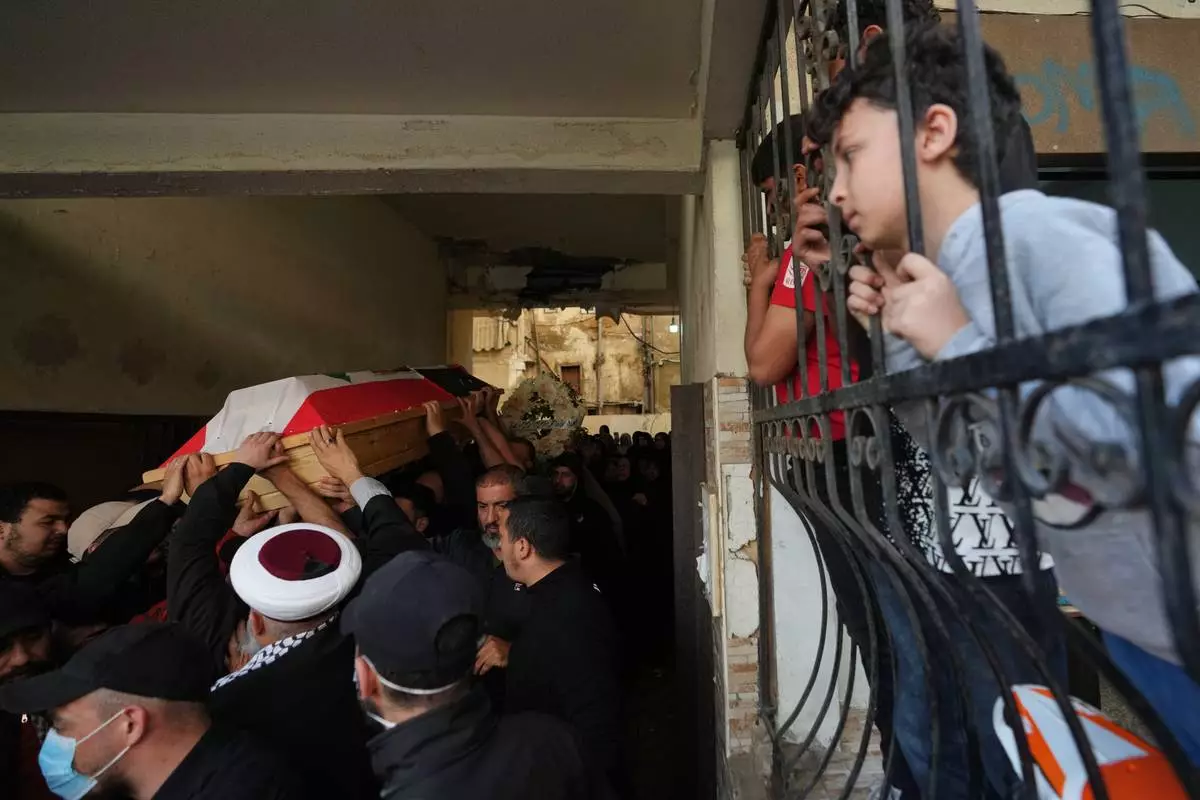
Mourners carry the coffin of Palestinian fighter Hozeifa Hamza Ghannamieh, who was killed alongside Ibrahim Anwar al-Khalayli while fighting alongside Hezbollah against Israel in southern Lebanon, during their funeral procession as children watch from behind a fence in Beirut, Lebanon, Tuesday, April 28, 2026. (AP Photo/Hassan Ammar)

A boy reacts as mourners gather around the coffins of Palestinian fighters Hozeifa Hamza Ghannamieh and Ibrahim Anwar al-Khalayli, who were killed while fighting alongside Hezbollah against Israel in southern Lebanon, during their funeral in Beirut, Lebanon, Tuesday, April 28, 2026. (AP Photo/Hassan Ammar)
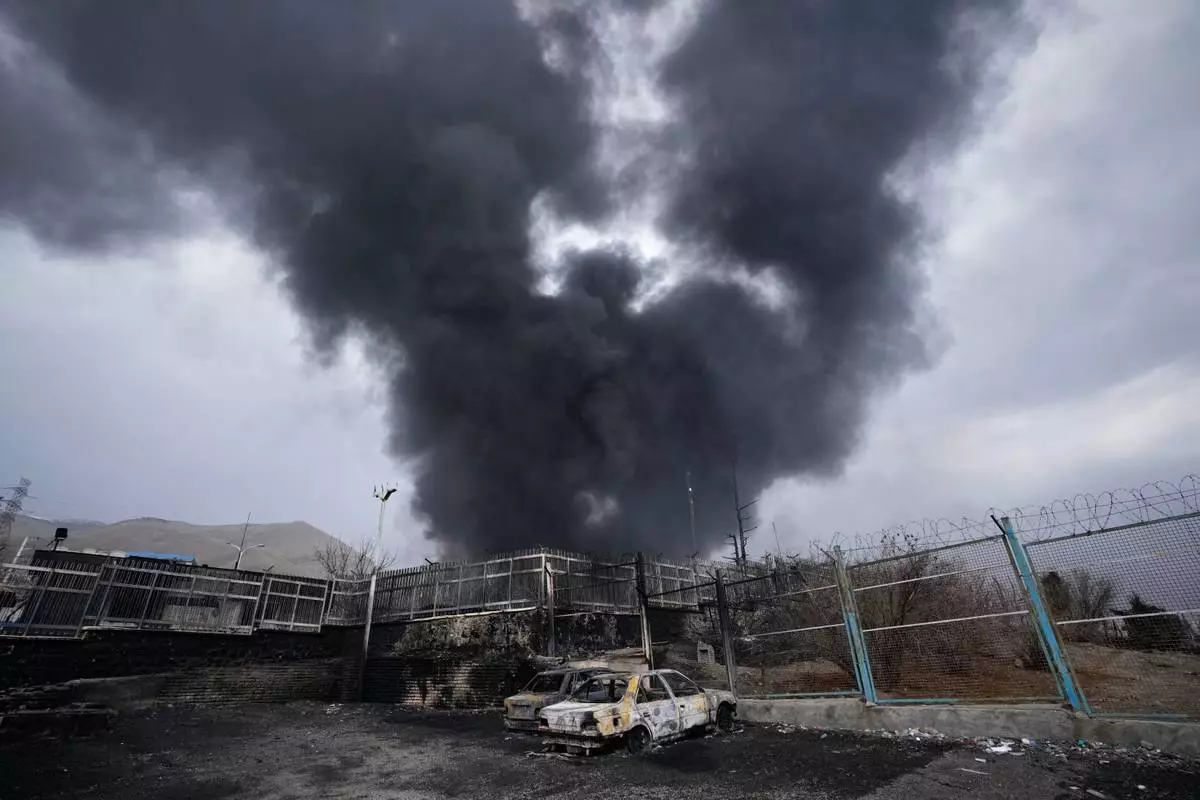
FILE - A thick plume of smoke rises from an oil storage facility hit by a U.S.-Israeli strike in Tehran, Iran, March 8, 2026. (AP Photo/Vahid Salemi, File)
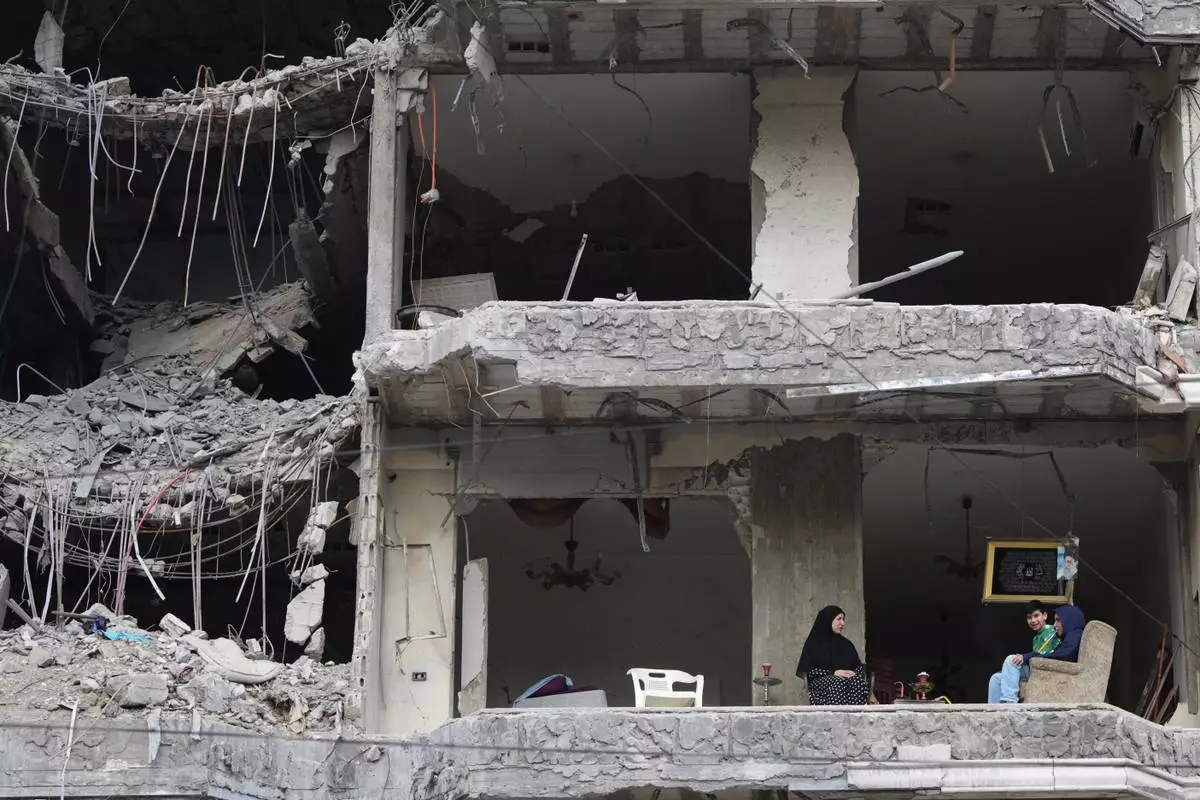
The wife and children of Fadi Al Zein, who lost both his homes in Israeli strikes in his village of Khiam and in Dahiyeh, sit on the balcony of their heavily damaged apartment building in Beirut's southern suburbs, Lebanon, Saturday, April 25, 2026. (AP Photo/Hassan Ammar)
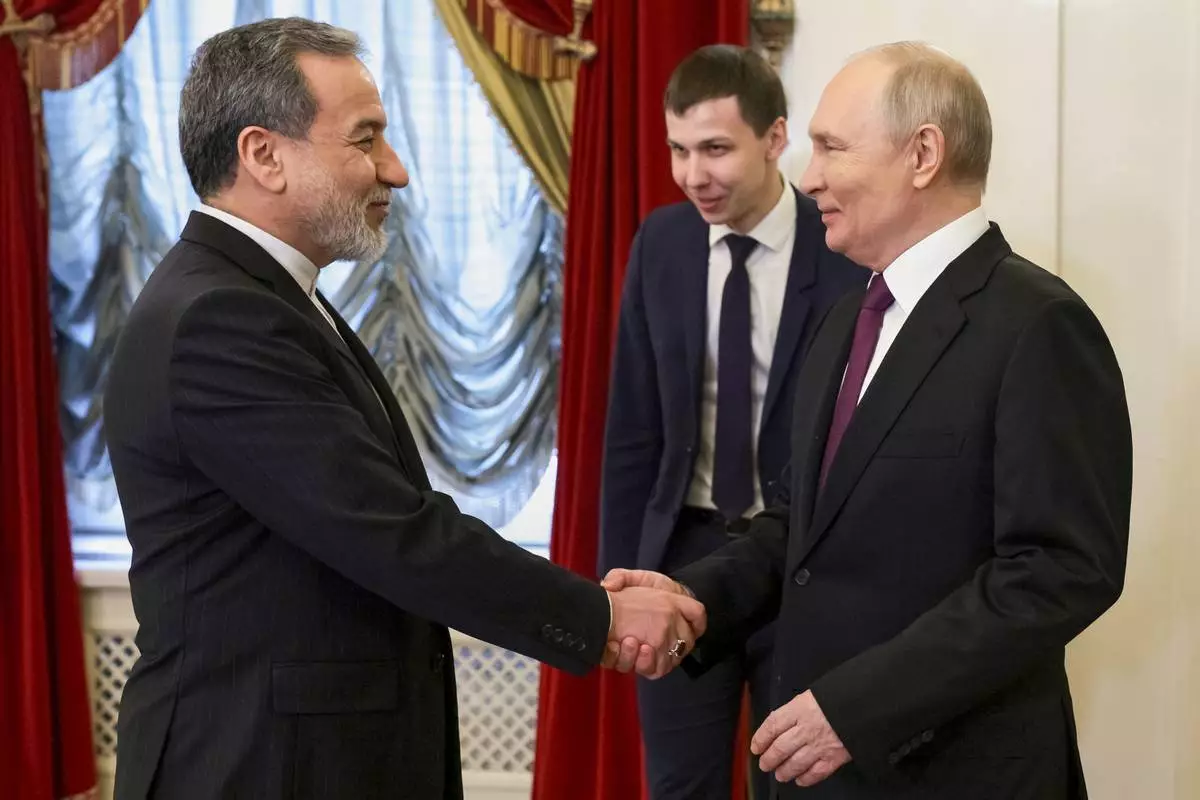
Russian President Vladimir Putin, right, shakes hands with Iranian Foreign Minister Abbas Araghchi during their meeting at the Boris Yeltsin Presidential Library, in St. Petersburg, Russia, Monday, April 27, 2026. (Gavriil Grigorov, Sputnik, Kremlin Pool Photo via AP)
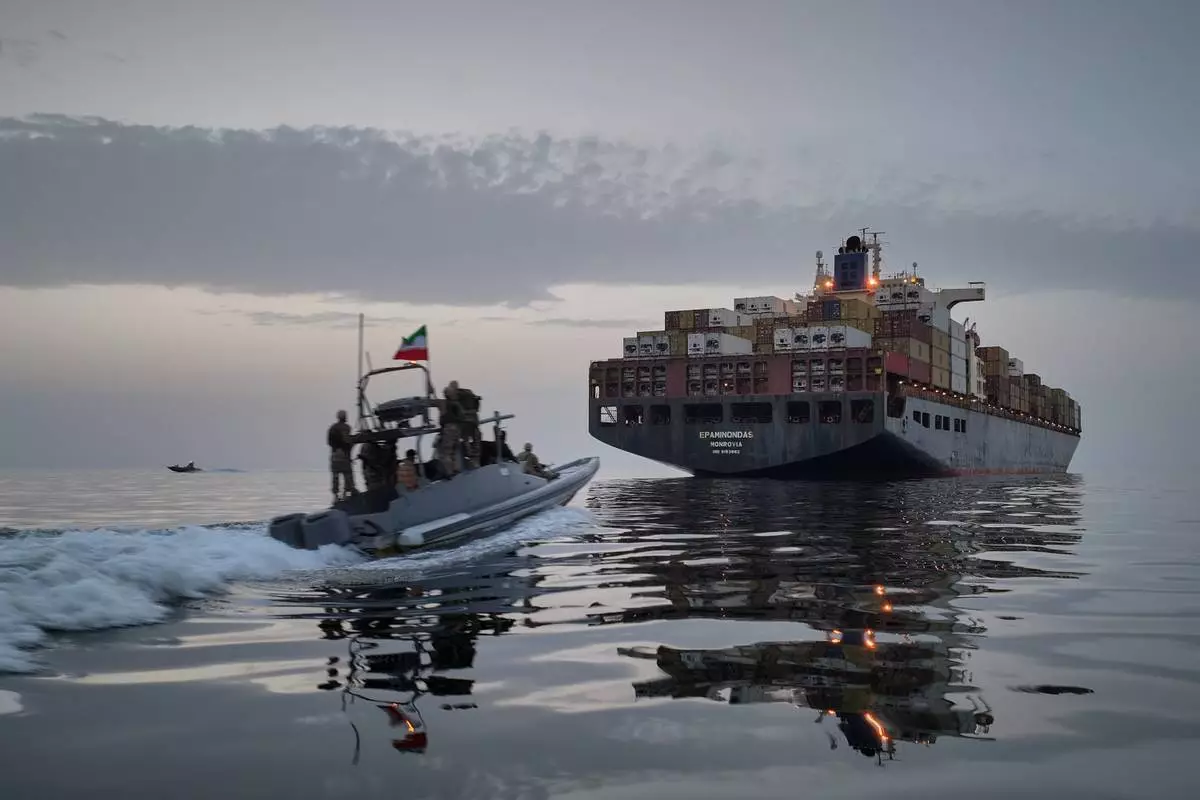
FILE - In this photo released by Tasnim News Agency, a Revolutionary Guard Navy (IRGC) speedboat approaches the cargo ship Epaminondas during what state media described as the seizure of one of two vessels accused of violations in the Strait of Hormuz, April 21, 2026. (Meysam Mirzadeh/Tasnim News Agency via AP, File)
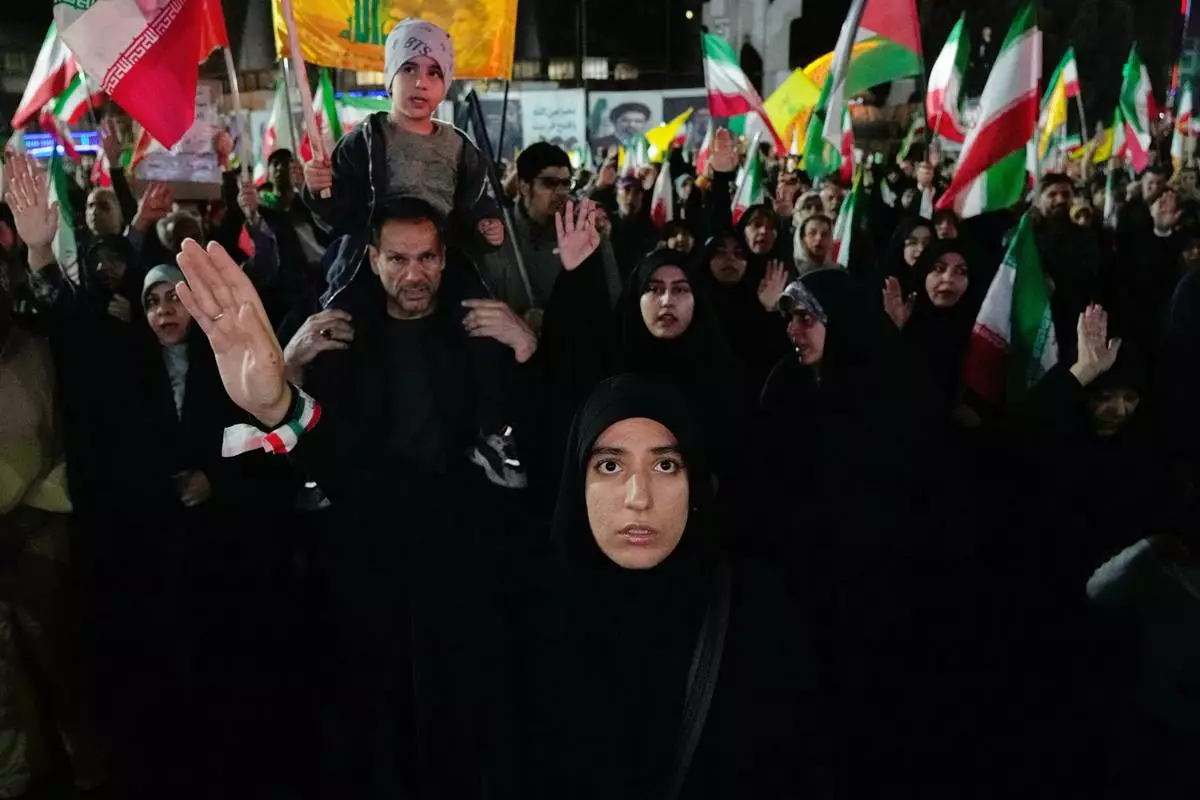
Pro-government demonstrators attend a gathering in Tehran, Iran, Monday, April 27, 2026. (AP Photo/Vahid Salemi)
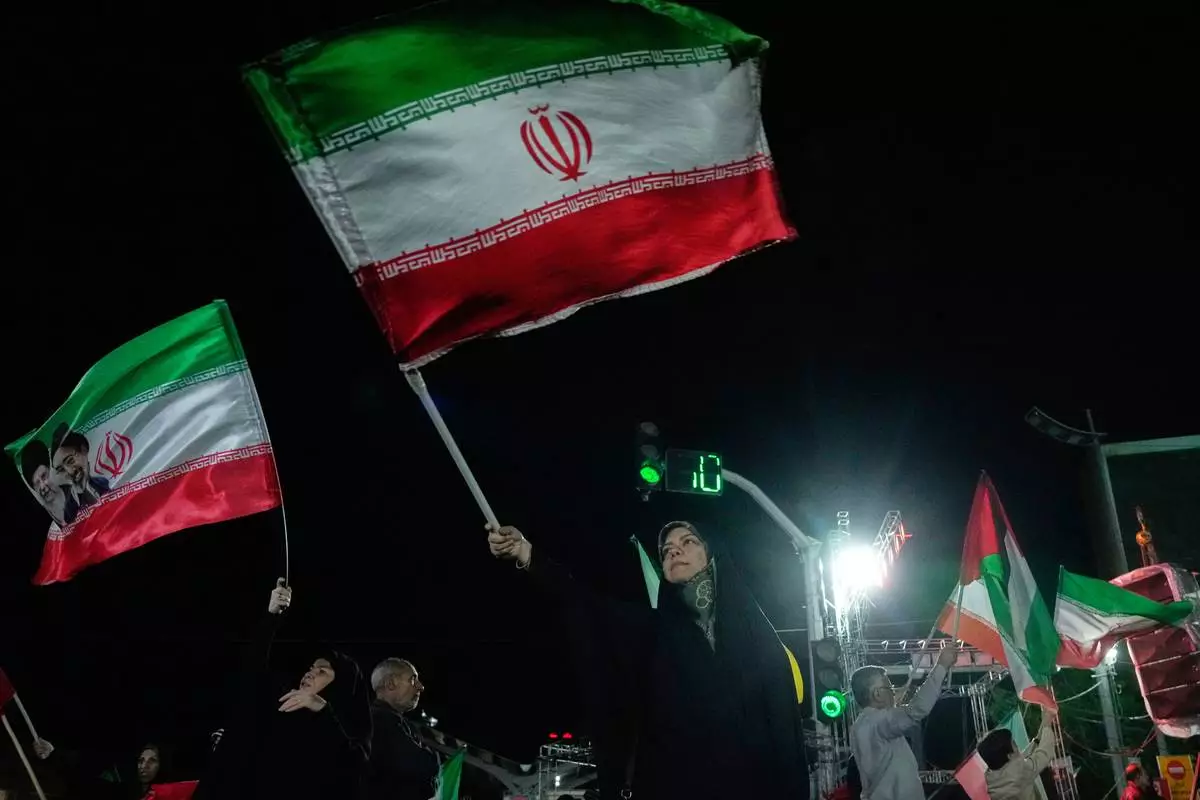
Pro-government demonstrators wave Iranian flags during a gathering in Tehran, Iran, Monday, April 27, 2026. (AP Photo/Vahid Salemi)