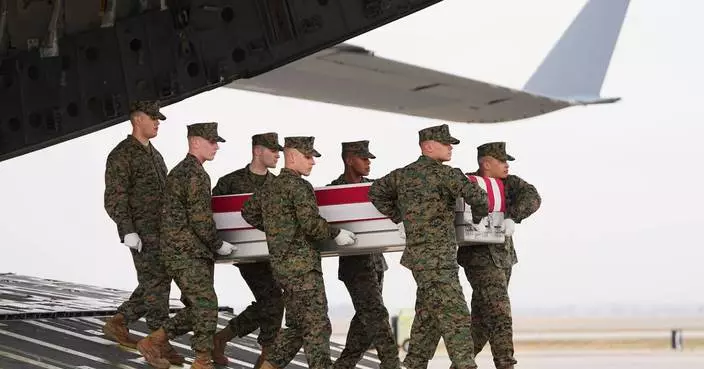
WASHINGTON (AP) — President Donald Trump on Saturday will join grieving families at Dover Air Force Base on Saturday at the dignified transfer for the six U.S. soldiers killed in the war in the Middle East.
The dignified transfer, a ritual that returns the remains of U.S. service members killed in action, is considered one of the most somber duties of any commander in chief. During his first term, Trump said bearing witness to the transfer was “the toughest thing I have to do” as president.
Trump, speaking at a summit of Latin American leaders in Miami before his trip to Delaware, said the fallen service members were heroes “coming home in a different manner than they thought they’d be coming home.” He pledged to keep American war deaths “to a minimum.”
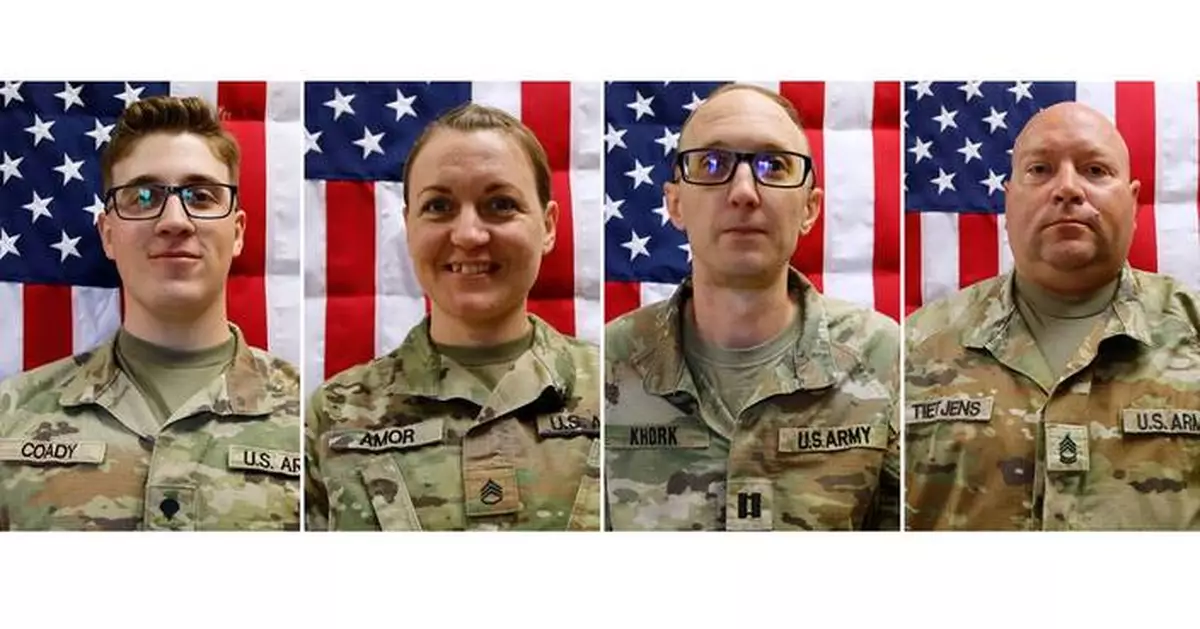
Those killed in action were Sgt. 1st Class Nicole Amor, 39, of White Bear Lake, Minnesota; Capt. Cody Khork, 35, of Winter Haven, Florida; Chief Warrant Officer 3 Robert Marzan, 54, of Sacramento, California; Maj. Jeffrey O’Brien, 45, of Indianola, Iowa; Sgt. 1st Class Noah Tietjens, 42, of Bellevue, Nebraska; and Sgt. Declan Coady, 20, of West Des Moines, lowa, who was posthumously promoted from specialist.
The six members of the Army Reserve, who were killed by a drone strike at a command center in Kuwait, were all from the 103rd Sustainment Command based in Des Moines, Iowa, which provides food, fuel, water and ammunition, transport equipment and supplies. They died just one day after the U.S. and Israel launched its military campaign against Iran.
“These soldiers engaged in the most noble mission: protecting their fellow Americans and keeping our homeland secure,” Republican Sen. Joni Ernst of Iowa, a combat veteran, said after the six were identified. “Our nation owes them an incredible debt of gratitude that can never be repaid.”
During the ritual, transfer cases draped with the American flag and holding the remains of the fallen soldiers are carried from the military aircraft that transported them to an awaiting vehicle to take them to the mortuary facility at the base. There, the service members are prepared for their final resting place.
Amor’s husband, Joey Amor, said earlier this week that she had been scheduled to return home to him and their two children within days.
“You don’t go to Kuwait thinking something’s going to happen, and for her to be one of the first – it hurts,” Joey Amor said.
O’Brien had served in the Army Reserve for nearly 15 years, according to his LinkedIn account, and his aunt said in a post on Facebook that O’Brien “was the sweetest blue-eyed, blonde farm kid you’d ever know. He is so missed already.”
Marzan’s sister described him in a Facebook post as a “strong leader” and loving husband, father and brother.
“My baby brother, you are loved and I will hold onto all our memories and cherish them always in my heart,” Elizabeth Marzan wrote.
Coady was among the youngest people in his class, trained to troubleshoot military computer systems, but he impressed his instructors, his father, Andrew Coady, told The Associated Press.
“He trained hard, he worked hard, his physical fitness was important to him. He loved being a soldier,” Coady said. “He was also one of the most kindest people you would ever meet, and he would do anything and everything for anyone.”
Khork's family described him as “the life of the party” who was known for his “infectious spirit” and “generous heart” and who had wanted to serve in the military since childhood.
“That commitment helped shape the course of his life and reflected the deep sense of duty that was always at the core of who he was,” according to a statement from his mother, Donna Burhans, his father, James Khork, and his stepmother, Stacey Khork.
Tietjens, who came from a military family, previously served alongside his father in Kuwait. When he returned home in February 2010, he reunited with his overjoyed wife in a local church’s gym.
Tietjens’ cousin Kaylyn Golike asked for prayers, especially for Tietjens’ 12-year-old son, wife and parents, as they navigate “unimaginable loss.”
Trump most recently traveled to Dover in December to honor two Iowa National Guard members and a U.S. civilian interpreter who were killed in an ambush attack in the Syrian desert. He attended dignified transfers several times during his first term, including for a Navy SEAL killed during a raid in Yemen, for two Army officers whose helicopter crashed in Afghanistan and for two Army soldiers killed in Afghanistan when a person dressed in an Afghan army uniform opened fire.
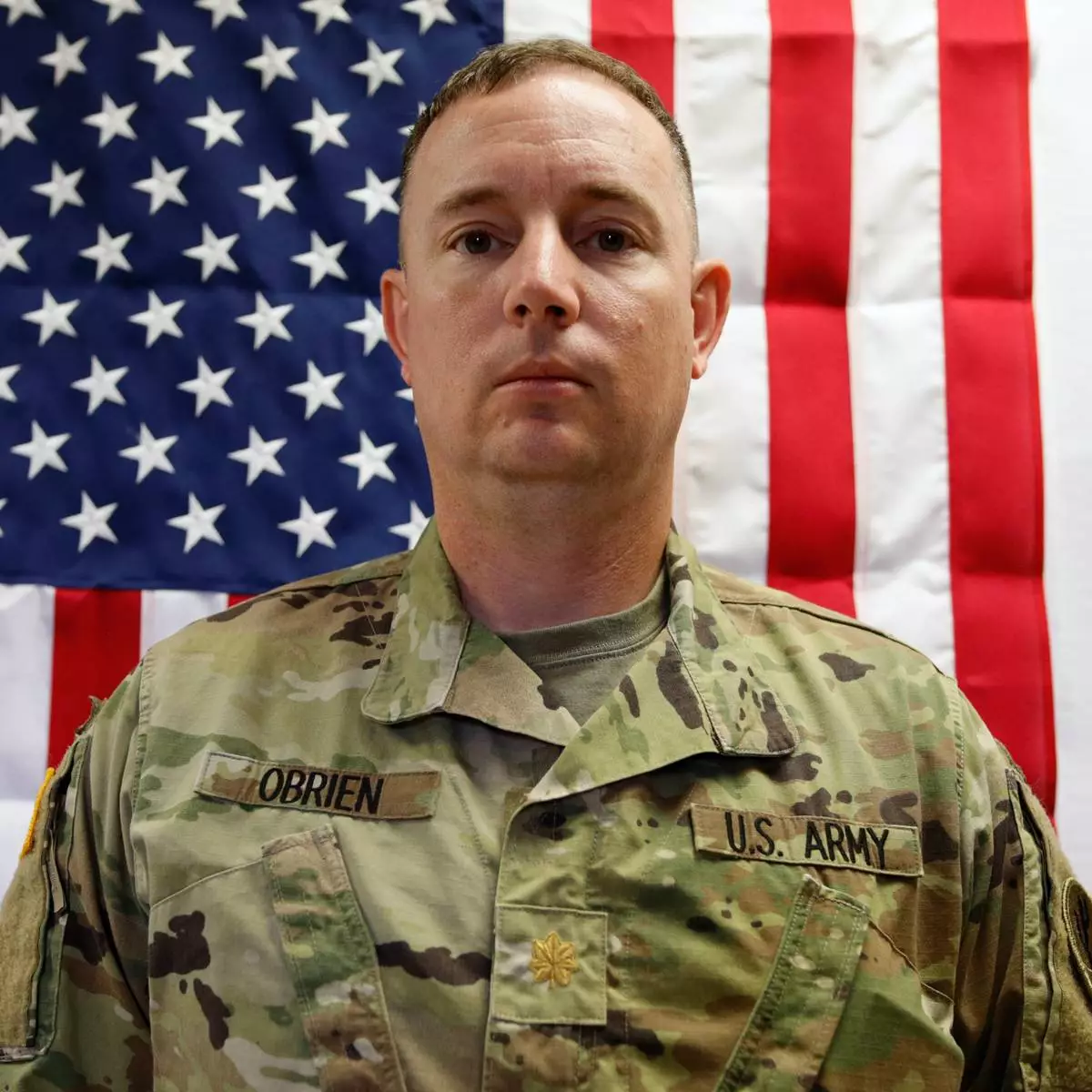
This image provided by the U.S. Army shows Maj. Jeffrey R. O'Brien, 45, of Indianola, Iowa, in this May 16, 2025, photo. (U.S. Amy via AP)
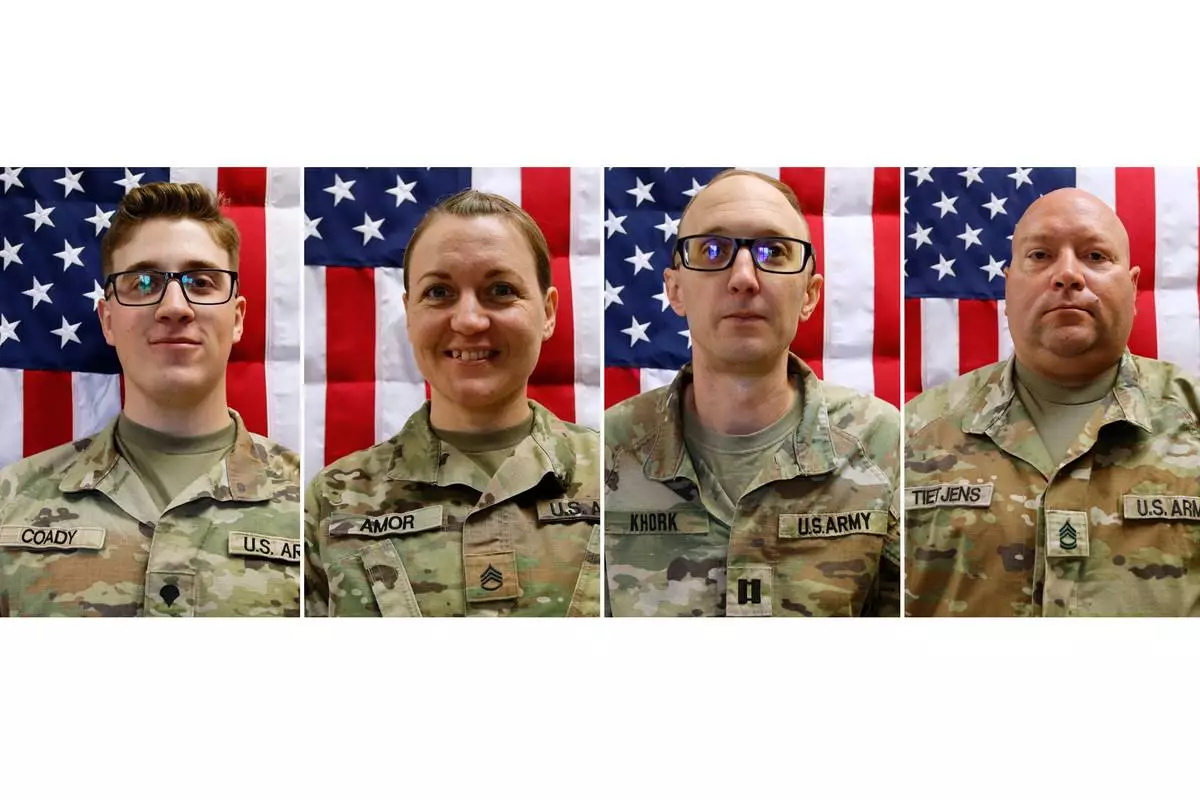
This combination of images provided by the U.S. Army taken on May 16, 2025 shows, from left, Sgt. Declan Coady, 20, of Des Moines, Iowa, Sgt. 1st Class Nicole Amor, 39, of White Bear Lake, Minn., Capt. Cody Khork, 35, of Lakeland, Fla., and Sgt. 1st Class Noah Tietjens, 42, of Bellevue, Neb. (Sgt. Brent Newton/U.S. Army via AP)
NEW YORK (AP) — The price of oil surged higher and showed no signs of halting its rapid climb a week after the U.S. and Israel launched major attacks on Iran that escalated into a war in the Middle East.
The conflict, in which nearly every country in the Middle East has sustained damage from missiles or drone strikes, has left ships that carry roughly 20 million barrels of oil a day stranded in the Persian Gulf, unable to safely pass through the Strait of Hormuz, the narrow mouth of the Gulf that is bordered on its north side by Iran.
The disruption and damage to key oil and gas facilities in the Middle East has led to an interruption in the supply of oil and gas.
Oil prices surpassed $90 a barrel Friday, with American crude settling at $90.90, up 36% from a week ago, and Brent, the international standard, climbing 27% over the course of the week to land at $92.69.
The fallout is ratcheting up what consumers and business will pay for gasoline, diesel and jet fuel, with some drivers already feeling it at the pump.
“It’s crazy. It’s not needed, especially at a time when people are already struggling, but not unexpected from all this turmoil that’s going on,” said Mark Doran, who was pumping gas in Middlebury, Vermont Friday. “I don’t think there’s been an end in sight to any Middle East conflict that’s been started by us, so the fact that they say that there’s going to be an end that quickly is not believable, and the Middle East is, you know, a place that the U.S. is not going to solve.”
On Monday, President Donald Trump said that the U.S. expected its military operations against Iran to last four to five weeks but has “ the capability to go far longer.” And on Friday, Trump appeared to rule out talks with Iran absent its “unconditional surrender.”
“The more news we get, the more it seems like this is going to last a really long time,” said Al Salazar, head of macro oil and gas research at Enverus.
In the U.S., a gallon of regular gasoline rose to $3.41 on Saturday, up about 43 cents from a week ago, according to AAA motor club. Diesel was selling for $4.51 a gallon Saturday, up about 75 cents from last week.
The price shocks were felt even more heavily in Europe and Asia, markets that rely more heavily on energy supplies from the Middle East. Diesel prices doubled in Europe, and jet fuel prices rose by close to 200% in Asia, according to Claudio Galimberti, chief economist at Rystad Energy.
Energy prices climbed throughout the week as Iran launched a series of retaliatory attacks, including a drone strike on the U.S. Embassy in Saudi Arabia, and the conflict widened. Iran also hit a major refinery in Saudi Arabia and a liquefied natural gas (LNG) facility in Qatar, halting flows of refined products and taking about 20% of the world’s LNG supply offline.
“We keep seeing news of vessels being hit or refineries or pipelines, so the list is very long,” Galimberti said. As a result, roughly 9 million barrels of oil per day are off the market because of facilities being hit or producers taking precautionary measures, he said. “Right now, with all of this shut in, we are in a situation of extreme deficit.”
The U.S. is a net exporter of oil, but that does not mean it is immune to increases in the price of oil or gasoline, or that its producers can just make up the difference.
Oil is traded on global markets, so even the oil produced in the U.S. has risen in price based on what's happening in the Middle East. And for many American oil producers, "if you put more wells in the ground, there’s about a six-month lag before you get that production uplift," Salazar said.
In addition, the U.S. can't simply turn all of its crude oil into gasoline. That's because most of the oil produced in the U.S. is light, sweet crude, and refineries on the East and West coasts are primarily designed to process heavier, sour crude. As a result, the U.S. exports some of its crude oil and imports some refined products such as gasoline.
Jerry Dalpiaz of Covington, Louisiana, said he started filling up his cars and gas cans on “the day that they announced that the United States has started military operations against Iran" because he assumed gas prices would climb.
“I can weather the storm because I’m in good financial position, but I feel sorry for my fellow citizens who are living paycheck to paycheck because they have to drive to get to work and they have to change their oil and all those things,” Dalpiaz said. "And they need some relief and it doesn’t seem to be coming anytime soon.”
Trump issued a plan Friday to insure losses up to approximately $20 billion in the Gulf region, aiming to restore confidence in maritime trade, help stabilize international commerce and support American and allied businesses operating in the Middle East.
But some energy experts said extra insurance won't solve the problem.
“The problem is that in the oil trading, oil shipping world, people are worried about counterterrorism,” said Amy Jaffe, director of the Energy, Climate Justice and Sustainability Lab at New York University, adding that they're worried about automated drone speedboats, weapon-carrying, flying drones and mines or other devices. "In order for the United States to create the atmosphere that undoes the current bottleneck at the Strait of Hormuz, there has to be some credible demonstration of solutions to the counter-terrorism problem.”
Salazar wondered what the “new normal” would look like if the Strait of Hormuz was effectively re-opened, and what effective security would look like.
“All it takes is one individual with a RPG (rocket-propelled grenade) to stand on the shore and take out a tanker, right?” Salazar said. “And this is forever, do you know what I mean?”
Associated Press journalists Amanda Swinhart in Middlebury, Vermont, Stephen Smith in Covington, Louisiana and Stan Choe in New York contributed to this report.
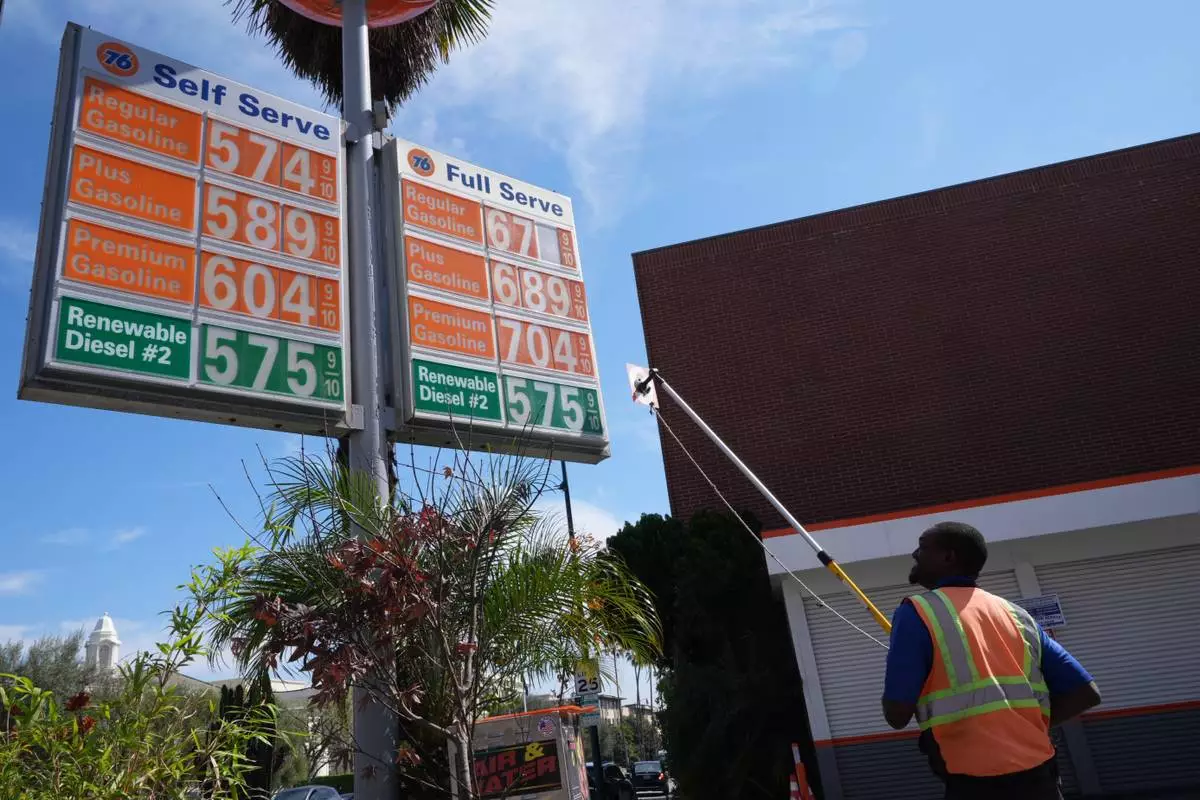
Gas prices are manually increased in Beverly Hills, Calif., Tuesday, March 3, 2026. (AP Photo/Damian Dovarganes)