Skip to Content Facebook Feature Image

Oil and gas prices rapidly rise as Iran war shows no signs of letting up

News

Oil and gas prices rapidly rise as Iran war shows no signs of letting up
News

News

Oil and gas prices rapidly rise as Iran war shows no signs of letting up

2026-03-08 00:18 Last Updated At:00:20

NEW YORK (AP) — The price of oil surged higher and showed no signs of halting its rapid climb a week after the U.S. and Israel launched major attacks on Iran that escalated into a war in the Middle East.

The conflict, in which nearly every country in the Middle East has sustained damage from missiles or drone strikes, has left ships that carry roughly 20 million barrels of oil a day stranded in the Persian Gulf, unable to safely pass through the Strait of Hormuz, the narrow mouth of the Gulf that is bordered on its north side by Iran.

The shipping disruption and damage to key Middle East oil and gas facilities has interrupted supplies from some of the world's largest oil producers. Kuwait, for example, said on Saturday that it would reduce its oil production as a “precautionary” measure due to the war, which could jolt global energy markets even further.

Oil prices surpassed $90 a barrel Friday, with American crude settling at $90.90, up 36% from a week ago, and Brent, the international standard, climbing 27% over the course of the week to land at $92.69.

The fallout is ratcheting up what consumers and business will pay for gasoline, diesel and jet fuel, with some drivers already feeling it at the pump.

“It’s crazy. It’s not needed, especially at a time when people are already struggling, but not unexpected from all this turmoil that’s going on,” said Mark Doran, who was pumping gas in Middlebury, Vermont Friday. “I don’t think there’s been an end in sight to any Middle East conflict that’s been started by us, so the fact that they say that there’s going to be an end that quickly is not believable, and the Middle East is, you know, a place that the U.S. is not going to solve.”

President Donald Trump said Monday that the U.S. expected its military operations against Iran to last four to five weeks but has “ the capability to go far longer.” On Friday, Trump appeared to rule out talks with Iran absent its “unconditional surrender.”

“The more news we get, the more it seems like this is going to last a really long time,” said Al Salazar, head of macro oil and gas research at Enverus.

In the U.S., a gallon of regular gasoline rose to $3.41 on Saturday, up about 43 cents from a week ago, according to AAA motor club. Diesel was selling for $4.51 a gallon Saturday, up about 75 cents from last week.

The price shocks were felt even more heavily in Europe and Asia, markets that rely more heavily on energy supplies from the Middle East. Diesel prices doubled in Europe, and jet fuel prices rose by close to 200% in Asia, according to Claudio Galimberti, chief economist at Rystad Energy.

Energy prices climbed throughout the week as Iran launched a series of retaliatory attacks, including a drone strike on the U.S. Embassy in Saudi Arabia, and the conflict widened. Iran also hit a major refinery in Saudi Arabia and a liquefied natural gas (LNG) facility in Qatar, halting flows of refined products and taking about 20% of the world’s LNG supply offline.

“We keep seeing news of vessels being hit or refineries or pipelines, so the list is very long,” Galimberti said. As a result, roughly 9 million barrels of oil per day are off the market because of facilities being hit or producers taking precautionary measures, he said. “Right now, with all of this shut in, we are in a situation of extreme deficit.”

The U.S. is a net exporter of oil, but that does not mean it is immune to increases in the price of oil or gasoline, or that its producers can just make up the difference.

Oil is traded on global markets, so even the oil produced in the U.S. has risen in price based on what's happening in the Middle East. And for many American oil producers, "if you put more wells in the ground, there’s about a six-month lag before you get that production uplift," Salazar said.

In addition, the U.S. can't simply turn all of its crude oil into gasoline. That's because most of the oil produced in the U.S. is light, sweet crude, and refineries on the East and West coasts are primarily designed to process heavier, sour crude. As a result, the U.S. exports some of its crude oil and imports some refined products such as gasoline.

Jerry Dalpiaz of Covington, Louisiana, said he started filling up his cars and gas cans on “the day that they announced that the United States has started military operations against Iran" because he assumed gas prices would climb.

“I can weather the storm because I’m in good financial position, but I feel sorry for my fellow citizens who are living paycheck to paycheck because they have to drive to get to work and they have to change their oil and all those things,” Dalpiaz said. "And they need some relief and it doesn’t seem to be coming anytime soon.”

Trump issued a plan Friday to insure losses up to approximately $20 billion in the Gulf region, aiming to restore confidence in maritime trade, help stabilize international commerce and support American and allied businesses operating in the Middle East.

But some energy experts said extra insurance won't solve the problem.

“The problem is that in the oil trading, oil shipping world, people are worried about counterterrorism,” said Amy Jaffe, director of the Energy, Climate Justice and Sustainability Lab at New York University, adding that they're worried about automated drone speedboats, weapon-carrying, flying drones and mines or other devices. "In order for the United States to create the atmosphere that undoes the current bottleneck at the Strait of Hormuz, there has to be some credible demonstration of solutions to the counter-terrorism problem.”

Salazar wondered what the “new normal” would look like if the Strait of Hormuz was effectively re-opened, and what effective security would look like.

“All it takes is one individual with a RPG (rocket-propelled grenade) to stand on the shore and take out a tanker, right?” Salazar said. “And this is forever, do you know what I mean?”

Associated Press journalists Amanda Swinhart in Middlebury, Vermont, Stephen Smith in Covington, Louisiana, Josef Federman in Jerusalem and Stan Choe and Wyatte Grantham-Philips in New York contributed to this report.
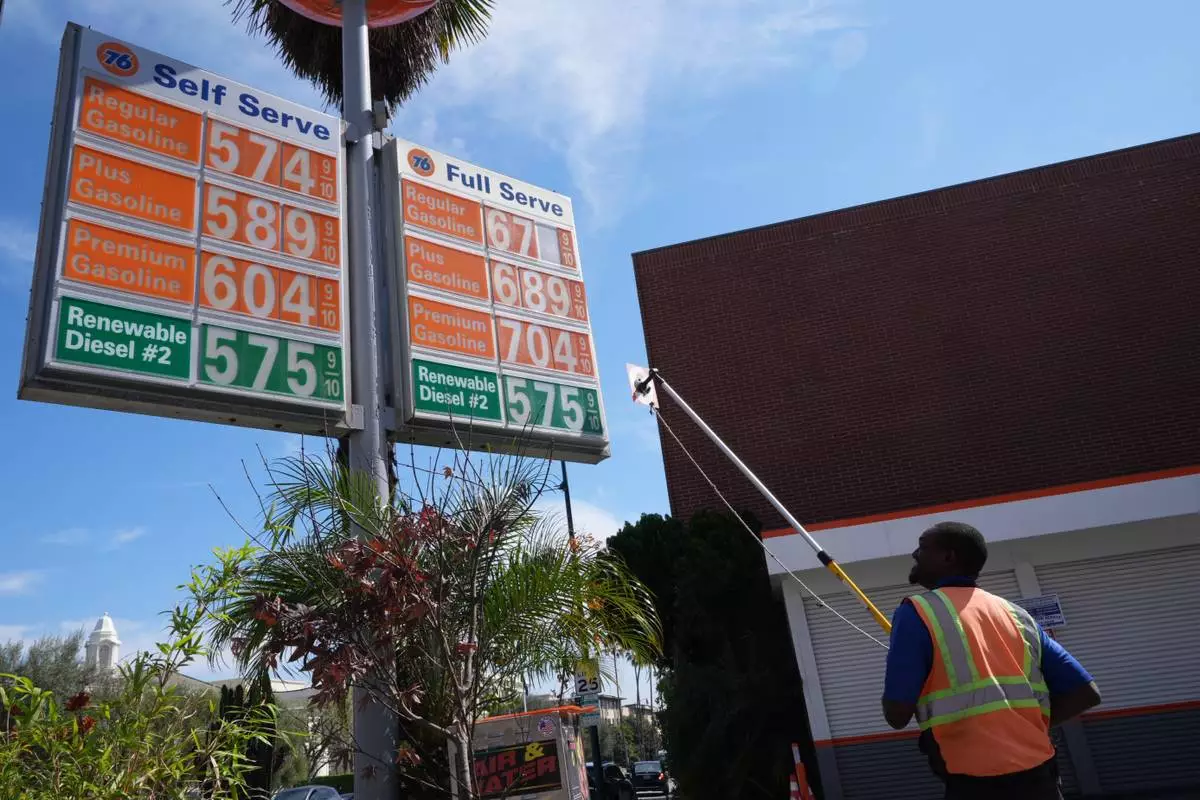
Gas prices are manually increased in Beverly Hills, Calif., Tuesday, March 3, 2026. (AP Photo/Damian Dovarganes)
Gas prices are manually increased in Beverly Hills, Calif., Tuesday, March 3, 2026. (AP Photo/Damian Dovarganes)
ANCHORAGE, Alaska (AP) — Hundreds of barking dogs will take over downtown Anchorage on Saturday for the ceremonial start of the world’s most famous sled dog race. The event, catered to fans who hope to see and cheer on their favorite mushers, takes place a day before the competitive start.

Here’s what to know about the 54th running of the Iditarod Trail Sled Dog Race, which features a new amateur category and financial support from a Norwegian billionaire.

The Iditarod was conceived by co-founders Dorothy Page and Joe Redington Sr. as a long-distance sled dog race to honor both Alaska’s mushing tradition and the Iditarod Trail. That was a 938-mile (1,510-kilometer) freight and mail route that ran from Seward on Alaska’s southern coast to Nome, on the Bering Sea on Alaska’s western coast.

The start of the race was placed in the Anchorage area to energize residents of the state’s largest city. The late Howard Farley was instrumental in making Nome, about 1,000 miles (1,610 kilometers) away, the finish line.

Thirty-four mushers started the 1973 race, but only 22 finished.

Dick Wilmarth won it in 20 days. He never raced again. When asked why, he once said, “ Cause I won.”

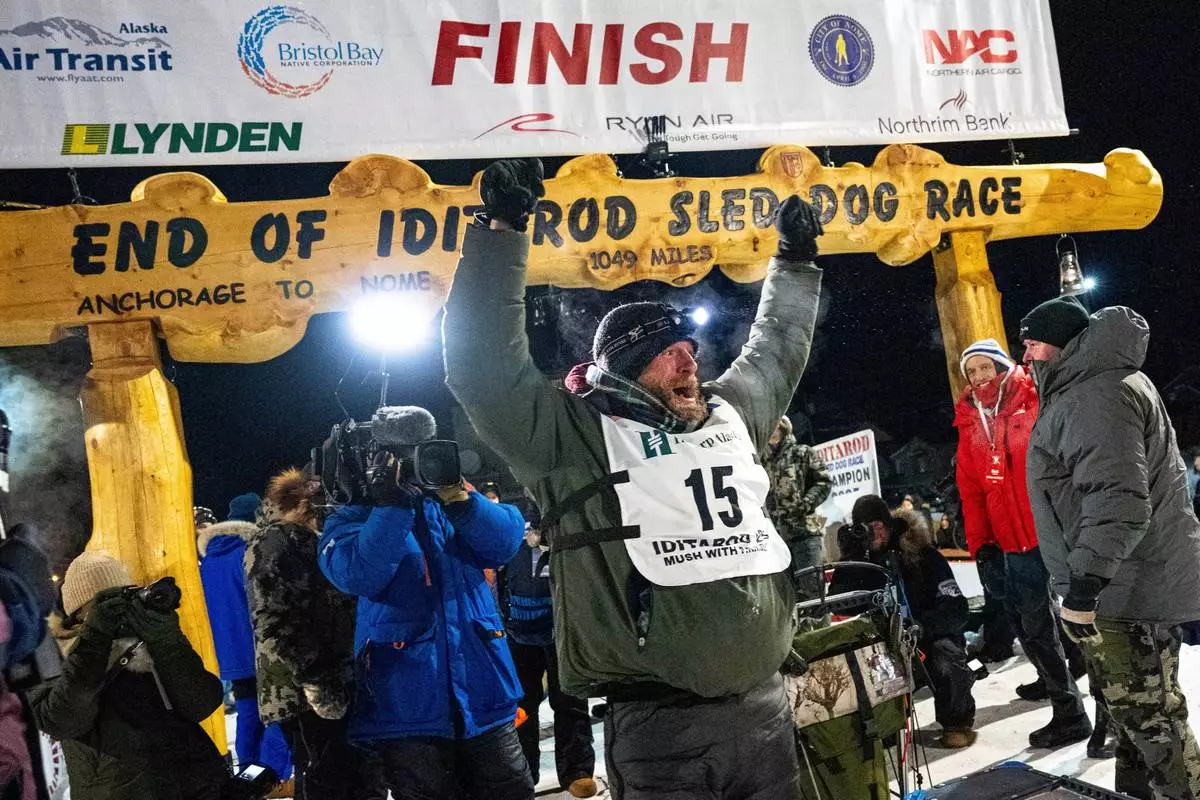
Since then, mushers have become faster and faster, with winners reaching the finish line a block off the Bering Sea in about 10 days.

The number of mushers jostling to be the first to Nome has varied over the years, but the retirements of many longtime mushers and the high cost of supplies, such as dog food, have kept the fields small this decade.

The largest field was 96 mushers starting the race in 2008. Over the race's first five decades, about 60 competed on average. Just 33 started the race in 2023 and 2025 — the fewest ever.

This year, 34 mushers are competing, matching the number who started in 1973. They will glide their sleds over 11 miles (18 kilometers) of trails in Anchorage past cheering fans on Saturday. The competitive 1,000-mile (1,610-kilometer) race starts Sunday on a frozen lake about 75 miles (120 kilometers) north of Anchorage.

There actually are 37 mushers in this year’s race, but three are not eligible for the championship or prize money. The Iditarod has started a new Iditarod Expedition Musher Program, which allows people to race in the honorary category.

Participating this year will be Norwegian billionaire Kjell Rokke, who now lives in Switzerland, and Canadian entrepreneur Steve Curtis. Unlike Iditarod contestants, they are allowed outside help.

Norwegian musher Thomas Waerner, who won the 2020 Iditarod and then famously was stuck in Alaska for three months because of the COVID-19 pandemic, will provide support for Rokke running a dog team. Four-time champion Jeff King will aid Curtis on a snowmachine.

Rokke is providing financial support to the race, including boosting the race purse by $100,000 to a total of $650,000 and providing $170,000 in support for the 17 Alaska Native villages that serve as checkpoints.

Iditarod CEO Rob Urbach said Rokke's donation to the purse should raise the payouts to competitors, with the winner getting about $80,000, well above the nearly $57,000 paid to the top musher last year.

“I believe it is healthy for the sport to evolve and look at new opportunities,” Waerner told The Associated Press in an interview conducted by private message. “The cost of running a competitive kennel has increased significantly over the years, and this initiative is an attempt to explore more sustainable ways to finance both a racing kennel and the race itself — while maintaining high standards for dog care, training, competition, and overall quality.”

Curtis, whose addition was only announced three days before the ceremonial start, has committed $50,000 to support youth sports programs in villages along the Iditarod trail, race officials said in a social media post.

This year's field includes four competitive mushers from other countries: two from Canada, one from Norway and one from Denmark.

Even though Waerner is ineligible to win, the field includes three other former champions all looking for their second title: defending champion Jessie Holmes, 2023 champion Ryan Redington and 2019 winner Pete Kaiser.

Holmes, a former reality television star on National Geographic’s “Life Below Zero,” is trying to join former champions Susan Butcher and Lance Mackey as the only mushers to win their second title the year after winning their first.

Both Butcher and Mackey went on to win four championships apiece. Each died from cancer, Butcher in 2006 and Mackey in 2022.

Redington is the grandson of Joe Redington Sr., the race's co-founder, and Kaiser was the fist Yup'ik to win the race.

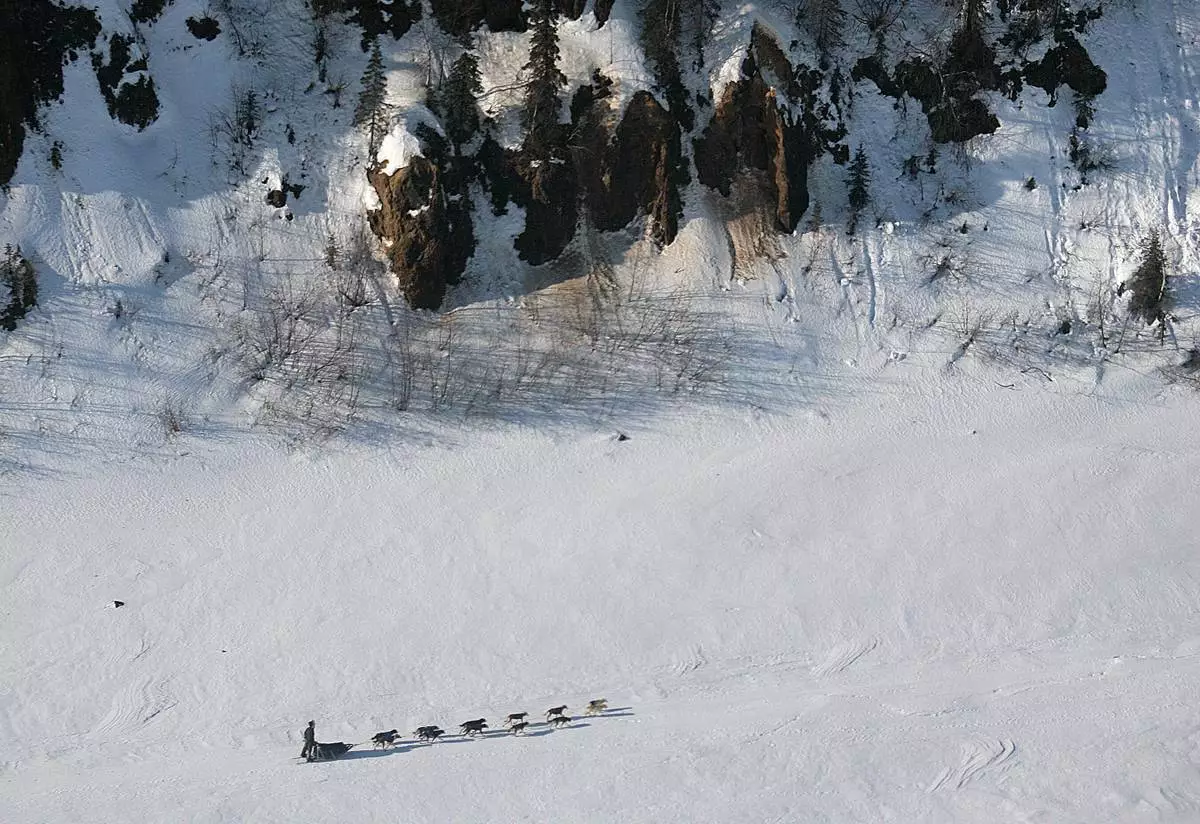
Deep snow should greet mushers along much of the 1,000-mile (1,610-kilometer) trek to the state’s western coast.

The route takes mushers over two mountain ranges, the frozen Yukon River and treacherous Bering Sea ice before ending on Front Street in Nome.

The finish line is near City Hall, built on the former site of The Dexter, a bar that was owned by Wyatt Earp — he of the Gunfight-at-the-OK-Corral fame — during Nome’s heady gold rush days.

The winner is expected to reach Nome early the week of March 16.

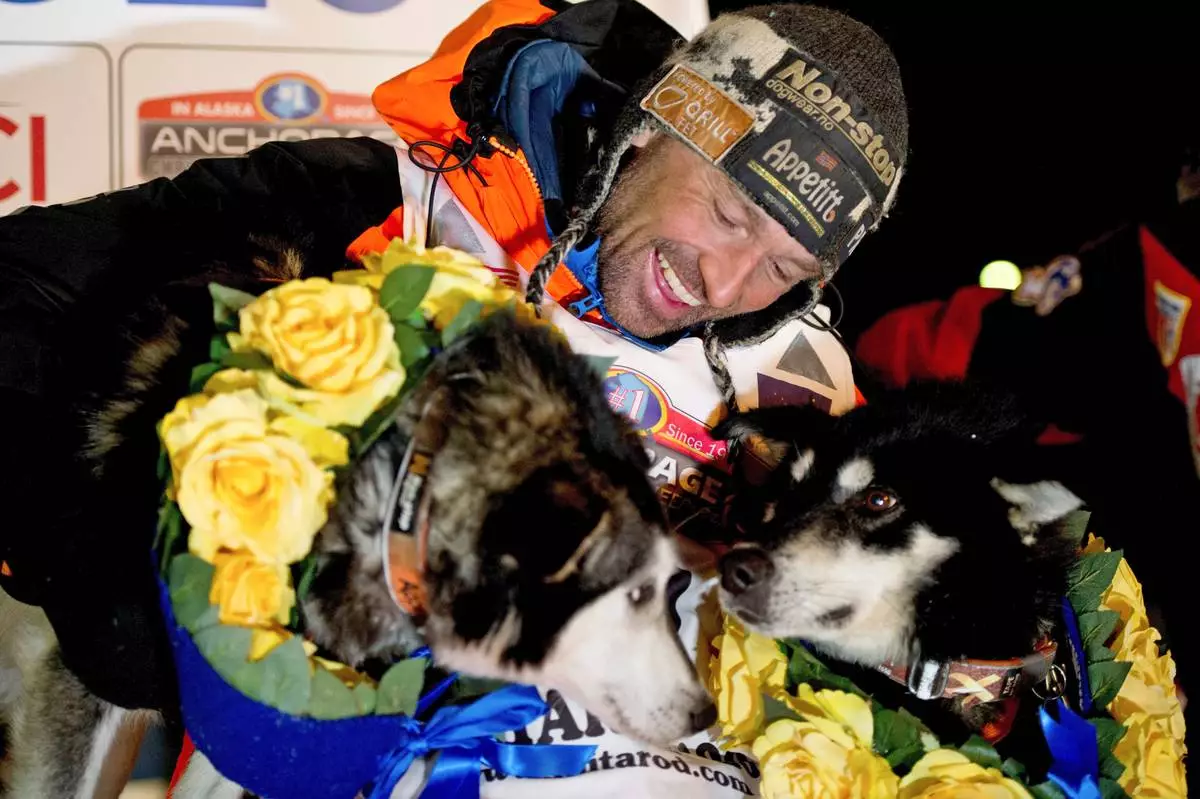
FILE - Thomas Waerner, of Norway, celebrates his win in the Iditarod Trail Sled Dog Race, March 18, 2020, in Nome, Alaska. (Marc Lester/Anchorage Daily News via AP, File)

FILE - Thomas Waerner, of Norway, celebrates his win in the Iditarod Trail Sled Dog Race, March 18, 2020, in Nome, Alaska. (Marc Lester/Anchorage Daily News via AP, File)

FILE - Jessie Holmes celebrates after winning the Iditarod Trail Sled Dog Race, March 14, 2025 in Nome, Alaska. (Loren Holmes/Anchorage Daily News via AP, File)

FILE - Jessie Holmes celebrates after winning the Iditarod Trail Sled Dog Race, March 14, 2025 in Nome, Alaska. (Loren Holmes/Anchorage Daily News via AP, File)

FILE - Ryan Redington of Knik, Alaska, grandson of Joe Redington Sr., the father of the Iditarod, drives his team on the Yukon River past the bluffs near Grayling, Alaska, on the Iditarod Trail Sled Dog Race, March 10, 2007. (AP Photo/Al Grillo)

FILE - Ryan Redington of Knik, Alaska, grandson of Joe Redington Sr., the father of the Iditarod, drives his team on the Yukon River past the bluffs near Grayling, Alaska, on the Iditarod Trail Sled Dog Race, March 10, 2007. (AP Photo/Al Grillo)

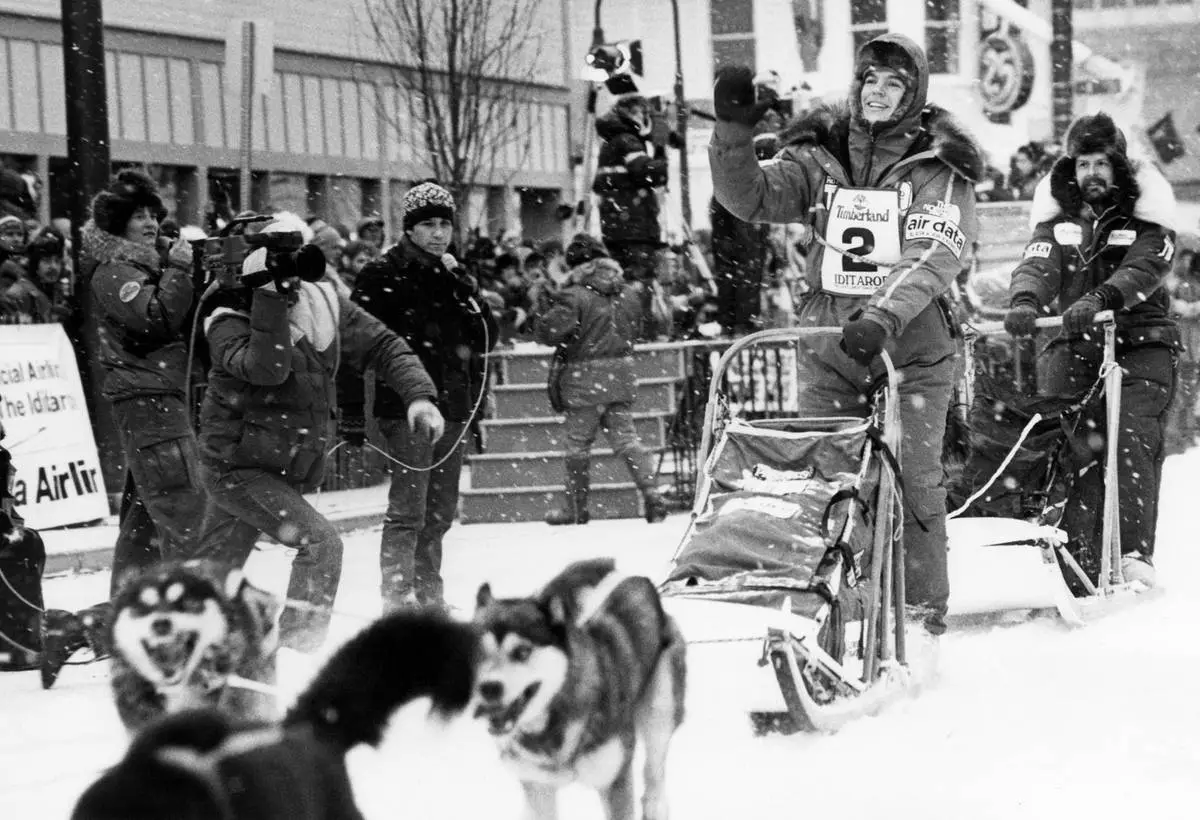
FILE - Susan Butcher races in the Iditarod Trail Sled Dog Race, in Anchorage, Alaska, March 7, 1987. (AP Photo/Rob Stapleton, File)

FILE - Susan Butcher races in the Iditarod Trail Sled Dog Race, in Anchorage, Alaska, March 7, 1987. (AP Photo/Rob Stapleton, File)

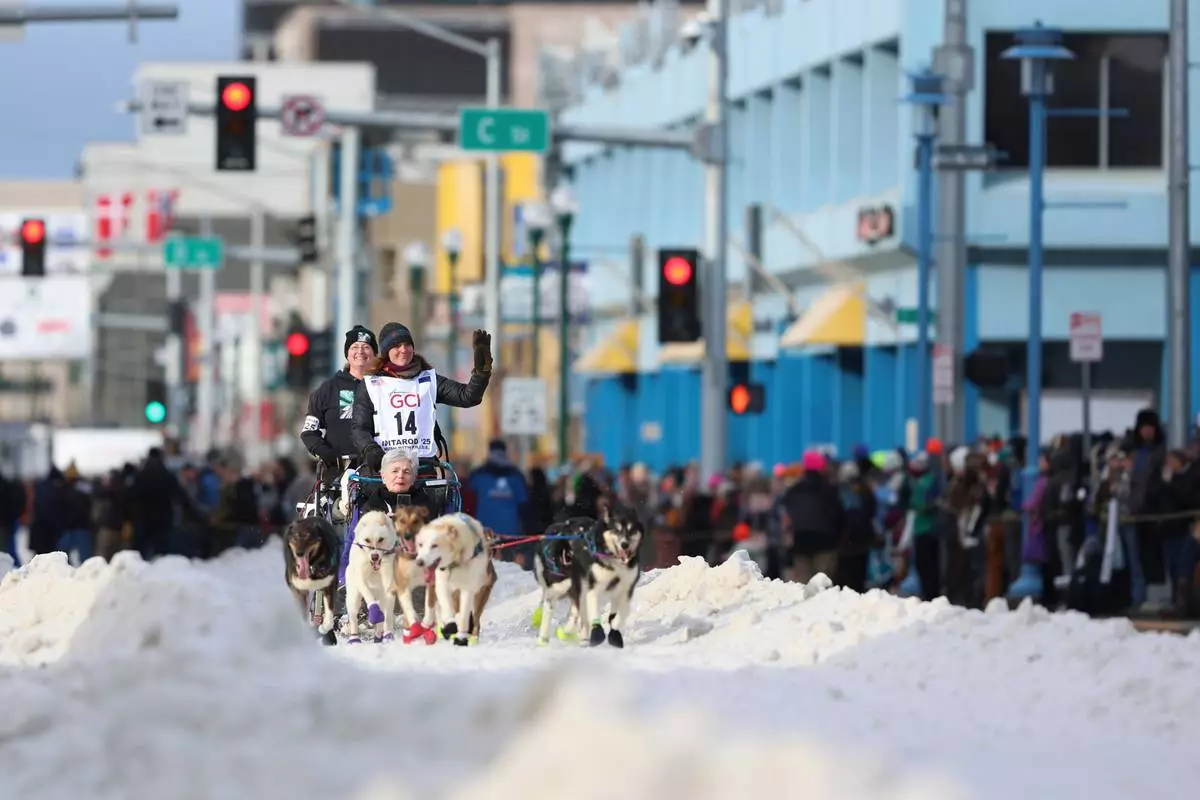
FILE - Michelle Phillips (14), of Canada, mushes down Fourth Street during the Ceremonial Start of the Iditarod Trail Sled Dog Race, in Anchorage, Alaska, March 1, 2025. (AP Photo/Amanda Loman, File)

FILE - Michelle Phillips (14), of Canada, mushes down Fourth Street during the Ceremonial Start of the Iditarod Trail Sled Dog Race, in Anchorage, Alaska, March 1, 2025. (AP Photo/Amanda Loman, File)

Recommended Articles