It's said that January is one of the prime months that Hollywood chooses to dump its most embarrassing films and "The Upside" doesn't exactly disprove that notion.
Few films in memory have squandered so much acting talent in such a cliche-ridden, exploitative and dishonest way. It deserves its frozen grave.
The film stars Kevin Hart as a lazy, skirt-chasing ex-con hoping to reconnect with his estranged wife and son. He accidentally gets a job taking care of an obscenely wealthy New York businessman who became a paraplegic while hang gliding, played by Bryan Cranston. ("You as rich as Jay-Z?" Hart's character asks. "No, richer," comes the reply.)

This image released by STXfilms shows Bryan Cranston, from left, Jahi Di'Allo Winston, and Kevin Hart in a scene from "The Upside." (David LeeSTXfilms via AP)
You can virtually write the rest as "The Upside " unspools. Will Hart's street-wise Dell break his high-class boss out of his luxury Park Avenue apartment and teach him about the joys of corner-bought weed, street hot dogs and driving the older man's fleet of Ferraris very fast? Oh, yes. Rich white dudes in these films always need loosening up.
Will Cranston's Phillip teach his young aide about the joys of opera, investing in start-ups, kumquats and abstract painting? You saw that coming, too, huh? Poor black guys in these films could always use some smartening up.
The movie is based on a true story — and lifted from the 2011 French film "Les Intouchables" — but no one really worked on the shaky racial angle for an American audience, one that has seen elements of this in movies such as "Driving Miss Daisy" or "Trading Places" (that last one also has a pottery smashing scene).

This image released by STXfilms shows Nicole Kidman in a scene from "The Upside." (David LeeSTXfilms via AP)
Hart often plays a version of the magical black man, a hurricane of truth who readjusts the stuffy white world. There are moments when race could have been addressed — "Your plantation is bananas," Hart's Dell tells Phillip, "but I'm nobody's servant" — however it's quickly dropped. There's also a moment when the two men bond over both feeling mostly invisible to the larger society — one in a wheelchair, the other a minority in white America — but that peters out.
There's not enough drama and yet not enough laugh-out-loud moments. Hart shines in a scene in which he encounters a high-tech shower with a robot voice in German, but a later scene in which he cuts Cranston's facial hair is marred by a Hitler joke. When you have hired consummate comedians in Kevin Hart and Bryan Cranston, relying on a Hitler joke is a sign something has gone horribly wrong. (Another sign: This joke — "You are Verdi ugly.")
The film comes with its own heavy baggage, including that it was previously owned by The Weinstein Co., before it collapsed amid the Harvey Weinstein sexual misconduct scandal. Reacquired, it is released as Hart deals with fallout over his previous homophobic tweets, not helped now by a performance in the film in which he balks at using the word "penis" and initially outright refuses to change his boss' catheter because it means touching another man's privates.
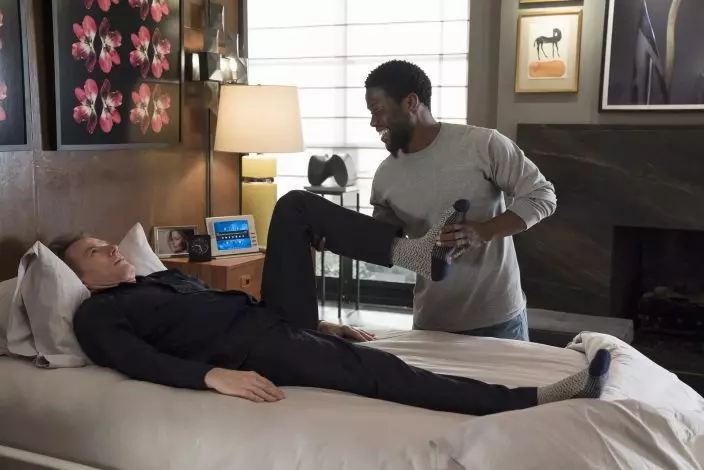
This image released by STXfilms shows Bryan Cranston, left, and Kevin Hart in a scene from "The Upside." (David LeeSTXfilms via AP)
Hart, a comic force, reveals his limits as a dramatic actor in his fish-out-of-water role, while Cranston shows only a few glimpses of his formidable skills, especially when he turns steely. Appearances by Nicole Kidman, Aja Naomi King and Julianna Margulies are welcome, understated — and completely wasted.
Mostly the problem is that once the filmmakers — led by director Neil Burger — establish their odd couple pairing, they don't know what to do with it. Dell needs money to repair his family and Phillip needs love after losing his wife. Jon Hartmere's screenplay needs tension, so it's artificially added when the rich dude starts lashing out at his staff and growing depressed after a bad blind date. The answer? Our heroes go hang gliding. Roll credits.
Only one person really comes through this whole meandering mess unscathed: Aretha Franklin. The late Queen of Soul, it turns out, is the key that connects Dell and Phillip, particularly when it's revealed that Franklin sang opera, too. Her music fills the soundtrack and that's the only reason this film gets any points, the only upside, if you will. Better yet, skip this movie and just put on one of her CDs.
"The Upside," an STX Entertainment release, is rated PG-13 for "suggestive content and drug use." Running time: 125 minutes. A half star out of four.
MPAA Definition of PG-13: Parents Strongly Cautioned. Some material may be inappropriate for children under 13.
Online: https://www.stxentertainment.com
Mark Kennedy is at http://twitter.com/KennedyTwits
LUXOR, Egypt (AP) — Egypt on Sunday revealed the revamp of two colossal statues of a prominent pharaoh in the southern city of Luxor, the latest in the government’s archaeological events that aim at drawing more tourists to the country.
The giant alabaster statues, known as the Colossi of Memnon, were reassembled in a renovation project that lasted about two decades. They represent Amenhotep III, who ruled ancient Egypt about 3,400 years ago.
“Today we are celebrating, actually, the finishing and the erecting of these two colossal statues,” Mohamed Ismail, secretary-general of the Supreme Council of Antiquities, told The Associated Press ahead of the ceremony.
Ismail said the colossi are of great significance to Luxor, a city known for its ancient temples and other antiquities. They’re also an attempt to “revive how this funerary temple of king Amenhotep III looked like a long time ago,” Ismail said.
Amenhotep III, one of the most prominent pharaohs, ruled during the 500 years of the New Kingdom, which was the most prosperous time for ancient Egypt. The pharaoh, whose mummy is showcased at a Cairo museum, ruled between 1390–1353 BC, a peaceful period known for its prosperity and great construction, including his mortuary temple, where the Colossi of Memnon are located, and another temple, Soleb, in Nubia.
The colossi were toppled by a strong earthquake in about 1200 BC that also destroyed Amenhotep III’s funerary temple, said Mohamed Ismail, secretary-general of the Supreme Council of Antiquities.
They were fragmented and partly quarried away, with their pedestals dispersed. Some of their blocks were reused in the Karnak temple, but archaeologists brought them back to rebuild the colossi, according to the Antiquities Ministry.
In late 1990s, an Egyptian German mission, chaired by German Egyptologist Hourig Sourouzian, began working in the temple area, including the assembly and renovation of the colossi.
“This project has in mind … to save the last remains of a once-prestigious temple,” she said.
The statues show Amenhotep III seated with hands resting on his thighs, with their faces looking eastward toward the Nile and the rising sun. They wear the nemes headdress surmounted by the double crowns and the pleated royal kilt, which symbolizes the pharaoh’s divine rule.
Two other small statues on the pharaoh’s feet depict his wife, Tiye.
The colossi — 14.5 meters (48 feet) and 13.6 meters (45 feet) respectively — preside over the entrance of the king’s temple on the western bank of the Nile. The 35-hectare (86-acre) complex is believed to be the largest and richest temple in Egypt and is usually compared to the temple of Karnak, also in Luxor.
The colossi were hewn in Egyptian alabaster from the quarries of Hatnub, in Middle Egypt. They were fixed on large pedestals with inscriptions showing the name of the temple, as well as the quarry.
Unlike other monumental sculptures of ancient Egypt, the colossi were partly compiled with pieces sculpted separately, which were fixed into each statue’s main monolithic alabaster core, the ministry said.
Sunday’s unveiling in Luxor came just six weeks after the inauguration of the long-delayed Grand Egyptian Museum, the centerpiece of the government’s bid to boost the country’s tourism industry and bring cash into the troubled economy. The mega project is located near the famed Giza Pyramids and the Sphinx.
The tourism sector, which depends heavily on Egypt’s rich pharaonic artifacts, has suffered during years of political turmoil and violence following the 2011 uprising. In recent years, the sector has started to recover after the coronavirus pandemic and amid Russia’s war on Ukraine — both countries are major sources of tourists visiting Egypt.
“This site is going to be a point of interest for years to come,” said Tourism and Antiquities Minister Sherif Fathy, who attended the unveiling ceremony. “There are always new things happening in Luxor.”
A record number of about 15.7 million tourists visited Egypt in 2024, contributing about 8% of the country’s GDP, according to official figures.
Fathy, the minister,has said about 18 million tourists are expected to visit the country this year, with authorities hoping for 30 million visitors annually by 2032.
Magdy reported from Cairo.
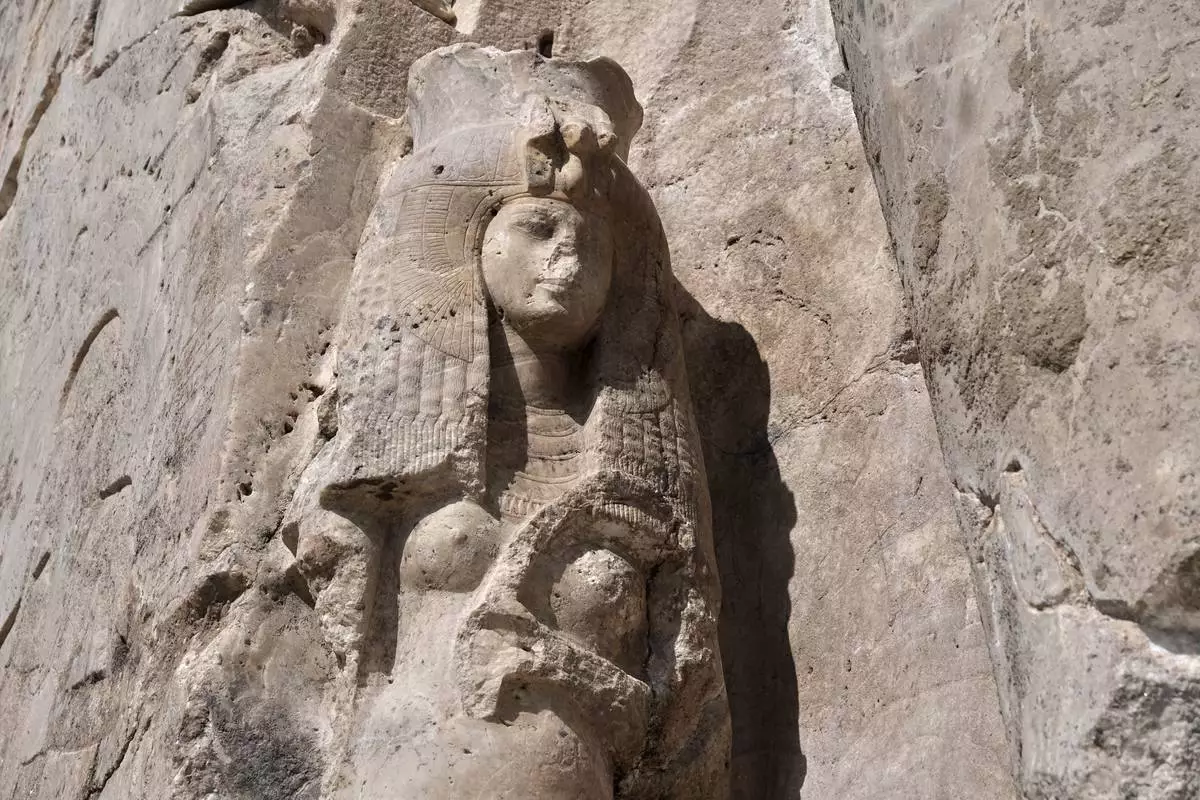
A view of the great royal Consort Tiye, near the right leg of the giant alabaster statue of Pharoah Amenhotep III, in the southern city of Luxor, Egypt, Sunday, Dec. 14, 2025. (AP Photo/Amr Nabil)
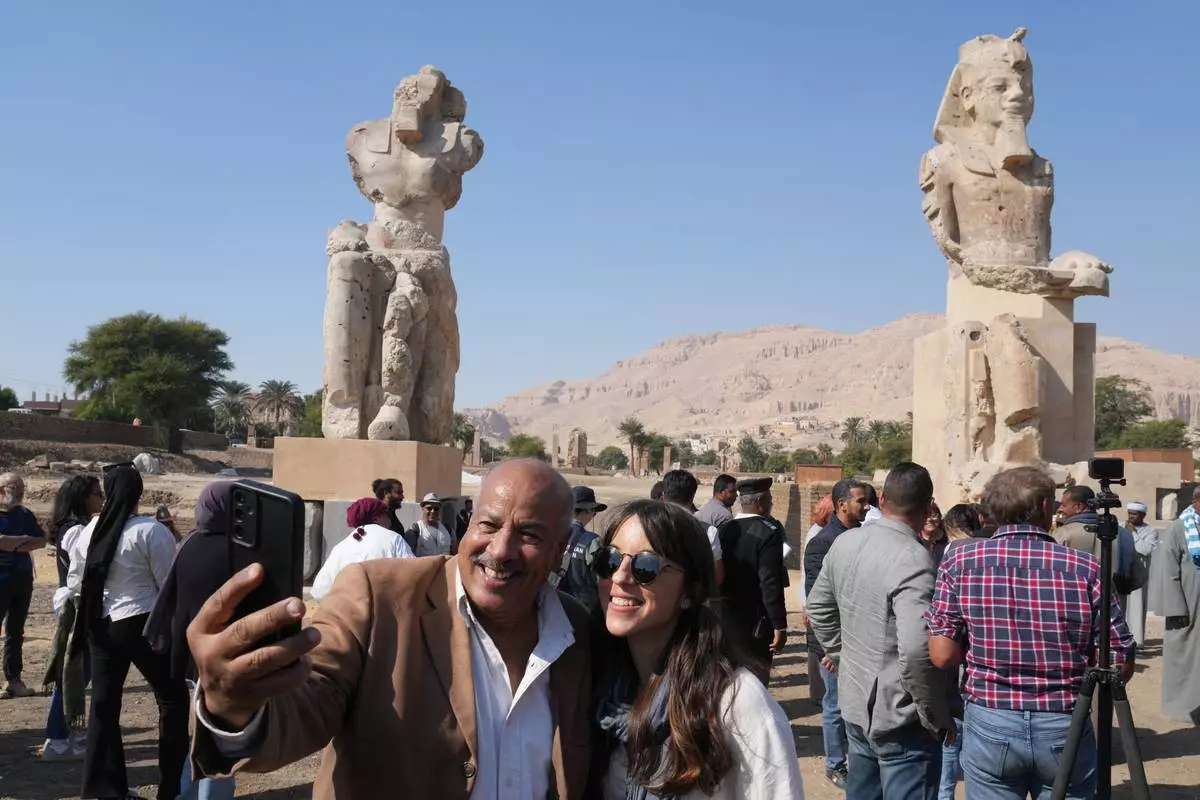
Visitors take photos with the two giant reassembled alabaster statues of Pharoah Amenhotep III, in the southern city of Luxor, Egypt, Sunday, Dec. 14, 2025. (AP Photo/Amr Nabil)
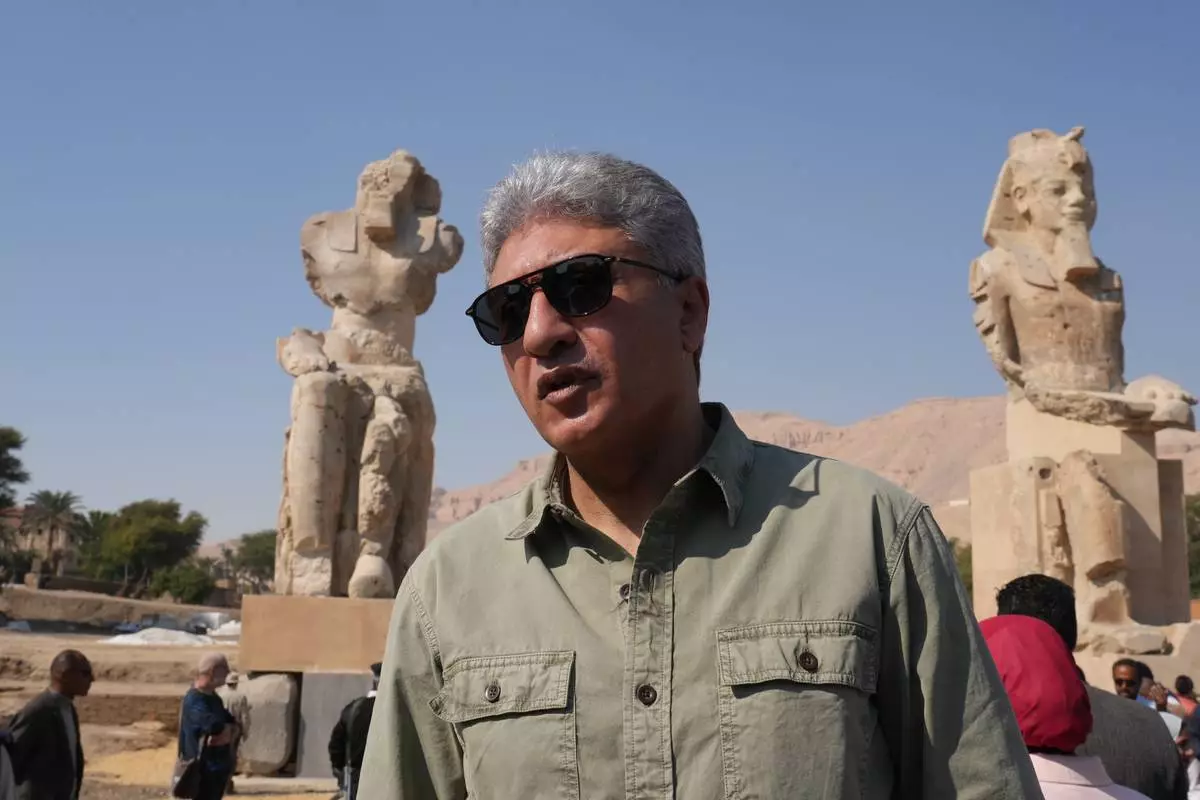
Minister of Tourism and Antiquities Sherif Fathy speaks in front of the two giant reassembled alabaster statues of Pharoah Amenhotep III, in the southern city of Luxor, Egypt, Sunday, Dec. 14, 2025. (AP Photo/Amr Nabil)

One of the two giant alabaster statues of Pharoah Amenhotep III, is photographed during the official opening, in the southern city of Luxor, Egypt, Sunday, Dec. 14, 2025. (AP Photo/Amr Nabil)
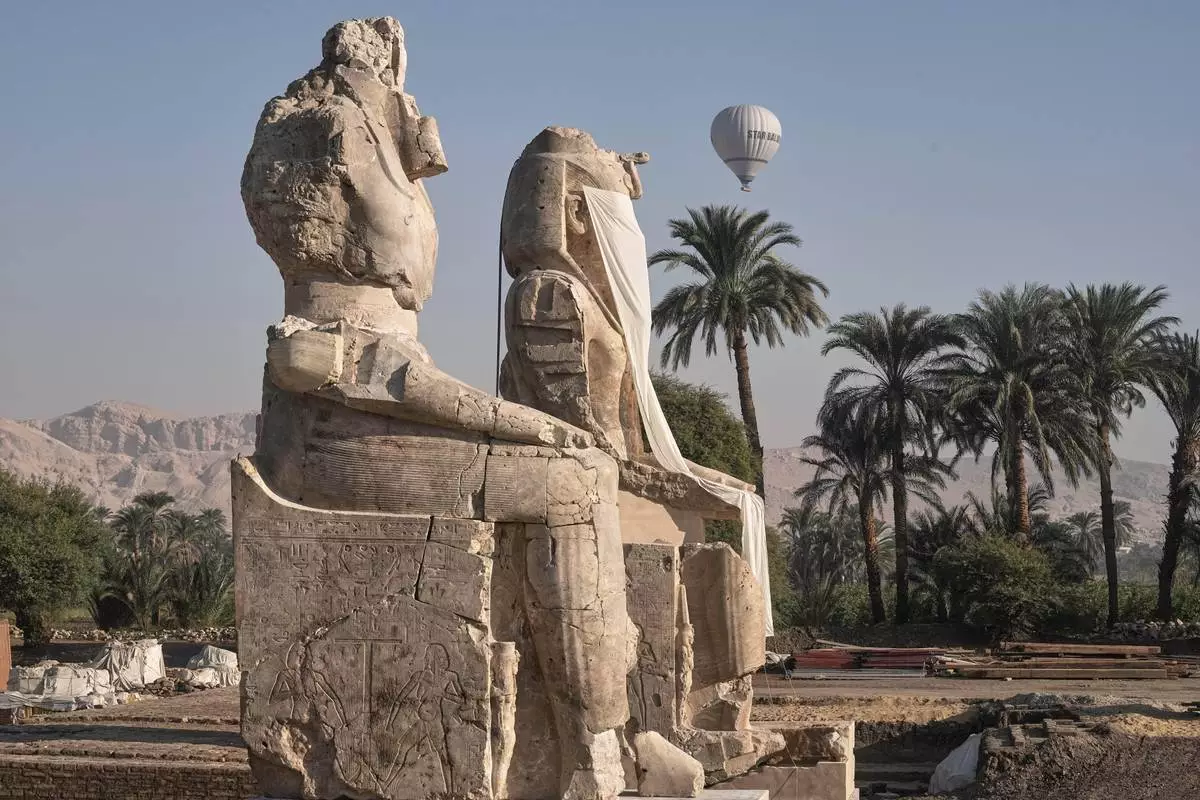
A hot air ballon flys over the assembly of two giant alabaster statues for Pharoah Amenhotep III, before the official opening, in the southern city of Luxor, Egypt, Sunday, Dec. 14, 2025. (AP Photo/Amr Nabil)