Wells Fargo, the consumer banking giant, said its fourth-quarter profits fell slightly on Tuesday as the bank remains restrained by federal regulators, who put a tight leash on it after years of scandals and missteps.
The San Francisco-based bank said it earned a profit of $6.06 billion in the last three months of a year, or $1.21 per share. That is down from $6.15 billion, or $1.16 per share, in the same period a year earlier. The results did beat analysts' expectations, who were looking for Wells to earn $1.19 a share.
Wells Fargo has been in a multi-year attempt to turn itself around after years of scandals in nearly every part of its business. Federal regulators have fined the bank billions of dollars for violating consumer protection laws, and the Federal Reserve has restrained Wells Fargo from growing any larger than its current size until the bank can prove it's a better-run company.
The restraints have put a hamper on the ability of Wells Fargo to grow profits in the past year. The bank saw its total loans fall slightly from a year ago, and deposits were also down slightly. That's notable because in a growing economy, a bank the size of Wells Fargo would typically be growing both deposits and assets, just like its competition.
The biggest U.S. mortgage lender posted revenue of $25.26 billion in the period. Its revenue net of interest expense was $20.98 billion, which also missed forecasts. Analysts were looking for Wells to earn $21.74 billion in revenue.
Wells Fargo shares were down 1 percent in pre-market trading. They are up 5 percent so far this year.
DUBAI, United Arab Emirates (AP) — A hard-line cleric leading Friday prayers in Iran's capital demanded the death penalty for protesters detained in a nationwide crackdown and directly threatened U.S. President Donald Trump, showing the hard-line rage gripping the Islamic Republic after the demonstrations.
Ayatollah Ahmad Khatami's sermon carried by Iranian state radio sparked chants from those gathered for prayers, including: “Armed hypocrites should be put to death!” Executions, as well as the killing of peaceful protesters, had been two of the red lines laid down by Trump for possible military action against Iran over the protests.
Khatami's remarks also offered the first nationwide counts of damage done during the demonstrations, which began Dec. 28 over Iran's ailing economy and soon morphed into demonstrations directly challenging the country's theocracy.
Iran cut off access to the internet Jan. 8 and intensified a bloody crackdown on all dissent, which the U.S.-based Human Rights Activists News Agency reports killed at least 2,677 people. The Associated Press has been unable to independently assess the death toll and Iran has offered no overall casualty figures.
Khatami, appointed by Supreme Leader Ayatollah Ali Khamenei and a member of both the country's Assembly of Experts and Guardian Council, described the protesters at time as the “butlers” of Israeli Prime Minister Benjamin Netanyahu and “Trump's soldiers.” He insisted their plans “had imagined disintegrating the country”
“They should wait for hard revenge from the system,” Khatami said of Netanyahu and Trump. “Americans and Zionists should not expect peace.”
Khatami long has been known for his hard-line views in Iran, including in 2007 when he said a fatwa calling for the death of writer Salman Rushdie remained in effect. He also threatened Israel in a 2018 speech by saying Iran could “raze Tel Aviv and Haifa to the ground” with its missile arsenal.
Khatami also provided the first overall statistics on damage from the protests, claiming 350 mosques, 126 prayer halls and 20 other holy places had sustained damage. Another 80 homes of Friday prayer leaders — an important position within Iran's theocracy — also had been damaged, likely underlining the anger demonstrators felt toward symbols of the country's government.
Khatami said 400 hospitals, 106 ambulance, 71 fire department vehicles and another 50 emergency vehicles sustained damage, showing the scale of the protests.
“They want you to withdraw from religion,” Khatami said. “They planned these crimes from a long time ago,"
Khatami, as a cleric in the public positions, would have access to such data from authorities and mentioning it at Friday prayers likely meant Iran's government wanted the information to be communicated without having to formally address the public. He also issued a call for the arrest of “individuals who supporters the rioters in any way.”
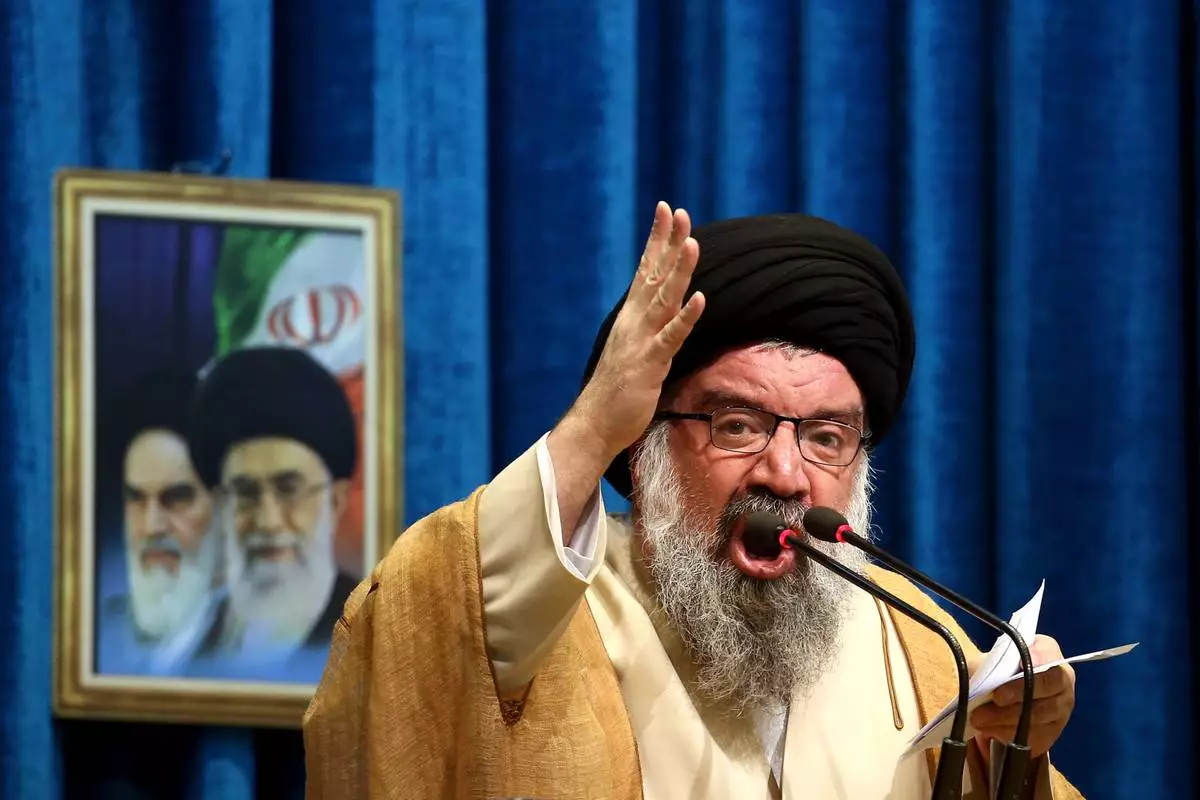
FILE - Iranian senior cleric Ahmad Khatami delivers his sermon during Friday prayer ceremony in Tehran, Iran, Friday, Jan. 5, 2018. (AP Photo/Ebrahim Noroozi, File)