


EDITOR'S NOTE: On Jan. 16, 1979, Iran's powerful Shah Mohammad Reza Pahlavi abandoned his Peacock Throne and left his nation, never to return home, setting the stage for the country's 1979 Islamic Revolution a month later.
His departure and the ensuing chaos blindsided the United States, which for decades relied on Iran and its absolute ruler as Washington's closest Mideast ally. Washington sold billions of dollars in weaponry to the shah, whom America empowered in a CIA-backed 1953 coup, and stationed sensitive spying stations in northern Iran to monitor the Soviet Union.
Click to Gallery
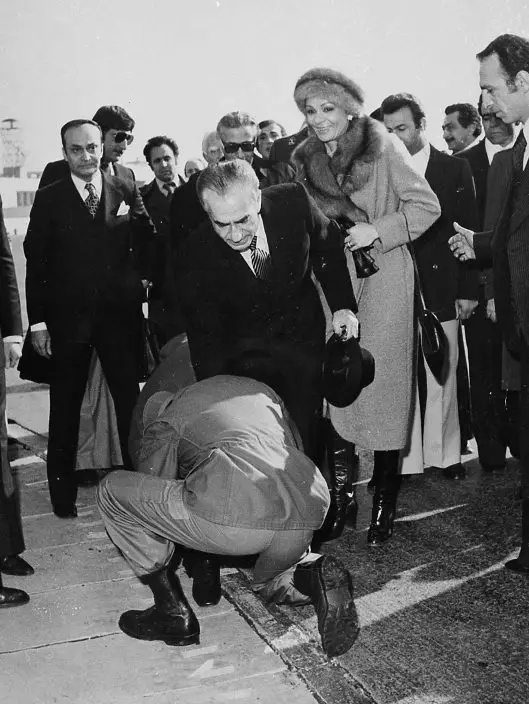
FILE - In this Jan. 16, 1979 file photo, a soldier bends to kiss the feet of Iran's Shah Mohammad Reza Pahlavi on the tarmac of Mehrabad Airport in Tehran, Iran. Behind the shah is his wife, Empress Farah. Wednesday, Jan. 16, 2019 marks the 40th anniversary of the shah abandoning his Peacock Throne and leaving his nation for the last time in his life, setting the stage for the country's 1979 Islamic Revolution only a month later. (AP Photo, File)
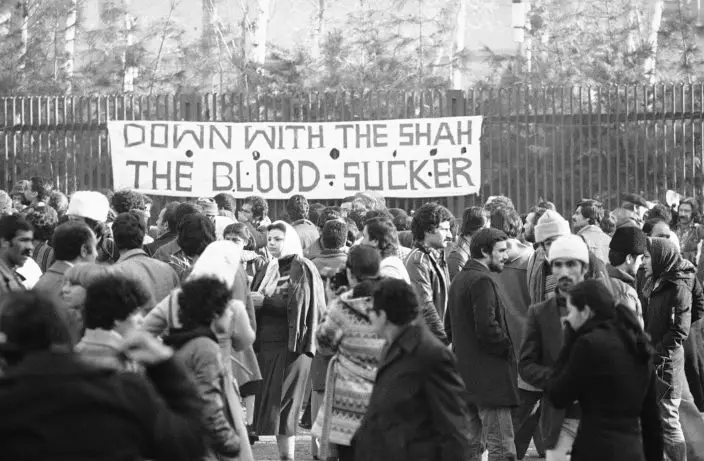
FILE - In this Jan. 13, 1979 file photo, a banner denouncing Shah Mohammad Reza Pahlavi is put up at the entrance of Tehran University in Tehran, Iran. Wednesday, Jan. 16, 2019 marks the 40th anniversary of the shah abandoning his Peacock Throne and leaving his nation for the last time in his life, setting the stage for the country's 1979 Islamic Revolution only a month later. (AP PhotoBernhard Frye, File)
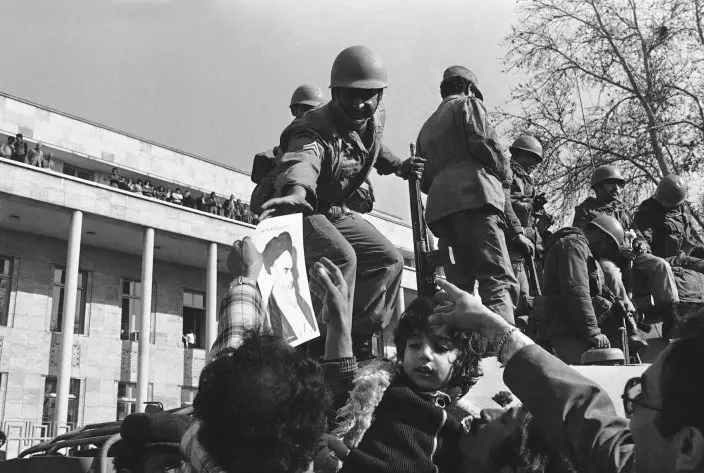
FILE - In this Jan. 15, 1979 file photo, a smiling Iranian soldier is hailed by demonstrators who decorated them with flowers and pictures of Ayatollah Ruhollah Khomeini, in Tehran, Iran. Wednesday, Jan. 16, 2019 marks the 40th anniversary of the shah abandoning his Peacock Throne and leaving his nation for the last time in his life, setting the stage for the country's 1979 Islamic Revolution only a month later. (AP Photo, File)
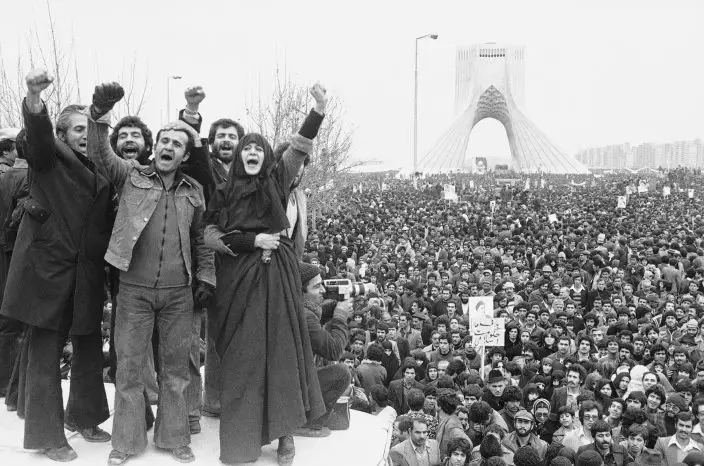
FILE - In this Jan. 19, 1979 file photo, more than a million supporters of an Islamic Republic assembled around the Shayad monument, in Tehran, Iran. Wednesday, Jan. 16, 2019 marks the 40th anniversary of the shah abandoning his Peacock Throne and leaving his nation for the last time in his life, setting the stage for the country's 1979 Islamic Revolution only a month later. (AP PhotoAristotle Saris, File)
The shah's departure, initially described as a "vacation," came as he was fatally stricken with cancer. His arrival in America after months abroad would spark the U.S. Embassy takeover and hostage crisis, stoking the animosity that persists between Tehran and Washington to this day.
FILE - In this Jan. 16, 1979 file photo, a soldier bends to kiss the feet of Iran's Shah Mohammad Reza Pahlavi on the tarmac of Mehrabad Airport in Tehran, Iran. Behind the shah is his wife, Empress Farah. Wednesday, Jan. 16, 2019 marks the 40th anniversary of the shah abandoning his Peacock Throne and leaving his nation for the last time in his life, setting the stage for the country's 1979 Islamic Revolution only a month later. (AP Photo, File)
Now, 40 years later, The Associated Press is making its stories about the shah's departure from Iran available, along with historic photos from that climactic day. The stories have been edited for typographical errors, but maintain the AP style of the day, such as using "Moslem" as opposed to Muslim.
IRAN CHEERS DEPARTURE
By ROBERT H. REID
FILE - In this Jan. 13, 1979 file photo, a banner denouncing Shah Mohammad Reza Pahlavi is put up at the entrance of Tehran University in Tehran, Iran. Wednesday, Jan. 16, 2019 marks the 40th anniversary of the shah abandoning his Peacock Throne and leaving his nation for the last time in his life, setting the stage for the country's 1979 Islamic Revolution only a month later. (AP PhotoBernhard Frye, File)
Associated Press Writer
TEHRAN, Iran — Shah Mohammad Reza Pahlavi, a weeping king driven from his kingdom, flew his royal jet out of Iran Tuesday on a journey from which he may never return.
His departure set off an explosion of joy by millions of his people. If his triumphant foes have their way, the shah's flight means the end of monarchy in a land ruled by kings for 2,500 years.
FILE - In this Jan. 15, 1979 file photo, a smiling Iranian soldier is hailed by demonstrators who decorated them with flowers and pictures of Ayatollah Ruhollah Khomeini, in Tehran, Iran. Wednesday, Jan. 16, 2019 marks the 40th anniversary of the shah abandoning his Peacock Throne and leaving his nation for the last time in his life, setting the stage for the country's 1979 Islamic Revolution only a month later. (AP Photo, File)
Jubilant Iranians poured into Tehran's streets, singing and dancing, cheering each other in celebration of victory in the bloody year-long popular struggle against the man who has ruled their nation since 1941.
"The shah is gone forever!" they chanted.
Motorists honked horns and flashed headlights. People waved portraits of Ayatollah Khomeini, the bearded Moslem leader who marshaled a broad political and religious movement that forced the shah from the country.
FILE - In this Jan. 19, 1979 file photo, more than a million supporters of an Islamic Republic assembled around the Shayad monument, in Tehran, Iran. Wednesday, Jan. 16, 2019 marks the 40th anniversary of the shah abandoning his Peacock Throne and leaving his nation for the last time in his life, setting the stage for the country's 1979 Islamic Revolution only a month later. (AP PhotoAristotle Saris, File)
But not all Iranians rejoiced. Diplomatic sources said pro-shah soldiers fired at demonstrators in northern Tehran and there had been some injuries. The reported violence pointed up the divisiveness that remains in Iran and may foreshadow continued bloodshed.
The 59-year-old monarch took the controls himself and piloted his "Shah's Falcon" Boeing 727 jetliner into the bright skies over Tehran and on to Aswan, Egypt, where he was welcomed by President Anwar Sadat.
He is expected to stay there for a few days before flying on to the United States for what is officially described as an "extended vacation." Reportedly he will meet in Aswan with former President Gerald R. Ford, who had long been scheduled to meet with Sadat there.
President Carter said in an interview aired Tuesday night by NBC News that he thinks the Soviet Union, Iran's neighbor to the north, wants stability in Iran.
The broadcast was taped Saturday, before the shah's departure. Carter said a change in government in Iran "doesn't mean Iran will no longer exist."
There was no official Soviet comment from Moscow. A dispatch filed from New York by Tass, the Soviet news agency, mostly quoted Western press reports, but also said the monarch left "like a fugitive, without a pompous sendoff and without an honorary escort."
At Tehran's airport, two royal guard officers fell tearfully to their knees to try and kiss the shah's feet as he neared the plane ramp, an eyewitness reported. He told them to stand, and the officers then lifted a copy of the Koran, the Moslem holy book, over their heads as a canopy under which the royal couple mounted the ramp, the shah in a dark suit and winter coat, the Empress Farah in fur hat and collar.
The monarch - "Shah of Shahs," ''Center of the Universe, Shadow of the Almighty" - left behind shattered dreams of glory for his Pahlavi dynasty and a volatile political situation.
THE SHAH IS GONE
By The Associated Press
Jubilant Iranians danced in the streets of Tehran Tuesday, chanting "The shah is gone" as word spread swiftly through the capital that the monarch had left the country.
Their joy spread to other parts of the Arab world and to Paris, where the shah's arch foe, Ayatollah Khomeini, greeted the news with the Moslem expression, "God is great."
Statues of Shah Mohammad Reza Pahlavi were pulled to the ground in Tehran, and some Iranians cut his portrait out of banknotes.
Horns honked, bakers gave away free cakes and cookies, and Iranians dumped candy into passing cars. They sprinkled each other with rosewater as they heard that the shah had slipped out of the country and flown to Egypt.
Throughout Iran, cheering demonstrators held aloft portraits of Khomeini, the self-exiled Shiite Moslem leader who directed the religious opposition to the shah. He has vowed to establish an Islamic republic in Iran, where more than 90 percent of the population is Moslem, as is the shah.
The shah, under withering religious and political pressure, left unannounced early Tuesday for Egypt and is expected to go to the United States. He said his departure was for medical treatment, but there is wide speculation he will not return.
When the shah arrived in Aswan in southern Egypt he was greeted by small crowds along the route he traveled with President Anwar Sadat.
In Tehran, the joy was mixed with bitterness toward the man who had held virtually absolute rule.
"We hope the next national government will be able to bring the shah back and put him on trial," said Hamid Shahbazi, a student.
"We'll be happy when the shah is dead," said a girl who gave her name as Nistanish.
Other Iranians expressed hope their country could return to normalcy after a year of anti-shah strikes and rioting that took at least 1,500 lives.
"First of all I hope the oil workers go back to so I will be able to buy some fuel oil for my central heating," said Alsofah Niasi, a housewife.
In Damascus, Syria, where 270 members of the Palestinian National Council were meeting to discuss their goal of an independent Palestinian state, the news of the shah's departure provided a distraction.
"Everyone is happy," said Mahmoud Labady, a spokesman for the Palestinian Liberation Organization. "We see the victory in Iran as a victory for the PLO too. It shows a trend in the Middle East against American interests and influence."
There was no official comment from Moscow, but the Soviet news agency Tass, quoting "eyewitnesses," said the monarch left "like a fugitive without a pompous send off and without an honorary escort."
In Paris, scores of Iranian exiles turn the knobs on shortwave radios, looking for Iranian broadcasts. They had heard the news on French radio, but many said they wouldn't believe it until they heard it from home.
The 78-year-old Khomeini, who has lived in a modest villa in a Paris suburb since Oct. 6, made an appearance Tuesday afternoon and was swallowed up in a swirl of admirers as he crossed the street to the operations house where he prepared messages to be beamed at Iran.