

The 1969 mission to the moon has been seen in many phases before but never with the shining, crystal-clear fullness of Todd Douglas Miller's extraordinary "Apollo 11," a documentary culled from archival footage and audio recordings that in heart-stopping, minute-by-minute detail, recaptures the propulsive force of man's most glorious feat, giving new resonance to those beautiful, headlong Mission Control words: "We Are Go."
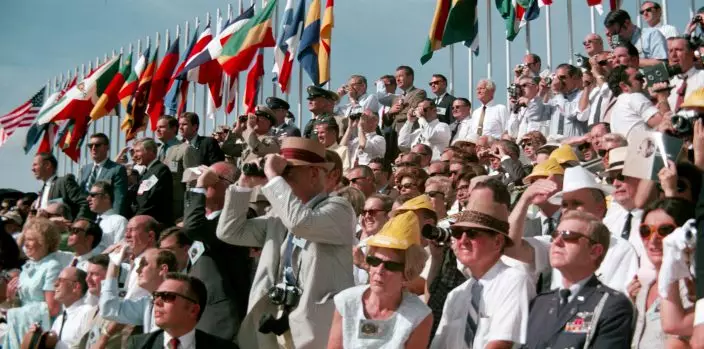
Timed to the upcoming 50th anniversary of the lunar landing, "Apollo 11" was compiled partly from a previously forgotten trove of 70mm film that includes footage from the launch, the Cape Canaveral crowds watching outside J.C. Penny's and along motel balconies, and the astronauts' recovery. It features no talking heads or narration, just audio from some 11,000 hours of NASA audio recordings and, occasionally, the sonorous gravity of Walter Cronkite's broadcasts.
The clarity of the large-format and restored images is startling. So much of the imagery from the moon landing has by now flattened into iconography, but, here, the event is brought back to life. Miller starts on the cusp of launch as the enormous platform is moved by giant tracks toward the launch site. It could be a shot from "Star Wars" or any number of science fictions the moon mission birthed. Later we see Neil Armstrong, Buzz Aldrin and Michael Collins in their suits before putting on their helmets, and it's like we've never seen their faces — confident, with an almost mischievous glint — so well.
This image released by NeonCNN Films shows a scene from the film "Apollo 11." (NeonCNN Films via AP)
"Apollo 11" might not tell you anything you don't already know about the moon landing. But it will make you feel it, and see it, anew. Miller has condensed the eight-day expedition into an immersive thrill ride, from launch to return, that puts you in in the shuttle with the astronauts and in Mission Control's ear. It's the grandeur of Apollo 11 distilled down to its still jaw-dropping essence.
Much of the emphasis is on how the drive to the moon was so much broader than the two astronauts who carried out John F. Kennedy's 1962 pledge. Kennedy's words ("We choose to go the moon in this decade and do the other things not because they are easy, but because they are hard") hang over the movie with a kind of fervor and ambition that today sounds downright alien. Later, while the spacecraft is in mid-flight to the moon, news of Chappaquiddick and Ted Kennedy will play on NASA television sets while onlookers, drawn back to earth, momentarily gawk.
But it's in the thousands who contributed to the mission that the magnitude of the effort comes through. Their faces are seen in montages and their voices are heard, again and again, on NASA radio: a multitude who at every significant turn confirms that their department is, indeed, "a go."
This image released by NeonCNN Films shows a scene from the film "Apollo 11." (NeonCNN Films via AP)
We have, of course, been to the moon before at the movies. Most recently, there was Damien Chazelle's rigorous if overly brooding "First Man," which — despite its many fine attributes — looks all the more muted in comparison to "Apollo 11." More notable was Al Reinert's brilliant and similarly verite-styled 1989 documentary "For All Mankind," which also used NASA archival footage and a good score (from Brian Eno) to recreate Apollo moon missions.
But in 2019, as we are writing obituaries for the deceased Mars Rover ("He was 15"), "Apollo 11" feels even more like another time and another world. What was this splendid, sunny American dream and where did it go?
"Apollo 11," a Neon and CNN Films release, is rated G by the Motion Picture Association of America. Running time: 93 minutes. Three and a half stars out of four.
This image released by NeonCNN Films shows a scene from the film "Apollo 11." (NeonCNN Films via AP)
Follow AP Film Writer Jake Coyle on Twitter at: http://twitter.com/jakecoyleAP
LONDON (AP) — The Eurovision Song Contest, which aims to be an upbeat celebration of music and unity, is facing the biggest crisis in its seven-decade history after four countries walked out of the competition over Israel’s participation, and others indicated they could join the boycott.
Spain, the Netherlands, Ireland and Slovenia announced they will not take part in the 2026 contest in Vienna in May after organizers declined to expel Israel over its conduct of the war against Hamas in Gaza. Iceland is considering whether to follow suit.
The walkouts cast a cloud over the future of what's meant to be a feel-good cultural party, dealing a blow to fans, broadcasters and the contest's finances.
Eurovision expert Paul Jordan said Friday “it’s unlikely we’ll see a mass exodus” but that 2026 will be a "tense year.”
Founded in 1956, in part to help unite a shattered continent after World War II, Eurovision pits acts from dozens of countries against one another for the continent’s musical crown.
Overtly political symbols and lyrics are prohibited, but global tensions have often imposed themselves. Russia, for example, was expelled in 2022 after its full-scale invasion of Ukraine.
Tensions rose again after Hamas’ Oct. 7, 2023, attack on Israel, which killed some 1,200 people, and Israel’s subsequent campaign in Gaza that has left more than 70,000 people dead. The last two Eurovision contests have seen pro-Palestinian protests both outside the venues and inside, forcing organizers to clamp down on political flag-waving.
A number of performers and countries have called for the exclusion of Israel, which has taken part in Eurovision since 1973, one of a few non-European countries to compete.
The Geneva-based European Broadcasting Union — a group of public broadcasters from 56 countries that runs Eurovision — tried to assuage concerns by adopting tougher contest voting rules in response to allegations that Israel manipulated the public vote in favor of its competitor Yuval Raphael. She came second in this year’s contest behind Austrian singer JJ.
The EBU’s general assembly approved the new rules Thursday, but did not hold a vote on Israel’s participation. It said “a large majority of members” felt “the Eurovision Song Contest 2026 should proceed as planned, with the additional safeguards in place.”
Israeli President Isaac Herzog said on social platform X that he was “pleased” Israel will again take part, and hoped “the competition will remain one that champions culture, music, friendship between nations and cross-border cultural understanding.”
Immediately after the EBU decision, broadcasters RTVE in Spain, AVROTROS in the Netherlands, RTÉ in Ireland and Slovenia’s RTVSLO announced they were pulling out of the 2026 contest.
RTVE said the situation in Gaza — despite the recent ceasefire — and “Israel’s use of the contest for political purposes, make it increasingly difficult to maintain Eurovision as a neutral cultural event.”
Icelandic broadcaster RUV, which had recommended Israel be barred, said its chiefs will meet Wednesday to discuss whether Iceland will also walk away.
Other countries’ broadcasters, including Norway’s NRK and Britain’s BBC, welcomed the decision to keep Israel in the competition.
“We support the collective decision made by members of the EBU,” the BBC said in a statement. “This is about enforcing the rules of the EBU and being inclusive.”
French Foreign Affairs Minister Jean-Noël Barrot said his country opposes a cultural boycott of Israel.
“I am pleased that Eurovision did not give in to pressure, and that France helped prevent a boycott of Israel in this forum,” he wrote on X. “I deeply regret that several European television channels made a different choice.”
The boycotting countries will not send a musical act to the 2026 contest and will not broadcast it. That will likely cut into viewership of a contest that typically draws more than 150 million viewers, though another Dutch broadcaster, NPO, said it will air it in the Netherlands. Fans in the boycotting countries also should be able to watch on digital platforms including YouTube.
The boycotts are a financial blow to Eurovision, which is funded largely by participating broadcasters — and to the boycotting broadcasters themselves at a time when many are under financial pressure from government funding cuts and competition for viewers from social media.
The EBU does not disclose how much each country pays, but the pullouts include Spain, one of the “Big Five” large-market countries that contribute the most to the contest. The others are France, Germany, Italy and the U.K.
So far, more than two dozen countries have confirmed they will compete in Vienna. The EBU says a final list of participants will be released before Christmas.
The boycott is offset to an extent by the return of three countries — Bulgaria, Moldova and Romania — after periods of absence because of financial and artistic reasons.
Jordan said viewing figures would be closely watched, “and if they are significantly down, then that’ll probably raise alarm bells.
“But I think overall the contest is a sturdy thing,” he said.
Keaten reported from Geneva. Associated Press writer Samuel Petrequin in Paris contributed to this story.
FILE - Singer Yuval Raphael, from Israel, holds the national flag during a dress rehearsal for the Grand Final of the 69th Eurovision Song Contest, May 16, 2025, in Basel, Switzerland. (AP Photo/Martin Meissner, File)
FILE - Israeli fans cheer for Yuval Raphael, from Israel, after she performed during the semi-final of the 69th Eurovision Song Contest in Basel, Switzerland, May 15, 2025. (AP Photo/Martin Meissner, File)
FILE - JJ, from Austria, stands on the stage with his trophy after winning the Grand Final of the 69th Eurovision Song Contest in Basel, Switzerland, May 18, 2025. (AP Photo/Martin Meissner, File)