Algeria's longtime leader Abdelaziz Bouteflika has been known as a wily political survivor ever since he fought for independence from France in the 1950s and 1960s. And his crafty concessions Monday aimed at quelling mass protests show he's not ready to give up yet.
While he abandoned his bid for a fifth term in office , his simultaneous postponement of an election set for next month has critics worried he intends to hold on to power indefinitely.
Click to Gallery
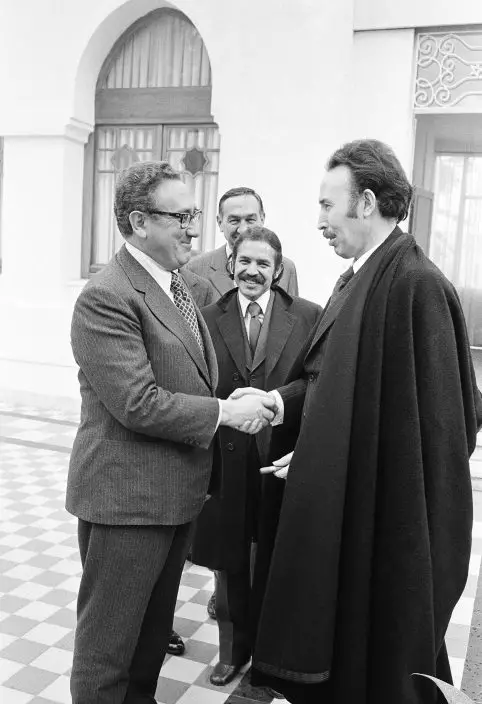
FILE - In this Dec. 14, 1973 file photo, the then Algerian Foreign Minister Abdelaziz Bouteflika, centre, looks on as U.S. Secretary of State Henry Kissinger, left, takes leave of President Houari Boumedienne of Algeria after talks in Algiers. Bouteflika became foreign minister at the young age of 25, and stood up to the likes of Henry Kissinger at the height of the Cold War, with the Algerian capital Algiers nicknamed "Moscow on the Med." (AP PhotoMichel Lipchitz, File)
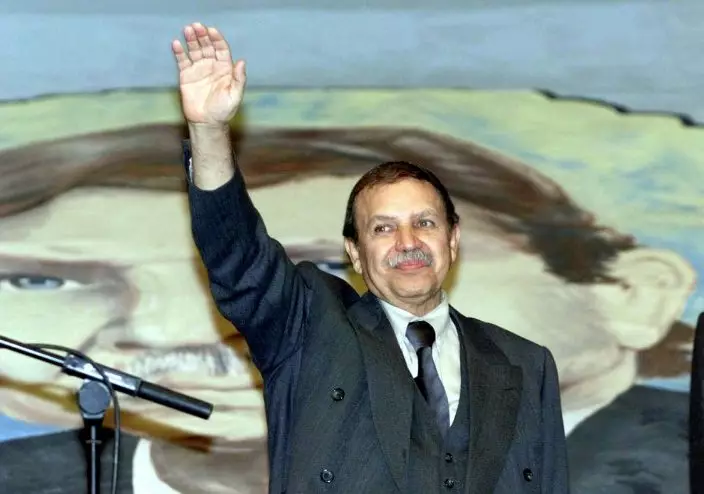
FILE - In this April 11, 1999 file photo, Algerian presidential candidate and former Foreign Minister Abdelaziz Bouteflika waves to supporters as he campaigns in Algiers, Sunday, April 11, 1999. Algeria's longtime leader Abdelaziz Bouteflika has abandoned his bid for election to a fifth term in office, but has simultaneously postponed the election set for next month. (AP PhotoLaurent Rebours, File)
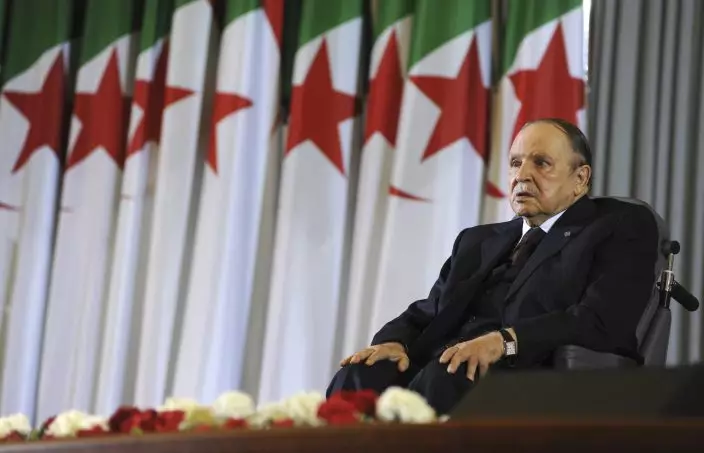
FILE - In this April 28, 2014 file photo, Algerian President Abdelaziz Bouteflika sits on a wheelchair after taking the oath as President, in Algiers. Algeria's longtime leader Bouteflika has abandoned his bid for election to a fifth term in office, but has simultaneously postponed the election set for next month.(AP PhotoSidali Djarboub, File)
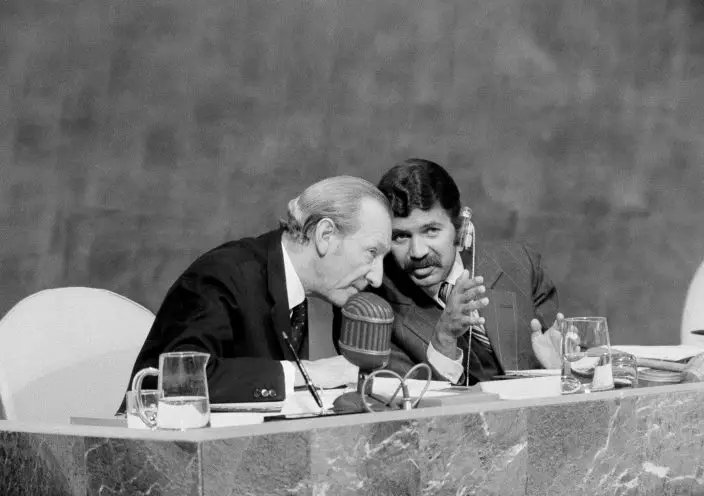
FILE - In this Sept. 18, 1974, President Abdelaziz Bouteflika of Algeria, right, and UN Secretary-General Kurt Waldheim confer during the opening of the General Assembly in New York. Algeria's longtime leader Abdelaziz Bouteflika has been known as a wily political survivor ever since he fought for independence from France in the 1960s, and now in 2019, he needs to overcome mass protests against his rule. (AP PhotoMarty Lederhandler, File)
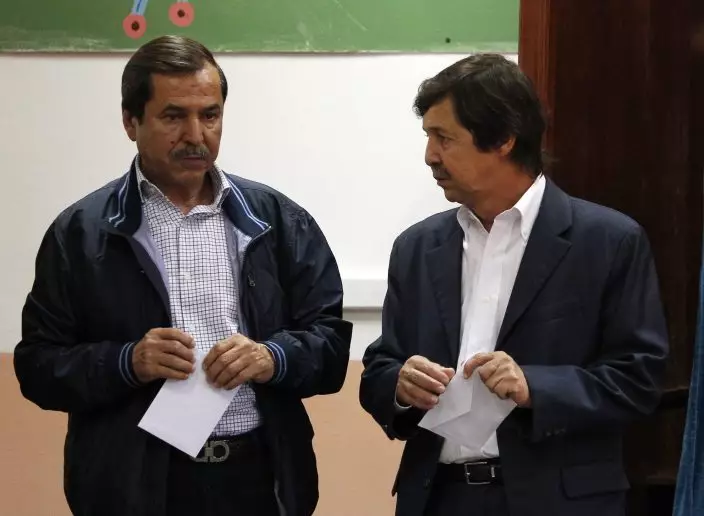
FILE - In this May 4, 2017 file photo, Algerian President Abdelaziz Bouteflika's brothers Said Bouteflika, right, and Nacer Bouteflika talk before voting in Algiers. Said Bouteflika, 61, is a top aide to his brother Abdelaziz Bouteflika, and is said to hold enormous influence in the presidential apparatus, with critics claiming he has grown rich during Bouteflika’s presidency. (AP PhotoSidali Djarboub, File)
So much about the 82-year-old Bouteflika, badly weakened by a 2013 stroke, has remained an enigma. The president returned Sunday from two weeks in a Geneva hospital, but the exact state of his health is unclear.
FILE - In this Dec. 14, 1973 file photo, the then Algerian Foreign Minister Abdelaziz Bouteflika, centre, looks on as U.S. Secretary of State Henry Kissinger, left, takes leave of President Houari Boumedienne of Algeria after talks in Algiers. Bouteflika became foreign minister at the young age of 25, and stood up to the likes of Henry Kissinger at the height of the Cold War, with the Algerian capital Algiers nicknamed "Moscow on the Med." (AP PhotoMichel Lipchitz, File)
A slow, frail Bouteflika shown in rare televised images released on Monday night gave little hint of his firebrand past.
Bouteflika famously negotiated with the terrorist known as Carlos the Jackal to free oil ministers who had been taken hostage in a 1975 attack on OPEC headquarters in Vienna and flown to Algiers.
He became foreign minister at the young age of 25, and stood up to the likes of Henry Kissinger at the height of the Cold War. At the time, Algeria was a model of doctrinaire socialism tethered to the former Soviet Union and the country's capital, Algiers, was nicknamed "Moscow on the Med."
FILE - In this April 11, 1999 file photo, Algerian presidential candidate and former Foreign Minister Abdelaziz Bouteflika waves to supporters as he campaigns in Algiers, Sunday, April 11, 1999. Algeria's longtime leader Abdelaziz Bouteflika has abandoned his bid for election to a fifth term in office, but has simultaneously postponed the election set for next month. (AP PhotoLaurent Rebours, File)
More recently, Bouteflika helped reconcile his own citizens after a decade of civil war between radical Muslim militants and Algeria's security forces.
In 20 years as president, however, age and illness took its toll on the once-charismatic figure. Corruption scandals over infrastructure and hydrocarbon projects have also dogged him for years and tarnished many of his closest associates.
Secrecy surrounds Algeria's leadership and Bouteflika himself — it has never been clear whether full power lay in his hands, or whether army generals who molded the North African nation called the shots from offstage.
FILE - In this April 28, 2014 file photo, Algerian President Abdelaziz Bouteflika sits on a wheelchair after taking the oath as President, in Algiers. Algeria's longtime leader Bouteflika has abandoned his bid for election to a fifth term in office, but has simultaneously postponed the election set for next month.(AP PhotoSidali Djarboub, File)
All this has driven unprecedented protests that have shaken Algeria since last month, demanding Bouteflika abandon plans for a fifth term in the April 18 elections.
In a letter to the nation released by state news agency APS on Monday, Bouteflika stressed the importance of including Algeria's disillusioned youth in the reform process and putting the country "in the hands of new generations."
But for many of the protesters, the most important sentence said: "There will be no fifth term."
FILE - In this Sept. 18, 1974, President Abdelaziz Bouteflika of Algeria, right, and UN Secretary-General Kurt Waldheim confer during the opening of the General Assembly in New York. Algeria's longtime leader Abdelaziz Bouteflika has been known as a wily political survivor ever since he fought for independence from France in the 1960s, and now in 2019, he needs to overcome mass protests against his rule. (AP PhotoMarty Lederhandler, File)
Others were more cautious, as Bouteflika gave no date or timeline for the delayed election. Critics said they fear the moves could pave the way for the president to install a hand-picked successor. Others saw his decision to postpone the election indefinitely as a threat to democracy in Algeria.
Born in the border town of Oujda, Morocco, Bouteflika became one of his country's most enduring politicians. In Algeria's bloody independence war, he commanded the southern Mali front and slipped into France clandestinely in 1961 to contact jailed liberation leaders.
He later embodied the Third World revolutionary who defied the West, acting as a prominent voice for the developing nation's movement. He was active in the United Nations, and presided over the U.N. General Assembly in 1974.
FILE - In this May 4, 2017 file photo, Algerian President Abdelaziz Bouteflika's brothers Said Bouteflika, right, and Nacer Bouteflika talk before voting in Algiers. Said Bouteflika, 61, is a top aide to his brother Abdelaziz Bouteflika, and is said to hold enormous influence in the presidential apparatus, with critics claiming he has grown rich during Bouteflika’s presidency. (AP PhotoSidali Djarboub, File)
Yet Bouteflika stood firmly with the United States in the fight against terrorism after the Sept. 11, 2001 attacks, particularly on intelligence-sharing and military cooperation.
After becoming president in 1999, Bouteflika managed to bring stability to a country nearly brought to its knees in the 1990s as an Islamic insurgency left an estimated 200,000 people dead. He unveiled a bold program in 2005 to reconcile a nation fractured by a civil war by persuading Muslim radicals to lay down their arms. Many victims' families still oppose it.
Bouteflika and the country's armed forces neutralized Algeria's Islamic insurgency, but then watched it metastasize into a Sahara-wide movement linked to smuggling and kidnapping — and to al-Qaida.
He also failed to create an economy that could offer enough jobs for Algeria's growing youth population despite the nation's vast oil and gas wealth.
When Arab Spring uprisings in 2011 overthrew dictators to the east, Bouteflika balked at the region-wide calls for change. He then kept his job through a combination of swift salary and subsidy increases, a vigilant security force and taking advantage of the lack of unity among the country's opposition.
Concerns over Bouteflika's health began during his second term in 2005, when he secretly entered the Val de Grace military hospital in Paris for a bleeding ulcer. Numerous hospitalizations and medical visits followed, few publicly reported. In April 2013, he had a stroke.
Whole sections of Bouteflika's life have been kept secret, including his marital status — or how he was allowed to assume the presidency when the constitution demands that any head of state be wedded to an Algerian. There have been reports of a secret 1990 marriage to the daughter of a diplomat.
Said Bouteflika, 61, a brother of the president and top aide, is said to hold enormous influence in the presidential apparatus. Critics claim he is at the center of the circle of businessman, pejoratively called "oligarchs," who grew rich during Bouteflika's presidency.
After years in office, Bouteflika's powerful political machine had the constitution changed to cancel the presidency's two-term limit. He was then re-elected in 2009 and 2013, amid charges of fraud and a lack of powerful challengers.
The recent protests surprised Algeria's opaque leadership and freed the country's people, long fearful of a watchful security apparatus, to openly criticize the president. The citizens' revolt drew millions into the streets across the country to demand Bouteflika abandon his candidacy.
Associated Press writer Aomar Ouali in Algiers, Algeria, contributed to this report.