From his eyes to his immune system, astronaut Scott Kelly's body sometimes reacted strangely to nearly a year in orbit, at least compared to his Earth-bound identical twin — but newly published research shows nothing that would cancel even longer space treks, like to Mars.
The good news: Kelly largely bounced back after returning home, say scientists who released final results from NASA's "twins study," a never-before opportunity to track the biological consequences of spaceflight in genetic doubles.
It marks "the dawn of human genomics in space," said Dr. Andrew Feinberg of Johns Hopkins University. He led one of 10 teams of researchers that scrutinized the twins' health down to the molecular level before, during and after Kelly's 340-day stay at the International Space Station.
More importantly, the study "represents more than one small step for mankind" by pointing out potential risks of longer-duration spaceflight that need study in more astronauts, said Markus Lobrich of Germany's Darmstadt University and Penny Jeggo of the University of Sussex, who weren't involved in the work.
The findings were published in Friday's edition of the journal Science, on some notable space anniversaries — when Soviet cosmonaut Yuri Gagarin became the first person in space in 1961, and the first launch of the space shuttle in 1981.
KEY FINDINGS
NASA already knew some of the toll of space travel, such as bone loss that requires exercise to counter. This time, NASA-funded scientists looked for a gamut of physiologic and genomic changes that Scott Kelly experienced in space, comparing them to his DNA double on the ground, former astronaut Mark Kelly. Some results had been reported in February.
Possibly the weirdest finding had to do with something called telomeres, the protective ends of chromosomes. Those tips gradually shorten as we get older, and are thought to be linked to age-related diseases including some cancers.
But in space, Scott Kelly's telomeres got longer. "We were surprised," said Colorado State University telomere expert Susan Bailey. She can't explain it although it doesn't mean Kelly got younger. Back on Earth, his telomeres mostly returned to preflight average although he did have more short telomeres than before.
Next, Kelly's DNA wasn't mutated in space but the activity of many of his genes — how they switch on and off — did change, especially in the last half of the voyage, which ended in March 2016.
Immune system genes especially were affected, putting it "almost on high alert as a way to try and understand this new environment," said study co-author Christopher Mason, a Weill Cornell Medicine geneticist in New York.
Again, most gene expression returned to normal back home, but some of the immune-related genes were hyperactive six months later.
Other findings:
—Some changes in the structure of Kelly's eye and thickening of his retina suggested that, like about 40% of astronauts, he experienced symptoms of "spaceflight-associated neuro-ocular syndrome." It may be caused by fluids shifting in the absence of gravity.
—He experienced some chromosomal instability that might reflect radiation exposure in space.
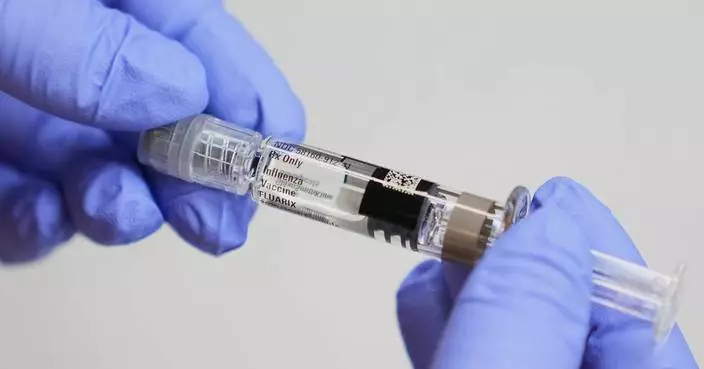
—A flu shot given in space worked as well as one on Earth.
—Kelly aced cognitive tests in space but slowed down after his return, maybe as more things competed for his attention.
ULTRA LONG-DISTANCE TESTING
Researchers needed months' worth of blood, urine and fecal samples, along with cognitive and physical tests and ultrasound scans. That meant getting creative: Some blood samples required analysis so rapidly that Kelly would time collection so the blood could travel on Russian Soyuz capsules carrying other astronauts back to Earth.
That wouldn't be an option on a three-year trip to Mars. One of the study's technological advances: Portable DNA-sequencing equipment that will let astronauts run some of their own genomic analyses on future missions, said Weill Cornell's Mason.
WHAT'S NEXT?
Studying one pair of twins can't prove risks of spaceflight, researchers cautioned. And longer missions, to the moon or Mars, will mean greater stress and radiation exposure.
Colorado State's Bailey plans to study 10 additional astronauts on year-long missions, using the twin findings as a road map.
"We need to get outside of low-Earth orbit and we need for the astronauts to spend longer periods of time to really evaluate some of these health effects," she said.
The Associated Press Health and Science Department receives support from the Howard Hughes Medical Institute's Department of Science Education. The AP is solely responsible for all content.
The Kennedy Center is ending the year with a new round of artists saying they are canceling scheduled performances after President Donald Trump's name was added to the facility, prompting the institution's president to accuse the performers of making their decisions because of politics.
The Cookers, a jazz supergroup that has performed together for nearly two decades, announced their withdrawal from “A Jazz New Year’s Eve” on their website, saying the “decision has come together very quickly” and acknowledging frustration from those who may have planned to attend.
Doug Varone and Dancers, a dance group based in New York, said in an Instagram post late Monday they would pull out of a performance slated for April, saying they “can no longer permit ourselves nor ask our audiences to step inside this once great institution.”
Those moves come after musician Chuck Redd canceled a Christmas Eve performance last week. They also come amid declining sales for tickets to the venue, as well as news that viewership for the Dec. 23 broadcast of the Kennedy Center Honors — which Trump had predicted would soar — was down by about 35% compared to the 2024 show.
The announcements amount to a volatile calendar for one of the most prominent performing arts venues in the U.S. and cap a year of tension in which Trump ousted the Kennedy Center board and named himself the institution's chairman. That led to an earlier round of artist pushback, with performer Issa Rae and the producers of “Hamilton” canceling scheduled engagements while musicians Ben Folds and Renee Fleming stepped down from advisory roles.
The Cookers didn't mention the building's renaming or the Trump administration but did say that, when they return to performing, they wanted to ensure that “the room is able to celebrate the full presence of the music and everyone in it,” reiterating a commitment “to playing music that reaches across divisions rather than deepening them.”
The group may not have addressed the Kennedy Center situation directly, but one of its members has. On Saturday, saxophone player Billy Harper said in comments posted on the Jazz Stage Facebook page that he “would never even consider performing in a venue bearing a name (and being controlled by the kind of board) that represents overt racism and deliberate destruction of African American music and culture. The same music I devoted my life to creating and advancing.”
According to the White House, Trump’s handpicked board approved the renaming. Harper said both the board "as well as the name displayed on the building itself represents a mentality and practices I always stood against. And still do, today more than ever.”
Richard Grenell, a Trump ally whom the president chose to head the Kennedy Center after he forced out the previous leadership, posted Monday night on X, “The artists who are now canceling shows were booked by the previous far left leadership,” intimating the bookings were made under the Biden administration.
In a statement Tuesday to The Associated Press, Grenell said the ”last minute cancellations prove that they were always unwilling to perform for everyone — even those they disagree with politically," adding that the Kennedy Center had been “flooded with inquiries from real artists willing to perform for everyone and who reject political statements in their artistry.”
There was no immediate word from Kennedy Center officials about whether the entity would pursue legal action against the latest round of artists to cancel performances. Following Redd's cancellation last week, Grenell said he would seek $1 million in damages for what he called a “political stunt.”
Not all artists are calling off their shows. Bluegrass banjoist Randy Barrett, scheduled to perform at the Kennedy Center next month, told the AP he was “deeply troubled by the politicization” of the venue and respected those who had canceled but feels that “our tribalized country needs more music and art, not less. It’s one of the few things that can bring us together.”
President John F. Kennedy was assassinated in 1963, and Congress passed a law the following year naming the center as a living memorial to him. Scholars have said any changes to the building's name would need congressional approval; the law explicitly prohibits the board of trustees from making the center into a memorial to anyone else, and from putting another person’s name on the building’s exterior.
Associated Press writers Steven Sloan and Hillel Italie contributed to this report.
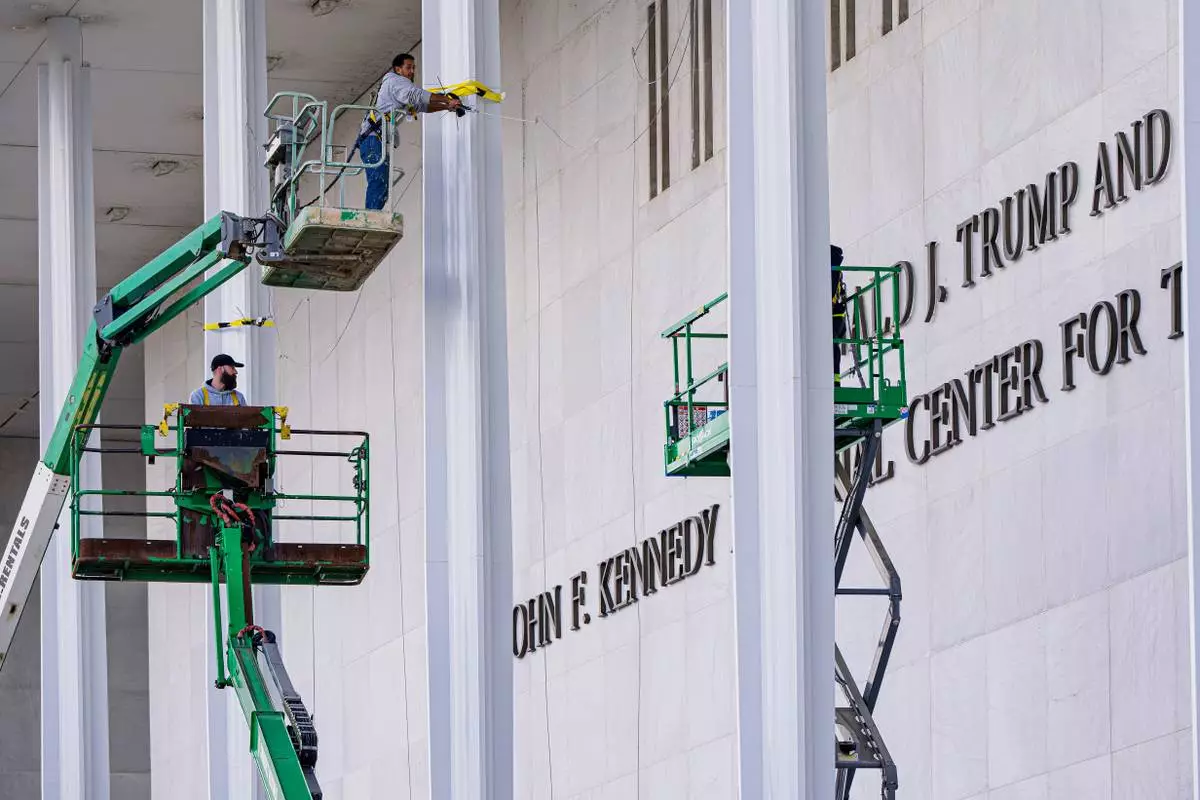
Workers add President Donald Trump's name to the John F. Kennedy Memorial Center for the Performing Arts, after a Trump-appointed board voted to rename the institution, in Washington, Friday, Dec. 19, 2025. (AP Photo/J. Scott Applewhite)
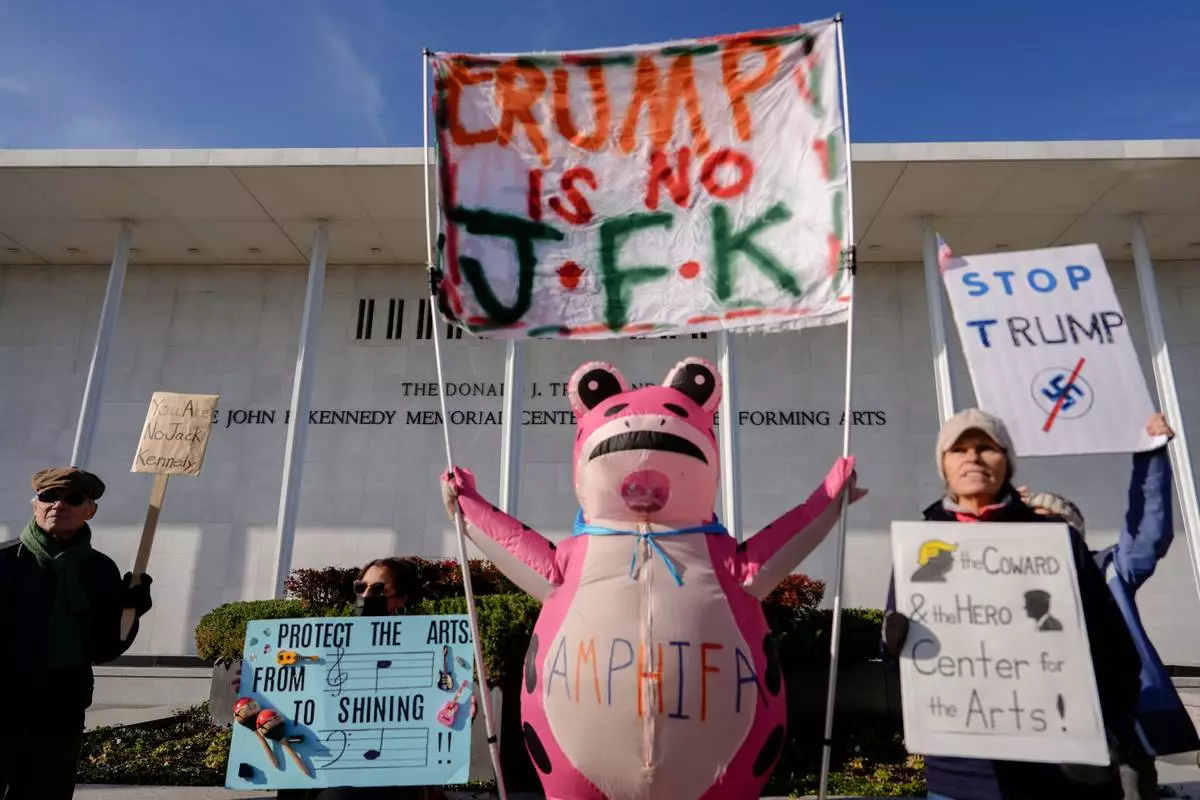
Demonstrators, including Nadine Siler, of Waldorf, Md., dressed in a pink frog costume, hold up signs at a designated protest point in front of the John F. Kennedy Memorial Center for the Performing Arts, a day after a Trump-appointed board voted to add President Donald Trump's name to the Kennedy Center, Saturday, Dec. 20, 2025, in Washington. (AP Photo/Julia Demaree Nikhinson)
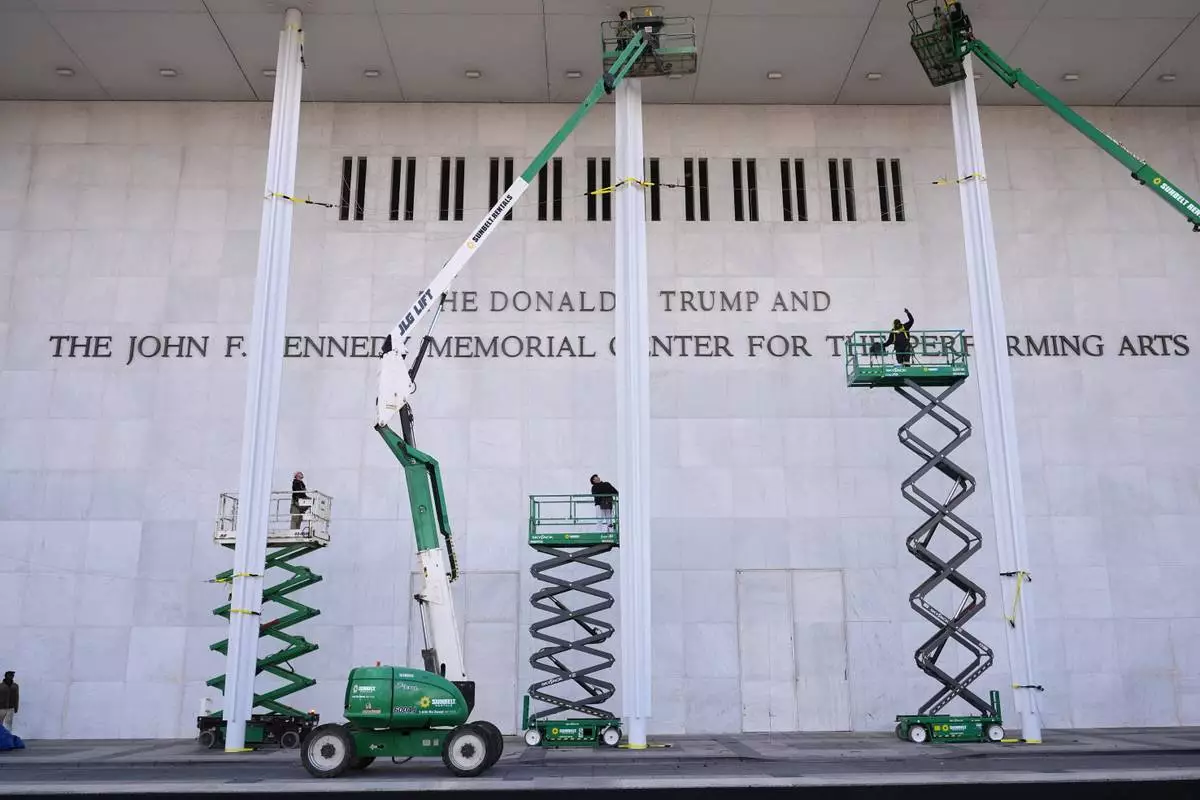
New signage, The Donald J. Trump and The John F. Kennedy Memorial Center For The Performing Arts, is unveiled on the Kennedy Center, Friday, Dec. 19, 2025, in Washington. (AP Photo/Jacquelyn Martin)