
Skip to Content Facebook Feature Image

'Dorm chef' still cooking up culinary buzz

News

'Dorm chef' still cooking up culinary buzz
News

News

'Dorm chef' still cooking up culinary buzz

2019-05-26 23:36 Last Updated At:23:50

Jonah Reider became an object of media fascination when he opened a sophisticated supper club in his Columbia University dorm that briefly became one of New York City's most coveted reservations.

Three years after graduation, the "dorm chef " is still cooking up culinary buzz.

More Images
In this May 20, 2019 photo, Jonah Reider sniffs rhubarb as he shops in New York's Union Square Greenmarket for ingredients for his next dinner party. (AP PhotoRichard Drew)

In this May 20, 2019 photo, Jonah Reider sniffs rhubarb as he shops in New York's Union Square Greenmarket for ingredients for his next dinner party. (AP PhotoRichard Drew)

In this May 17, 2019, photo Jonah Reider prepares a Pith dinner at his New York apartment. “Don’t call me a chef,” he says with a grin, explaining, “I think of myself as a good home cook. The food is upscale, but very simple.” (AP PhotoMary Altaffer)
In this May 17, 2019, photo Jonah Reider prepares a Pith dinner at his New York apartment. “Don’t call me a chef,” he says with a grin, explaining, “I think of myself as a good home cook. The food is upscale, but very simple.” (AP PhotoMary Altaffer)

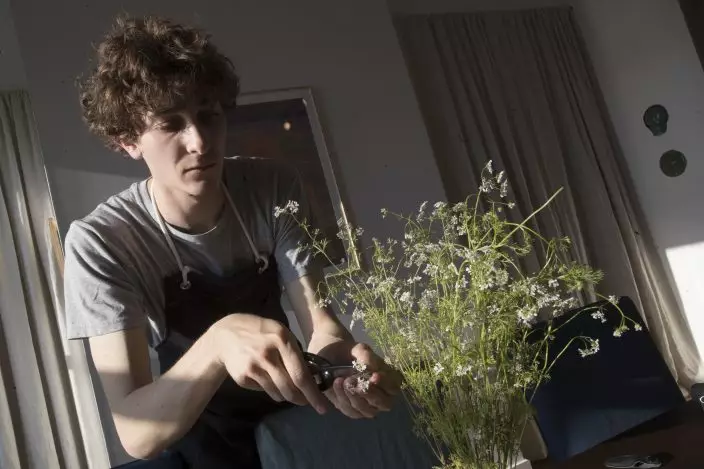
In this May 17, 2019 photo, Jonah Reider trims flowering cilantro to use in a beef tartare toast appetizer during a Pith dinner in New York. He’s managed to earn a living as an innovative cook with no formal training, hired by corporations and individuals to take his unique pop-up creations around the world, from Italy and Japan to Australia and the United States. (AP PhotoMary Altaffer)
In this May 17, 2019 photo, Jonah Reider trims flowering cilantro to use in a beef tartare toast appetizer during a Pith dinner in New York. He’s managed to earn a living as an innovative cook with no formal training, hired by corporations and individuals to take his unique pop-up creations around the world, from Italy and Japan to Australia and the United States. (AP PhotoMary Altaffer)

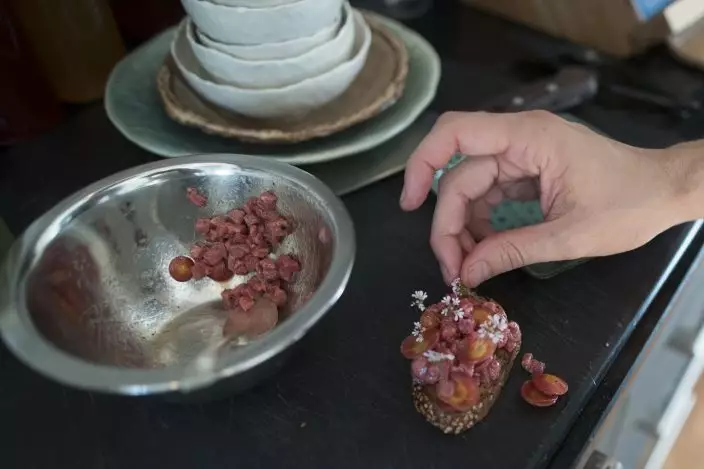
In this May 17, 2019 photo, Jonah Reider prepares a beef tartare toast appetizer during a Pith dinner in New York. Reider’s informal kitchen training started during childhood in Newton, Massachusetts, in a family that cooked far-from-ordinary meals. (AP PhotoMary Altaffer)
In this May 17, 2019 photo, Jonah Reider prepares a beef tartare toast appetizer during a Pith dinner in New York. Reider’s informal kitchen training started during childhood in Newton, Massachusetts, in a family that cooked far-from-ordinary meals. (AP PhotoMary Altaffer)
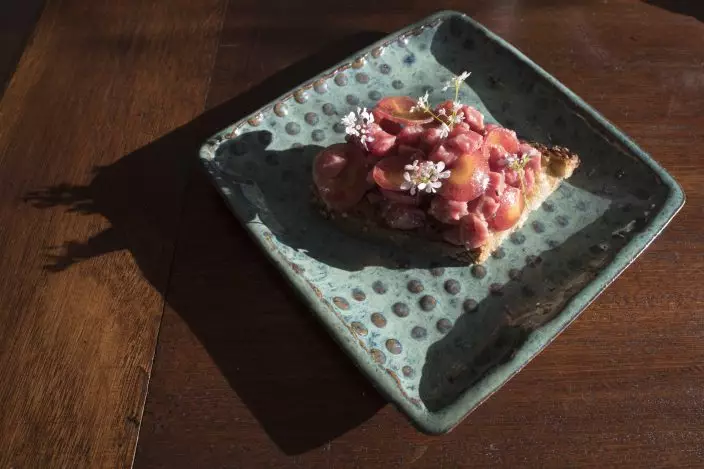
In this  In this May 17, 2019 photo, a beef tartare toast is an appetizer at a Pith home-cooked dinner prepared by Jonah Reider in his New York apartment. Reider’s informal kitchen training started during childhood in Newton, Massachusetts, in a family that cooked far-from-ordinary meals. (AP PhotoMary Altaffer)

In this In this May 17, 2019 photo, a beef tartare toast is an appetizer at a Pith home-cooked dinner prepared by Jonah Reider in his New York apartment. Reider’s informal kitchen training started during childhood in Newton, Massachusetts, in a family that cooked far-from-ordinary meals. (AP PhotoMary Altaffer)

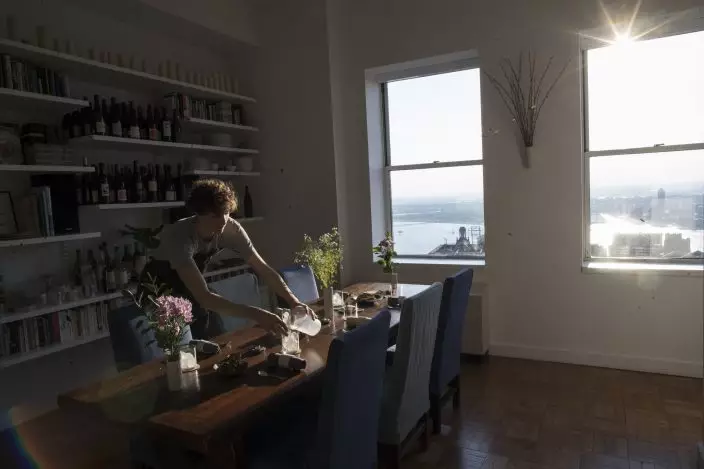
In this May 17, 2019 photo, Jonah Reider sets the table before dinner guests arrive in New York. His apartment has a view of New York Harbor and the Statue of Liberty. (AP PhotoMary Altaffer)

In this May 17, 2019 photo, Jonah Reider sets the table before dinner guests arrive in New York. His apartment has a view of New York Harbor and the Statue of Liberty. (AP PhotoMary Altaffer)

In this May 17, 2019 photo, guests have drinks and appetizers while Jonah Reider, right, checks on the entrees in his oven at his New York apartment. “I think the best meals are happening in people's homes, not at restaurants," he said. “I want to show people how joyful cooking can be.” (AP PhotoMary Altaffer)

In this May 17, 2019 photo, guests have drinks and appetizers while Jonah Reider, right, checks on the entrees in his oven at his New York apartment. “I think the best meals are happening in people's homes, not at restaurants," he said. “I want to show people how joyful cooking can be.” (AP PhotoMary Altaffer)

In this May 17, 2019 photo, Jonah Reider shows his guests wild spring onions that were an ingredient in one of the dishes during a Pith dinner in New York. He named his little enterprise Pith - the soft white lining of citrus fruits. (AP PhotoMary Altaffer)
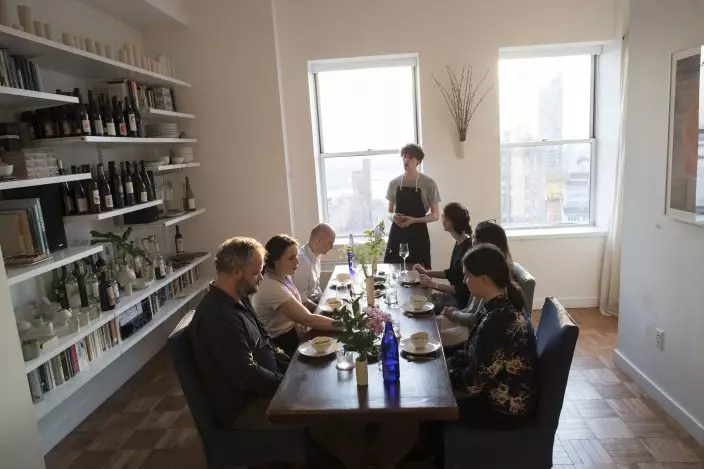
In this May 17, 2019 photo, Jonah Reider shows his guests wild spring onions that were an ingredient in one of the dishes during a Pith dinner in New York. He named his little enterprise Pith - the soft white lining of citrus fruits. (AP PhotoMary Altaffer)

In this May 17, 2019 photo, Jonah Reider, center, talks to his guests about the dinner he is serving them in his New York apartment. His new mission: to inspire people to do relaxed home cooking for friends and family rather than overspending at fancy restaurants. (AP PhotoMary Altaffer)
In this May 17, 2019 photo, Jonah Reider, center, talks to his guests about the dinner he is serving them in his New York apartment. His new mission: to inspire people to do relaxed home cooking for friends and family rather than overspending at fancy restaurants. (AP PhotoMary Altaffer)

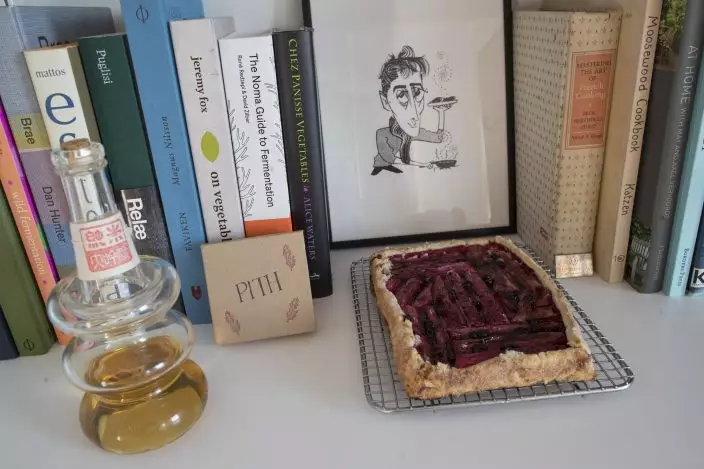
In this May 17, 2019 photo, a rhubarb tart is displayed with a caricature of Jonah Reider and his cookbooks in his New York apartment. In the competitive food world, Reider is a millennial whose cooking is opening doors to adventures far beyond food. (AP PhotoMary Altaffer)

In this May 17, 2019 photo, a rhubarb tart is displayed with a caricature of Jonah Reider and his cookbooks in his New York apartment. In the competitive food world, Reider is a millennial whose cooking is opening doors to adventures far beyond food. (AP PhotoMary Altaffer)

His club, Pith, has a new incarnation. After a short life in a Brooklyn townhouse, he's now cooking for small groups at his high-rise apartment near Wall Street.

In this May 20, 2019 photo, Jonah Reider sniffs rhubarb as he shops in New York's Union Square Greenmarket for ingredients for his next dinner party. (AP PhotoRichard Drew)

In this May 20, 2019 photo, Jonah Reider sniffs rhubarb as he shops in New York's Union Square Greenmarket for ingredients for his next dinner party. (AP PhotoRichard Drew)

Reider flew overseas this spring to make a television pilot in Japan that features the lanky American presenting Japanese food traditions many younger people there have abandoned. And he's planning to open a grilled cheese sandwich shop in Tokyo.

He's also launched a U.S. company called Alto that sells honey, olive oil and salt infused with CBD, the legal cannabis derivative, and THC in Oregon.

That's not bad for a 25-year-old with no professional training as a chef — and lots of disdain for the "dorm chef" moniker that made him famous.

In this May 17, 2019, photo Jonah Reider prepares a Pith dinner at his New York apartment. “Don’t call me a chef,” he says with a grin, explaining, “I think of myself as a good home cook. The food is upscale, but very simple.” (AP PhotoMary Altaffer)

In this May 17, 2019, photo Jonah Reider prepares a Pith dinner at his New York apartment. “Don’t call me a chef,” he says with a grin, explaining, “I think of myself as a good home cook. The food is upscale, but very simple.” (AP PhotoMary Altaffer)

"That's history; I've done so much more since then and I don't want to be identified that way," he said.

Don't call him a chef either, he added with a grin.

"I think of myself as a good home cook. The food is upscale, but very simple," he said, explaining that he's trying to inspire people to host friends and family at home rather than overspending at fancy restaurants.

In this May 17, 2019 photo, Jonah Reider trims flowering cilantro to use in a beef tartare toast appetizer during a Pith dinner in New York. He’s managed to earn a living as an innovative cook with no formal training, hired by corporations and individuals to take his unique pop-up creations around the world, from Italy and Japan to Australia and the United States. (AP PhotoMary Altaffer)

In this May 17, 2019 photo, Jonah Reider trims flowering cilantro to use in a beef tartare toast appetizer during a Pith dinner in New York. He’s managed to earn a living as an innovative cook with no formal training, hired by corporations and individuals to take his unique pop-up creations around the world, from Italy and Japan to Australia and the United States. (AP PhotoMary Altaffer)

"I think the best meals are happening in people's homes," he said on a recent morning as he surveyed Manhattan's Union Square greenmarket for a Pith dinner the next night. "I want to show people how joyful cooking can be."

Reider's informal kitchen training started during childhood in Newton, Massachusetts, in a family that loved cooking.

He landed on New York's foodie scene as a Columbia University senior in 2015, when a review of his dorm meals in the campus newspaper led to wider media coverage and a 4,000-person waiting list.

In this May 17, 2019 photo, Jonah Reider prepares a beef tartare toast appetizer during a Pith dinner in New York. Reider’s informal kitchen training started during childhood in Newton, Massachusetts, in a family that cooked far-from-ordinary meals. (AP PhotoMary Altaffer)

In this May 17, 2019 photo, Jonah Reider prepares a beef tartare toast appetizer during a Pith dinner in New York. Reider’s informal kitchen training started during childhood in Newton, Massachusetts, in a family that cooked far-from-ordinary meals. (AP PhotoMary Altaffer)

The icing on the cake came when Reider appeared on Stephen Colbert's "Late Show," serving the TV host a phyllo dough dessert filled with black truffle-infused honey and a side of pear nectar sorbet.

The university was not thrilled with the young entrepreneur's venture — costing each guest about $15 for groceries — and booted the economics major from the dorm, but not before Reider won kudos from renowned culinary expert Ruth Reichl, who said his food was "impossible to stop eating."

Since graduation, he's managed to earn a living as an innovative cook, hired by corporations and individuals to take his unique pop-up creations around the world, from Italy and Japan to Australia and New Zealand. He's prepared food linked to events sponsored by the likes of Google, Penguin Random House, KitchenAid, Jaguar Land Rover and even the government of Malaysia.

In this  In this May 17, 2019 photo, a beef tartare toast is an appetizer at a Pith home-cooked dinner prepared by Jonah Reider in his New York apartment. Reider’s informal kitchen training started during childhood in Newton, Massachusetts, in a family that cooked far-from-ordinary meals. (AP PhotoMary Altaffer)

In this In this May 17, 2019 photo, a beef tartare toast is an appetizer at a Pith home-cooked dinner prepared by Jonah Reider in his New York apartment. Reider’s informal kitchen training started during childhood in Newton, Massachusetts, in a family that cooked far-from-ordinary meals. (AP PhotoMary Altaffer)

After Columbia, the graduate rented a room in a Brooklyn hedge fund manager's townhouse where he staged a series of Pith dinners, with tickets going for $95 plus a $45 wine pairing. He says he wanted to prove he was capable of producing high-end professional meals. He also gave free cooking lessons to public schoolkids.

At that table last year, he met "the love of my life" — a Belgian-born college student whose brother gave her the dinner as a birthday gift.

Romance blossomed and the pair now split the rent for a tiny Manhattan apartment they have stylishly redecorated in the Art Deco high-rise with a spectacular New York Harbor view.

In this May 17, 2019 photo, Jonah Reider sets the table before dinner guests arrive in New York. His apartment has a view of New York Harbor and the Statue of Liberty. (AP PhotoMary Altaffer)

In this May 17, 2019 photo, Jonah Reider sets the table before dinner guests arrive in New York. His apartment has a view of New York Harbor and the Statue of Liberty. (AP PhotoMary Altaffer)

The Pith table seats a half dozen guests about two evenings a week. Tickets go for $40.

"Crispy salmon with nice flaky salt" and "little potatoes roasted with herbs from my bedroom window sill" are Reider's descriptions of some of the nine dishes at a recent Pith evening, plus appetizers.

In addition, the dinner featured chilled cucumber soup with sheep's yogurt; beef tartare toast; a salad of baby lettuces and radishes; morels and wild spring onions crisped in miso butter; farro cooked in morel broth with spring peas — all topped by a rhubarb tart with toasted almond gelato.

In this May 17, 2019 photo, guests have drinks and appetizers while Jonah Reider, right, checks on the entrees in his oven at his New York apartment. “I think the best meals are happening in people's homes, not at restaurants," he said. “I want to show people how joyful cooking can be.” (AP PhotoMary Altaffer)

In this May 17, 2019 photo, guests have drinks and appetizers while Jonah Reider, right, checks on the entrees in his oven at his New York apartment. “I think the best meals are happening in people's homes, not at restaurants," he said. “I want to show people how joyful cooking can be.” (AP PhotoMary Altaffer)

He posted invitations on Instagram just two hours before the 7 p.m. feast — up for grabs to anyone who was interested, first come, first served. The meal sold out in 10 seconds to strangers who arrived at the door and quickly settled into lively conversations around the candlelit table as the sun set over the Statue of Liberty.

Dinners also are announced on the Pith website.

Reider's entrepreneurship was the subject of a TEDx talk he gave at Georgetown University in Washington, titled "Economic and Creative Enfranchisement Through Food." At Stanford University, he's spoken about "Values and Aesthetics in Home Cooking."

In this May 17, 2019 photo, Jonah Reider shows his guests wild spring onions that were an ingredient in one of the dishes during a Pith dinner in New York. He named his little enterprise Pith - the soft white lining of citrus fruits. (AP PhotoMary Altaffer)

In this May 17, 2019 photo, Jonah Reider shows his guests wild spring onions that were an ingredient in one of the dishes during a Pith dinner in New York. He named his little enterprise Pith - the soft white lining of citrus fruits. (AP PhotoMary Altaffer)

His endeavors in Japan began when he got attention for a Pith pop-up in that country. Later, an executive from a Japanese video production company, was in New York and contacted Reider.

"I've always wanted to make a TV show celebrating home cooking and the joy of do-it-yourself hospitality, so I had him come over and made him a few scallops," Reider said.

The executive invited him to film the pilot for a Japanese show focusing not on top restaurants in big cities, but "the culinary traditions of farmers, brewers, grandmas etc. all around less traveled areas," Reider said.

In this May 17, 2019 photo, Jonah Reider, center, talks to his guests about the dinner he is serving them in his New York apartment. His new mission: to inspire people to do relaxed home cooking for friends and family rather than overspending at fancy restaurants. (AP PhotoMary Altaffer)

In this May 17, 2019 photo, Jonah Reider, center, talks to his guests about the dinner he is serving them in his New York apartment. His new mission: to inspire people to do relaxed home cooking for friends and family rather than overspending at fancy restaurants. (AP PhotoMary Altaffer)

"My goal anywhere I go is to highlight home hospitality and culinary traditions," he said. "I want to show how home cooking connects all of us around the globe. It's a travel and culture show, happening in homes everywhere."

The cheese sandwich shop also is being financed by private investors, who with Reider are looking to lease a Tokyo location this summer.

Meanwhile, he's taking Japanese lessons

In this May 17, 2019 photo, a rhubarb tart is displayed with a caricature of Jonah Reider and his cookbooks in his New York apartment. In the competitive food world, Reider is a millennial whose cooking is opening doors to adventures far beyond food. (AP PhotoMary Altaffer)

In this May 17, 2019 photo, a rhubarb tart is displayed with a caricature of Jonah Reider and his cookbooks in his New York apartment. In the competitive food world, Reider is a millennial whose cooking is opening doors to adventures far beyond food. (AP PhotoMary Altaffer)

Greenland's harsh environment, lack of key infrastructure and difficult geology have so far prevented anyone from building a mine to extract the sought-after rare earth elements that many high-tech products require. Even if President Donald Trump prevails in his effort to take control of the arctic island, those challenges won't go away.

Trump has prioritized breaking China's stranglehold on the global supply of rare earths ever since the world's number two economy sharply restricted who could buy them after the United States imposed widespread tariffs last spring. The Trump administration has invested hundreds of millions of dollars and even taken stakes in several companies. Now the president is again pitching the idea that wresting control of Greenland away from Denmark could solve the problem.

“We are going to do something on Greenland whether they like it or not,” Trump said Friday.

But Greenland may not be able to produce rare earths for years — if ever. Some companies are trying anyway, but their efforts to unearth some of the 1.5 million tons of rare earths encased in rock in Greenland generally haven't advanced beyond the exploratory stage. Trump's fascination with the island nation may be more about countering Russian and Chinese influence in the Arctic than securing any of the hard-to-pronounce elements like neodymium and terbium that are used to produce the high-powered magnets needed in electric vehicles, wind turbines, robots and fighter jets among other products.

“The fixation on Greenland has always been more about geopolitical posturing — a military-strategic interest and stock-promotion narrative — than a realistic supply solution for the tech sector,” said Tracy Hughes, founder and executive director of the Critical Minerals Institute. “The hype far outstrips the hard science and economics behind these critical minerals."

Trump confirmed those geopolitical concerns at the White House Friday.

“We don’t want Russia or China going to Greenland, which if we don’t take Greenland, you can have Russia or China as your next door neighbor. That’s not going to happen,” Trump said

The main challenge to mine in Greenland is, “of course, the remoteness. Even in the south where it’s populated, there are few roads and no railways, so any mining venture would have to create these accessibilities,” said Diogo Rosa, an economic geology researcher at the Geological Survey of Denmark and Greenland. Power would also have to be generated locally, and expert manpower would have to be brought in.

Another concern is the prospect of mining rare earths in the fragile Arctic environment just as Greenland tries to build a thriving tourism industry, said Patrick Schröder, a senior fellow in the Environment and Society program at the Chatham House think-tank in London.

“Toxic chemicals needed to separate the minerals out from the rock, so that can be highly polluting and further downstream as well, the processing," Shröder said. Plus, rare earths are often found alongside radioactive uranium.

Besides the unforgiving climate that encases much of Greenland under layers of ice and freezes the northern fjords for much of the year, the rare earths found there tend to be encased in a complex type of rock called eudialyte, and no one has ever developed a profitable process to extract rare earths from that type of rock. Elsewhere, these elements are normally found in different rock formation called carbonatites, and there are proven methods to work with that.

“If we’re in a race for resources — for critical minerals — then we should be focusing on the resources that are most easily able to get to market," said David Abraham, a rare earths expert who has followed the industry for decades and wrote the book “The Elements of Power.”

This week, Critical Metals’ stock price more than doubled after it said it plans to build a pilot plant in Greenland this year. But that company and more than a dozen others exploring deposits on the island remain far away from actually building a mine and would still need to raise at least hundreds of millions of dollars.

Even the most promising projects can struggle to turn a profit, particularly when China resorts to dumping extra materials onto the market to depress prices and drive competitors out of business as it has done many times in the past. And currently most critical minerals have to be processed in China.

The U.S. is scrambling to expand the supply of rare earths outside of China during the one-year reprieve from even tougher restrictions that Trump said Xi Jinping agreed to in October. A number of companies around the world are already producing rare earths or magnets and can deliver more quickly than anything in Greenland, which Trump has threatened to seize with military power if Denmark doesn't agree to sell it.

“Everybody’s just been running to get to this endpoint. And if you go to Greenland, it’s like you’re going back to the beginning,” said Ian Lange, an economics professor who focuses on rare earths at the Colorado School of Mines.

Many in the industry, too, think America should focus on helping proven companies instead of trying to build new rare earth mines in Greenland, Ukraine, Africa or elsewhere. A number of other mining projects in the U.S. and friendly nations like Australia are farther along and in much more accessible locations.

The U.S. government has invested directly in the company that runs the only rare earths mine in the U.S., MP Materials, and a lithium miner and a company that recycles batteries and other products with rare earths.

Scott Dunn, CEO of Noveon Magnetics, said those investments should do more to reduce China's leverage, but it's hard to change the math quickly when more than 90% of the world's rare earths come from China.

“There are very few folks that can rely on a track record for delivering anything in each of these instances, and that obviously should be where we start, and especially in my view if you’re the U.S. government,” said Dunn, whose company is already producing more than 2,000 metric tons of magnets each year at a plant in Texas from elements it gets outside of China.

Funk reported from Omaha, Nebraska, and Naishadham reported from Madrid.

FILE - A view of houses in Nuuk, Greenland, June 22, 2025. (AP Photo/Kwiyeon Ha, File)

FILE - A view of houses in Nuuk, Greenland, June 22, 2025. (AP Photo/Kwiyeon Ha, File)

FILE - Danish military forces participate in an exercise with hundreds of troops from several European NATO members in Kangerlussuaq, Greenland, Sept. 17, 2025. (AP Photo/Ebrahim Noroozi, File)

FILE - Danish military forces participate in an exercise with hundreds of troops from several European NATO members in Kangerlussuaq, Greenland, Sept. 17, 2025. (AP Photo/Ebrahim Noroozi, File)

FILE - Tourists kayak at sea in front of Nuuk Cathedral in Nuuk, Greenland, June 16, 2025. (AP Photo/Kwiyeon Ha, File)

FILE - Tourists kayak at sea in front of Nuuk Cathedral in Nuuk, Greenland, June 16, 2025. (AP Photo/Kwiyeon Ha, File)

Recommended Articles