
Skip to Content Facebook Feature Image

Venezuela reopens border crossing with Colombia

News

Venezuela reopens border crossing with Colombia
News

News

Venezuela reopens border crossing with Colombia

2019-06-08 21:32 Last Updated At:21:40

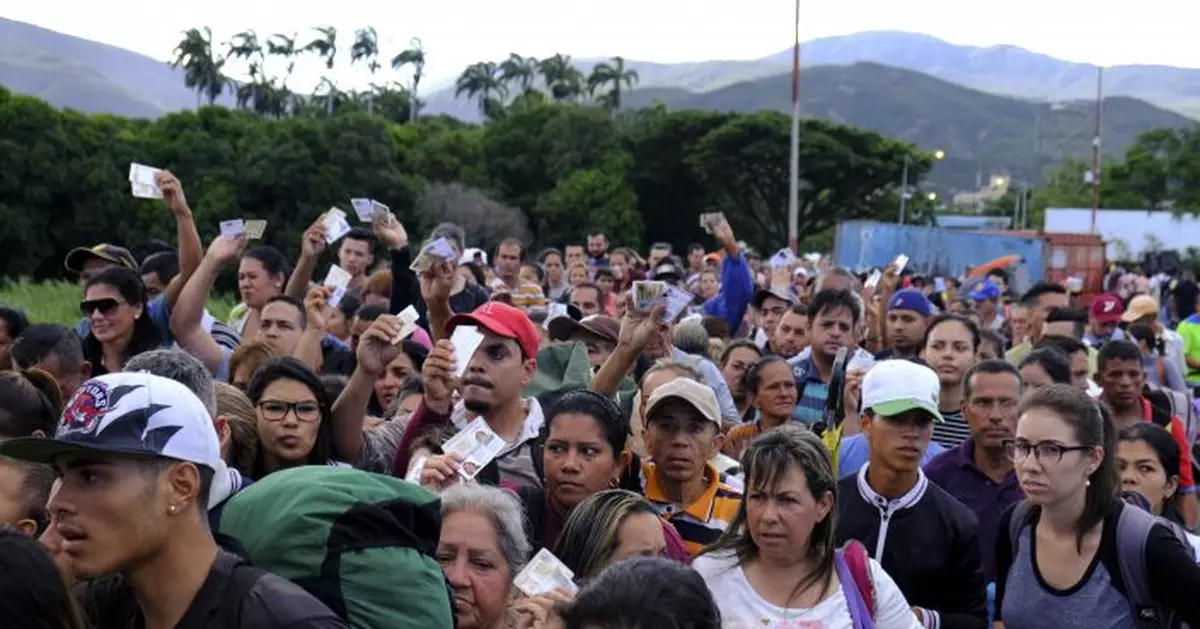
Thousands are crossing into Colombia to buy food and medicine after Venezuela's embattled president reopened two border crossings that had been shut for almost four months.

Long lines of Venezuelans stood at two international bridges near the city of Cúcuta on Saturday waiting to have their documents checked by Colombian officials. Venezuelan border guards dressed in green uniforms helped to control the crowds.

The pedestrian border crossings were shut down by Venezuelan President Nicolás Maduro in late February after his political opponents tried to use the bridges to transport several tons of food and medicine into the country.
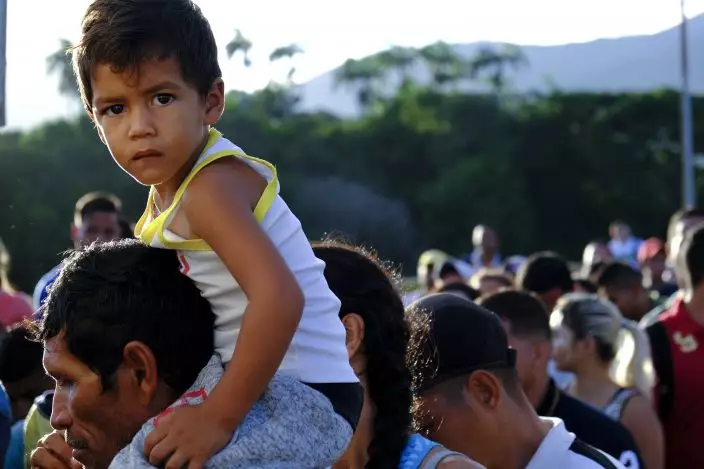
A Venezuelan man carrying a child on his shoulders lines up to cross the Simon Bolivar international bridge into Cucuta, Colombia, Saturday, June 8, 2019. Venezuela's President Nicolas Maduro ordered the partial re-opening of the border that has been closed since February when he stationed containers on the bridge to block an opposition plan to deliver humanitarian aid into the country. (AP PhotoFerley Ospina)

A Venezuelan man carrying a child on his shoulders lines up to cross the Simon Bolivar international bridge into Cucuta, Colombia, Saturday, June 8, 2019. Venezuela's President Nicolas Maduro ordered the partial re-opening of the border that has been closed since February when he stationed containers on the bridge to block an opposition plan to deliver humanitarian aid into the country. (AP PhotoFerley Ospina)

Most of the aid was donated by the United Sates but rejected by Maduro, who said it was part of a plot to strengthen the opposition.
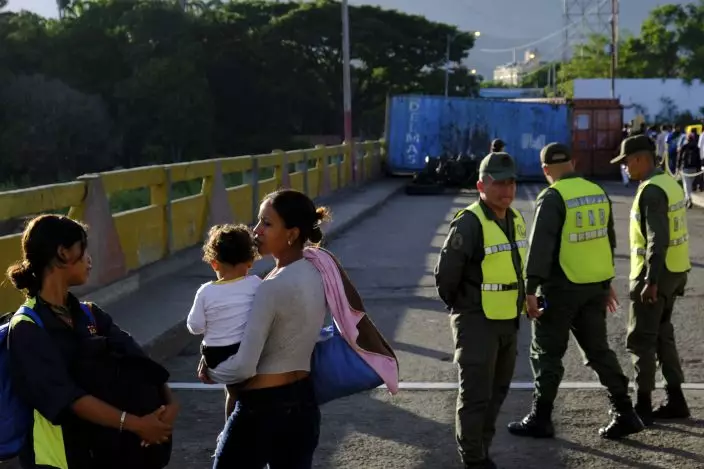
Venezuelans wait to cross the Simon Bolivar international bridge into Cucuta, Colombia, next to Bolivarian National Guard officers, Saturday, June 8, 2019. Venezuela's President Nicolas Maduro ordered the partial re-opening of the border that has been closed since February when he stationed containers on the bridge to block an opposition plan to deliver humanitarian aid into the country. (AP PhotoFerley Ospina)
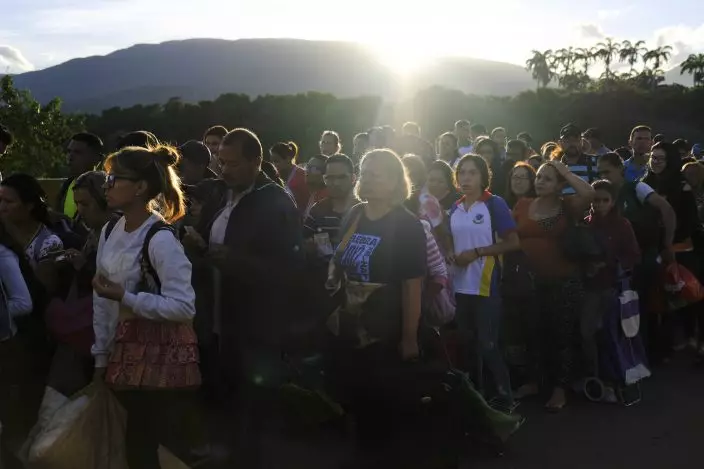
Venezuelans wait to cross the Simon Bolivar international bridge into Cucuta, Colombia, next to Bolivarian National Guard officers, Saturday, June 8, 2019. Venezuela's President Nicolas Maduro ordered the partial re-opening of the border that has been closed since February when he stationed containers on the bridge to block an opposition plan to deliver humanitarian aid into the country. (AP PhotoFerley Ospina)

Venezuelans line up to cross the Simon Bolivar international bridge into Cucuta, Colombia, Saturday, June 8, 2019. Venezuela's President Nicolas Maduro ordered the partial re-opening of the border that has been closed since February when he stationed containers on the bridge to block an opposition plan to deliver humanitarian aid into the country. (AP PhotoFerley Ospina)

Venezuelans line up to cross the Simon Bolivar international bridge into Cucuta, Colombia, Saturday, June 8, 2019. Venezuela's President Nicolas Maduro ordered the partial re-opening of the border that has been closed since February when he stationed containers on the bridge to block an opposition plan to deliver humanitarian aid into the country. (AP PhotoFerley Ospina)

WASHINGTON (AP) — U.S. forces on Saturday stopped a vessel off the coast of Venezuela for the second time in less than two weeks as President Donald Trump continues to ramp up pressure on Venezuelan President Nicolás Maduro.

The move, which was confirmed by two U.S. officials familiar with matter, comes days after Trump announced a “blockade” of all sanctioned oil tankers coming in and out of the South American country and follows the Dec. 10 seizure by American forces of an oil tanker off Venezuela’s coast.

The officials were not authorized to discuss publicly the ongoing military operation and spoke on condition of anonymity. One official described the action as a “consented boarding,” with the tanker stopping voluntarily and allowing U.S. forces to board it.

Pentagon and White House officials did not immediately respond to a requests for comment.

Trump following the first tanker seizure this month vowed that the U.S. would carry out a blockade of Venezuela. It all comes as Trump has ratcheted up his rhetoric toward Maduro and warned that the longtime Venezuelan leader’s days in power are numbered.

Trump this week demanded that Venezuela return assets that it seized from U.S. oil companies years ago, justifying anew his announcement of a “blockade” against oil tankers traveling to or from the South American country that face American sanctions.

Trump cited the lost U.S. investments in Venezuela when asked about his newest tactic in a pressure campaign against Maduro, suggesting the Republican administration’s moves are at least somewhat motivated by disputes over oil investments, along with accusations of drug trafficking. Some sanctioned tankers already are diverting away from Venezuela.

"We’re not going to be letting anybody going through who shouldn’t be going through,” Trump told reporters earlier this week. “You remember they took all of our energy rights. They took all of our oil not that long ago. And we want it back. They took it — they illegally took it.”

U.S. oil companies dominated Venezuela’s petroleum industry until the country’s leaders moved to nationalize the sector, first in the 1970s and again in the 21st century under Maduro and his predecessor, Hugo Chávez. Compensation offered by Venezuela was deemed insufficient, and in 2014 an international arbitration panel ordered the country’s socialist government to pay $1.6 billion to ExxonMobil.

The targeting of tankers comes as Trump has ordered the Defense Department to carry out a series of attacks on vessels in the Caribbean and eastern Pacific Ocean that his administration alleges are smuggling fentanyl and other illegal drugs into the United States and beyond.

At least 104 people have been killed in 28 known strikes since early September.

The strikes have faced scrutiny from U.S. lawmakers and human rights activists, who say the administration has offered scant evidence that its targets are indeed drug smugglers and that the fatal strikes amount to extrajudicial killings.

The Coast Guard, sometimes with help from the Navy, had typically interdicted boats suspected of smuggling drugs in the Caribbean Sea, searched for illicit cargo, and arrested the people aboard for prosecution.

The administration has justified the strikes as necessary, asserting it is in “armed conflict” with drug cartels aimed at halting the flow of narcotics into the United States. Maduro faces federal charges of narcoterrorism in the U.S.

The U.S. in recent months has sent a fleet of warships to the region, the largest buildup of forces in generations, and Trump has stated repeatedly that land attacks are coming soon.

Maduro has insisted the real purpose of the U.S. military operations is to force him from power.

White House chief of staff Susie Wiles said in an interview with Vanity Fair published this week that Trump “wants to keep on blowing boats up until Maduro cries uncle.”

President Nicolas Maduro addresses supporters during a rally marking the anniversary of the Battle of Santa Ines, which took place during Venezuela's 19th-century Federal War, in Caracas, Venezuela, Wednesday, Dec. 10, 2025. (AP Photo/Ariana Cubillos)

President Nicolas Maduro addresses supporters during a rally marking the anniversary of the Battle of Santa Ines, which took place during Venezuela's 19th-century Federal War, in Caracas, Venezuela, Wednesday, Dec. 10, 2025. (AP Photo/Ariana Cubillos)

President Donald Trump walks to speak with reporters while departing the White House as chief of staff Susie Wiles, right, looks on, Friday, Dec. 19, 2025, in Washington. (AP Photo/Julia Demaree Nikhinson)

President Donald Trump walks to speak with reporters while departing the White House as chief of staff Susie Wiles, right, looks on, Friday, Dec. 19, 2025, in Washington. (AP Photo/Julia Demaree Nikhinson)

Recommended Articles