The artisan vodka, branded Atomik, has been described as ‘the most important bottle of spirits in the world’, and it’s alcohol-free.
A radioactivity-free vodka produced from crops in Chernobyl’s abandoned zone has been brewed by a team of British scientists.
Professor Jim Smith, from the University of Portsmouth, described the artisan vodka – branded Atomik – as “possibly the most important bottle of spirits in the world” as he believed it would help the region recover economically.
He said tests on the vodka showed that, following the distillation process, only “natural Carbon-14” radioactivity was found in line with any normal spirit drink.
Prof Smith now wants to produce the traditionally-brewed vodka for sale through a social enterprise called The Chernobyl Spirit Company, with 75% of the profits going back to the affected community in Ukraine.
He said: “I think this is the most important bottle of spirits in the world because it could help the economic recovery of communities living in and around the abandoned areas.
“Many thousands of people are still living in the Zone of Obligatory Resettlement where new investment and use of agricultural land is still forbidden.”
A University of Portsmouth spokesman said: “The team found some radioactivity in the grain: Strontium-90 is slightly above the cautious Ukrainian limit of 20 Bq/kg.
“But, because distilling reduces any impurities in the original grain, the only radioactivity the researchers could detect in the alcohol is natural Carbon-14 at the same level you would expect in any spirit drink.”
A 1,622 square mile (4,200 sq km) human exclusion zone around Chernobyl was put in place due to chronic radiation fall-out following the nuclear reactor accident in 1986.
Radiation was detected across Europe and about 300,000 residents were permanently evacuated from their homes after the accident.
To produce the vodka, Prof Smith and his team diluted the distilled alcohol with mineral water from a deep aquifer in Chernobyl town, 6.2 miles (10km) south of the reactor, which is free from contamination and which he says has similar chemistry to groundwater in the Champagne region of France.
Prof Smith, a professor of environmental science, said: “We don’t think the main exclusion zone should be extensively used for agriculture as it is now a wildlife reserve but there are other areas where people live but agriculture is still banned.
“Thirty-three years on, many abandoned areas could now be used to grow crops safely without the need for distillation.
“We aim to make a high-value product to support economic development of areas outside the main exclusion zone where radiation isn’t now a significant health risk.”
Oleg Nasvit, first deputy head of the State Agency of Ukraine for Exclusion Zone Management, said: “We welcome this initiative to use abandoned lands to help local communities. It is important that we do everything we can to support the restoration of normal life in these areas whilst always putting safety first.”
Mr Nasvit added: “I’d call this a high-quality moonshine – it isn’t typical of a more highly purified vodka, but has the flavour of the grain from our original Ukrainian distillation methods – I like it.”
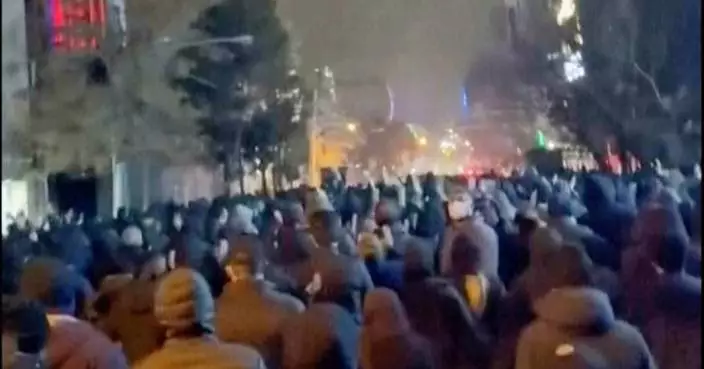
TEL AVIV, Israel (AP) — Israel is “closely monitoring” the fallout from widespread Iranian protests, Prime Minister Benjamin Netanyahu said Sunday, as U.S. President Donald Trump’s threats to attack Iran could escalate the protests within the borders of the Islamic Republic into a regional war.
“The people of Israel, the entire world, are in awe of the tremendous heroism of the citizens of Iran,” Netanyahu said at the start of the weekly cabinet meeting. He condemned the killing of civilians and said he hoped to rebuild relations between Israel and Iran once the country was “freed from the yoke of tyranny.”
Netanyahu and U.S. Secretary of State Marco Rubio spoke overnight Saturday about a number of issues, including Iran, according to an Israeli official who spoke on the condition of anonymity because they were not authorized to speak to the media.
But Israel’s military said there are no new guidelines for civilians to stay close to bomb shelters due to concerns about an attack of Iranian missiles, as there have been in the past when there were concrete threats.
The Israeli military said the protests in Iran are an “internal Iranian matter,” but that the military “will be equipped to respond with power if need be.”
A former Israeli intelligence official said Israel is unlikely to instigate an attack against Iran, even though Israel could have an easy target as Iranian leadership is weakened and distracted by the protests roiling the country.
“From an Iranian standpoint, the last thing Iran wants to see is diverting their attention towards Israel,” said Danny Citrinowicz, who once headed research on Iran in one of the Israeli military's intelligence branches and is now a senior researcher with the Israeli defense think tank the Institute for National Security Studies.
“Their priority, first and foremost, is to retrieve the calmness and stability in Iran."
The current situation in Iran is so uncertain that Israel is likely to wait and see what will happen next, Citrinowicz said. He added that “neither side has an appetite” to start a new round of the 12-day war this past summer.
The war began with Israel targeting Iranian nuclear and military sites, saying it could not allow Tehran to develop atomic weapons and that it feared the Islamic Republic was close. Iran has long maintained that its program is peaceful.
Israeli strikes on Iran killed 1,190 people and wounded another 4,475, according to the U.S.-based Human Rights Activists News Agency. Iran’s missile barrages killed almost 30 people in Israel and wounded 1,000.
On Sunday, Iran’s parliament speaker warned the U.S. military and Israel would be “legitimate targets” if America strikes the Islamic Republic. Mohammad Bagher Qalibaf made the threat as lawmakers rushed the dais in the Iranian parliament, shouting: “Death to America!”
Trump, who has posted a number of times on social media about Iran over the weekend, has a history of following through on threats to attack. “Do not play games with President Trump. When he says he’ll do something, he means it,” the State Department warned on Saturday.
Citrinowicz said that an attack, either American or Israeli, could have the opposite impact on the protests, possibly even weakening the protests by fostering a sense of patriotism and uniting against a common enemy.
The U.S. both brokered the ceasefire and assisted Israel during the Israel-Iran war this past summer, by dropping bunker-buster bombs on multiple Iranian nuclear sites — a move that was crucial for Netanyahu to declare to the Israeli public that Israel had achieved its objectives against Iran’s nuclear program and accept Trump's truce.
“What Israel is really concerned with is ballistic missiles, and stuff like that, not what kind of regime is going to be in Iran,” said Menahem Merhavy, an expert on Iran from the Hebrew University of Jerusalem.
“Unless there’s something really dramatic happening with missiles, I don’t see Israel stepping into this."
And an Iranian attack against Israel would be “a suicide note for the regime,” Merhavy said, because there will be little outcry if Israel responds strongly against the Iranian leadership given the outcry over their hardhanded response to the protests. “There are few tears that will be shed if, say, Israel kills the minister of foreign affairs,” Merhavy said.
He noted that Israel could help on the margins, like enabling internet access to certain individuals or leaders, but said even that is doubtful.
“Israel doesn’t want to meddle with this. It’s internally an Iranian matter,” Merhavy said.
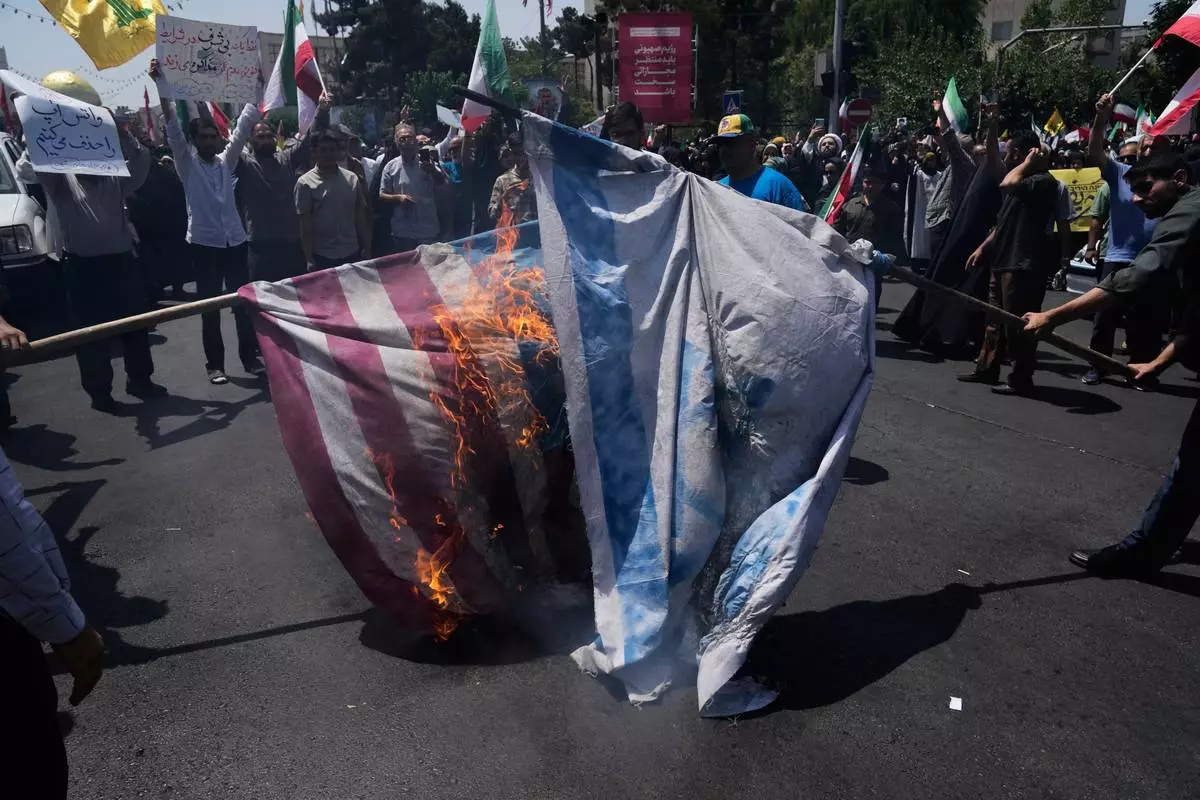
FILE - Iranian protestors burn representations of the Israeli and U.S. flags during a protest to condemn Israeli attacks on multiple cities across Iran, after the Friday prayers ceremony in Tehran, Iran, Friday, June 20, 2025. (AP Photo/Vahid Salemi), File)