This story was first published after Allied troops entered Paris on Aug. 25, 1944 to liberate the French capital from Nazi occupation. The Associated Press is republishing a version of the story to mark the 75th anniversary of the important moment in World War II, along with wartime photos . It was the first witness account published in the U.S. press, and was passed through field censors.
Street fighting raged through the heart of Paris today as American and French columns drove into the city from the south amid a tumultuous welcome from hundreds of thousands of Parisians.
Click to Gallery
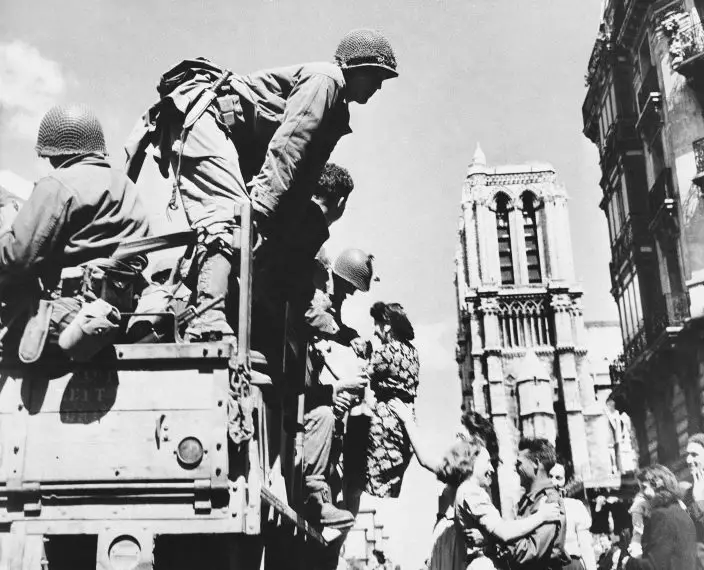
FILE - In this Aug. 28, 1944 file photo, French girls rush to greet American soldiers upon their arrival in Paris. The fighting for the liberation of Paris took place from August 19 to August 25, 1944. The French Resistance staged an uprising against the Nazis, leading attacks against German soldiers and vehicles and building barricades in the streets of the French capital. Towers of Notre Dame are in background at right. (AP Photo, File)
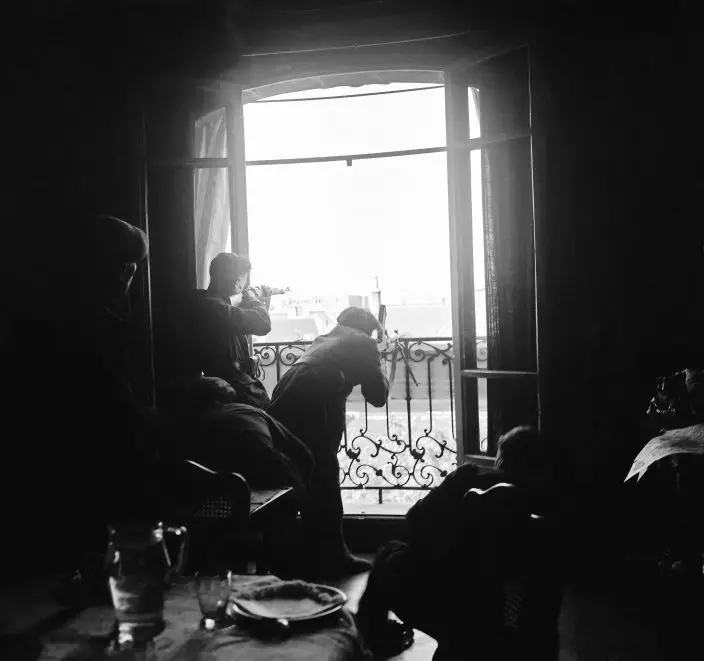
FILE - This Aug. 26, 1944 file photo shows members of the French Forces of the Interior (FFI) shoot at German snipers from a window in Paris. The fighting for the liberation of Paris took place from August 19 to August 25, 1944. (AP PhotoPeter J. Carroll, File)
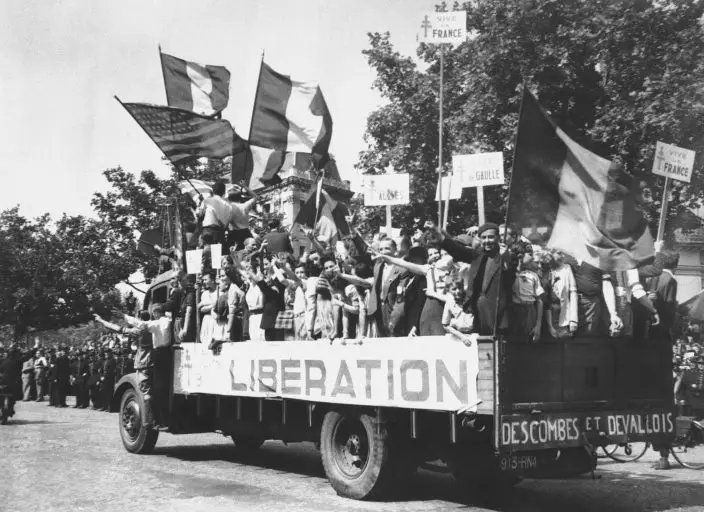
FILE - In this Aug. 28, 1944 file photo, a truck load of Parisians waving flags and carrying Vive De Gaulle banners drives through the streets of a madly rejoicing Paris. The fighting for the liberation of Paris took place from August 19 to August 25, 1944. The French Resistance staged an uprising against the Nazis, leading attacks against German soldiers and vehicles and building barricades in the streets of the French capital. (AP Photo, File)
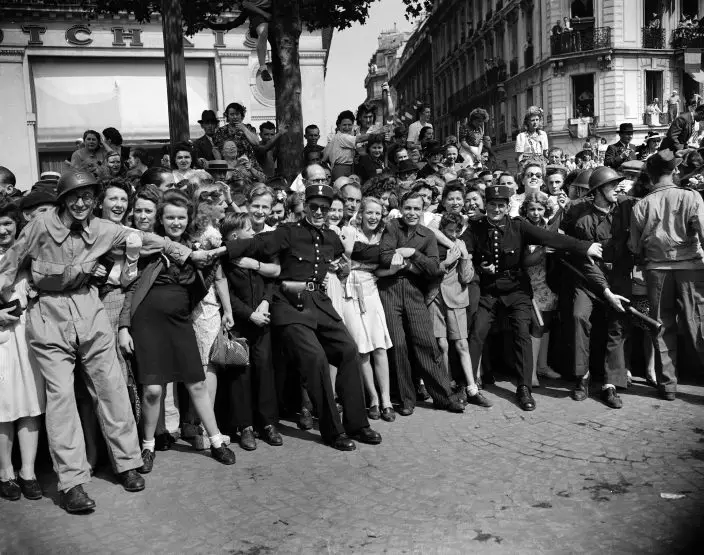
FILE - In this Aug. 26, 1944 file photo, gendarmes and F.F.I. hold back crowds of people as they throng the streets to see General Charles De Gaulle in Paris. The fighting for the liberation of Paris took place from August 19 to August 25, 1944. (AP PhotoLaurence Harris, File)
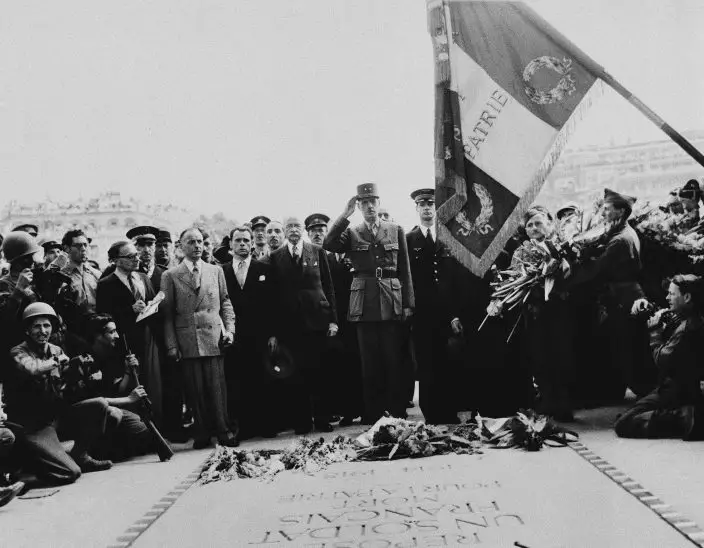
FILE - In this Aug. 28, 1944 file photo, General Charles De Gaulle, center, salutes the Tricolor after placing his wreath on the Tomb of the French Unknown Soldier of the last war, at the Arc de Triomphe in Paris. The fighting for the liberation of Paris took place from August 19 to August 25, 1944. The French Resistance staged an uprising against the Nazis, leading attacks against German soldiers and vehicles and building barricades in the streets of the French capital. (AP PhotoAndrew Lopez, File)
The first French column to enter the city reached Luxembourg at 10:20 a.m. The Germans, the collaborationist militia and the French Gestapo organization opened fire with machine guns, rifles and pistols and the battle was on.
FILE - In this Aug. 28, 1944 file photo, French girls rush to greet American soldiers upon their arrival in Paris. The fighting for the liberation of Paris took place from August 19 to August 25, 1944. The French Resistance staged an uprising against the Nazis, leading attacks against German soldiers and vehicles and building barricades in the streets of the French capital. Towers of Notre Dame are in background at right. (AP Photo, File)
An American infantry column drove to Notre Dame at 11 a.m. in a spectacular ground attack to close in on strongholds still defended by the embattled Germans and the Vichy French militia.
The columns fought toward the center of the city where 5,000 French Forces of the Interior (the French Resistance) and city police have held out for the past week.
Machine guns and rifles cracked on all sides as the column I was with drove to within a block of the Luxembourg.
FILE - This Aug. 26, 1944 file photo shows members of the French Forces of the Interior (FFI) shoot at German snipers from a window in Paris. The fighting for the liberation of Paris took place from August 19 to August 25, 1944. (AP PhotoPeter J. Carroll, File)
Joyous, happy throngs who greeted the entrance of the tanks and infantry with a thundering welcome fled to the safety of buildings, and within a few minutes the streets that had been choked with humanity, laughing and crying over the liberation, were bare battlegrounds.
As I write this story, the Germans are still holding out in the area on both sides of the Seine halfway along the Champs-Elysees, Place de la Concorde, Qua d'Orsay, Tuileries, gardens of the Louvre, the Madeleine, the Chamber of Deputies, the Senate and the Hotel Crillon.
French patriots have a grip on the Ile de la Cite, the Palais de Justice, the Prefecture of Police, the Prefecture of the Seine, most of the Mairies (neighborhood town halls) and the factory district.
FILE - In this Aug. 28, 1944 file photo, a truck load of Parisians waving flags and carrying Vive De Gaulle banners drives through the streets of a madly rejoicing Paris. The fighting for the liberation of Paris took place from August 19 to August 25, 1944. The French Resistance staged an uprising against the Nazis, leading attacks against German soldiers and vehicles and building barricades in the streets of the French capital. (AP Photo, File)
But Frenchmen are fighting Frenchmen as well as Germans in liberating a city wild with happiness over the freedom which they waited for four years.
There was so much confusion and excitement over the entrance into the city that it is difficult to give a coherent account of the events that moved so swiftly, once the French armored column began rolling through the heavy morning fog that made vehicles look like prehistoric monsters appearing out of the swamps of creation.
But when the last enemy resistance crumbled at the gate to Paris, then this heart of France went mad — wildly, violently mad with happiness.
FILE - In this Aug. 26, 1944 file photo, gendarmes and F.F.I. hold back crowds of people as they throng the streets to see General Charles De Gaulle in Paris. The fighting for the liberation of Paris took place from August 19 to August 25, 1944. (AP PhotoLaurence Harris, File)
All the emotions suppressed by four years of German domination surged through the people. The streets of the city as we entered were like a combined Mardi Gras, Fourth of July celebration, American Legion convention and New Year's Eve in Times Square all packed into one.
Our column began to roll at 7 a.m. from Longjumeau, six miles south of Paris. A French captain stopped all correspondents one mile from town and insisted he had orders that no one without a written permit could enter the city. He told three British correspondents they would be shot if they drove by without a pass.
As American colonel heard the story and said the captain was acting without proper authority. I drove to the blockade and suddenly my jeep lurched forward into the column (of troops). Unfortunately it was too late to turn back so I kept going.
FILE - In this Aug. 28, 1944 file photo, General Charles De Gaulle, center, salutes the Tricolor after placing his wreath on the Tomb of the French Unknown Soldier of the last war, at the Arc de Triomphe in Paris. The fighting for the liberation of Paris took place from August 19 to August 25, 1944. The French Resistance staged an uprising against the Nazis, leading attacks against German soldiers and vehicles and building barricades in the streets of the French capital. (AP PhotoAndrew Lopez, File)
Two miles farther the column halted. Forward elements had run into a German strongpoint and mines on the road.
French Brig. Gen. Jacques Leclerc and his staff went into conference. Tanks wheeled and started to outflank the position, but after a while they returned because they ran into the route of an American infantry advance.
Then the column began to roll again. The strongpoint had been knocked out ahead of us. And at 9:57 a.m. my jeep rolled through the gates into Paris.
Never do I expect to see such scenes as I saw on the streets of Paris. There was only a narrow lane through which the armor could roll. Men and women cried with joy. They grabbed the arms and hands of soldiers and cheered until their voices were hoarse.
When the column stopped I was smothered, but pleasantly, with soft arms and lips giving not one kiss but the usual French double one. They hugged me and my jeep driver and pinned French tricolors on us, and left us exhausted, with our bosoms covered with emblems and ribbons.
One old man came up, saluted, and said with tears in his eyes: "God bless America. You have saved France."
Men and women, old and young, and children stormed the jeep every time the column stopped. And they were wild with emotion.
Crowds were banked from the center of the streets to the sidewalks in a colorful, cheering throng which stretched for miles. There seemed to be no end and apparently everyone in Paris except the Germans and collaborationists was standing there to cheer, shout, cry and leave themselves exhausted with happiness.
Our column moved to a point one block from the Luxembourg Gardens. Then from all sides burst machine-gun fire. From housetops and windows guns rattled. Machine guns of tanks opened up in reply. We leaped from the jeep and took cover behind a tank.
Jerry Beatson of Rockford, Ill., was beside me and leveled his carbine at the top of the building. The gun cracked in my ear.
"There's one ---- up there," he cried, and kept firing at the rooftop.
Bullets rattled on the streets and glanced off with ugly whines.
The crowds, which a few minutes before lined the streets, melted as if a blast from a furnace had hit a snowbank. Then the streets were terribly lonely and barren except for armor with guns clattering.
My driver and I leaped into a jeep and raced back down the street, but another burst of machine-gun fire sent us diving for the curb. We felt bare and exposed there in the street.
FFI resistance leaders crouched and ran from door to door, pointing to the rooftops and windows.
Up there, shooting down on us were the milice (Vichy collaborators) who were helping the Germans defend the city. One Frenchman said there were many German snipers in civilian clothes.
Red Cross aid men dressed in white ran out of a doorway with a stretcher. A nurse in starched white followed them. They picked up a wounded man and laid him on a stretcher while waving a Red Cross flag.
An FFI member ran up to me and cried in English: "Give us arms and ammunition. We want guns and bullets. That's all we ask. ... We haven't enough ammunition and most of us have only pistols."
Ahead of us, patriots crouched along the buildings and answered the enemy fire. Lying there, I felt lonely and lost in the city which all of us had dreamed of entering as a joyous occasion.
The drive on Paris began at 7 a.m. yesterday under sullen, drizzling skies. The French and American columns had moved into position on Wednesday afternoon facing the enemy's position west of Paris.
The Germans did not have much in front of us — but enough to make the armor move cautiously, and occasionally artillery would pound gun positions along the way.
Our column avoided the main road to Versailles and turned into a secondary road leading to the Grand National Highway running south of the city to Orleans. Other columns of armor, assault guns, half-tracks and supply trains fanned out on other roads. The historic move on paris was under way.
The column moved in lurches, going forward for short distances, then stopping, either for reconnaissance or for guns to engage strongpoints. Rain glistened on the dark green trees and hedges and gave the countryside a freshly washed appearance.
Ins small towns people crowded along the streets despite the rain, to wave tricolors and to cheer each vehicle that passed. Never have I seen more joyous faces than those along the road to Paris. It was a triumphal, exciting and colorful march.
Pretty girls stood on the roadside and tossed flowers at the vehicles. As the column would stop, they would deck the tanks and armored trucks with flowers until they seemed to be camouflaged as mobile flower pots. Farmers tossed fresh tomatoes and apples to the troops.
Sergt. Bob Fraley of Des Moines, Iowa; Private Ray Rooney of Glen Ellyn, Ill. And Pvt Harry Grant of Hamburg, Ark., sat in a jeep watching this outburst of emotion at the edge of the war.
"This is the first real holiday I've had in weeks," Farley said. "We've been doing reconnaissance up where the fighting really was tough. But this is like a circus."
Suddenly there was an uproar in the streets. Down the road came the French in lightweight summer uniforms which I last saw in the desert and Sicily. Most of them were middle-aged or older, but they looked well-fed and in excellent physical condition.
A ripple of excitement ran through the crowds.
The Maquis marched down the street with four women whose heads were bald as babies. The crowd jeered and heaped scorn on these women because they had kept company with German soldiers. One of the women glared defiantly at the crowds.
"That woman," someone said, "had a husband in Germany as a prisoner. He escaped and returned to her but she betrayed him to the Germans and was shot."
The other women hung their heads and stumbled along with their faces ashen and ugly from fear and embarrassment.
Late in the day the Germans shelled the town and sent the crowds scurrying to cover. Two shells burst squarely in the main street but the casualties fortunately were light among the civilians.
All night the guns dueled, but this was the enemy's last stand before Paris.
For more AP coverage of World War II: https://www.apnews.com/WorldWarII