Every year, thousands trek to a mountainside in Venezuela for rituals played out with fire, blood and smoke to pay tribute to the indigenous goddess Maria Lionza, who is revered across the crisis-stricken South American nation.
Devotees come to the weeklong observance at Sorte Mountain seeking spiritual connection and physical healing. The traditions are hundreds of years old and draw on Roman Catholicism, the Afro-Caribbean religion Santeria and indigenous rituals — all set to a pulse of constant drumming.
Click to Gallery

In this photo taken Oct. 12, 2019, a spiritual guide known as a "madrina" performs a ritual on a man training to become a medium to receive spirits into his body on Sorte Mountain where followers of indigenous goddess Maria Lionza gather annually in Venezuela's Yaracuy state. The tradition is hundreds of years old and draws on elements of the Afro-Caribbean religion Santeria and indigenous rituals, as well as Catholicism. (AP PhotoAriana Cubillos)
In this photo taken Oct. 12, 2019, a spiritual healer known as a "madrina" starts a ritual on Sorte Mountain where followers of indigenous goddess Maria Lionza gather annually in Venezuela's Yaracuy state. While her followers gather on the mountain for weeks at this time of the year, Oct. 12 marks the biggest gathering, coinciding with Indigenous People's Day, known in Latin America as "Dia de la Raza." (AP PhotoAriana Cubillos)
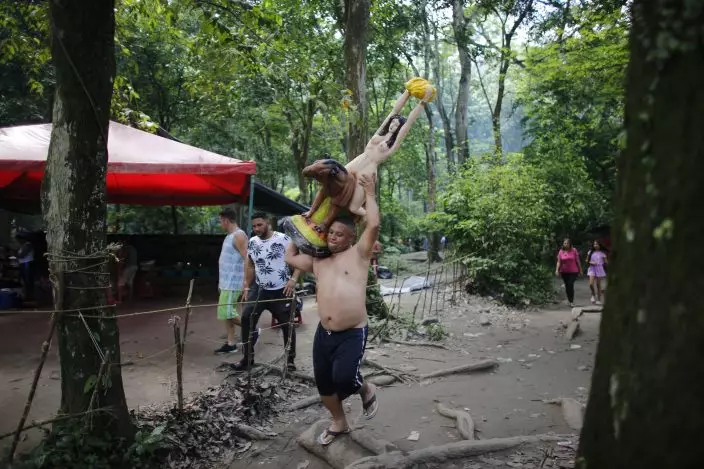
In this photo taken Oct. 13, 2019, a man carries a statue of indigenous goddess Maria Lionza riding on a tapir, on Sorte Mountain where her followers gather annually in Venezuela's Yaracuy state. According to legend, the goddess came from the mountain at Sorte, near the northwestern town of Chivacoa. (AP PhotoAriana Cubillos)
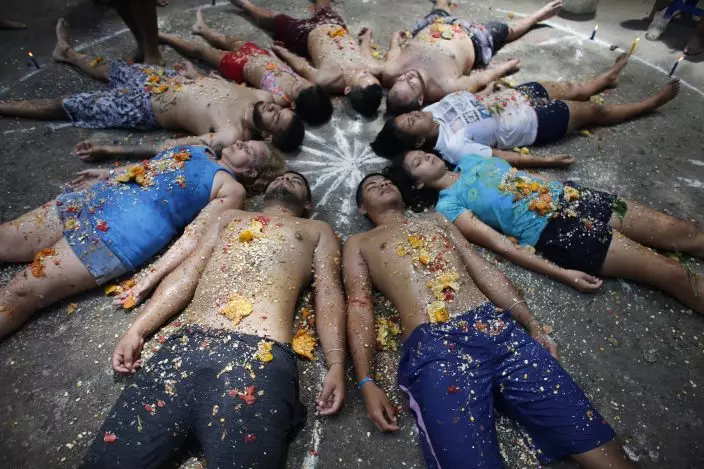
In this photo taken Oct. 13, 2019, followers of Maria Lionza lie amid candles and white powder designs inside a circle called an oracle during a ritual for prosperity on Sorte Mountain where followers of indigenous goddess Maria Lionza gather annually in Venezuela's Yaracuy state. Venezuela is predominantly Roman Catholic, and the church disapproves of the folk religion but has long since abandoned its attempts to suppress it. (AP PhotoAriana Cubillos)
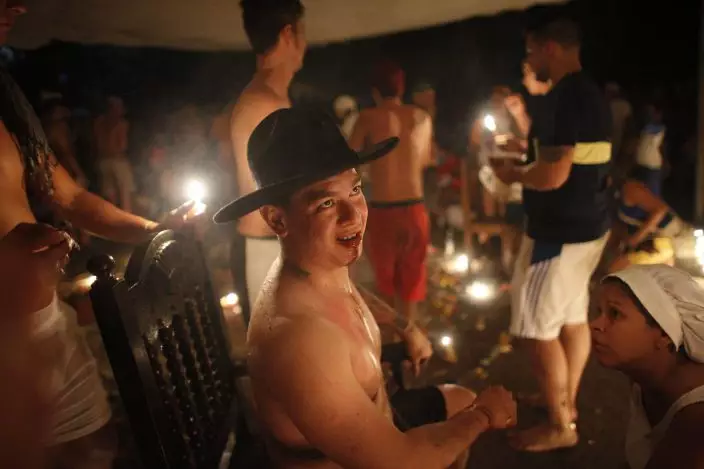
In this photo taken Oct. 12, 2019, a man with chewing tobacco dripping from his mouth goes into a trance as a grandfather spirit known as a "Chamarrero" is believed to enter his body during an annual gathering of followers of indigenous goddess Maria Lionza on Sorte Mountain in Venezuela's Yaracuy state. Those immersed in the old tradition say it puts them in a trance that allows them to channel spirits and escape injury from otherwise dangerous feats. (AP PhotoAriana Cubillos)
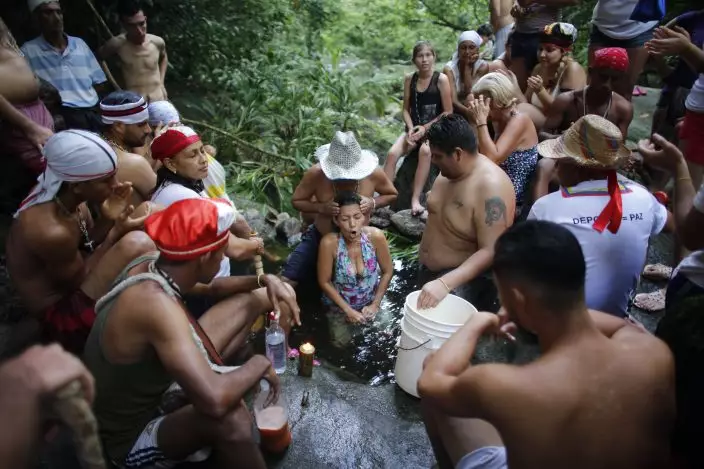
In this photo taken Oct. 12, 2019, Juan Carlos Paso performs a cleansing ritual on a woman in a pool of water on Sorte Mountain where followers of indigenous goddess Maria Lionza gather annually in Venezuela's Yaracuy state. Devotees say the number of followers swells as Venezuelans turn for answers to the struggle of daily life outside traditional political system, churches and hospitals. (AP PhotoAriana Cubillos)
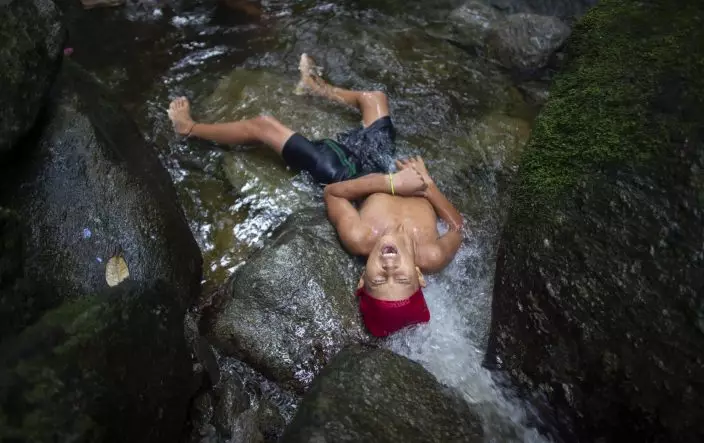
In this photo taken Oct. 12, 2019, a youth lies in water for a cleansing ritual on Sorte Mountain where followers of indigenous goddess Maria Lionza gather annually in Venezuela's Yaracuy state. Believers congregated for rituals on the remote mountainside where adherents make the pilgrimage to pay homage to the goddess, seeking spiritual connection and physical healing. (AP PhotoAriana Cubillos)
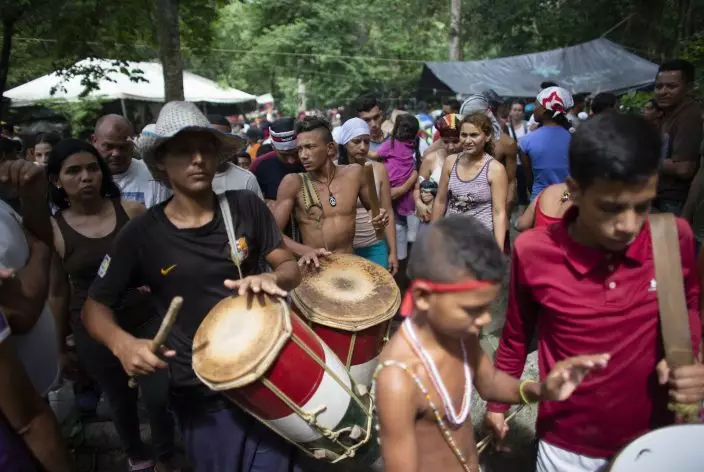
In this photo taken Oct 12, 2019, people play drums during a procession on Sorte Mountain where followers of indigenous goddess Maria Lionza gather annually in Venezuela's Yaracuy state. The gathering in honor of Maria Lionza is hundreds of years old and draws on Catholicism, Afro-Caribbean religion Santeria and indigenous rituals, all set to a pulse of constant drumming. (AP PhotoAriana Cubillos)
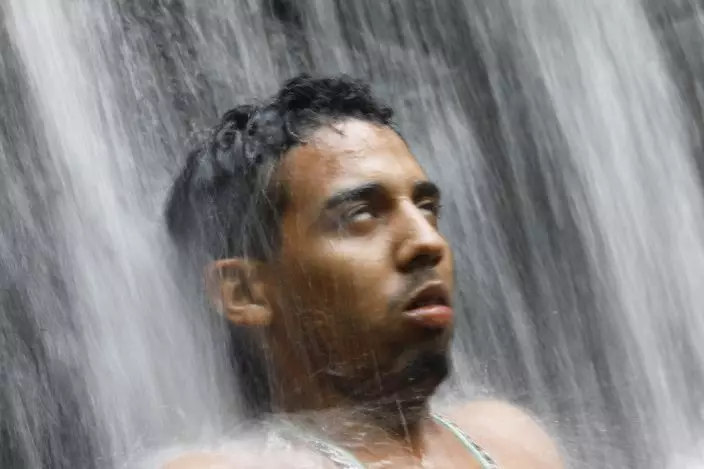
In this photo taken Oct. 12, 2019, a man with his eyes rolled back stands under a waterfall during a spiritual ceremony on Sorte Mountain where followers of indigenous goddess Maria Lionza gather annually in Venezuela's Yaracuy state. The tradition is hundreds of years old and draws on elements of the Afro-Caribbean religion Santeria and indigenous rituals, as well as Catholicism. (AP PhotoAriana Cubillos)
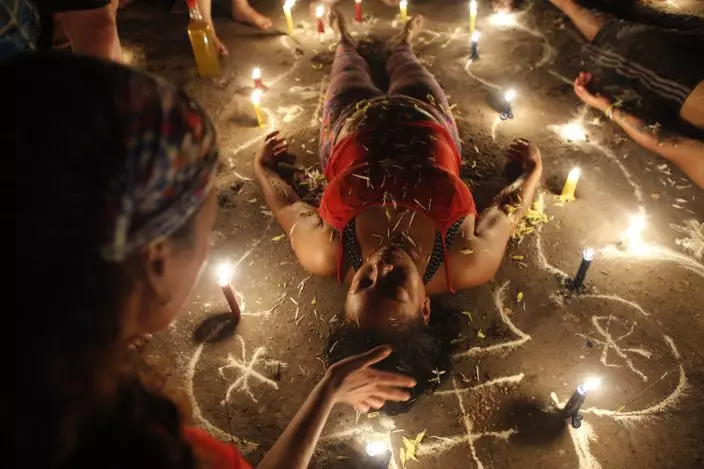
In this photo taken Oct. 11, 2019, a woman surrounded by candles and designs drawn on the ground with white powder lies with her eyes closed during a spiritual ceremony on Sorte Mountain where followers of indigenous goddess Maria Lionza gather annually in Venezuela's Yaracuy state. Believers often ask for spiritual healing or protection from witchcraft, or thank the goddess for curing an illness. (AP PhotoAriana Cubillos)
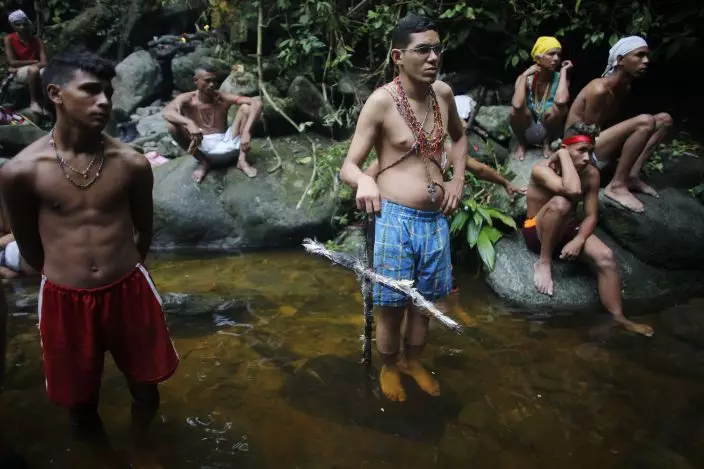
In this photo taken Oct. 12, 2019, men standing in a pool of water watch a spiritual ceremony on Sorte Mountain where followers of indigenous goddess Maria Lionza gather annually in Venezuela's Yaracuy state. Devotees say the number of followers swells as Venezuelans turn for answers to the struggle of daily life outside traditional political system, churches and hospitals. (AP PhotoAriana Cubillos)
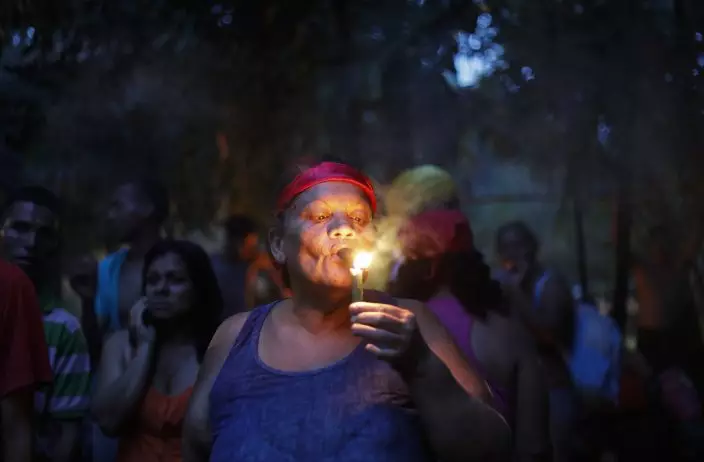
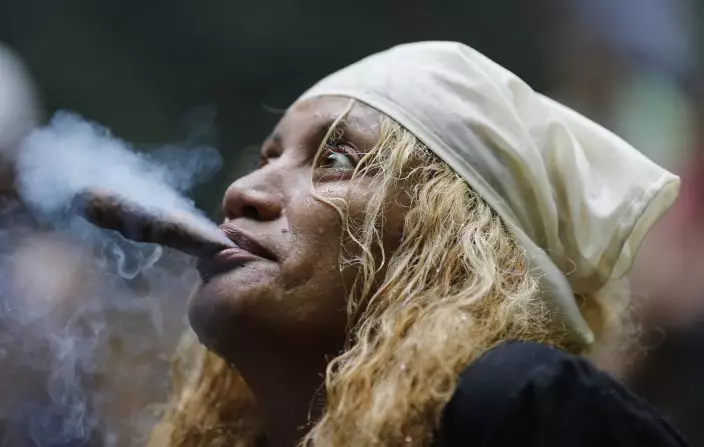
In this photo taken Oct. 11, 2019, a woman lights a cigar at the entrance of Sorte mountain to ask for permission to perform spiritual rituals where followers of indigenous goddess Maria Lionza gather annually in Venezuela's Yaracuy state. Believers congregated for rituals on the remote mountainside where adherents make a pilgrimage to pay homage to the goddess, seeking spiritual connection and physical healing. (AP PhotoAriana Cubillos)
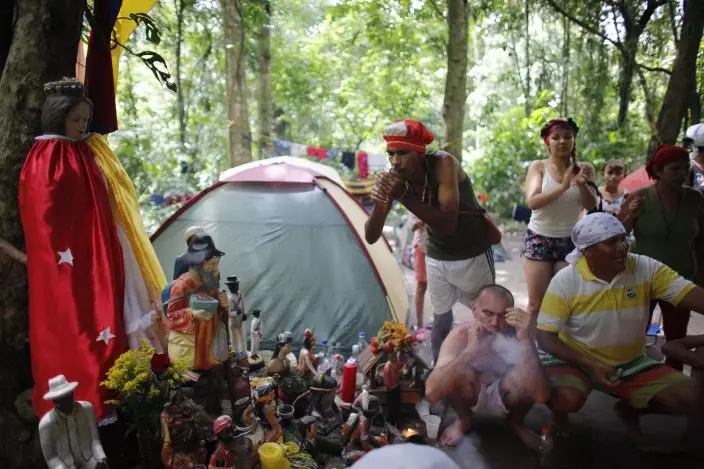
In this photo taken Oct. 12, 2019, followers of indigenous goddess Maria Lionza smoke cigars during purification rituals and to deflect evil spirits, next to an altar featuring her statue, left, on Sorte Mountain where followers of the goddess gather annually in Venezuela's Yaracuy state. Many camped in tents among the old-growth forest while dedicating several days to spiritual ceremonies. (AP PhotoAriana Cubillos)
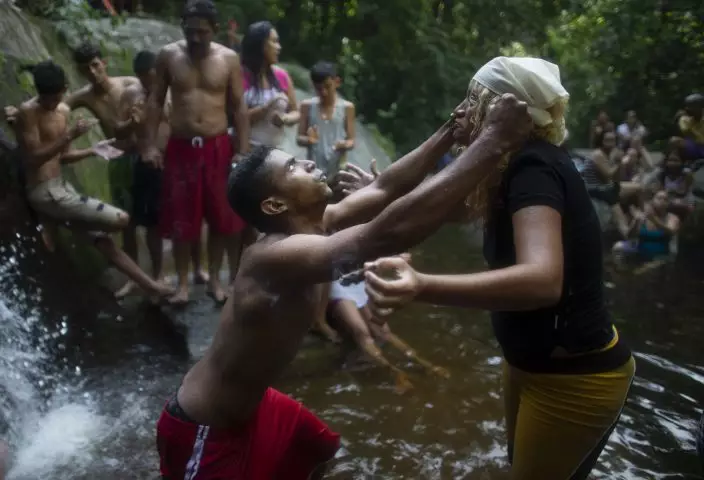
In this photo taken Oct. 12, 2019, a man's eyes roll backwards as he partakes in a ritual with a spiritual healer known as a "madrina" on Sorte Mountain where followers of indigenous goddess Maria Lionza gather annually in Venezuela's Yaracuy state. Venezuela is predominantly Roman Catholic, and while the church disapproves of the folk religion, it has long since abandoned its attempts to suppress it. (AP PhotoAriana Cubillos)
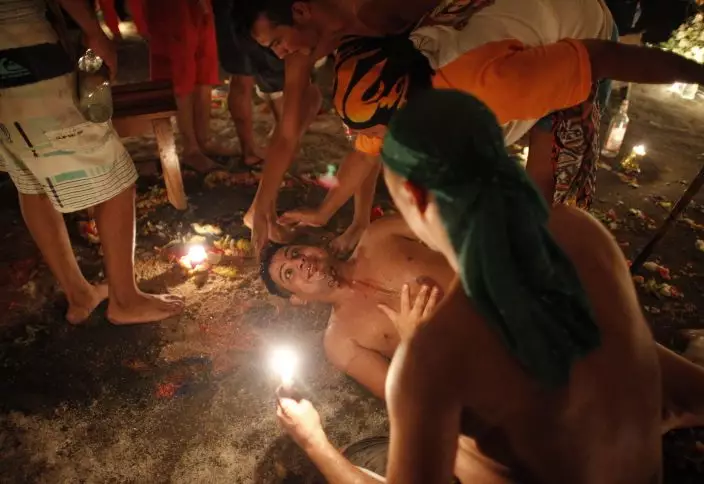
In this photo taken Oct. 12, 2019, a man with chewing tobacco dripping from his mouth goes into a trance as a grandfather spirit known as a "Chamarrero" is believed to enter his body during an annual gathering of followers of indigenous goddess Maria Lionza on Sorte Mountain in Venezuela's Yaracuy state. Those immersed in the old tradition say it puts them in a trance that allows them to channel spirits and escape injury from otherwise dangerous feats. (AP PhotoAriana Cubillos)

In this photo taken Oct. 12, 2019, Juan Carlos Paso sprays water from his mouth on others during a ceremony on Sorte Mountain where followers of indigenous goddess Maria Lionza gather in Venezuela's Yaracuy state. The cult of the goddess is hundreds of years old and draws on elements of the Afro-Caribbean religion Santeria and indigenous rituals, as well as Catholicism. (AP PhotoAriana Cubillos)
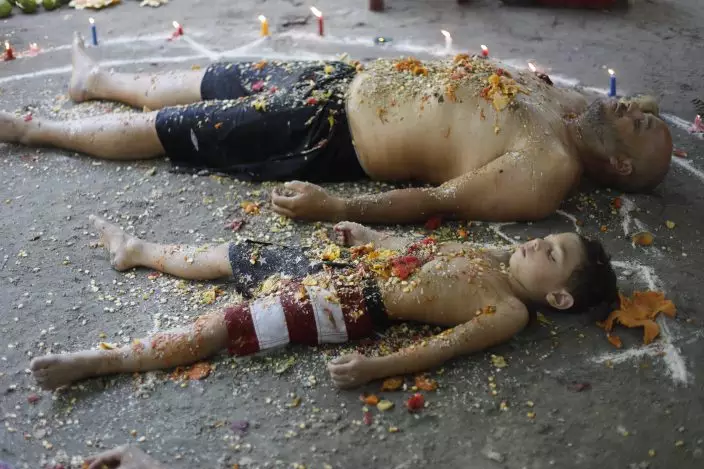
In this photo taken Oct. 13, 2019, a man and boy lie with their eyes closed amid candles inside a circle, called an oracle, made of white powder during a ritual for prosperity on Sorte Mountain where followers of indigenous goddess Maria Lionza gather annually in Venezuela's Yaracuy state. Venezuela is predominantly Roman Catholic, whose church disapproves of the folk religion but has long since abandoned its attempts to suppress it. (AP PhotoAriana Cubillos)
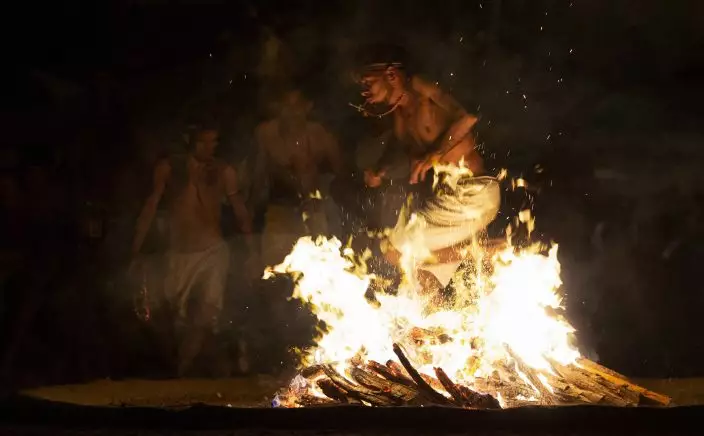
In this photo taken Oct. 11, 2019, a man performs the flame dance on Sorte Mountain where followers of indigenous goddess Maria Lionza gather annually in Venezuela's Yaracuy state. Those immersed in the old tradition say it puts them in a trance that allows them to channel spirits and escape injury from otherwise dangerous feats. (AP PhotoAriana Cubillos)
According to legend, Maria Lionza came from the mountain at Sorte, which is near the northwestern town of Chivacoa.
In this photo taken Oct. 12, 2019, a spiritual guide known as a "madrina" performs a ritual on a man training to become a medium to receive spirits into his body on Sorte Mountain where followers of indigenous goddess Maria Lionza gather annually in Venezuela's Yaracuy state. The tradition is hundreds of years old and draws on elements of the Afro-Caribbean religion Santeria and indigenous rituals, as well as Catholicism. (AP PhotoAriana Cubillos)
The main day is Oct. 12, observed by many Latin Americans as Indigenous People's Day, but many participants camp in tents among the old-growth forest while dedicating several days to the spiritual ceremonies.
Those immersed in the old rituals say they are put into a trance that allows them to channel spirits and escape injury from otherwise dangerous feats.
At this year's opening event Saturday, Francisco Verdaguer hurled his body through flames and danced across red-hot coals. He circled the flames through the night, striking his forehead with a smoldering club.
In this photo taken Oct. 12, 2019, a spiritual healer known as a "madrina" starts a ritual on Sorte Mountain where followers of indigenous goddess Maria Lionza gather annually in Venezuela's Yaracuy state. While her followers gather on the mountain for weeks at this time of the year, Oct. 12 marks the biggest gathering, coinciding with Indigenous People's Day, known in Latin America as "Dia de la Raza." (AP PhotoAriana Cubillos)
None of that left a single mark on his flesh, he said later.
"I feel good, thank God," Verdaguer said. "My feet are fine, and my body is free of any burns. Above all, I thank the divine trinity — the Father, Son and Holy Ghost — and my holy mother, Queen Maria Lionza."
A man also in the circle bit into a stick of glowing embers, while yet another wearing a red cape summoned a Viking spirit. Adopting a strange, gruff voice and speaking a mythical language, he shouted words to heal those around him.
In this photo taken Oct. 13, 2019, a man carries a statue of indigenous goddess Maria Lionza riding on a tapir, on Sorte Mountain where her followers gather annually in Venezuela's Yaracuy state. According to legend, the goddess came from the mountain at Sorte, near the northwestern town of Chivacoa. (AP PhotoAriana Cubillos)
Maria Lionza is looked to by many across the country. She is memorialized in a salsa song popular among Venezuelans, and a statue of her naked and sitting astride a wild tapir stands in the center-divide of a Caracas highway.
As Venezuela has sunk deeper into economic and social crisis after two decades of socialist rule, devotees say their numbers have swollen as people look for answers to their daily struggles outside the political system and churches.
In various healing ceremonies, a man who had summoned a spirit slashed at his tongue with a razor and jabbed it into his bare chest. Blood smeared his face and dripped down his chest, while those gathered around cheered.
In this photo taken Oct. 13, 2019, followers of Maria Lionza lie amid candles and white powder designs inside a circle called an oracle during a ritual for prosperity on Sorte Mountain where followers of indigenous goddess Maria Lionza gather annually in Venezuela's Yaracuy state. Venezuela is predominantly Roman Catholic, and the church disapproves of the folk religion but has long since abandoned its attempts to suppress it. (AP PhotoAriana Cubillos)
Other men lay motionless and face-up in the dirt amid candles and elaborate drawings in white power as onlookers pass through them and step over their bodies.
Jenny Campos said she is a true believer. A shaman once performed a ceremony over her at Sorte before a major surgery on her ovaries, and she credits that with a quick recovery.
"He told me you won't need to spend much time in the hospital after having surgery," Campos said. "It was a big operation, but after two days my stitches were already healed."
In this photo taken Oct. 12, 2019, a man with chewing tobacco dripping from his mouth goes into a trance as a grandfather spirit known as a "Chamarrero" is believed to enter his body during an annual gathering of followers of indigenous goddess Maria Lionza on Sorte Mountain in Venezuela's Yaracuy state. Those immersed in the old tradition say it puts them in a trance that allows them to channel spirits and escape injury from otherwise dangerous feats. (AP PhotoAriana Cubillos)
In this photo taken Oct. 12, 2019, Juan Carlos Paso performs a cleansing ritual on a woman in a pool of water on Sorte Mountain where followers of indigenous goddess Maria Lionza gather annually in Venezuela's Yaracuy state. Devotees say the number of followers swells as Venezuelans turn for answers to the struggle of daily life outside traditional political system, churches and hospitals. (AP PhotoAriana Cubillos)
In this photo taken Oct. 12, 2019, a youth lies in water for a cleansing ritual on Sorte Mountain where followers of indigenous goddess Maria Lionza gather annually in Venezuela's Yaracuy state. Believers congregated for rituals on the remote mountainside where adherents make the pilgrimage to pay homage to the goddess, seeking spiritual connection and physical healing. (AP PhotoAriana Cubillos)
In this photo taken Oct 12, 2019, people play drums during a procession on Sorte Mountain where followers of indigenous goddess Maria Lionza gather annually in Venezuela's Yaracuy state. The gathering in honor of Maria Lionza is hundreds of years old and draws on Catholicism, Afro-Caribbean religion Santeria and indigenous rituals, all set to a pulse of constant drumming. (AP PhotoAriana Cubillos)
In this photo taken Oct. 12, 2019, a man with his eyes rolled back stands under a waterfall during a spiritual ceremony on Sorte Mountain where followers of indigenous goddess Maria Lionza gather annually in Venezuela's Yaracuy state. The tradition is hundreds of years old and draws on elements of the Afro-Caribbean religion Santeria and indigenous rituals, as well as Catholicism. (AP PhotoAriana Cubillos)
In this photo taken Oct. 11, 2019, a woman surrounded by candles and designs drawn on the ground with white powder lies with her eyes closed during a spiritual ceremony on Sorte Mountain where followers of indigenous goddess Maria Lionza gather annually in Venezuela's Yaracuy state. Believers often ask for spiritual healing or protection from witchcraft, or thank the goddess for curing an illness. (AP PhotoAriana Cubillos)
In this photo taken Oct. 12, 2019, men standing in a pool of water watch a spiritual ceremony on Sorte Mountain where followers of indigenous goddess Maria Lionza gather annually in Venezuela's Yaracuy state. Devotees say the number of followers swells as Venezuelans turn for answers to the struggle of daily life outside traditional political system, churches and hospitals. (AP PhotoAriana Cubillos)
In this photo taken Oct. 11, 2019, a woman lights a cigar at the entrance of Sorte mountain to ask for permission to perform spiritual rituals where followers of indigenous goddess Maria Lionza gather annually in Venezuela's Yaracuy state. Believers congregated for rituals on the remote mountainside where adherents make a pilgrimage to pay homage to the goddess, seeking spiritual connection and physical healing. (AP PhotoAriana Cubillos)
In this photo taken Oct. 12, 2019, followers of indigenous goddess Maria Lionza smoke cigars during purification rituals and to deflect evil spirits, next to an altar featuring her statue, left, on Sorte Mountain where followers of the goddess gather annually in Venezuela's Yaracuy state. Many camped in tents among the old-growth forest while dedicating several days to spiritual ceremonies. (AP PhotoAriana Cubillos)
In this photo taken Oct. 12, 2019, a man's eyes roll backwards as he partakes in a ritual with a spiritual healer known as a "madrina" on Sorte Mountain where followers of indigenous goddess Maria Lionza gather annually in Venezuela's Yaracuy state. Venezuela is predominantly Roman Catholic, and while the church disapproves of the folk religion, it has long since abandoned its attempts to suppress it. (AP PhotoAriana Cubillos)
In this photo taken Oct. 12, 2019, a man with chewing tobacco dripping from his mouth goes into a trance as a grandfather spirit known as a "Chamarrero" is believed to enter his body during an annual gathering of followers of indigenous goddess Maria Lionza on Sorte Mountain in Venezuela's Yaracuy state. Those immersed in the old tradition say it puts them in a trance that allows them to channel spirits and escape injury from otherwise dangerous feats. (AP PhotoAriana Cubillos)
In this photo taken Oct. 12, 2019, Juan Carlos Paso sprays water from his mouth on others during a ceremony on Sorte Mountain where followers of indigenous goddess Maria Lionza gather in Venezuela's Yaracuy state. The cult of the goddess is hundreds of years old and draws on elements of the Afro-Caribbean religion Santeria and indigenous rituals, as well as Catholicism. (AP PhotoAriana Cubillos)
In this photo taken Oct. 13, 2019, a man and boy lie with their eyes closed amid candles inside a circle, called an oracle, made of white powder during a ritual for prosperity on Sorte Mountain where followers of indigenous goddess Maria Lionza gather annually in Venezuela's Yaracuy state. Venezuela is predominantly Roman Catholic, whose church disapproves of the folk religion but has long since abandoned its attempts to suppress it. (AP PhotoAriana Cubillos)
In this photo taken Oct. 11, 2019, a man performs the flame dance on Sorte Mountain where followers of indigenous goddess Maria Lionza gather annually in Venezuela's Yaracuy state. Those immersed in the old tradition say it puts them in a trance that allows them to channel spirits and escape injury from otherwise dangerous feats. (AP PhotoAriana Cubillos)