A room full of grey suits, strict instructions only to photograph the audience from behind and — of course — a medley of James Bond tunes to lighten the mood.
Germany's intelligence agencies on Tuesday inaugurated a joint training center in the heart of Berlin, a city that was dubbed the 'capital of spies' during the Cold War and that to this day remains a hotspot of espionage.
The heads of the foreign and domestic spy agencies officially opened the Center for Intelligence Service Training close to where the Berlin Wall once sliced the city in two, fulfilling German lawmakers' demands that they cut costs by merging their long-separate training facilities.

Bruno Kahl, right, head of the German Federal Intelligence Service, and Thomas Haldenwang, left, head of the German Federal Office for the Protection of the Constitution, attend the opening of a center for advanced education at the Federal Intelligence Service (BND) in Berlin, Germany, Tuesday, Nov. 12, 2019. Germany's intelligence agencies are inaugurating a joint spy school in the heart of Berlin, a city that was dubbed the 'capital of spies' during the Cold War and remains a hotspot of espionage.(AP PhotoMichael Sohn)
Closer cooperation would benefit both agencies, said Hans-Georg Engelke, a senior German security official, citing an incident several years back when a visiting delegation from one organization was denied entry to another.
In a separate case, officials at the BfV domestic intelligence agency at one point were surprised to learn that their American counterparts had provided long-sought information to the foreign intelligence agency BND — who had kept it to themselves.
With space for 700 students, more than 110 of whom can live on-site, the school offers lessons in covert observation, law, interrogation and IT. Among the practical skills students will learn are how to fend off cyberattacks, foil terrorists and shake off hostile agents on their tail.
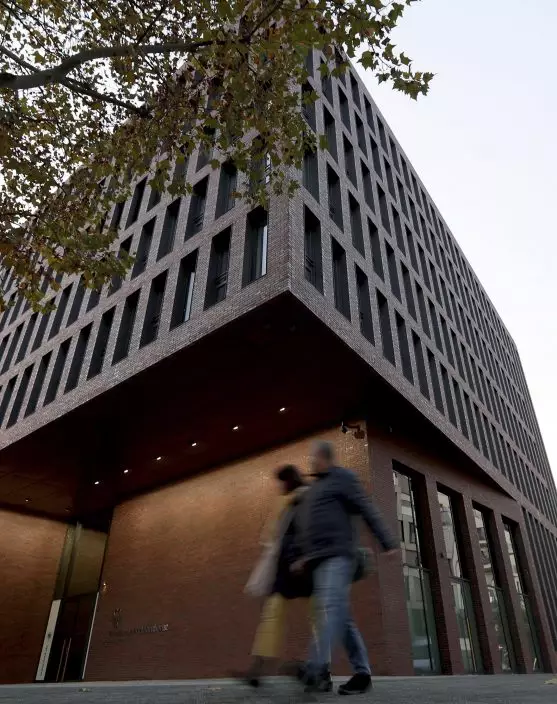
People walk past the center for advanced education (ZNAF) at the Federal Intelligence Service (BND) in Berlin, Germany, Tuesday, Nov. 12, 2019. Germany's intelligence agencies are inaugurating a joint spy school in the heart of Berlin, a city that was dubbed the 'capital of spies' during the Cold War and remains a hotspot of espionage.(AP PhotoMichael Sohn)
Students include recruits fresh out of high school, as well as those who have already completed first degrees and want to pursue a two-year Masters in Intelligence and Security.
Known by its German acronym, ZNAF, the facility includes laboratories, workshops and video studies — all strictly off limits to the press.
The spy school is located at the new 1 billion-euro ($1.1 billion) headquarters of the BND, which opened earlier this year and houses 4,000 staff. The agency was previously based in a sprawling Nazi-era complex in Pullach, near Munich, which remains the site of Germany's electronic eavesdropping operation.
BRUSSELS (AP) — The European Union is expanding its powers to track, raid and deport migrants to " return hubs ″ in third countries in Africa and elsewhere, quietly adopting tactics of the Trump administration that have drawn public criticism across the 27-nation bloc.
The EU continues to tighten migration policies after right-wing parties took power in some countries in 2024. European Commission President Ursula von der Leyen, from the center-right European People's Party coalition, has said that the new measures will prevent a repeat of the 2015 crisis caused by Syria's civil war, when about 1 million people arrived to seek asylum.
“We have learnt the lessons of the past. And today, we are better equipped," von der Leyen has said. The new policies, known as the Pact on Migration and Asylum, go into effect on June 12.
Far-right parties in Europe have praised the deportation policies of U.S. President Donald Trump and called for the EU to adopt a similar approach. Human rights groups warn that authorities are already illegally pushing back migrants at EU borders and hollowing out their legal protections.
The EU already spends millions of dollars to deter migrants before they reach its shores, and has supported tens of thousands of Africans returning home, voluntarily or by force.
What's envisioned now is an expansion of what Italy has created under Prime Minister Giorgia Meloni and her “tough on migration” stance. It operates two migrant detention centers for rejected asylum-seekers in Albania. One currently holds at least 90 migrants, said lawmaker Rachele Scarpa, who said that she found people confused and scared during a recent visit.
In addition, Meloni’s Cabinet has approved an anti-immigration package that would allow the navy to halt vessels in international waters for up to six months if they are deemed a threat to public order; return intercepted migrants to countries of origin or third countries; and speed up the deportation of foreign nationals convicted of crimes.
An “informal group” of EU nations including Germany, Austria, the Netherlands, Denmark and Greece are pursuing deportation center agreements, said Bernd Parusel, a researcher at the Swedish Institute for European Policy Studies.
Kenya is one country they are speaking with, said Tineke Strik, a Dutch member of the European Parliament. Whether consciously or not, the plan is similar to Trump’s deals with nations like El Salvador to take in deported migrants, she said.
Other countries are exploring similar ideas. Sweden’s migration minister has said the conservative ruling coalition approves setting up hubs outside Europe, especially for Afghan and Syrian asylum-seekers.
During the Winter Olympics in Italy, protests erupted over the deployment of U.S. Immigration and Customs Enforcement agents to provide security to the U.S. delegation. But others in Europe have praised ICE’s actions and called for setting up deportation-focused police units.
In 2024, Belgium passed a law allowing the EU border service Frontex operations inside the country, stoking fears among activists that Frontex could join in on raids.
But Frontex’s mandate just covers borders, said spokesperson Chris Borowski, and the current role in voluntary or involuntary returns for the service includes “coordinating flights, helping with travel documents and making sure fundamental rights are respected throughout the process.”
The European Commission has declined requests to take a position on U.S. federal immigration policies.
In Britain, which left the EU several years ago, the center-left Labour Party government has made curbing unauthorized immigration a key focus.
In February, the Home Office said that almost 60,000 people had been deported since the government was elected in July 2024. It said 9,000 arrests were made of people working without permission in 2025, up by more than half from the year before.
Under the principle of non-refoulement in EU and international law, a person can't be returned to a country where they would face persecution.
But European immigration enforcement tactics include so-called pushbacks, where people trying to cross into the EU are forced back across a border without access to asylum procedures.
Authorities in Europe carry out an average of 221 pushbacks a day, according to a February report by a group of humanitarian organizations. More than 80,000 pushbacks were recorded in 2025, the report said, mostly in Italy, Poland, Bulgaria and Latvia.
"Men, women and children — including individuals in critical medical condition — are routinely subjected to beatings, attacks by police dogs, forced stripping, forced river crossings and theft of personal belongings," according to the report.
European agents are brutalizing migrants just like in the U.S., said Flor Didden, migration policy expert at the Belgian human rights group 11.11.11. Some, like in Greece, even wear masks.
"The images are shocking and the outrage is justified,” he said of the U.S. “But where is that same moral clarity when European border authorities abuse, rob and let people die?”
The groups also have recorded an expansion of surveillance technology like drones, thermal cameras and satellites to monitor people on the move.
Other human rights groups warn of a weakening of legal protections.
The EU’s new migration regulations allow for more police raids in private homes and public spaces and more use of surveillance and racial profiling, said a letter to EU institutions in February from 88 nonprofit groups including the Brussels-based Platform for International Cooperation on Undocumented Migrants.
“We cannot be outraged by ICE in the United States while also supporting these practices in Europe,” said the platform's director, Michele LeVoy.
Olivia Sundberg Diez, EU migration advocate for Amnesty International, said Europe retains more protections for vulnerable migrants than the United States but shares much of the political momentum toward harsher policies.
“There’s a level of institutions' and courts' independence and human rights compliance in Europe that you can’t disregard,” she said. “But the fundamental political impulse is the same, and I worry that the human consequences will be the same.”
Giada Zampano reported from Rome. Elena Becatoros in Athens, Greece, Jill Lawless in London, Paolo Santalucia in Rome, Claudia Ciobanu in Warsaw, Poland, and Kirsten Grieshaber in Berlin, contributed to this report.
This story has been corrected to show that Frontex's mandate just covers borders, and that it didn't join raids with Belgian authorities.
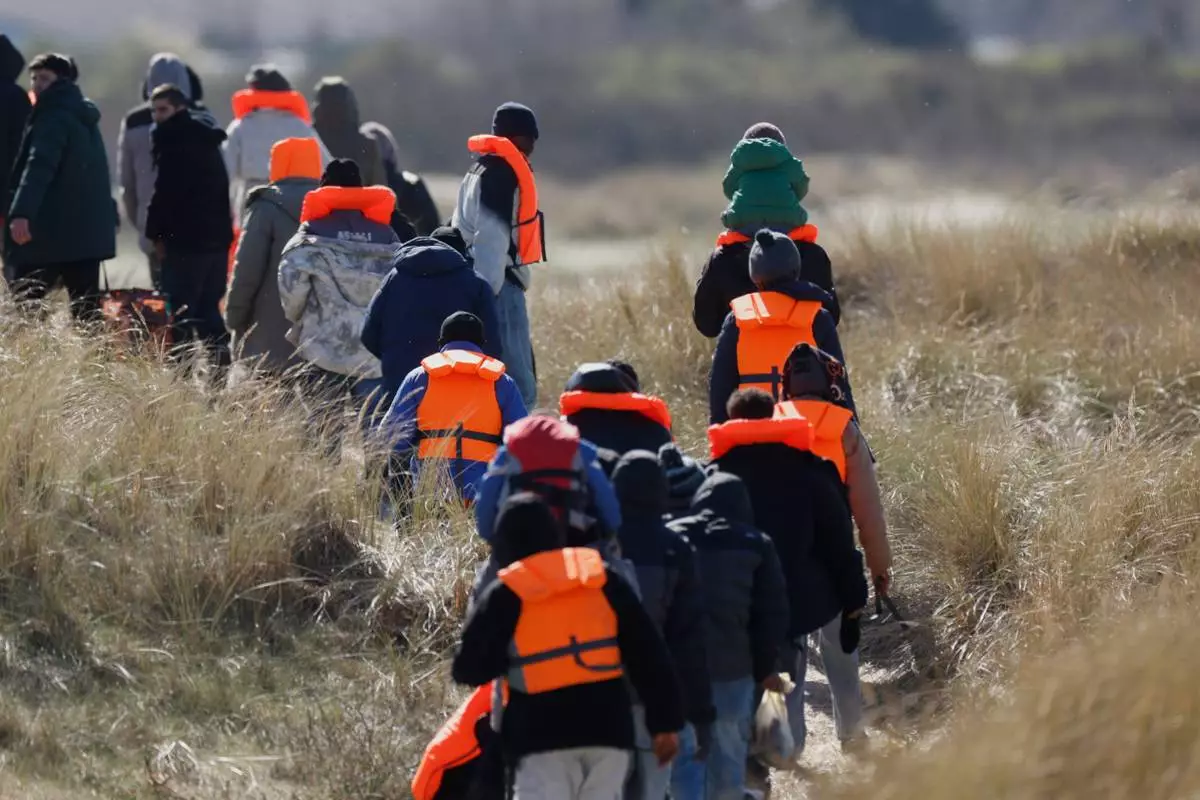
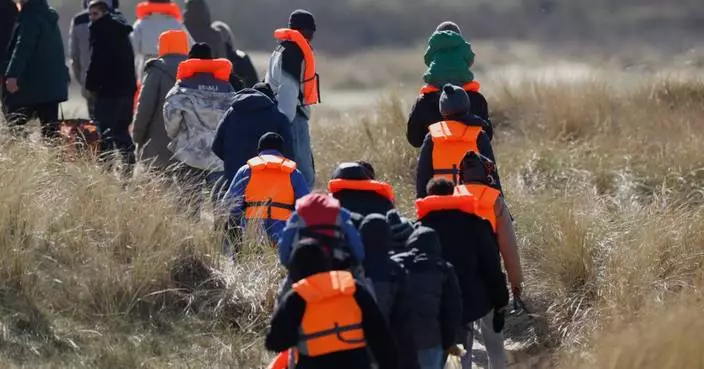
Migrants trying to reach Britain, walk on a beach shore in Gravelines, northern France, Wednesday, March 18, 2026. (AP Photo/Jean-Francois Badias)