
Skip to Content Facebook Feature Image

AP FACT CHECK: Trump's misstatements at NATO summit

News

AP FACT CHECK: Trump's misstatements at NATO summit
News

News

AP FACT CHECK: Trump's misstatements at NATO summit

2019-12-04 04:31 Last Updated At:04:40

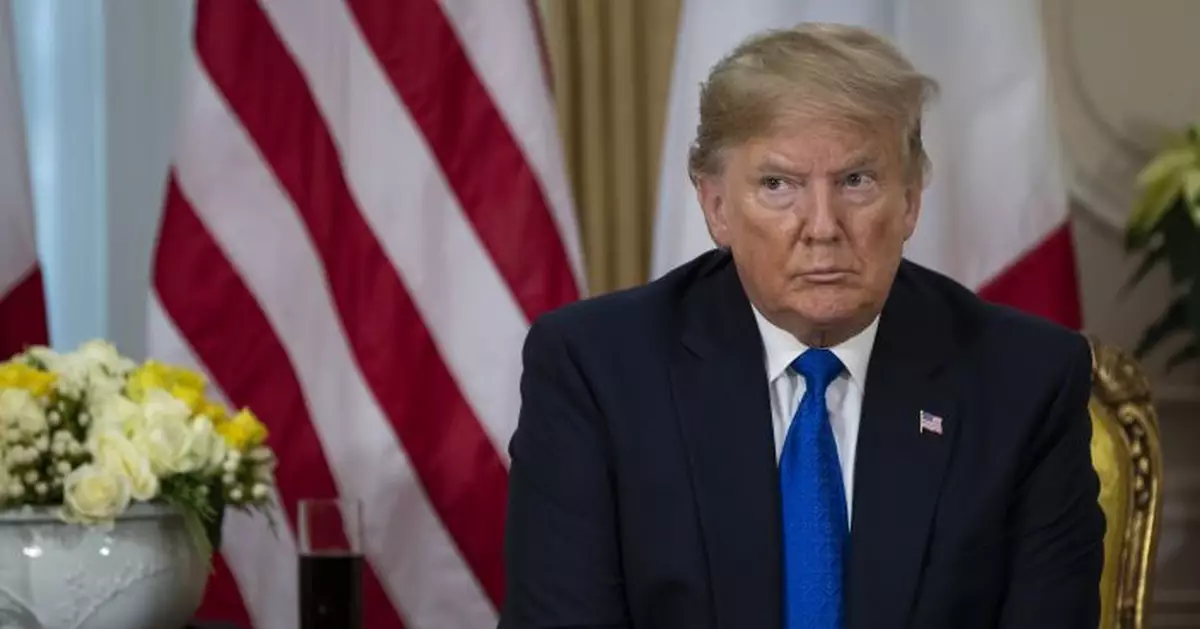
President Donald Trump on Tuesday wholly misrepresented the U.S. record on international trade disputes and dismissed as a mysterious “rumor” his own statement from months ago about Britain's health system.

Here's a look at some of his statements from London, where's he is attending a NATO meeting:

TRUMP: “We won, in the World Trade Organization, we won seven and a half billion dollars. We never used to win before me, because, before me, the United States was a sucker for all of these different organizations.” — remarks with NATO Secretary-General Jens Stoltenberg.
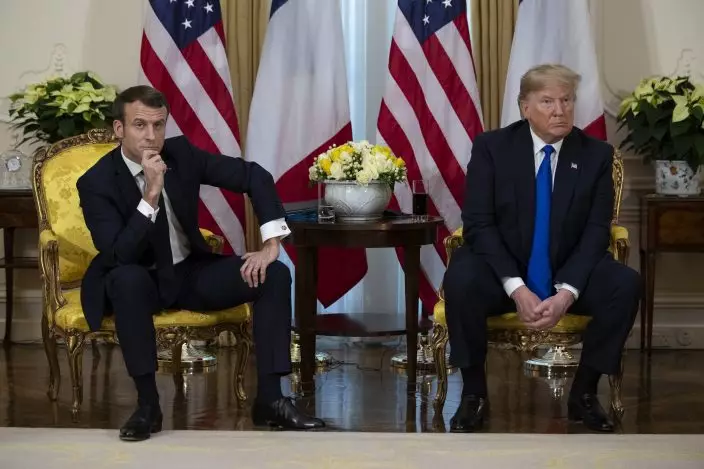
President Donald Trump meets President Emmanuel Macron at Winfield House during the NATO summit, Tuesday, Dec. 3, 2019, in London. (AP Photo Evan Vucci)

President Donald Trump meets President Emmanuel Macron at Winfield House during the NATO summit, Tuesday, Dec. 3, 2019, in London. (AP Photo Evan Vucci)

THE FACTS: He is wildly wrong to state that the U.S. never won victories in disputes taken to the trade organization before him.

The U.S. has always had a high success rate when it pursues cases against other countries at the WTO. In 2017, trade analyst Daniel Ikenson of the libertarian Cato Institute found that the U.S. had won 91% of times it brought a complaint that ended up being adjudicated by the Geneva-based trade monitor.

As Ikenson noted, countries bringing complaints to the organization tend to win because they don't bother going to the WTO in the first place if they don't have a strong case.
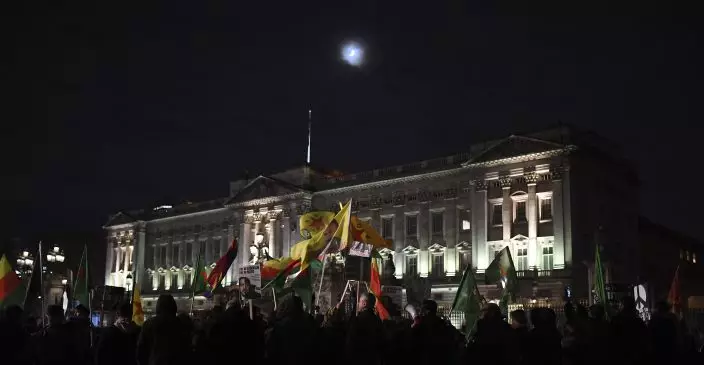
Demonstrators against the NATO summit and U.S. President Donald Trump's visit, gather at Buckingham Palace in London, Tuesday, Dec. 3, 2019. Trump and his NATO counterparts were gathering in London Tuesday to mark the alliance's 70th birthday amid deep tensions as spats between leaders expose a lack of unity that risks undermining military organization's credibility. (AP PhotoAlberto Pezzali)

Demonstrators against the NATO summit and U.S. President Donald Trump's visit, gather at Buckingham Palace in London, Tuesday, Dec. 3, 2019. Trump and his NATO counterparts were gathering in London Tuesday to mark the alliance's 70th birthday amid deep tensions as spats between leaders expose a lack of unity that risks undermining military organization's credibility. (AP PhotoAlberto Pezzali)

As for his claim that the U.S. “won” $7.5 billion from the WTO, that's not quite right.

Trump was referring to a WTO decision in October siding with the U.S. on imposing tariffs on $7.5 billion worth of European imports annually. The value of the tariffs on those imports is much less than $7.5 billion.

The WTO announcement culminated a 15-year fight over EU subsidies for Airbus — a fight that began long before Trump was in office.

TRUMP: “We have a tremendous amount of captured fighters, ISIS fighters over in Syria. And, they're all under lock and key, but many are from France, many are from Germany. Many are from U.K. They are mostly from Europe.” — remarks with French President Emmanuel Macron.

MACRON: There are “very large number of fighters ... ISIS fighters coming from Syria, from Iraq and the region.” Those from Europe are "a tiny minority of the overall problem."

THE FACTS: Trump is incorrect to say the Islamic State fighters who were captured and held by the Kurds in Syria are mostly from Europe.

Of the more than 12,000 IS fighters in custody in Kurdish areas, only 2,500 are from outside the region of the conflict, some from Europe, some from other parts of the world. Most of the captured fighters — about 10,000 — are natives of Syria or Iraq.

European nations have indeed been reluctant to take detainees who came from Europe, frustrating Trump. But such detainees are far fewer than the majority he frequently claims.

TRUMP, speaking about claims that Britain's state-funded health care system would be part of future U.K.-U.S. trade talks: “I don't even know where that rumor started. We have absolutely nothing to do with it and we wouldn't want to. If you handed it to us on a silver platter, we want nothing to do with it.” — remarks with Jens Stoltenberg.

THE FACTS: He's referring to his own past statements as a “rumor.”

Asked about the National Health Service during a visit to Britain in June, he said “when you're dealing in trade, everything’s on the table. So, NHS or anything else."

The service, which provides free health care to all Britons, could in fact be a bargaining chip in U.S.-U.K. trade talks. U.S. health-services firms can already bid for contracts if they have European subsidiaries. A future government could increase the amount of private-sector involvement or let U.S. companies bid directly.

As well, the U.S. could demand during trade talks that Britain pay American pharma firms more for drugs. Medicines became a big issue in negotiations on a revamped North American free trade deal, as the U.S. pushed successfully for tighter restrictions on the development in Canada and Mexico of generic versions of U.S.-patented drugs.

Leaked documents from preliminary talks between U.S. and U.K. negotiators over two years from July 2017 — released by the Labour Party last week — said “patent issues” around “NHS access to generic drugs will be a key consideration” in talks.

It’s an overstatement to say the national health service as a whole would be up for sale, as Labour has alleged will happen if Prime Minister Boris Johnson’s Conservatives win the Dec. 12 election and try to strike a post-Brexit trade deal with the U.S. Britain would not be “selling off” the health service, as Labour asserts, because taxpayers would still be footing the bill.

But it's also improbable to think U.S. negotiators would “want nothing to do" with Britain's health care market, despite Trump’s words.

TRUMP, on protecting oilfields in Syria: “We have the oil, and we can do with the oil what we want." — remarks with Stoltenberg.

THE FACTS: That’s not true. The oil in Syria belongs to Syria and the U.S. can’t do anything it wants with it.

As secretary of state, Rex Tillerson reviewed whether the U.S. could make money off the oil-rich areas and concluded there was no practical way to do so, said Brett McGurk, Trump's former special envoy to the global coalition to defeat the Islamic State. “Maybe there are new lawyers now, but it was just illegal for an American company to go and seize and exploit these assets,” McGurk told a panel on Syria held in October by the Foundation for Defense of Democracies.

Stephen Vladeck, a national security law professor at the University of Texas at Austin, said there is no solid legal argument the Trump administration could make if it sought to claim Syria's oil.

While Trump has said he will withdraw the bulk of roughly 1,000 American troops from Syria, he’s made clear he will leave some military forces in the country to help secure the oil from any Islamic State resurgence.

The Pentagon has said it is committed to sending additional military forces to eastern Syria to "reinforce" control of the oil fields and prevent them from “falling back to into the hands of ISIS or other destabilizing actors.”

EDITOR'S NOTE — A look at the veracity of claims by political figures.

Find AP Fact Checks at http://apne.ws/2kbx8bd

Follow @APFactCheck on Twitter: https://twitter.com/APFactCheck

It looked like a turning point in the global fight against scams. Myanmar’s military leadership, under growing international pressure, vowed to wipe out the industrial-scale cyberscam centers that have taken root in the country. They started by raiding and then bombing KK Park — a notorious compound that has become a symbol of impunity in the battle against one of the most lucrative criminal industries in the world.

It’s too early to say whether KK Park will be abandoned, repurposed or rebuilt over time. But even if KK Park were to close, it’s just one of around 30 scam compounds along Myanmar’s border with Thailand — one indication that the crackdown may not turn out to be as deep or long-lasting as Myanmar’s military rulers would like it to appear.

The Associated Press found that at least two scam compounds in the area continued to use Starlink to get online even after SpaceX announced it had cut off service. And there are other signs the scam industry is adapting fast: The physical damage to KK Park sent thousands of workers scattering to other scam companies in Myanmar and abroad, interviews with current and former scam center workers show. Telegram is popping with job ads for newly displaced workers. And work has continued uninterrupted at other scam centers in Myanmar, where people trafficked from around the world still wait to be rescued.

“Even if you destroy buildings, if you haven’t arrested the heads of the transnational syndicates behind this, seized their wealth and put them in jail, it’s not a real crackdown yet,” said Jay Kritiya, the coordinator of the Civil Society Network for Human Trafficking Victim Assistance.

Myanmar state media announced the raid on KK Park on Oct. 20, which was followed by a weekslong demolition campaign. In November, Myanmar’s military rulers pledged to “eradicate scam activities from their roots.” State media broadcast images of wreckage and soldiers standing with dozens of seized Starlink terminals. They then went after Shwe Kokko, another notorious compound that’s been in the crosshairs of U.S. authorities. SpaceX announced it cut off access to more than 2,500 Starlink units in Myanmar, where they have been widely used by scammers to get online. And Meta said this month it had taken down 2,000 Facebook accounts used by scammers in Myanmar.

It looked as if growing American pressure on foreign scam centers through sanctions, prosecutions and a new, high-level Scam Center Strike Force, was having swift impact as Myanmar prepares for national elections, which have been widely criticized as a sham effort to legitimize the army’s 2021 seizure of power.

Myanmar has said the demolition at KK Park — and raids at additional scam sites — are meant to ensure that criminal activity never returns. This month the government created a high-level task force to enact what it calls a “zero tolerance” policy against scams. The state-run Global New Light of Myanmar on Dec. 15 devoted five full pages to coverage of a press conference showcasing what it described as the government’s aggressive efforts to stop fraud, and characterized cyberscams as the work of foreign criminal networks that have taken root in lawless borderlands controlled by insurgents.

Government officials said that by Dec. 13, 413 buildings in KK Park had been “demolished” and the remaining 222 would be cleared as well. Detailed visual analysis of the first wave of demolition, which the government says is complete, shows that 31 structures were flattened. At least 78 more were partially damaged, according to the Center for Information Resilience (CIR), a London-based nonprofit focused on exposing human rights violations.

More than half the buildings were damaged by heavy machinery, which often left roofs, ceilings and layers between floors intact, said Guy Fusfus, an investigator at Myanmar Witness, a CIR project. “There may be an intention to reconstruct and reuse these buildings,” he said in an email.

New satellite imagery shows that most buildings in KK Park appeared wholly or partially intact on Dec. 4, even as demolition had spread to other sections of the compound. Once home to thousands of workers, many victims of human trafficking, the streets of KK Park appeared empty. Where all those people went — and what that portends for the future of a criminal industry the FBI says cost Americans more than $16 billion last year — remain open questions.

“This isn’t just breaking windows and moving on. You can’t come in and restart operations here at the same scale as before,” said Eric Heintz, a global analyst at the International Justice Mission, a Washington, D.C.-based NGO, who reviewed satellite images of the damage. “But we don’t know if that activity is just going to be displaced to other locations.”

Myanmar’s track record of lasting enforcement is poor. Raids in response to Chinese pressure earlier this year failed to contain the growth of scam compounds, according to C4ADS, a U.S.-based nonprofit that takes a data-driven approach to conflict analysis. Over 7,000 scam center workers were released as part of that purge, according to the U.N. Office on Drugs and Crime, but the scams kept on running.

C4ADS examined satellite imagery of 21 known scam compounds in Myawaddy Township and found that 14 of them — including KK Park — had shown construction or expansion since January. Some solar panels also appeared — a step toward energy independence that could blunt the impact of crackdowns from neighboring Thailand, which has occasionally cut off power.

“This continued growth of scam compounds is emblematic of the junta’s inability to rein in the industry within Myanmar,” said Michael Di Girolamo, a C4ADS analyst focused on cybercrime.

Analysts say that some of the same people who led the raid on KK Park have profited from scams over the years. KK Park, like most scam compounds along the Thai border, operates under the protection of the Karen Border Guard Force — also known as the Karen National Army — an armed militia made up of ethnic Karen people who live in eastern Myanmar that is affiliated with the Myanmar military, according to U.S. and European government sanctions notices.

Jason Tower, a senior expert at the Global Initiative Against Transnational Organized Crime, said the action at KK Park was a way for Myanmar’s military leadership to relieve pressure, primarily from the U.S. and China, and continue to host highly lucrative criminal activity. “There’s no real political will to crack down,” he said.

A month after KK Park was raided, another scam center fell, far from the glare of government propaganda. On Nov. 21, forces of the Karen National Union, a rebel group opposed to Myanmar’s military leadership, stormed a scam compound called Shunda Park in an area controlled by a pro-government militia.

“This looks much more like a real crackdown on crime,” Tower said.

While Myanmar state television broadcast images of a steamroller crushing rows of scammers’ computers, the Karen National Union gathered 604 mobile phones, bank cards, computers and other evidence from Shunda and handed them over to Thai authorities for investigation.

“The Myanmar military just destroys everything,” KNU spokesperson Padoh Saw Taw Nee told AP. “It’s clear they don’t want people to know who is controlling it.”

Requests for comment to a Myanmar military government spokesman went unanswered. But the Global New Light of Myanmar called claims that evidence was being destroyed “astonishing.” All evidence was properly collected, the paper said, and would be “released as appropriate in future public statements.”

Since the raid on KK Park, the Thai military said around 1,500 people who worked there have made it out through official channels in Thailand — a fraction of the total workforce, estimated to be in the tens of thousands.

The whereabouts of the rest are unknown. Some followed company bosses to other locations, four workers who fled KK Park told AP. They spoke on condition of anonymity, fearing for their safety.

One Filipino worker said he and 20 others who jumped the fence at KK Park were picked up by government-allied forces and made it to Thailand. But five Ethiopians on his team stayed behind. “They wanted to go to another company,” he explained. He said he overheard his boss, who was Chinese, talk about relocating the operation to Cambodia.

Another Filipina worker said her company relocated dozens of staff, computers and Wi-Fi equipment to a nearby compound called Huanya, to get the business targeting older American men with a gold investment scam back up and running as quickly as possible.

Telegram is awash with recruitment offers for displaced workers. One company seeking staff to target U.S. “clients” appeared to offer the option of working remotely from the town of Myawaddy. “No daily attendance or registration required,” the notice read.

A company seeking staff for “finding and chatting” with cryptocurrency clients said it would arrange direct flights from Yangon in Myanmar to Phnom Penh, Cambodia’s capital, for those with passports and “safe transportation by car” for those without. “Come quickly,” the announcement urged.

More than 200 African workers from KK Park went to the nearby Apollo scam compound, according to a foreign woman trapped there.

Another 100 or so moved to a compound known as Hengsheng Park 4, according to an employee who says his bosses won’t let him leave even if he pays a ransom. He said KK workers stayed for a week and then moved on. “I heard that most of them went to Cambodia, Mauritius and Africa,” he said.

He said his company still uses Starlink to get online — three units stopped working after SpaceX announced the ban, but a fourth still functions.

Starlink is also still up and running at the Deko Park compound, 35 miles (56 kilometers) south of KK Park, according to a worker trapped there.

The Associated Press is withholding the names of all three for safety reasons. AP asked SpaceX for comment and provided the locations of both compounds, but the company did not reply.

The Myanmar government’s pledges to wipe out scams haven’t helped the man at Deko Park, whose legs bloomed with bruises from a beating, photos show. He sends pleas almost daily: “Is there any latest news?” he wrote in a recent text message to a woman who is trying to help him escape. “I really want to go.”

---

This story is part of an ongoing collaboration between The Associated Press and FRONTLINE (PBS) that includes an upcoming documentary.

—-

Associated Press reporter Huizhong Wu contributed from Bangkok, Thailand.

—-

Contact AP’s global investigative team at Investigative@ap.org or https://www.ap.org/tips/.

FILE - People from China, Vietnam and Ethiopia, believed to have been trafficked and forced to work in scam centers, sit with their faces masked while in detention after being released from the centers in Myawaddy district in eastern Myanmar, Wednesday, Feb. 26, 2025. (AP Photo/Thanaphon Wuttison, File)

FILE - People from China, Vietnam and Ethiopia, believed to have been trafficked and forced to work in scam centers, sit with their faces masked while in detention after being released from the centers in Myawaddy district in eastern Myanmar, Wednesday, Feb. 26, 2025. (AP Photo/Thanaphon Wuttison, File)

FILE - In this image provided by the Myanmar military on Oct. 19, 2025, soldiers stand next to Starlink satellite internet devices as they seize KK Park online scam center in Myawaddy township, Karen State, Myanmar. (The Myanmar Military True News Information Team via AP, File)

FILE - In this image provided by the Myanmar military on Oct. 19, 2025, soldiers stand next to Starlink satellite internet devices as they seize KK Park online scam center in Myawaddy township, Karen State, Myanmar. (The Myanmar Military True News Information Team via AP, File)

FILE - In this image provided by the Myanmar military on Oct. 19, 2025, soldiers raid the KK Park online scam center in Myawaddy township, Karen State, Myanmar. (The Myanmar Military True News Information Team via AP, File)

FILE - In this image provided by the Myanmar military on Oct. 19, 2025, soldiers raid the KK Park online scam center in Myawaddy township, Karen State, Myanmar. (The Myanmar Military True News Information Team via AP, File)

FILE - White smoke billows after an explosion at KK Park online scam center in Myawaddy township, Karen State, Myanmar, Saturday, Oct. 25, 2025. (AP Photo/Sarot Meksophawannakul, File)

FILE - White smoke billows after an explosion at KK Park online scam center in Myawaddy township, Karen State, Myanmar, Saturday, Oct. 25, 2025. (AP Photo/Sarot Meksophawannakul, File)

Recommended Articles