Skip to Content Facebook Feature Image

Europe's employment aid keeps jobs from vanishing -- for now

News

Europe's employment aid keeps jobs from vanishing -- for now
News

News

Europe's employment aid keeps jobs from vanishing -- for now

2020-04-30 14:52 Last Updated At:15:00

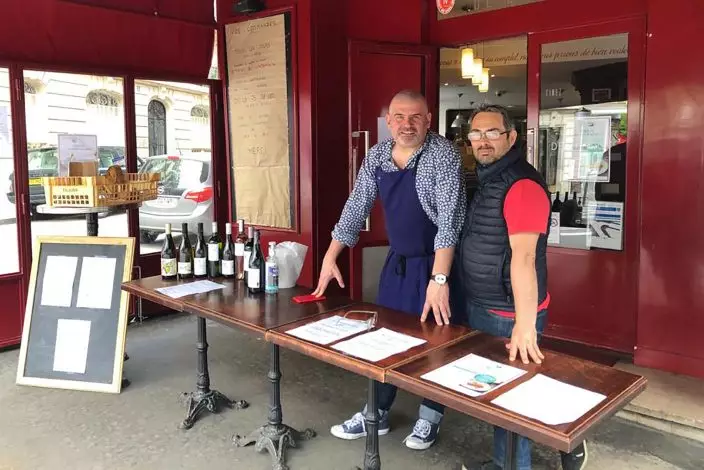
Christian Etchebest's Parisian bistro is a shadow of its usual bustling self. Five lunch specials sit in neat paper bags on the bar awaiting takeout customers — a tiny fraction of his normal midday business before the coronavirus.

A skeleton staff rotates in daily at La Cantine du Troquet near the banks of the Seine River, just blocks from the Eiffel Tower. One day they packaged a streamlined version of his Basque menu: sausages with a celery and beetroot remoulade, mashed potatoes and a dessert of strawberries with lemon sauce.

More Images
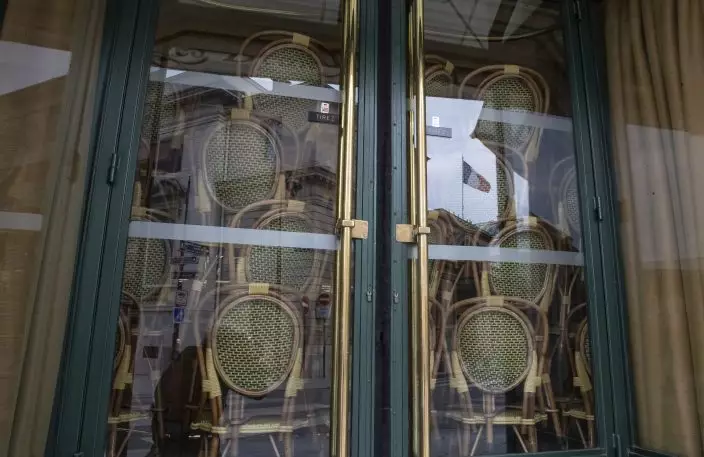
FILE - In this Thursday, April 2, 2020 file photo, chairs are stacked behind a entrance door of a restaurant during a nationwide confinement to counter the coronavirus, in Paris. Programs across Europe are keeping hard-hit businesses afloat, preventing millions of workers from losing their jobs and income for now and thousands of bosses from seeing their trained staff scatter to the four winds. (AP PhotoMichel Euler, File)
FILE - In this Thursday, April 2, 2020 file photo, chairs are stacked behind a entrance door of a restaurant during a nationwide confinement to counter the coronavirus, in Paris. Programs across Europe are keeping hard-hit businesses afloat, preventing millions of workers from losing their jobs and income for now and thousands of bosses from seeing their trained staff scatter to the four winds. (AP PhotoMichel Euler, File)

In this photo taken Tuesday, April 28, 2020 restaurant owner, Christian Etchebest, 50, left, and his chef Thierry Larallde, who is temporary unemployed, pose in the restaurant La Cantine du Troquet in Paris. Christian Etchebest's Parisian bistro is on life support. Five 22-euro lunch specials sit in neat paper bags on the zinc bar awaiting takeout customers, a tiny fraction of his normally bustling midday business before the coronavirus outbreak. (AP PhotoMasha Macpherson)

In this photo taken Tuesday, April 28, 2020 restaurant owner, Christian Etchebest, 50, left, and his chef Thierry Larallde, who is temporary unemployed, pose in the restaurant La Cantine du Troquet in Paris. Christian Etchebest's Parisian bistro is on life support. Five 22-euro lunch specials sit in neat paper bags on the zinc bar awaiting takeout customers, a tiny fraction of his normally bustling midday business before the coronavirus outbreak. (AP PhotoMasha Macpherson)

FILE - In this Wednesday, April 29, 2020 file photo, a hearse passes under an electronic message sign reading "Stay at Home, Only Together We Can Control Corona", on the ring road in Amsterdam, Netherlands. Businesses across Europe, many with employees on temporary unemployment due to coronavirus restrictions, are waiting for government rules to ease before some can go back to work. (AP PhotoPeter Dejong, File)

FILE - In this Wednesday, April 29, 2020 file photo, a hearse passes under an electronic message sign reading "Stay at Home, Only Together We Can Control Corona", on the ring road in Amsterdam, Netherlands. Businesses across Europe, many with employees on temporary unemployment due to coronavirus restrictions, are waiting for government rules to ease before some can go back to work. (AP PhotoPeter Dejong, File)

FILE - In this photo taken on Friday, April 24, 2020, Femke Zimmerman, manager of Brasserie Berlage, a cafe and restaurant nestled in the manicured gardens of The Hague's historic art deco Kunstmuseum, poses for a portrait as she prepares the restaurant for reopening, in The Hague, Netherlands. Businesses across Europe, many with employees on temporary unemployment due to coronavirus restrictions, are waiting for government rules to ease before some can go back to work. (AP PhotoPeter Dejong)

FILE - In this photo taken on Friday, April 24, 2020, Femke Zimmerman, manager of Brasserie Berlage, a cafe and restaurant nestled in the manicured gardens of The Hague's historic art deco Kunstmuseum, poses for a portrait as she prepares the restaurant for reopening, in The Hague, Netherlands. Businesses across Europe, many with employees on temporary unemployment due to coronavirus restrictions, are waiting for government rules to ease before some can go back to work. (AP PhotoPeter Dejong)

FILE - In this Sunday, April 26, 2020 file photo, Nursery S. Schouten created a message of support in times of the coronavirus reading "#StayStrong" by cutting of the flower heads in a field of tulips in Bant, Netherlands. Businesses across Europe, many with employees on temporary unemployment due to coronavirus restrictions, are waiting for government rules to ease before some can go back to work. (AP PhotoStef Hoffer, File)
FILE - In this Sunday, April 26, 2020 file photo, Nursery S. Schouten created a message of support in times of the coronavirus reading "#StayStrong" by cutting of the flower heads in a field of tulips in Bant, Netherlands. Businesses across Europe, many with employees on temporary unemployment due to coronavirus restrictions, are waiting for government rules to ease before some can go back to work. (AP PhotoStef Hoffer, File)

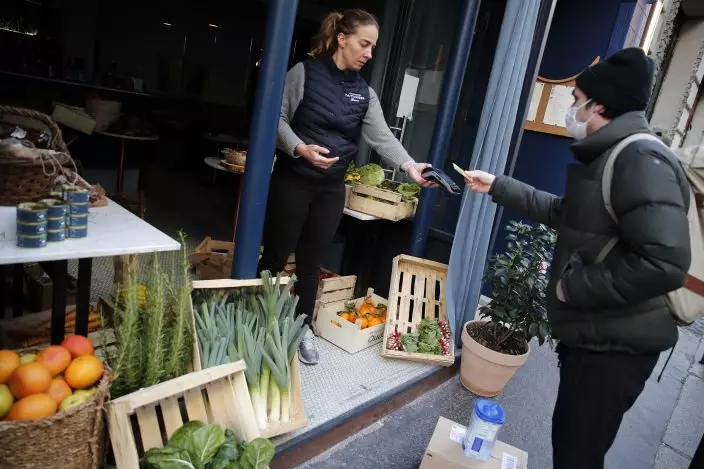
FILE - In this Friday, March 27, 2020 file photo, Chef Amandine Chaignot, left, receives payment from a customer after turning her restaurant into a shop to sell vegetables during the lockdown to prevent the spread of coronavirus, in Paris. Many restaurants in Europe have had to find alternate ways to stay in business, with many offering only takeout service or transforming their brick and mortar shops into small supermarkets. (AP PhotoFrancois Mori, File)

FILE - In this Friday, March 27, 2020 file photo, Chef Amandine Chaignot, left, receives payment from a customer after turning her restaurant into a shop to sell vegetables during the lockdown to prevent the spread of coronavirus, in Paris. Many restaurants in Europe have had to find alternate ways to stay in business, with many offering only takeout service or transforming their brick and mortar shops into small supermarkets. (AP PhotoFrancois Mori, File)

FILE - In this Friday, April 3, 2020 file photo, a note that reads in French: "Ghislain. I would like coronavirus to be eradicated so we can go back to normal" is left among others in a church during a partial lockdown against the spread of coronavirus in Brussels. (AP PhotoFrancisco Seco, File)

FILE - In this Friday, April 3, 2020 file photo, a note that reads in French: "Ghislain. I would like coronavirus to be eradicated so we can go back to normal" is left among others in a church during a partial lockdown against the spread of coronavirus in Brussels. (AP PhotoFrancisco Seco, File)

FILE - In this Tuesday, April 28, 2020 file photo, two skulls painted in a Union Flag are displayed in a window of a closed souvenir shop in London, as the lockdown continues due to the coronavirus. Businesses across Europe, many with employees on temporary unemployment due to coronavirus restrictions, are waiting for government rules to ease before some can go back to work. (AP PhotoAlberto Pezzali, File)
FILE - In this Tuesday, April 28, 2020 file photo, two skulls painted in a Union Flag are displayed in a window of a closed souvenir shop in London, as the lockdown continues due to the coronavirus. Businesses across Europe, many with employees on temporary unemployment due to coronavirus restrictions, are waiting for government rules to ease before some can go back to work. (AP PhotoAlberto Pezzali, File)

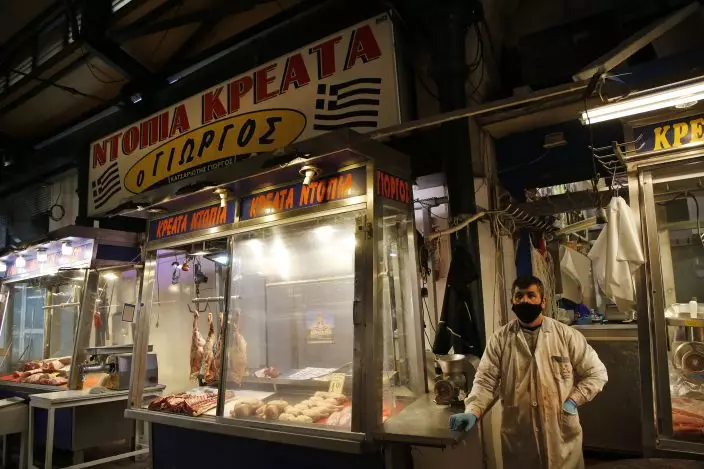
FILE - In this Friday, April 17, 2020 file photo, a butcher wearing a mouth mask to protect against coronavirus, waits for customers at the Varvakios meat market in Athens. Due to lockdown measures taken to prevent the spread of the COVID-19 the market saw much less business during the holiday Easter period. (AP PhotoLefteris Pitarakis, File)
FILE - In this Friday, April 17, 2020 file photo, a butcher wearing a mouth mask to protect against coronavirus, waits for customers at the Varvakios meat market in Athens. Due to lockdown measures taken to prevent the spread of the COVID-19 the market saw much less business during the holiday Easter period. (AP PhotoLefteris Pitarakis, File)

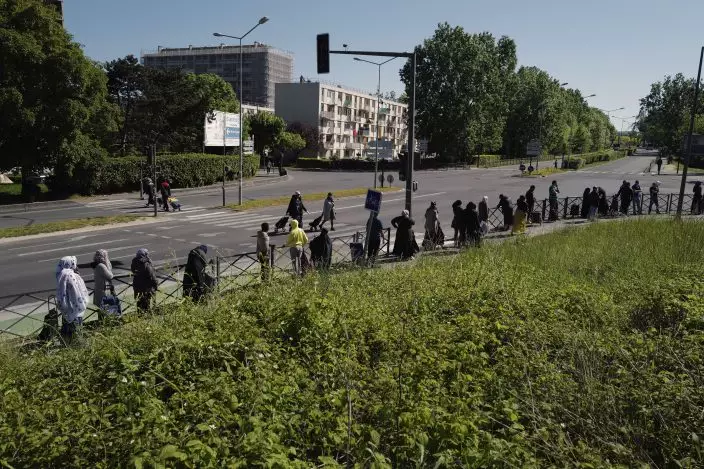
FILE - In this April 22, 2020, file photo, residents line up during a distribution to collect soap, vegetables, fruits and other staples distributed by volunteers in Clichy-sous-Bois, a suburb north of Paris. Open-air markets are closed, supermarket prices are skyrocketing and people are out of jobs. Putting food on the table is yet another challenge for the disenfranchised residents of France's housing projects, where the fallout of the national lockdown over the coronavirus is raising concerns about social unrest. (AP PhotoFrancois Mori, File)

FILE - In this April 22, 2020, file photo, residents line up during a distribution to collect soap, vegetables, fruits and other staples distributed by volunteers in Clichy-sous-Bois, a suburb north of Paris. Open-air markets are closed, supermarket prices are skyrocketing and people are out of jobs. Putting food on the table is yet another challenge for the disenfranchised residents of France's housing projects, where the fallout of the national lockdown over the coronavirus is raising concerns about social unrest. (AP PhotoFrancois Mori, File)

FILE - In this Saturday, April 18, 2020 file photo, a pilot and crew members of South African Airways go through the security check in Frankfurt, Germany. Due to the coronavirus outbreak many flights have been cancelled and some airports have grounded their planes. (AP PhotoMichael Probst, File)
FILE - In this Saturday, April 18, 2020 file photo, a pilot and crew members of South African Airways go through the security check in Frankfurt, Germany. Due to the coronavirus outbreak many flights have been cancelled and some airports have grounded their planes. (AP PhotoMichael Probst, File)

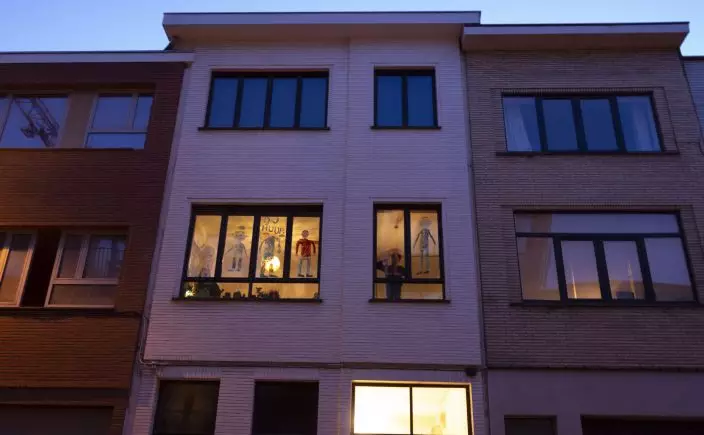
FILE - In this Sunday, March 22, 2020, a boy makes paintings on windows in a house in Antwerp, Belgium during a lockdown to prevent the spread of the coronavirus. Employees in many European countries have had to adapt to working from home and the additional task of homeschooling their children as the lockdown to prevent the spread of the coronavirus continues. (AP PhotoVirginia Mayo, File)

FILE - In this Sunday, March 22, 2020, a boy makes paintings on windows in a house in Antwerp, Belgium during a lockdown to prevent the spread of the coronavirus. Employees in many European countries have had to adapt to working from home and the additional task of homeschooling their children as the lockdown to prevent the spread of the coronavirus continues. (AP PhotoVirginia Mayo, File)

FILE - In this Sunday, Feb. 29, 2020 file photo, people walk past the Leonardo da Vinci museum, temporary closed due to the COVID-19, coronavirus outbreak, in Venice. Venice, which was nearing recovery in the Carnival season following a tourist lull after record flooding in November, saw bookings drop immediately after regional officials canceled events due to restrictions to prevent the spread of the coronavirus. (AP PhotoFrancisco Seco, File)

FILE - In this Sunday, Feb. 29, 2020 file photo, people walk past the Leonardo da Vinci museum, temporary closed due to the COVID-19, coronavirus outbreak, in Venice. Venice, which was nearing recovery in the Carnival season following a tourist lull after record flooding in November, saw bookings drop immediately after regional officials canceled events due to restrictions to prevent the spread of the coronavirus. (AP PhotoFrancisco Seco, File)

Yet Etchebest isn't facing bankruptcy — not yet anyway — thanks to a French government program that lets him put staff on reduced hours and makes up most of their lost salary, on the condition they are not fired. That support is giving him a chance to keep his trained team together, awaiting the day when restrictions are lifted and sit-down meals are again allowed at this restaurant and his six others across Paris.

FILE - In this Thursday, April 2, 2020 file photo, chairs are stacked behind a entrance door of a restaurant during a nationwide confinement to counter the coronavirus, in Paris. Programs across Europe are keeping hard-hit businesses afloat, preventing millions of workers from losing their jobs and income for now and thousands of bosses from seeing their trained staff scatter to the four winds. (AP PhotoMichel Euler, File)

FILE - In this Thursday, April 2, 2020 file photo, chairs are stacked behind a entrance door of a restaurant during a nationwide confinement to counter the coronavirus, in Paris. Programs across Europe are keeping hard-hit businesses afloat, preventing millions of workers from losing their jobs and income for now and thousands of bosses from seeing their trained staff scatter to the four winds. (AP PhotoMichel Euler, File)

Similar programs are keeping hard-hit businesses across Europe afloat, preventing millions of workers from losing their jobs and income for now, and thousands of bosses from seeing their trained staff scatter. Some 11.3 million workers in France are getting up to 84% of net salary. The government estimates the overall cost at 24 billion euros ($26 billion), with half of all private sector employees expected to take part.

Germany's economy ministry said 3 million workers are being supported, with the government paying up to 60% of their net salary if they are temporarily put on shorter or zero hours. Those with children get 67%, and many companies such as Volkswagen and Frankfurt airport operator Fraport add more.

The impact of the coronavirus pandemic and the cushioning provided by such short-work programs will be underlined Thursday when new unemployment figures for the 19-country eurozone are released.

In this photo taken Tuesday, April 28, 2020 restaurant owner, Christian Etchebest, 50, left, and his chef Thierry Larallde, who is temporary unemployed, pose in the restaurant La Cantine du Troquet in Paris. Christian Etchebest's Parisian bistro is on life support. Five 22-euro lunch specials sit in neat paper bags on the zinc bar awaiting takeout customers, a tiny fraction of his normally bustling midday business before the coronavirus outbreak. (AP PhotoMasha Macpherson)

In this photo taken Tuesday, April 28, 2020 restaurant owner, Christian Etchebest, 50, left, and his chef Thierry Larallde, who is temporary unemployed, pose in the restaurant La Cantine du Troquet in Paris. Christian Etchebest's Parisian bistro is on life support. Five 22-euro lunch specials sit in neat paper bags on the zinc bar awaiting takeout customers, a tiny fraction of his normally bustling midday business before the coronavirus outbreak. (AP PhotoMasha Macpherson)

Such programs are different from jobless benefits. They are only for temporary shutdowns that are no fault of the business itself. And they are no panacea. Such programs can't save jobs that disappear due to long-term slowdowns in customer demand or to technological changes. But it gives workers and bosses breathing space and hope, preventing the unnecessary destruction of otherwise viable businesses.

“I will roll up my sleeves up and I will fight for all my restaurants,” Etchebest said. “For the majority of my staff to remain with me and so on. What else can I say? I can’t contemplate the contrary ... I will fight for it until the end.”

His chef, Thierry Lararralde, was weathering the crisis financially thanks to the support. “I can't say I'm struggling; my net salary is around 3,000 euros ($3,222 a month), I am making 700 euros ($750) less." He is making ends meet by spending less on gas and cooking at home: “It's cheaper, we adapt.”

FILE - In this Wednesday, April 29, 2020 file photo, a hearse passes under an electronic message sign reading "Stay at Home, Only Together We Can Control Corona", on the ring road in Amsterdam, Netherlands. Businesses across Europe, many with employees on temporary unemployment due to coronavirus restrictions, are waiting for government rules to ease before some can go back to work. (AP PhotoPeter Dejong, File)

FILE - In this Wednesday, April 29, 2020 file photo, a hearse passes under an electronic message sign reading "Stay at Home, Only Together We Can Control Corona", on the ring road in Amsterdam, Netherlands. Businesses across Europe, many with employees on temporary unemployment due to coronavirus restrictions, are waiting for government rules to ease before some can go back to work. (AP PhotoPeter Dejong, File)

The takeout crew pushed aside their masks to eat together, Etchebest slicing a rare roast beef on a wooden board for them.

Etchebest realizes the road ahead could be tough after they re-open with fewer tables due to social distancing requirements.

“I am fully aware we will have 40%, 50% less of business,” he said, adding that some employees with health risks may not return. “I think everyone needs to adapt their business model — financially and operationally."

FILE - In this photo taken on Friday, April 24, 2020, Femke Zimmerman, manager of Brasserie Berlage, a cafe and restaurant nestled in the manicured gardens of The Hague's historic art deco Kunstmuseum, poses for a portrait as she prepares the restaurant for reopening, in The Hague, Netherlands. Businesses across Europe, many with employees on temporary unemployment due to coronavirus restrictions, are waiting for government rules to ease before some can go back to work. (AP PhotoPeter Dejong)

FILE - In this photo taken on Friday, April 24, 2020, Femke Zimmerman, manager of Brasserie Berlage, a cafe and restaurant nestled in the manicured gardens of The Hague's historic art deco Kunstmuseum, poses for a portrait as she prepares the restaurant for reopening, in The Hague, Netherlands. Businesses across Europe, many with employees on temporary unemployment due to coronavirus restrictions, are waiting for government rules to ease before some can go back to work. (AP PhotoPeter Dejong)

Economist Holger Schaefer at the German Economic Institute in Cologne said short-work support gives employers more options than the stark choice of keeping people or firing them.

“I can say, ‘You come 70% of the hours, or 50% or 30%.' One doesn't have to say either all or nothing,” he said. “When the crisis is past and the demand for labor rises, then the business owner has exactly the right staff available right away and doesn't have to find new people.”

The support also bolsters a country's entire economy. “When someone is afraid that their job will be lost in the near future, that person limits their consumption, they don't buy a new car and spend less money, and that has in turn an effect on the macro-economy,” Schaefer said.

FILE - In this Sunday, April 26, 2020 file photo, Nursery S. Schouten created a message of support in times of the coronavirus reading "#StayStrong" by cutting of the flower heads in a field of tulips in Bant, Netherlands. Businesses across Europe, many with employees on temporary unemployment due to coronavirus restrictions, are waiting for government rules to ease before some can go back to work. (AP PhotoStef Hoffer, File)

FILE - In this Sunday, April 26, 2020 file photo, Nursery S. Schouten created a message of support in times of the coronavirus reading "#StayStrong" by cutting of the flower heads in a field of tulips in Bant, Netherlands. Businesses across Europe, many with employees on temporary unemployment due to coronavirus restrictions, are waiting for government rules to ease before some can go back to work. (AP PhotoStef Hoffer, File)

Short-work schemes proved their value during the Great Recession in Germany, where 1.4 million workers took part. Encouraging companies to keep workers meant the unemployment rate barely budged even as the economy plummeted, rising from 7.3% in January 2009 to 7.5% in December that year even as the economy shrank a painful 5% percent. Growth then quickly rebounded.

It's the flip side of a European labor market, where worker protections are often blamed for deterring hiring in good times. It took seven years for unemployment to drop from a peak of just over 12% in 2013 in euro-currency countries to 7.3% in February, before the economic impact of the coronavirus crisis hit.

Femke Zimmermann, manager of Brasserie Berlage in The Hague in the Netherlands, has her eye on re-opening even as she spends most days at home looking after her 1-year-old and 5-year-old sons while the restaurant’s owners pay her with government help.

FILE - In this Friday, March 27, 2020 file photo, Chef Amandine Chaignot, left, receives payment from a customer after turning her restaurant into a shop to sell vegetables during the lockdown to prevent the spread of coronavirus, in Paris. Many restaurants in Europe have had to find alternate ways to stay in business, with many offering only takeout service or transforming their brick and mortar shops into small supermarkets. (AP PhotoFrancois Mori, File)

FILE - In this Friday, March 27, 2020 file photo, Chef Amandine Chaignot, left, receives payment from a customer after turning her restaurant into a shop to sell vegetables during the lockdown to prevent the spread of coronavirus, in Paris. Many restaurants in Europe have had to find alternate ways to stay in business, with many offering only takeout service or transforming their brick and mortar shops into small supermarkets. (AP PhotoFrancois Mori, File)

For now, she is not overly worried about losing her job. She stays in contact with her team and asked them to come in to give the restaurant a two-day spring clean.

“They hate sitting at home. They want to do something for the business,” she said.

Athens waiter George Sakkas, 26, is getting by on a Greek government program that lets businesses suspend workers' contracts and replaces their pay with a flat stipend of 800 euros ($870). Businesses that take the help cannot fire staff.

FILE - In this Friday, April 3, 2020 file photo, a note that reads in French: "Ghislain. I would like coronavirus to be eradicated so we can go back to normal" is left among others in a church during a partial lockdown against the spread of coronavirus in Brussels. (AP PhotoFrancisco Seco, File)

FILE - In this Friday, April 3, 2020 file photo, a note that reads in French: "Ghislain. I would like coronavirus to be eradicated so we can go back to normal" is left among others in a church during a partial lockdown against the spread of coronavirus in Brussels. (AP PhotoFrancisco Seco, File)

"The stipend definitely helped,” he said, noting the amount was roughly what he would make anyway.

“In the beginning we didn’t know about the stipend, so (the closing) hit us very badly,” he said. “When the stipend arrived it gave us some breathing space."

Follow AP pandemic coverage at http://apnews.com/VirusOutbreak and https://apnews.com/UnderstandingtheOutbreak

FILE - In this Tuesday, April 28, 2020 file photo, two skulls painted in a Union Flag are displayed in a window of a closed souvenir shop in London, as the lockdown continues due to the coronavirus. Businesses across Europe, many with employees on temporary unemployment due to coronavirus restrictions, are waiting for government rules to ease before some can go back to work. (AP PhotoAlberto Pezzali, File)

FILE - In this Tuesday, April 28, 2020 file photo, two skulls painted in a Union Flag are displayed in a window of a closed souvenir shop in London, as the lockdown continues due to the coronavirus. Businesses across Europe, many with employees on temporary unemployment due to coronavirus restrictions, are waiting for government rules to ease before some can go back to work. (AP PhotoAlberto Pezzali, File)

FILE - In this Friday, April 17, 2020 file photo, a butcher wearing a mouth mask to protect against coronavirus, waits for customers at the Varvakios meat market in Athens. Due to lockdown measures taken to prevent the spread of the COVID-19 the market saw much less business during the holiday Easter period. (AP PhotoLefteris Pitarakis, File)

FILE - In this Friday, April 17, 2020 file photo, a butcher wearing a mouth mask to protect against coronavirus, waits for customers at the Varvakios meat market in Athens. Due to lockdown measures taken to prevent the spread of the COVID-19 the market saw much less business during the holiday Easter period. (AP PhotoLefteris Pitarakis, File)

FILE - In this April 22, 2020, file photo, residents line up during a distribution to collect soap, vegetables, fruits and other staples distributed by volunteers in Clichy-sous-Bois, a suburb north of Paris. Open-air markets are closed, supermarket prices are skyrocketing and people are out of jobs. Putting food on the table is yet another challenge for the disenfranchised residents of France's housing projects, where the fallout of the national lockdown over the coronavirus is raising concerns about social unrest. (AP PhotoFrancois Mori, File)

FILE - In this April 22, 2020, file photo, residents line up during a distribution to collect soap, vegetables, fruits and other staples distributed by volunteers in Clichy-sous-Bois, a suburb north of Paris. Open-air markets are closed, supermarket prices are skyrocketing and people are out of jobs. Putting food on the table is yet another challenge for the disenfranchised residents of France's housing projects, where the fallout of the national lockdown over the coronavirus is raising concerns about social unrest. (AP PhotoFrancois Mori, File)

FILE - In this Saturday, April 18, 2020 file photo, a pilot and crew members of South African Airways go through the security check in Frankfurt, Germany. Due to the coronavirus outbreak many flights have been cancelled and some airports have grounded their planes. (AP PhotoMichael Probst, File)

FILE - In this Saturday, April 18, 2020 file photo, a pilot and crew members of South African Airways go through the security check in Frankfurt, Germany. Due to the coronavirus outbreak many flights have been cancelled and some airports have grounded their planes. (AP PhotoMichael Probst, File)

FILE - In this Sunday, March 22, 2020, a boy makes paintings on windows in a house in Antwerp, Belgium during a lockdown to prevent the spread of the coronavirus. Employees in many European countries have had to adapt to working from home and the additional task of homeschooling their children as the lockdown to prevent the spread of the coronavirus continues. (AP PhotoVirginia Mayo, File)

FILE - In this Sunday, March 22, 2020, a boy makes paintings on windows in a house in Antwerp, Belgium during a lockdown to prevent the spread of the coronavirus. Employees in many European countries have had to adapt to working from home and the additional task of homeschooling their children as the lockdown to prevent the spread of the coronavirus continues. (AP PhotoVirginia Mayo, File)

FILE - In this Sunday, Feb. 29, 2020 file photo, people walk past the Leonardo da Vinci museum, temporary closed due to the COVID-19, coronavirus outbreak, in Venice. Venice, which was nearing recovery in the Carnival season following a tourist lull after record flooding in November, saw bookings drop immediately after regional officials canceled events due to restrictions to prevent the spread of the coronavirus. (AP PhotoFrancisco Seco, File)

FILE - In this Sunday, Feb. 29, 2020 file photo, people walk past the Leonardo da Vinci museum, temporary closed due to the COVID-19, coronavirus outbreak, in Venice. Venice, which was nearing recovery in the Carnival season following a tourist lull after record flooding in November, saw bookings drop immediately after regional officials canceled events due to restrictions to prevent the spread of the coronavirus. (AP PhotoFrancisco Seco, File)
WASHINGTON (AP) — Defense Secretary Pete Hegseth acknowledged Wednesday that some Iranian air attacks may still hit their targets even as he asserted that U.S. military superiority is quickly giving it control of the Islamic Republic's airspace.

The U.S. has spared “no expense or capability” to enhance air defense systems to protect American forces and allies in the Middle East, Hegseth told reporters at the Pentagon days after the U.S. and Israel attacked Iran in a war that has widened throughout the region.

“This does not mean we can stop everything, but we ensured that the maximum possible defense and maximum possible force protection was set up before we went on offense,” he said.

The acknowledgement that additional drone or missile strikes in the region could cause damage and harm to troops comes as President Donald Trump and top defense leaders have warned that additional American casualties were expected in a conflict that began Saturday and could last months.

U.S. service members “remain in harm’s way, and we must be clear-eyed that the risk is still high,” Gen. Dan Caine, chairman of the Joint Chiefs of Staff, said at the same press conference.

Six soldiers were killed when an Iranian drone strike hit an operations center Sunday in the heart of a civilian port in Kuwait, miles away from the main Army base. The husband of one of the slain soldiers, who was part of a supply and logistics unit based in Iowa, says the center was a shipping container-style building and had no defenses.

Caine declined to answer a reporter’s question about the possibility of deploying ground troops in Iran, something that Trump has not ruled out.

“I’m not going to comment on U.S. boots on the ground,” Caine said. “I think that’s a question for policymakers. And I don’t make policy, I execute policy.”

Hegseth also signaled a possible longer time frame for the conflict than has previously been floated by the Trump administration, saying it could last eight weeks but that the U.S. has the munitions and the equipment to beat Iran in a war of attrition. He declined to set a specific time range, saying the specific duration of the war would depend on how it unfolds.

“You can say four weeks, but it could be six, it could be eight, it could be three,” he said. “Ultimately, we set the pace and the tempo. The enemy is off balance, and we’re going to keep them off balance.”

More forces continue to arrive in the region, including jet fighters and bombers, Hegseth said, and the U.S. “will take all the time we need to make sure that we succeed.”

Supplies of weaponry aren't an issue, Hegseth and Caine said, with Hegseth noting that the military used more advanced weapons at the start of the campaign but was switching to gravity bombs now that the U.S. gains control of Iranian skies. Stockpiles of the advanced weapons remain “extremely strong," the defense secretary said.

Caine added that the U.S. attacks on Iranian missile sites and other offensive targets have been successful enough to allow U.S. forces to strike deeper inland, allowing for the shift from sophisticated weapons that can be launched from far away to more traditional, precision bombs dropped by aircraft.

Caine said the U.S. has “sufficient precision munitions for the task at hand, both on the offense and defense,” but noted that the military would not be releasing quantities, citing operational security.

“So our air defenses and that of our allies have plenty of runway,” Hegseth said. “We can sustain this fight easily for as long as we need to.”

Trump said this week the campaign is likely to last four to five weeks but he was prepared “to go far longer than that.”

Tehran has vowed to completely destroy the Middle East’s military and economic infrastructure — signaling the war was nowhere near over and could expand further. But Iran's use of missiles and drones is putting a dent in its arsenal.

The number of ballistic missiles fired by Iran is down 86% from the first day of the U.S. military’s campaign, with a 23% drop in the last 24 hours, Caine said, and Iran's use of one-way attack drone shots is down 73% from the opening days. The decrease could indicate that Iran is holding some weapons in reserve to prolong the conflict.

Associated Press writers Ben Finley and Meg Kinnard contributed to this report.

A Dept. of Defense map entitled, Operation EPIC FURY Timeline - First 100 Hours, is displayed during a news conference with Defense Secretary Pete Hegseth and Chairman of the Joint Chiefs of Staff Gen. Dan Caine, at the Pentagon, Wednesday, March 4, 2026, in Washington. (AP Photo/Konstantin Toropin)

A Dept. of Defense map entitled, Operation EPIC FURY Timeline - First 100 Hours, is displayed during a news conference with Defense Secretary Pete Hegseth and Chairman of the Joint Chiefs of Staff Gen. Dan Caine, at the Pentagon, Wednesday, March 4, 2026, in Washington. (AP Photo/Konstantin Toropin)

Chairman of the Joint Chiefs of Staff Gen. Dan Caine, speaks during a press briefing at the Pentagon, Wednesday, March 4, 2026, in Washington. (AP Photo/Konstantin Toropin)

Chairman of the Joint Chiefs of Staff Gen. Dan Caine, speaks during a press briefing at the Pentagon, Wednesday, March 4, 2026, in Washington. (AP Photo/Konstantin Toropin)

Staff members watch as Defense Secretary Pete Hegseth, reflected in a window, speaks during a press briefing at the Pentagon, Monday, March 2, 2026, in Washington. (AP Photo/Mark Schiefelbein)

Staff members watch as Defense Secretary Pete Hegseth, reflected in a window, speaks during a press briefing at the Pentagon, Monday, March 2, 2026, in Washington. (AP Photo/Mark Schiefelbein)

Defense Secretary Pete Hegseth and Chairman of the Joint Chiefs of Staff Gen. Dan Caine take questions during a press briefing at the Pentagon, Monday, March 2, 2026, in Washington. (AP Photo/Mark Schiefelbein)

Defense Secretary Pete Hegseth and Chairman of the Joint Chiefs of Staff Gen. Dan Caine take questions during a press briefing at the Pentagon, Monday, March 2, 2026, in Washington. (AP Photo/Mark Schiefelbein)

Recommended Articles