Skip to Content Facebook Feature Image

Hegseth says US 'can't stop everything' that Iran fires even as he asserts air dominance

News

Hegseth says US 'can't stop everything' that Iran fires even as he asserts air dominance
News

News

Hegseth says US 'can't stop everything' that Iran fires even as he asserts air dominance

2026-03-05 03:55 Last Updated At:04:00

WASHINGTON (AP) — Defense Secretary Pete Hegseth acknowledged on Wednesday that some Iranian air attacks may still hit their targets even as he asserted that U.S. military superiority is quickly giving it control of the Islamic Republic's airspace.

The United States has spared “no expense or capability” to enhance air defense systems to protect American forces and allies in the Middle East, Hegseth told reporters at the Pentagon days after the U.S. and Israel attacked Iran in a war that has widened throughout the region.

More Images
A Dept. of Defense map entitled, Operation EPIC FURY Timeline - First 100 Hours, is displayed during a news conference with Defense Secretary Pete Hegseth and Chairman of the Joint Chiefs of Staff Gen. Dan Caine, at the Pentagon, Wednesday, March 4, 2026, in Washington. (AP Photo/Konstantin Toropin)

A Dept. of Defense map entitled, Operation EPIC FURY Timeline - First 100 Hours, is displayed during a news conference with Defense Secretary Pete Hegseth and Chairman of the Joint Chiefs of Staff Gen. Dan Caine, at the Pentagon, Wednesday, March 4, 2026, in Washington. (AP Photo/Konstantin Toropin)

Chairman of the Joint Chiefs of Staff Gen. Dan Caine, speaks during a press briefing at the Pentagon, Wednesday, March 4, 2026, in Washington. (AP Photo/Konstantin Toropin)
Chairman of the Joint Chiefs of Staff Gen. Dan Caine, speaks during a press briefing at the Pentagon, Wednesday, March 4, 2026, in Washington. (AP Photo/Konstantin Toropin)

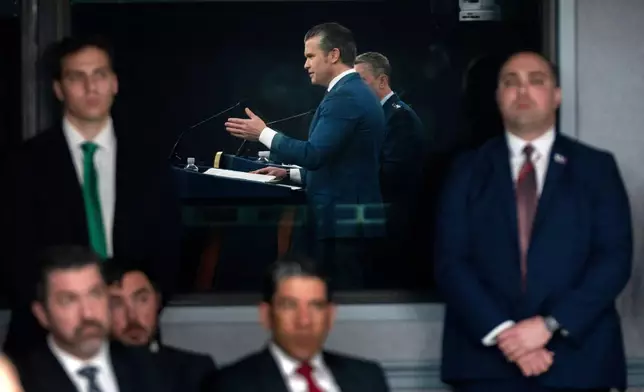
Staff members watch as Defense Secretary Pete Hegseth, reflected in a window, speaks during a press briefing at the Pentagon, Monday, March 2, 2026, in Washington. (AP Photo/Mark Schiefelbein)

Staff members watch as Defense Secretary Pete Hegseth, reflected in a window, speaks during a press briefing at the Pentagon, Monday, March 2, 2026, in Washington. (AP Photo/Mark Schiefelbein)

Defense Secretary Pete Hegseth and Chairman of the Joint Chiefs of Staff Gen. Dan Caine take questions during a press briefing at the Pentagon, Monday, March 2, 2026, in Washington. (AP Photo/Mark Schiefelbein)

Defense Secretary Pete Hegseth and Chairman of the Joint Chiefs of Staff Gen. Dan Caine take questions during a press briefing at the Pentagon, Monday, March 2, 2026, in Washington. (AP Photo/Mark Schiefelbein)

“This does not mean we can stop everything, but we ensured that the maximum possible defense and maximum possible force protection was set up before we went on offense,” he said.

The acknowledgment that additional drone or missile strikes in the region could cause damage and harm to troops comes as President Donald Trump and top defense leaders have warned that more American casualties were expected in a conflict that began Saturday and could last months. The U.S. and Israeli bombardment intensified, and Iran hit back, on Wednesday, when the Trump administration revealed that a U.S. submarine fired a torpedo that sank an Iranian warship in the Indian Ocean.

U.S. service members “remain in harm’s way, and we must be clear-eyed that the risk is still high,” Gen. Dan Caine, chairman of the Joint Chiefs of Staff, said at the news conference with Hegseth.

Six soldiers were killed when an Iranian drone strike hit an operations center Sunday in the heart of a civilian port in Kuwait, more than 10 miles from the main Army base. The husband of one of the slain soldiers, who was part of a supply and logistics unit based in Iowa, says the center was a shipping container-style building and had no defenses.

Caine declined to answer a question about the possibility of deploying ground troops in Iran, which Trump has not ruled out.

“I’m not going to comment on U.S. boots on the ground,” Caine said. “I think that’s a question for policymakers. And I don’t make policy, I execute policy.”

White House press secretary Karoline Leavitt told reporters that it was “not part of the plan for this operation at this time” but noted that "I’m not going to remove an option for the president that is on the table.”

Hegseth also signaled a possible longer time frame for the conflict than has previously been floated by the administration, saying it could last eight weeks but that the U.S. has the munitions and the equipment to beat Iran in a war of attrition. He declined to set a specific time range, saying the specific duration of the war would depend on how it unfolds.

“You can say four weeks, but it could be six, it could be eight, it could be three,” Hegseth said. “Ultimately, we set the pace and the tempo. The enemy is off balance, and we’re going to keep them off balance.”

More forces are arriving in the region, including jet fighters and bombers, Hegseth said, and the U.S. “will take all the time we need to make sure that we succeed.”

Supplies of weaponry are not an issue, Hegseth and Caine said, with the defense secretary noting that the military used more advanced weapons at the start of the campaign but was switching to gravity bombs now that the U.S. has gained control of the Iranian sky. Stockpiles of the advanced weapons remain “extremely strong," Hegseth said.

Caine said U.S. attacks on Iranian missile sites and other offensive targets have been successful enough that forces can strike deeper inland, allowing for the shift from sophisticated weapons that can be launched from far away to more traditional, precision bombs dropped by aircraft.

Caine said the U.S. has “sufficient precision munitions for the task at hand, both on the offense and defense.” He noted that the military would not be releasing quantities, citing operational security.

“Our air defenses and that of our allies have plenty of runway,” Hegseth said. “We can sustain this fight easily for as long as we need to.”

Trump said this week the campaign is likely to last four weeks to five weeks but he was prepared “to go far longer than that.”

Tehran has pledge to completely destroy Iran's military and economic infrastructure, signaling the war was nowhere near over and could expand further. But Iran's use of missiles and drones is putting a dent in its arsenal.

The number of ballistic missiles fired by Iran is down 86% from the first day of the U.S. military’s campaign, with a 23% drop in the past 24 hours, Caine said Wednesday, and Iran's use of one-way attack drone shots is down 73% from the opening days. The decrease could indicate that Iran is holding some weapons in reserve to prolong the conflict.

The administration promoted its efforts to help Americans depart the region. It abruptly advised those in 14 countries to leave immediately even as the threat of missiles and drones closed airspace in the region and caused widespread flight cancellations.

The State Department said it has assisted nearly 6,500 Americans since the start of the war and was working to arrange charter flights or other transportation. Caine said the military has opened up available seats as military transport planes arrive “to try to help folks get out.”

The State Department said more than 17,500 Americans have returned to the United States from the Middle East since Saturday, including more than 8,500 on Tuesday alone, although it acknowledged that the vast majority of those used commercial transportation without any government assistance.

Associated Press writers Ben Finley, Meg Kinnard, Matthew Lee and Michelle L. Price contributed to this report.

A Dept. of Defense map entitled, Operation EPIC FURY Timeline - First 100 Hours, is displayed during a news conference with Defense Secretary Pete Hegseth and Chairman of the Joint Chiefs of Staff Gen. Dan Caine, at the Pentagon, Wednesday, March 4, 2026, in Washington. (AP Photo/Konstantin Toropin)

A Dept. of Defense map entitled, Operation EPIC FURY Timeline - First 100 Hours, is displayed during a news conference with Defense Secretary Pete Hegseth and Chairman of the Joint Chiefs of Staff Gen. Dan Caine, at the Pentagon, Wednesday, March 4, 2026, in Washington. (AP Photo/Konstantin Toropin)

Chairman of the Joint Chiefs of Staff Gen. Dan Caine, speaks during a press briefing at the Pentagon, Wednesday, March 4, 2026, in Washington. (AP Photo/Konstantin Toropin)

Chairman of the Joint Chiefs of Staff Gen. Dan Caine, speaks during a press briefing at the Pentagon, Wednesday, March 4, 2026, in Washington. (AP Photo/Konstantin Toropin)

Staff members watch as Defense Secretary Pete Hegseth, reflected in a window, speaks during a press briefing at the Pentagon, Monday, March 2, 2026, in Washington. (AP Photo/Mark Schiefelbein)

Staff members watch as Defense Secretary Pete Hegseth, reflected in a window, speaks during a press briefing at the Pentagon, Monday, March 2, 2026, in Washington. (AP Photo/Mark Schiefelbein)


Defense Secretary Pete Hegseth and Chairman of the Joint Chiefs of Staff Gen. Dan Caine take questions during a press briefing at the Pentagon, Monday, March 2, 2026, in Washington. (AP Photo/Mark Schiefelbein)

Defense Secretary Pete Hegseth and Chairman of the Joint Chiefs of Staff Gen. Dan Caine take questions during a press briefing at the Pentagon, Monday, March 2, 2026, in Washington. (AP Photo/Mark Schiefelbein)

AUSTIN, Texas (AP) — James Talarico did not mention Donald Trump when he greeted exuberant supporters at his primary night celebration.

But the newly minted Democratic U.S. Senate nominee in Texas is now a front man for the political opposition to the Republican president, not just in his own state but around the country. With his victory over U.S. Rep. Jasmine Crockett, the state lawmaker from Austin will test whether a smiling message of unity and change is enough to answer voters’ frustrations amid discord at home and now a war abroad.

“We are not just trying to win an election," Talarico told supporters in the Texas capital early Wednesday. "We are trying to fundamentally change our politics, and it’s working.”

The campaign provided “Love thy Neighbor” signs to people in the crowd.

The question for Talarico as he heads into the general election campaign is whether he can generate enthusiasm from voters who opted for Crockett because they saw her as the more aggressive fighter against Trump. Crockett conceded to Talarico on Wednesday morning, saying that “Texas is primed to turn blue and we must remain united because this is bigger than any one person.”

Talarico was also endorsed by former vice president Kamala Harris, who previously backed Crockett in the primary.

Talarico will need all the help he can get in a Republican-dominated state where Democrats have gone three decades without winning a statewide race. He will face either U.S. Sen. John Cornyn or state Attorney General Ken Paxton, who advanced to a Republican runoff on Tuesday.

Conventional political wisdom has Talarico as the stronger Democratic candidate for November, especially if Republicans nominate Paxton, a conservative firebrand who has weathered allegations of corruption and infidelity over the years.

Although Democrats are often choosing between moderate and progressive candidates in primaries, they faced a largely stylistic choice in Texas.

Talarico, 36, is a Presbyterian seminarian who quotes Scripture and rarely raises his voice. Crockett, 44, is an unapologetic political brawler who hammers Trump and other Republicans with acidic flourish.

But Talarico’s broader argument is one that he could have made regardless of whether Trump was in the White House. He often said the country's fundamental divide is not partisan but “top vs. bottom.” He regularly assails the rise in Christian nationalism. A former teacher, he has advocated for public education — and against Texas conservatives’ policies to restrict curriculum and reshape how U.S. history is taught.

“He’s just a good friend and he’s a serious advocate for the disenfranchised and a serious policymaker,” said Lea Downey Gallatin, 40, an Austin resident who became friends with Talarico when they interned together for a congressman.

Crockett promised Democrats that she could increase turnout within the party's base, while Talarico campaigned on the theory that he could pull new people into the party's tent.

“I can’t tell you how many have come up to me, whispering that they’re not a Democrat,” Talarico said as he campaigned in San Antonio in the closing days of the primary campaign. “I can’t tell you how many young people have said it’s the first time that they’ve ever voted, and that they are participating for the first time.”

As he strolled through the city, Talarico posed for pictures and greeted the singer of a Tejano band playing nearby. He later spoke to hundreds of people at the historic Stable Hall, a 130-year-old circular structure built for showing horses and now a converted event center. Hundreds more, unable to get into the full event, wound around the corner and along the sidewalk for blocks.

Inside, Lori Alvarez, a 39-year-old who works for a disaster relief nonprofit, said she supported Talarico because “he really listens to what we need."

"I think he’s going to be able to make change in Washington for us,” said the married mother of three young girls.

Unofficial primary returns showed Talarico with a dominating performance around his home base of Austin, including in mostly white areas. He outpaced Crockett across much of rural and small-town Texas, including in the Rio Grande Valley, where Trump made gains in his 2024 presidential victory among Hispanic voters. Crockett was strongest in metro Houston and Dallas-Fort Worth, including areas with large concentrations of Black voters.

Crockett is Black, and Talarico is white.

A Democratic win in Texas would require stitching together that multiracial and multiethnic coalition, spanning the metro areas and heavily Latino South and West Texas, while limiting Republican margins in whiter rural counties.

In 2018, Democrat Beto O'Rourke came the closest to that mix, losing to Republican Sen. Ted Cruz by about 215,000 votes or about 2.5 percentage points. With both parties holding competitive primaries Tuesday, Democratic primary voters outnumbered Republicans by more than 110,000 out of almost 4.4 million — with some ballots still being tallied.

Because Texas does not have party registration and allows voters to choose either party’s primary ballot, Democrats saw their advantage as a sign of enthusiasm beyond the party's usual base.

But Talarico will also need to fire up voters who saw Crockett as their champion.

Troy Burrow, a 61-year-old Navy retiree, called her “rugged” and “the only one I see fighting for us.”

He added that “I like how she doesn’t back down from anybody.”

Burrow said some voters probably saw Talarico as more electable because he is more soft-spoken. But, he said, “We’ve got to get into the gutter with these folks, because that’s where they are.”

Talarico, meanwhile, keeps fighting his own way.

“Tonight, the people of our state gave this country a little bit of hope,” he said Tuesday, “and a little bit of hope is a dangerous thing.”

Barrow reported from Atlanta, Figueroa from Austin, Texas, and Beaumont from San Antonio. Associated Press writer Maya Sweedler in Washington contributed to this report.

This story has corrected the last name of Texas voter Troy Burrow, from Burroughs.

Supporters of Texas state Rep. James Talarico, D-Austin, a Democratic candidate for the U.S. Senate, react as results come in during a primary election watch party Tuesday, March 3, 2026, in Austin, Texas. (AP Photo/Eric Gay)

Supporters of Texas state Rep. James Talarico, D-Austin, a Democratic candidate for the U.S. Senate, react as results come in during a primary election watch party Tuesday, March 3, 2026, in Austin, Texas. (AP Photo/Eric Gay)

Texas state Rep. James Talarico, D-Austin, a Democratic candidate for the U.S. Senate, greets supporters at a primary election watch party Tuesday, March 3, 2026, in Austin, Texas. (AP Photo/Eric Gay)

Texas state Rep. James Talarico, D-Austin, a Democratic candidate for the U.S. Senate, greets supporters at a primary election watch party Tuesday, March 3, 2026, in Austin, Texas. (AP Photo/Eric Gay)

Rep. Jasmine Crockett, D-Texas, a Democratic candidate for U.S. Senate, speaks during a primary election watch party Tuesday, March 3, 2026, in Dallas. (AP Photo/Tony Gutierrez)

Rep. Jasmine Crockett, D-Texas, a Democratic candidate for U.S. Senate, speaks during a primary election watch party Tuesday, March 3, 2026, in Dallas. (AP Photo/Tony Gutierrez)

Texas state Rep. James Talarico, D-Austin, a Democratic candidate for the U.S. Senate, speaks at a primary election watch party Tuesday, March 3, 2026, in Austin, Texas. (AP Photo/Eric Gay)

Texas state Rep. James Talarico, D-Austin, a Democratic candidate for the U.S. Senate, speaks at a primary election watch party Tuesday, March 3, 2026, in Austin, Texas. (AP Photo/Eric Gay)

Recommended Articles