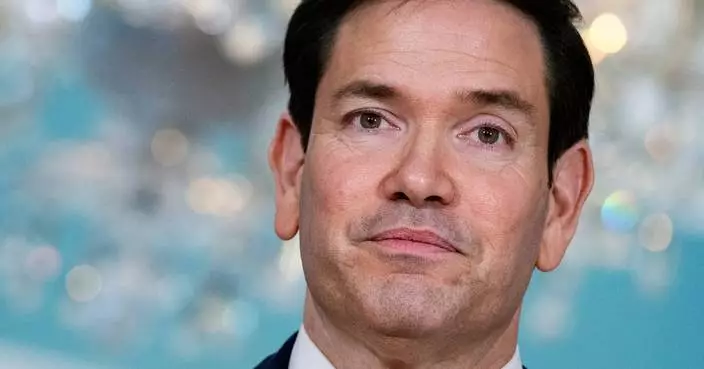
The world's richest person made the single-largest charitable contribution in 2020, according to The Chronicle of Philanthropy's annual list of top donations, a $10 billion gift that is intended to help fight climate change.
Amazon's founder and CEO, Jeff Bezos, whose “real-time” worth Forbes magazine estimates at roughly $188 billion, used the contribution to launch his Bezos Earth Fund. The fund, which supports non-profits involved in the climate crisis, has paid out $790 million to 16 groups so far, according to the Chronicle.
Setting aside Bezos' whopping gift, though, the sum total of the top 10 donations last year — $2.6 billion — was the lowest since 2011, even as many billionaires vastly increased their wealth in the stock market rally that catapulted technology shares in particular last year. According to the left-leaning Americans for Tax Fairness and the Institute for Policy Studies, from March 18 through Dec. 7, 2020, Bezos' wealth surged by 63%, from $113 billion to $184 billion.
Phil Knight, who with his wife, Penny, made the second- and third-largest donations last year according to the Chronicle, increased his wealth by about 77% over the same March-to-December period. Knight and his wife gave more than $900 million to the Knight Foundation and $300 million to the University of Oregon.
Fred Kummer, founder of construction company HBE Corporation, and his wife, June, gave $300 to establish a foundation to support programs at the Missouri University of Science and Technology.
Facebook's founder Mark Zuckerberg and his wife, Priscilla Chan, delivered the fourth-largest donation on the Chronicle's list: A $250 million gift to the Center for Tech and Civic Life, which worked on voting security issues in the 2020 election. Zuckerberg, whose wealth nearly doubled to $105 billion in the March-to-December period according to Americans for Tax Fairness and the Institute for Policy Studies, has been widely criticized and been called to testify before Congress for his company's handling of disinformation in the runup to the 2020 presidential election.
In the fifth spot was Arthur Blank, co-founder of Home Depot, who gave $200 million through his foundation to Children's healthcare of Atlanta to build a new hospital.
Bezos and the Zuckerbergs made up the next spots on last year's top 10 list, with $100 million donations — Bezos for Feeding America to aid food banks across the country and the Zuckerbergs to the same election security group.
They were followed by Stephen Ross, founder of real estate firm Related Companies; David Roux, co-founder of Silver Lake Partners, a private-equity firm, and his wife, Barbara; George and Renee Karfunkel, real-estate investors; Bernard Marcus, co-founder of Home Depot; and Charles Schwab, founder of Schwab Financial Services, and his wife, Helen.
Two billionaires who donated heavily to charity last year — MacKenzie Scott, Bezos' former wife, and Jack Dorsey, co-founder of Twitter — did not make the Chronicle's list because no single donation of theirs was large enough to qualify. In February, the Chronicle will publish its list of the 50 biggest donors, which counts cumulative donations, not individual gifts.
WASHINGTON (AP) — The Senate is headed toward a vote Wednesday on a war powers resolution that would put a check on President Donald Trump's ability to carry out further military attacks on Venezuela, but the president was putting intense pressure on his fellow Republicans to vote down the measure.
Trump has lashed out at five GOP senators who joined with Democrats to advance the resolution last week, raising doubts that the measure will ultimately pass. Yet even the possibility that the Republican-controlled Senate would defy Trump on such a high-profile vote revealed the growing alarm on Capitol Hill about the president's expanding foreign policy ambitions.
Democrats are forcing the vote after U.S. troops captured Venezuelan leader Nicolás Maduro in a surprise nighttime raid earlier this month.
“Here we have one of the most successful attacks ever and they find a way to be against it. It’s pretty amazing. And it’s a shame," Trump said at a speech in Michigan Tuesday. He also hurled insults at several of the Republicans who advanced the legislation, calling Sen. Rand Paul of Kentucky a “stone cold loser” and Sens. Lisa Murkowski of Alaska and Susan Collins of Maine “disasters.”
Trump's latest comments followed earlier phone calls with the senators, which they described as terse. The president's fury underscored how the war powers vote has taken on new political significance as Trump also threatens military action to accomplish his goal of possessing Greenland.
The legislation, even if passed by the Senate, has virtually no chance of becoming law because it would eventually need to be signed by Trump himself. But it represented both a test of GOP loyalty to the president and a marker for how much leeway the Republican-controlled Senate is willing to give Trump to use the military abroad.
Republican Senate leaders are trying to defuse the conflict between their members and Trump as well as move on quickly to other business.
In a floor speech Wednesday morning, Senate Majority Leader John Thune, R-S.D., vented his frustration as he questioned whether this war powers resolution should be prioritized under the chamber’s rules.
“We have no troops on the ground in Venezuela. We’re not currently conducting military operations there,” he said. “But Democrats are taking up this bill because their anti-Trump hysteria knows no bounds.”
By Wednesday evening, Republican leaders were moving to dismiss the measure under the argument that it is irrelevant to the current situation in Venezuela. That procedure will still receive a vote.
Sen. Josh Hawley, a Missouri Republican who helped advance the war powers resolution last week, has indicated he may change his position.
Hawley said that Trump's message during a phone call last week was that the legislation “really ties my hands." The senator said he had a follow-up phone call with Secretary of State Marco Rubio that was “really positive.”
Hawley said that Rubio told him Monday "point blank, we’re not going to do ground troops.” The senator said he also received assurances that the Trump administration will follow constitutional requirements if it becomes necessary to deploy troops again to the South American country.
“We’re getting along very well with Venezuela,” Trump told reporters at a ceremony for the signing of an unrelated bill Wednesday.
Hawley's position left the vote margin for the resolution, which advanced 52-47 last week, razor thin.
However, Collins told reporters Wednesday she will still support the resolution. Murkowski and Paul have also indicated they won't switch.
That left Sen. Todd Young, an Indiana Republican, with the crucial vote. He declined repeatedly to discuss his position but said he was “giving it some thought.”
Democratic Sen. Tim Kaine, who has brought a series of war powers resolutions this year, said he wasn't surprised at Trump's reaction to senators asserting their ability to put a check on the president.
“They're furious at the notion that Congress wants to be Congress,” he said. “But I think people who ran for the Senate, they want to be U.S. senators and they don't want to just vote their own irrelevance.”
Under the Constitution, Congress alone has the ability to declare war. But U.S. presidents have long stretched their powers to use the might of the U.S. military around the globe.
Ohio State University professor Peter Mansoor, a military historian and retired U.S. Army colonel with multiple combat tours, said that trend since World War II allows Congress to shirk responsibility for war and put all the risk on the president.
In the post-Vietnam War era, lawmakers tried to take back some of their authority over wartime powers with the War Powers Resolution of 1973. It allows lawmakers to hold votes on resolutions to restrict a president from using military force in specific conflicts without congressional approval.
“Politicians tend to like to evade responsibility for anything -- but then this gets you into forever wars,” Mansoor said.
Trump has used a series of legal arguments for his campaign against Maduro.
As he built up a naval force in the Caribbean and destroyed vessels that were allegedly carrying drugs from Venezuela, the Trump administration tapped wartime powers under the global war on terror by designating drug cartels as terrorist organizations.
The administration has claimed the capture of Maduro himself was actually a law enforcement operation, essentially to extradite the Venezuelan president to stand trial for charges in the U.S. that were filed in 2020.
In a classified briefing Tuesday, senators reviewed the Trump administration's still undisclosed legal opinion for using the military for the operation. It was described as a lengthy document.
But lawmakers, including a significant number of Republicans, have been alarmed by Trump's recent foreign policy talk. In recent weeks, he has pledged that the U.S. will “run” Venezuela for years to come, threatened military action to take possession of Greenland and told Iranians protesting their government that “ help is on its way.”
Senior Republicans have tried to massage the relationship between Trump and Denmark, a NATO ally that holds Greenland as a semi-autonomous territory. But Danish officials emerged from a meeting with Vice President JD Vance and Rubio Wednesday saying a “fundamental disagreement” over Greenland remains.
Senate Democratic leader Chuck Schumer said Trump's recent aggression amounted to a “dangerous drift towards endless war.”
More than half of U.S. adults believe President Donald Trump has “gone too far” in using the U.S. military to intervene in other countries, according to a new AP-NORC poll.
House Democrats have also filed a similar war powers resolution and can force a vote on it as soon as next week.
Associated Press writers Lisa Mascaro and Joey Cappelletti in Washington and Bill Barrow in Atlanta contributed to this report.
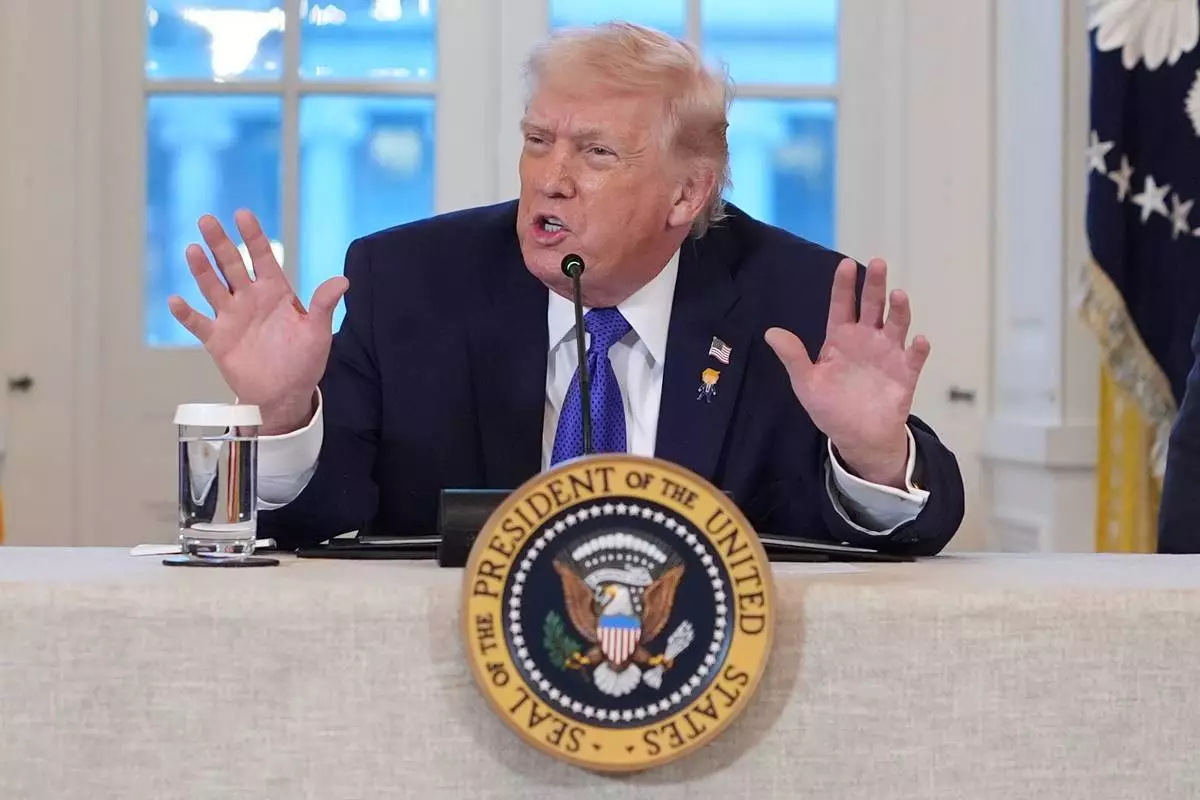
President Donald Trump speaks during a meeting with oil executives in the East Room of the White House, Friday, Jan. 9, 2026, in Washington. (AP Photo/Evan Vucci)
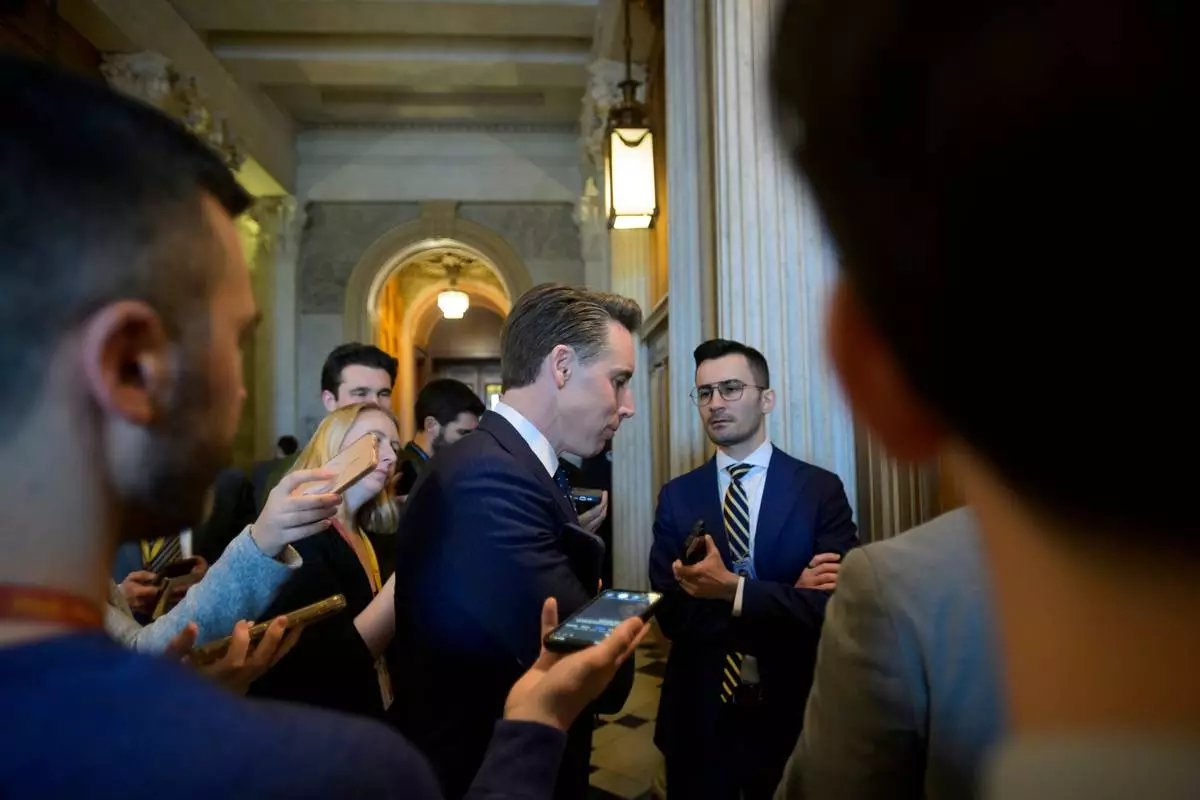
Sen. Josh Hawley, R-Mo., talks with reporters outside the Senate chamber during a vote at the Capitol, Tuesday, Jan. 6, 2026, in Washington. (AP Photo/Rod Lamkey, Jr.)
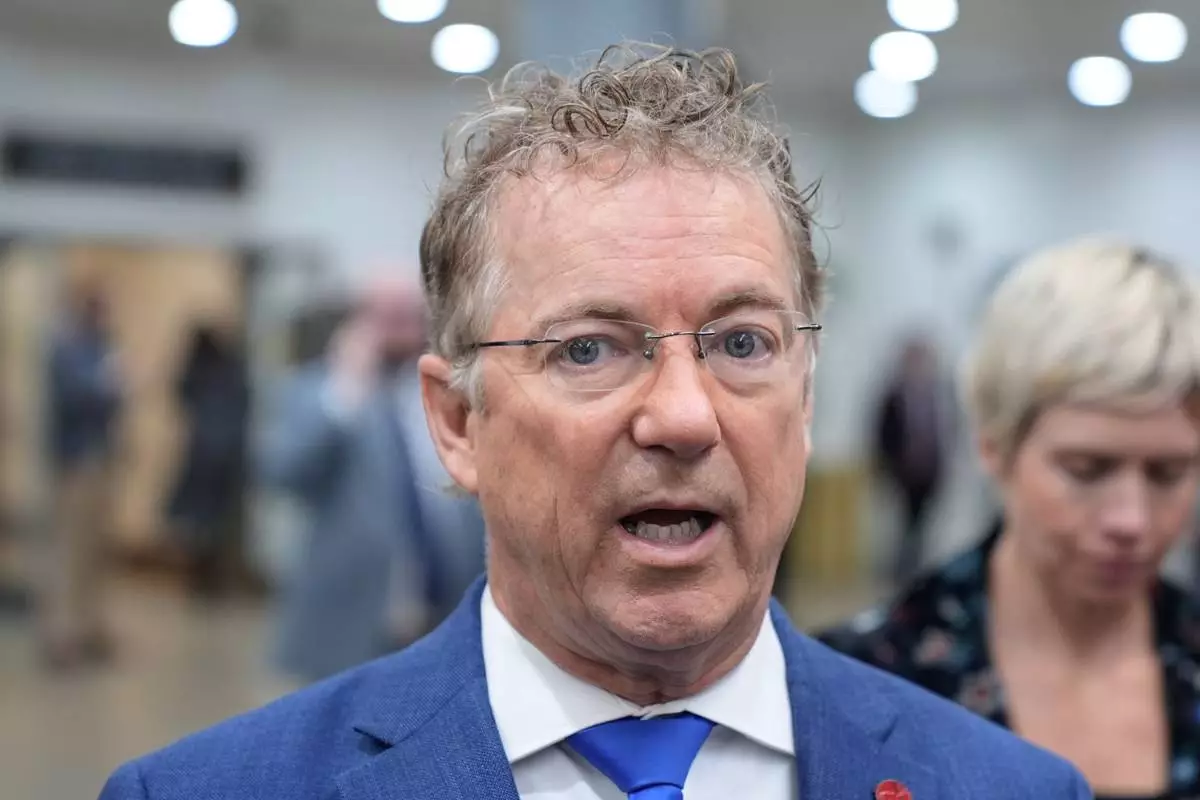
Sen. Rand Paul, R-Ky., speaks with reporters at the Senate Subway on Capitol Hill, Thursday, Jan. 8, 2026, in Washington. (AP Photo/Mariam Zuhaib)
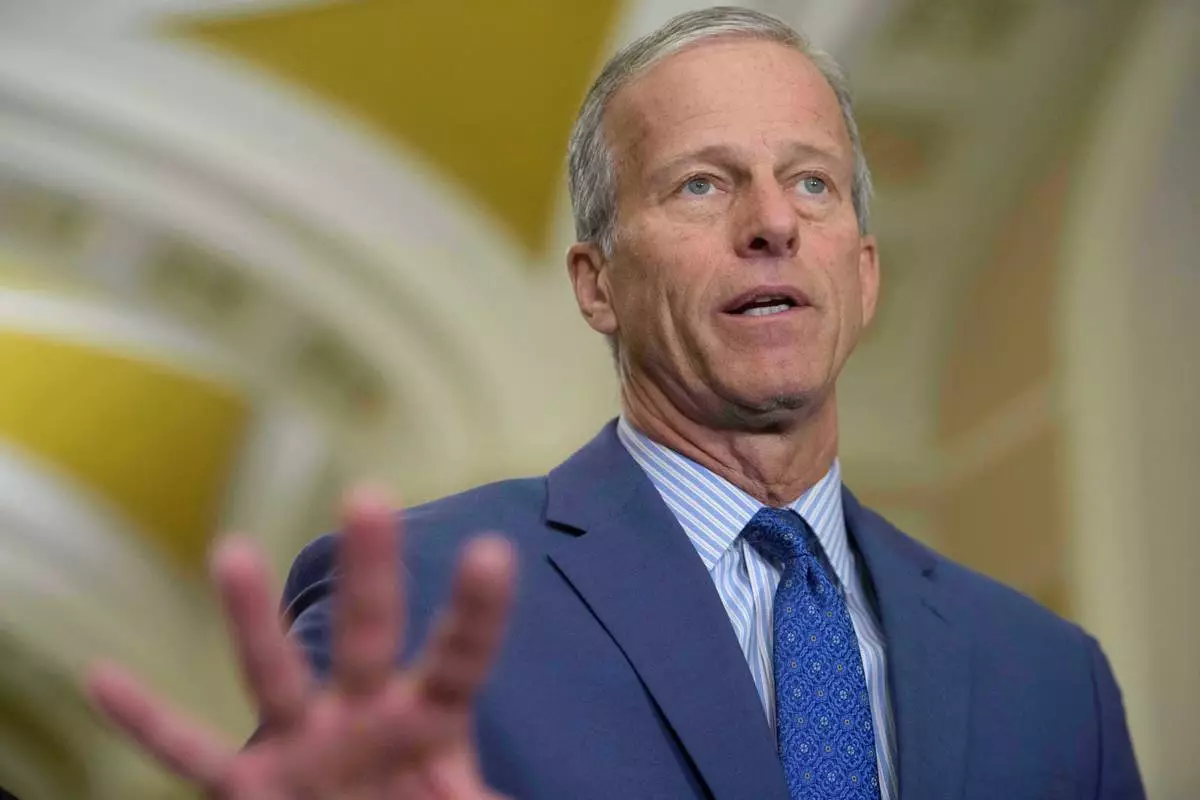
Senate Majority Leader John Thune, R-S.D., speaks during a news conference at the Capitol, Tuesday, Jan. 13, 2026, in Washington. (AP Photo/Rod Lamkey, Jr.)