Skip to Content Facebook Feature Image

Wall Street slumps as bank and tech stocks fall

News

Wall Street slumps as bank and tech stocks fall
News

News

Wall Street slumps as bank and tech stocks fall

2026-01-15 05:15 Last Updated At:05:20

NEW YORK (AP) — Losses for several banks and Big Tech stocks pulled indexes lower on Wednesday, even though the majority of stocks on Wall Street rose.

The S&P 500 slipped 0.5% for its second straight loss after setting its all-time high. The Dow Jones Industrial Average dipped 42 points, or 0.1%, and the Nasdaq composite lost 1%.

More Images
Specialist Michael Pistillo works at his post on the floor of the New York Stock Exchange, Friday, Jan. 2, 2026. (AP Photo/Richard Drew)

Specialist Michael Pistillo works at his post on the floor of the New York Stock Exchange, Friday, Jan. 2, 2026. (AP Photo/Richard Drew)

A dealer watches computer monitors near the screens showing the foreign exchange rates at a dealing room of Hana Bank in Seoul, South Korea, Wednesday, Jan. 14, 2026. (AP Photo/Lee Jin-man)

A dealer watches computer monitors near the screens showing the foreign exchange rates at a dealing room of Hana Bank in Seoul, South Korea, Wednesday, Jan. 14, 2026. (AP Photo/Lee Jin-man)

The screens show the Korea Composite Stock Price Index (KOSPI), left, and the foreign exchange rate between U.S. dollar and South Korean won are seen at a dealing room of Hana Bank in Seoul, South Korea, Wednesday, Jan. 14, 2026. (AP Photo/Lee Jin-man)

The screens show the Korea Composite Stock Price Index (KOSPI), left, and the foreign exchange rate between U.S. dollar and South Korean won are seen at a dealing room of Hana Bank in Seoul, South Korea, Wednesday, Jan. 14, 2026. (AP Photo/Lee Jin-man)

A dealer walks past near the screen showing the Korea Composite Stock Price Index (KOSPI) at a dealing room of Hana Bank in Seoul, South Korea, Wednesday, Jan. 14, 2026. (AP Photo/Lee Jin-man)

A dealer walks past near the screen showing the Korea Composite Stock Price Index (KOSPI) at a dealing room of Hana Bank in Seoul, South Korea, Wednesday, Jan. 14, 2026. (AP Photo/Lee Jin-man)

A dealer stands near the screens showing the Korea Composite Stock Price Index (KOSPI), left, and the foreign exchange rate between U.S. dollar and South Korean won at a dealing room of Hana Bank in Seoul, South Korea, Wednesday, Jan. 14, 2026. (AP Photo/Lee Jin-man)

A dealer stands near the screens showing the Korea Composite Stock Price Index (KOSPI), left, and the foreign exchange rate between U.S. dollar and South Korean won at a dealing room of Hana Bank in Seoul, South Korea, Wednesday, Jan. 14, 2026. (AP Photo/Lee Jin-man)

Wells Fargo helped pull the market lower after falling 4.6%. The San Francisco-based bank reported weaker profit and revenue for the latest quarter than expected, with analysts citing lower trading fees and other miscellaneous items.

Bank of America fell 3.8% despite reporting a stronger profit than analysts expected, with some consternation about the size of its upcoming expenses. Citigroup, which is in the midst of a turnaround under Chair and CEO Jane Fraser, fell 3.3% following its own profit report.

Companies across industries are under pressure to report strong growth in profits to justify how high their stock prices have run recently. Analysts are looking for businesses across the S&P 500 to report earnings per share for the final three months of 2025 that are roughly 8% higher than a year earlier, according to FactSet.

Biogen sank 5% after the biotechnology company said it expects to take a hit to its profit for the fourth quarter of 2025 due to research and development expenses and other costs that it acquired.

The heaviest weights on the market were tech stocks, which gave back a bit of their huge gains from recent years created by the frenzy around artificial-intelligence technology. Such stellar performances caused some critics to say their stock prices had become too expensive.

Nvidia fell 1.4%, and Broadcom sank 4.2%.

Still, more stocks rose on Wall Street than fell, and the strongest forces keeping the S&P 500 from steeper losses were Exxon Mobil and other oil companies.

Exxon Mobil rose 2.9%, and Chevron climbed 2.1% as the price for a barrel of benchmark U.S. oil rose 1.4% to settle at $62.02.

Stocks of smaller companies also did better than the rest of the market, with the Russell 2000 index rising 0.7%.

All told, the S&P 500 fell 37.14 points to 6,926.60. The Dow Jones Industrial Average dipped 42.36 to 49,149.63, and the Nasdaq composite fell 238.12 to 23,471.75.

Oil prices have rallied recently after protests swept Iran, which is a member of the OPEC group that helps set crude prices. The protests could lead to disruptions in production and squeeze supplies of crude.

Brent crude, the international standard, rose 1.6% and briefly brought its gain for the year so far to nearly 10%, before prices for both it and U.S. oil fell back later in the afternoon.

In the bond market, Treasury yields sank as investors sought investments seen as safer. Several reports on the U.S. economy also came in mixed.

One said that shoppers spent more at U.S. retailers in November than economists expected. That could be an encouraging signal about the main engine of the U.S. economy.

A separate report said prices rose modestly at the U.S. wholesale level in November. It followed data on Tuesday that said inflation at the U.S. consumer level was close last month to economists’ expectations, though it remained above the Federal Reserve’s 2% target.

Taken altogether, the reports did little to change Wall Street’s expectation that the Federal Reserve will cut its main interest rate at least twice this year to shore up the job market, likely beginning around June, according to CME Group.

The yield on the 10-year Treasury fell to 4.14% from 4.18% late Tuesday.

In stock markets abroad, Japan’s Nikkei 225 rallied 1.5% to another record as expectations grew that Prime Minister Sanae Takaichi may call general elections soon.

Indexes were mixed elsewhere. Stocks rose 0.6% in Hong Kong but fell 0.3% in Shanghai after a report showed China’s trade surplus surged 20% in 2025 to a record despite President Donald Trump’s tariffs.

AP Business Writers Yuri Kageyama and Matt Ott contributed.
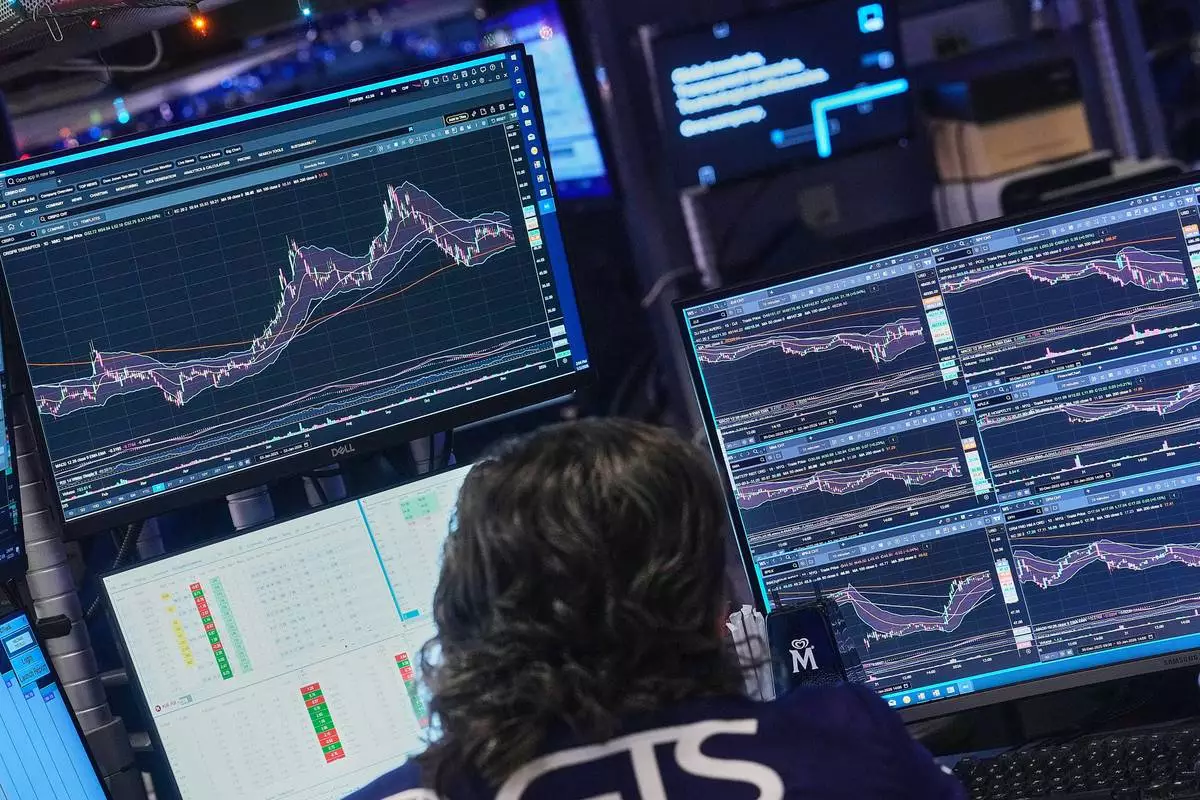
Specialist Michael Pistillo works at his post on the floor of the New York Stock Exchange, Friday, Jan. 2, 2026. (AP Photo/Richard Drew)

Specialist Michael Pistillo works at his post on the floor of the New York Stock Exchange, Friday, Jan. 2, 2026. (AP Photo/Richard Drew)

A dealer watches computer monitors near the screens showing the foreign exchange rates at a dealing room of Hana Bank in Seoul, South Korea, Wednesday, Jan. 14, 2026. (AP Photo/Lee Jin-man)

A dealer watches computer monitors near the screens showing the foreign exchange rates at a dealing room of Hana Bank in Seoul, South Korea, Wednesday, Jan. 14, 2026. (AP Photo/Lee Jin-man)
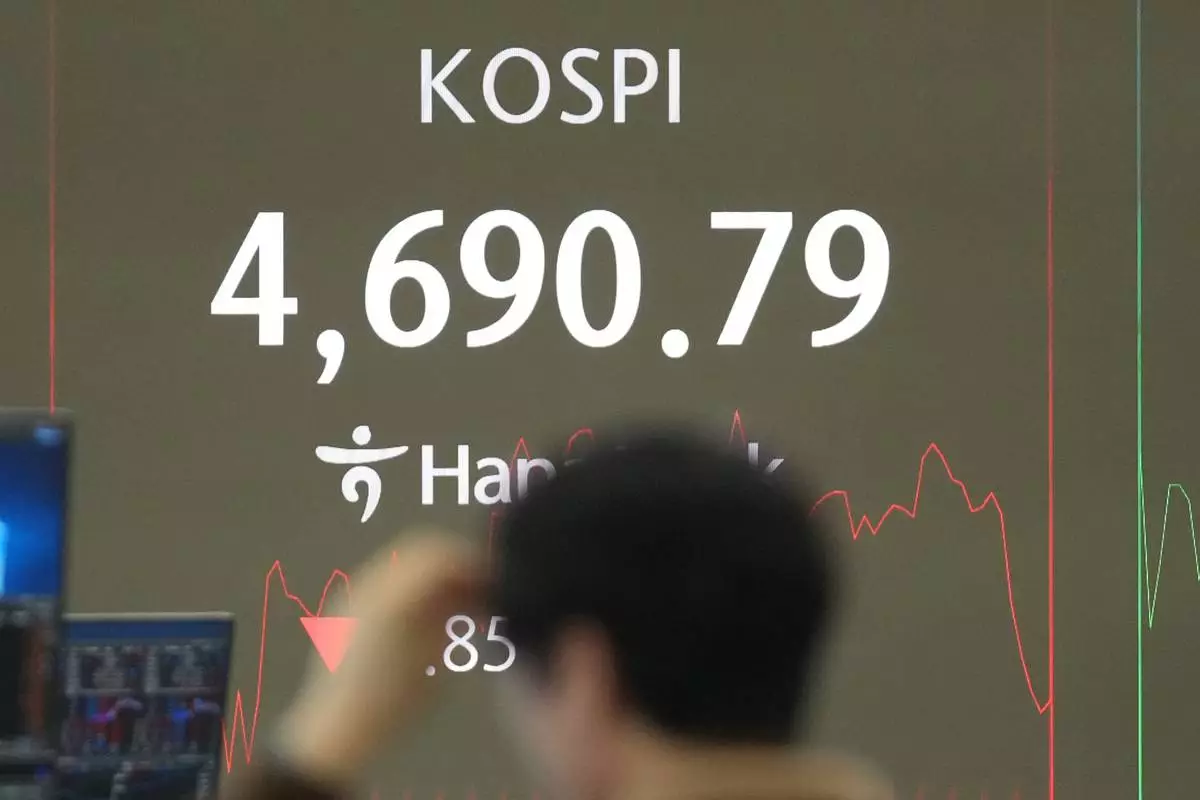
The screens show the Korea Composite Stock Price Index (KOSPI), left, and the foreign exchange rate between U.S. dollar and South Korean won are seen at a dealing room of Hana Bank in Seoul, South Korea, Wednesday, Jan. 14, 2026. (AP Photo/Lee Jin-man)

The screens show the Korea Composite Stock Price Index (KOSPI), left, and the foreign exchange rate between U.S. dollar and South Korean won are seen at a dealing room of Hana Bank in Seoul, South Korea, Wednesday, Jan. 14, 2026. (AP Photo/Lee Jin-man)
A dealer walks past near the screen showing the Korea Composite Stock Price Index (KOSPI) at a dealing room of Hana Bank in Seoul, South Korea, Wednesday, Jan. 14, 2026. (AP Photo/Lee Jin-man)

A dealer walks past near the screen showing the Korea Composite Stock Price Index (KOSPI) at a dealing room of Hana Bank in Seoul, South Korea, Wednesday, Jan. 14, 2026. (AP Photo/Lee Jin-man)
A dealer stands near the screens showing the Korea Composite Stock Price Index (KOSPI), left, and the foreign exchange rate between U.S. dollar and South Korean won at a dealing room of Hana Bank in Seoul, South Korea, Wednesday, Jan. 14, 2026. (AP Photo/Lee Jin-man)

A dealer stands near the screens showing the Korea Composite Stock Price Index (KOSPI), left, and the foreign exchange rate between U.S. dollar and South Korean won at a dealing room of Hana Bank in Seoul, South Korea, Wednesday, Jan. 14, 2026. (AP Photo/Lee Jin-man)

HAVANA (AP) — Cuba held recent talks with the U.S. government, President Miguel Díaz-Canel said Friday, marking the first time that the Caribbean country confirmed such speculation.

Díaz-Canel said in a speech that the talks “were aimed at finding solutions through dialogue to the bilateral differences between our two nations. International factors facilitated these exchanges.”

He didn't elaborate on those factors, or provide any details about the talks.

The White House didn't return an immediate request for comment on the talks with Cuba.

Díaz-Canel said that no petroleum shipments have arrived on the island in the past three months, which he blamed on a U.S. energy blockade. He said that Cuba is running on natural gas, solar power and thermoelectric plants, and that the depletion of fuel oil and diesel forced two power plants to shut down and has limited the generation of power at solar parks.

Cuba’s western region was hit by a major blackout last week, leaving millions without power.

He said that Cuba, which produces 40% of its petroleum, has been generating its own power, but that it hasn’t been sufficient to meet demand.

The Cuban leader said that the lack of power has affected communications, education and transportation, and that the government has had to postpone surgeries for tens of thousands of people as a result.

“The impact is tremendous,” Díaz-Canel said.

He said that more than 115 bakeries across the island have been converted to run on firewood or coal.

Díaz-Canel said that 955 solar panels have been installed in rural homes and social centers, and that more solar systems will come online before the end of March that will add 100 megawatts to Cuba’s crumbling electric grid.

“Even with everything we’re putting together, we still need oil,” he said.

Díaz-Canel noted that production output also has dropped.

“Without energy, no country can produce at normal levels," he said. "All of this has meant making adjustments to employment.”

Last month, Cuba implemented austere fuel-saving measures.

Díaz-Canel said that the purpose of the talks was to identify “bilateral problems that require solutions based on their severity and impact” and find solutions to them.

The president said that the aim was “to determine the willingness of both parties to take concrete actions for the benefit of the people of both countries. And in addition, to identify areas of cooperation to confront threats and guarantee the security and peace of both nations, as well as in the region.”

He said that Cuba is willing to carry out the process on the basis of equality and respect for the countries’ political systems and for Cuba’s “sovereignty and self-determination.”

Critical oil shipments from Venezuela were halted after the U.S. attacked the South American country and arrested then President Nicolás Maduro.

The most recent blackout was blamed on a broken boiler at a thermoelectric plant that forced the shutdown of Cuba's power grid.

Authorities have noted that some thermoelectric plants have been operating for more than three decades and receive little maintenance given the high cost. U.S. sanctions also have prevented the government from buying new equipment and specialized parts, officials say.

After his speech, Díaz-Canel took questions from a select group of state reporters.

The questions focused mostly on Cuba’s deepening crises, but one reporter asked about the recent shooting of a Florida-flagged boat in Cuban waters in which four of 10 Cubans from the U.S. were killed after the government accused them of opening fire on local troops.

A fifth suspect later died from his injuries, according to the Cuban government.

Díaz-Canel said that FBI officials would visit Cuba soon as both countries continue to share information on the incident.

The five other suspects have been detained and face terrorism charges.

Díaz-Canel spoke just a day after the Ministry of Foreign Affairs announced it would release 51 prisoners in a move that stems from a spirit of goodwill and close relations with the Vatican.

“It is a sovereign practice, no one imposes it on us,” Díaz-Canel said of the upcoming release. “It responds to our humanistic vocation."

Dánica Coto reported form San José, Costa Rica.

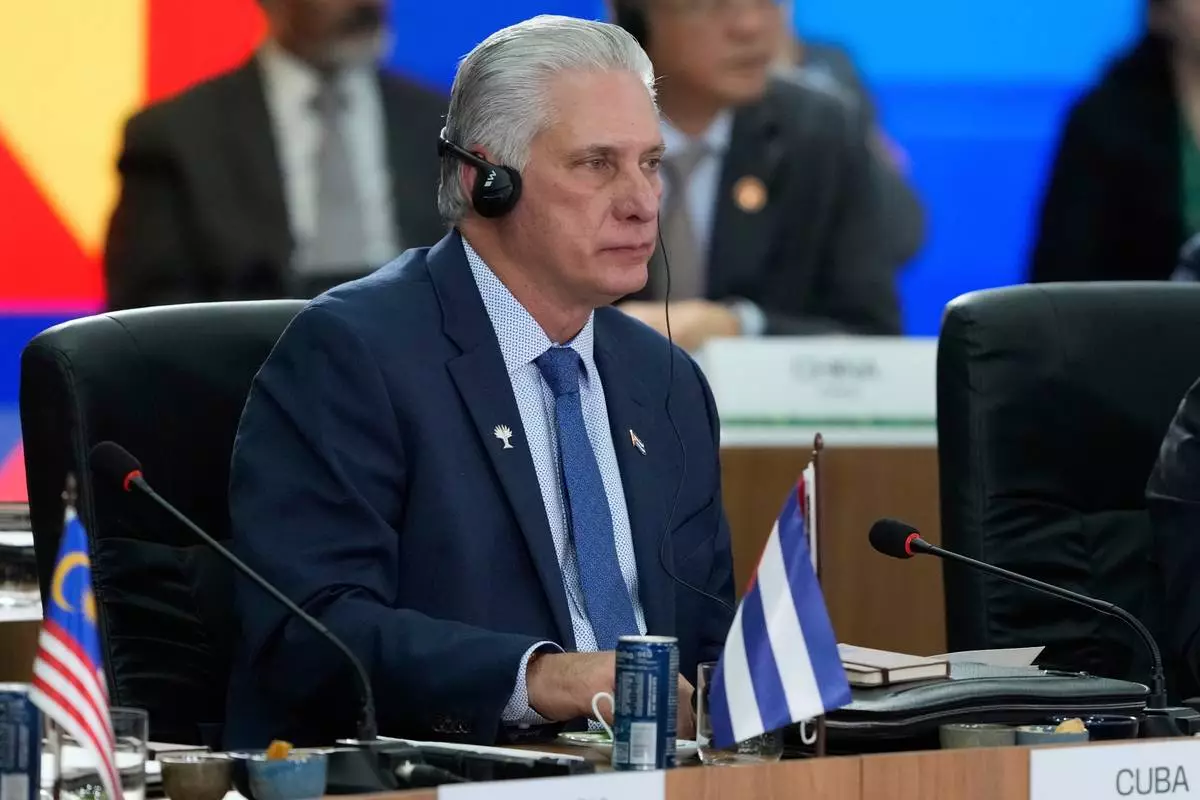
FILE - Cuba's President Miguel Diaz-Canel attends the 17th annual BRICS summit in Rio de Janeiro, July 6, 2025. (AP Photo/Eraldo Peres, File)

FILE - Cuba's President Miguel Diaz-Canel attends the 17th annual BRICS summit in Rio de Janeiro, July 6, 2025. (AP Photo/Eraldo Peres, File)

Recommended Articles