Enhanced guidelines for safe bamboo scaffolding: new code of practice released
The Labour Department (LD) published a revised Code of Practice for Bamboo Scaffolding Safety (CoP) in the Gazette today (April 19) to enhance the safety of bamboo scaffolds in the construction industry.
The major revisions of the CoP include the enhancement of technical requirements for the bracing, putlog and access and egress of bamboo scaffolds; the prohibition to unauthorised alteration of bamboo scaffolds including putlog; and further specifying the requirement of supervising work of competent persons to the bamboo scaffolders who perform erection, substantial addition, alteration or dismantling of bamboo scaffolds, and inspection prior to inclement weather.
A spokesperson for the LD said, "The revised CoP requires all trained workers who perform erection, substantial addition, alteration or dismantling of truss-out bamboo scaffolds should hold a valid certificate of 'Advanced Level Truss-out Scaffolder Safety Training' or 'Intermediate Level Truss-out Scaffolder Safety Training' issued by the Construction Industry Council before performing specified work. Considering the time required for the industry to arrange training to obtain the certificates, there will be a grace period of six months on the effective date of the revised CoP. It will take effect on October 19 to allow the industry to have sufficient time for preparation."
The spokesperson said that the CoP provides construction contractors with practical guidance to comply with the requirements set out in the occupational safety and health legislation regarding bamboo scaffolding work in order to safeguard workers' safety.
The spokesperson added, "This CoP has a special legal status. In criminal proceedings, if a relevant person fails to observe any provision of this Code, that failure may be taken by the court as a relevant factor in determining whether or not a person has breached the relevant safety and health legislation."
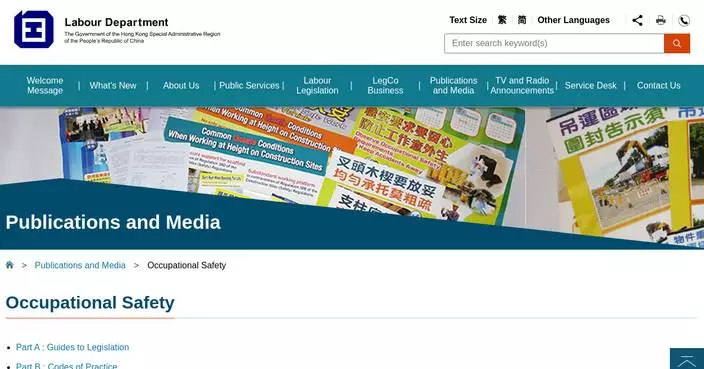
The revised CoP can be downloaded from the LD website (www.labour.gov.hk/eng/public/content2_8b.htm). Enquiries about the CoP can be made at 2559 2297.

Source: AI-generated images
Employers and employees should make reasonable work arrangements after tropical cyclones or rainstorms
The Labour Department (LD) today (July 26) reminded employers to make practical and reasonable work arrangements for employees after the cancellation of tropical cyclone warnings or rainstorm warnings, with due consideration to the road and traffic conditions and other factors, and make flexible arrangements for staff to resume work or work remotely (if applicable). This will help maintain good labour relations, and ensure the safety of employees as well as the smooth operation of organisations.
"For staff who have genuine difficulties in resuming work on time upon cancellation of a tropical cyclone or rainstorm warning, employers should be considerate and handle the situation in a flexible manner. For example, employers may allow employees to resume work by batches, permit employees who have difficulties in returning to workplaces to work remotely (if applicable) or allow more time for them to report for duty and resume work," a spokesman for the LD said.
The spokesman reminded employers to observe the statutory liabilities and requirements under the Employment Ordinance, Occupational Safety and Health Ordinance, Factories and Industrial Undertakings Ordinance, Employees' Compensation Ordinance and Minimum Wage Ordinance.
"Tropical cyclones and rainstorms are natural calamities. If employees are not required to report for duty, or are released from workplaces early, or are unable to report for duty at workplaces or resume work on time, etc due to adverse weather, extreme conditions or other environmental factors beyond their control, employers should not deduct their wages, good attendance bonus, or allowances, nor require employees to compensate subsequently for the loss of working hours in response to the aforementioned situations, or reduce employees' entitlements to annual leave, statutory holidays or rest days under the Employment Ordinance to compensate for the loss of working hours resulting from the issuance of adverse weather warnings or the extreme conditions announcement," the spokesman said.
Employers have an obligation to provide and maintain a safe working environment for their employees under the Occupational Safety and Health Ordinance and the Factories and Industrial Undertakings Ordinance. Moreover, under the Employees' Compensation Ordinance, employers are liable to pay compensation for injuries or deaths incurred when employees are travelling by a direct route from their residence to their workplace, or from their workplace back to their residence after work, four hours before or after working hours on a day when a Tropical Cyclone Warning Signal No. 8 or higher, a Red or Black Rainstorm Warning Signal or extreme conditions are in force.
The LD's latest revised "Code of Practice in Times of Adverse Weather and 'Extreme Conditions'" sets out the relevant guidelines in a reader-friendly and concise manner, reiterating the three major principles for formulating work arrangements under adverse weather and extreme conditions, including formulating work arrangements in advance, giving prime consideration to employees' safety, and complying with requirements of labour legislation, and incorporating corporate examples for reference. The booklet can be obtained from branch offices of the Labour Relations Division or downloaded from the department's webpage (www.labour.gov.hk/eng/public/wcp/Rainstorm.pdf).