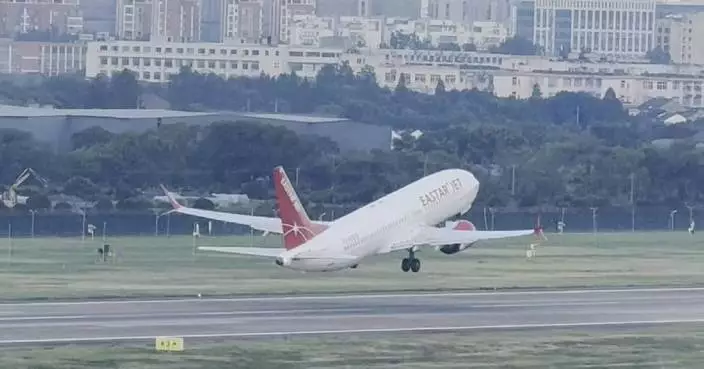
China's visa-free agreements with countries in Europe and Asia have led to an increase in foreigners entering China on business and tourism.
Starting on March 14, citizens of Switzerland, Ireland, Hungary, Austria, Belgium and Luxembourg can all enjoy visa-free entry and stay in China for up to 15 days for business, tourism, family visits, or transit. This latest extension of the visa-free policy follows up on visa exemptions for citizens of France, Germany, Italy, the Netherlands, Spain and Malaysia announced last year.
Not long ago, a plane carrying 133 passengers from Milan, Italy landed at Chongqing Jiangbei International Airport in southwest China. The local immigration officers quickly completed the border inspection procedures, allowing 17 European passengers to enter China under the visa-free policy.
Edoardo Orlandini, an Italian passenger doing export business shipping goods from China to Africa, was on his seventh trip to China. He said the implementation of the visa exemption has largely facilitated his business trip to China.
"It's much easier, much faster. I don't have to wait two months to get a visa. I just book an airplane, arrive and do the clearance. It's good. Great policy," said Orlandini.
Fabio Moretti was on the same flight to China on business, engaging in the trade of solar panels.
"When we know that it was visa free, obviously we decided to come because it was easier to come. It's really good. It was really fast, really smooth, everything. It's really fine," he said.
The visa-free policy has also given a boost to inbound tourism.
"It's my first time to China. I was always delaying that because of procedure of the visa. So I think it's a good idea. Well, that impression of some history secrets and I would like to know more about it in some future also as well. So I see the factories, how the business is grown all over the world, so I think it's good to know or good to see it," said Hashem Boschnani, a Luxembourgian passenger.
Thapakorn Saeheng, a monk from Thailand, was invited to visit China for the first time by a Chinese friend. He said the mutual visa-free policy between China and Thailand also made his trip easier.
"It's really nice that Thailand and (China) have mutual visa (exemption). We've been in (good) relationship for a long time. And right now we're really happy that China has opened the border for Thai people. I can give (this trip) like 11 or 12 (scores) because it was beyond my expectations," he said.
In the first quarter of this year, nearly 30,000 foreigners entered the country through Chongqing Jiangbei Airport, six times the number in the same period last year. Among them, more than 12,000 people entered without visas, twice that in the fourth quarter of 2023.
Visa-free policies boosts China's inbound tourism

South Africa's sugarcane sector, a cornerstone of the country's agriculture, stands ready to further integrate into the vast Chinese market as the zero-tariff policy for African countries officially takes effect.
China's Customs Tariff Commission of the State Council announced Tuesday that from May 1, 2026 to April 30, 2028, the country will grant zero-tariff treatment to 20 African countries that have established diplomatic ties with China and are not classified as the least developed countries.
This follows the country's earlier decision to grant zero-tariff treatment on 100 percent of tariff lines, effective from Dec 1, 2024, for the 33 least developed African countries with which it maintains diplomatic relations.
In effect, the zero-tariff treatment has been expanded to cover all 53 African countries that maintain ties with China.
In KwaZulu-Natal province, one of South Africa's traditional agricultural powerhouses, local farmers are hopeful that their sugarcane products will soon reach Chinese consumers.
Pratish Sharma, a sugarcane grower in the province, has witnessed the industry endure an unprecedented winter of challenges, including volatile international prices and trade barriers. When he heard of China's zero-tariff policy, however, his hope returned.
"It'll make trading in China a lot easier. It will create a better revenue stream for exports of sugar to China. And agreements like these assist in rejuvenating our economy within the industry and making us more viable," the farmer said.
Official data shows that China has been South Africa's largest trading partner for 17 consecutive years, with bilateral trade exceeding 53.5 billion U.S. dollars.
Yet, the country's agricultural products currently account for only 0.4 percent of China's total agricultural imports, indicating huge growth potential.
Kulani Siweya, market and trade policy director at the South African Sugar Association, sees greater opportunity ahead for the country's roughly 25,000 registered sugarcane growers.
"Main regions or destinations are the U.S., Europe. [We are] exporting about between 35,000 to 70,000 tonnes to the China market. South Africa stands ready to give you quality sweet sugar that will satisfy the Chinese palate," said Siweya.
Beyond sugar, South African specialties such as citrus, macadamia nuts, wine, and other high-quality agricultural products are also expected to gain broader market access in China. This has encouraged farmers like Sharma to experiment with a wider range of crops.
"I've converted 18 hectares of sugar cane into macadamias. So that process of diversification has already begun. And with trade initiatives such as the zero-rated making all of us more sustainable and viable," Sharma said.
John Steenhuisen, South African Minister of Agriculture, said China's zero-tariff initiative will help reshape the agricultural sector.
"The tariff-free access that's been granted us is going to be a game changer for not only citrus but also for the entire agricultural sector. We're now going to be able to compete with excellent quality wines and other agricultural goods in that market in a far more competitive basis," said the minister.
South African sugarcane growers eye sweeter exports as China's zero-tariff policy for Africa takes effect