The world's first intelligent capsule endoscopy system, which is suitable for home use and developed by a Chinese research team, has been recently approved for clinical use in Guangzhou City, south China's Guangdong Province.
Developed by a research team led by Liu Side, director of gastroenterology at Guangzhou's Nanfang Hospital, the system, which causes far less discomfort than traditional endoscopy examination, has been approved by relevant authorities of Guangzhou for hospitals in the city to use in clinical examination.
The system is operated by a designated application on mobile phone. After swallowing the capsule endoscopy device, the patient needs to change body positions according to instructions on the application, so that the device can take images of the stomach while moving inside. Images will be uploaded to an intelligent system for further analysis. The entire examination process can be completed in 20 minutes.
"The goal of our research is to solve a pain point. Traditional gastroscopy is quite painful but very important, so we hoped to develop a convenient and comfortable endoscopy device that is suitable for home use," said Liu.
The system has already been approved for clinical use. Patients need to complete the examination process in hospitals as it is still classified as a medical equipment. It is expected to be approved for independent operation by patients themselves after more cases of clinical application.
Liu's team is still conducting further research on the system, hoping to develop an advanced device that is able to complete the early screening of cancers on different organs of the digestive system.
"In the future, the capsule endoscopy system for the upper gastrointestinal will be able to take clear image of the esophagus. That will be the second one. Then we will develop a system for the colon and the rectum that are parts of the large intestine as colorectal cancer is also very harmful. In addition, the prevention and control of this cancer depends on early detection by endoscopy. Finding polyps and removing them will help prevent from getting colorectal cancer," said Liu.
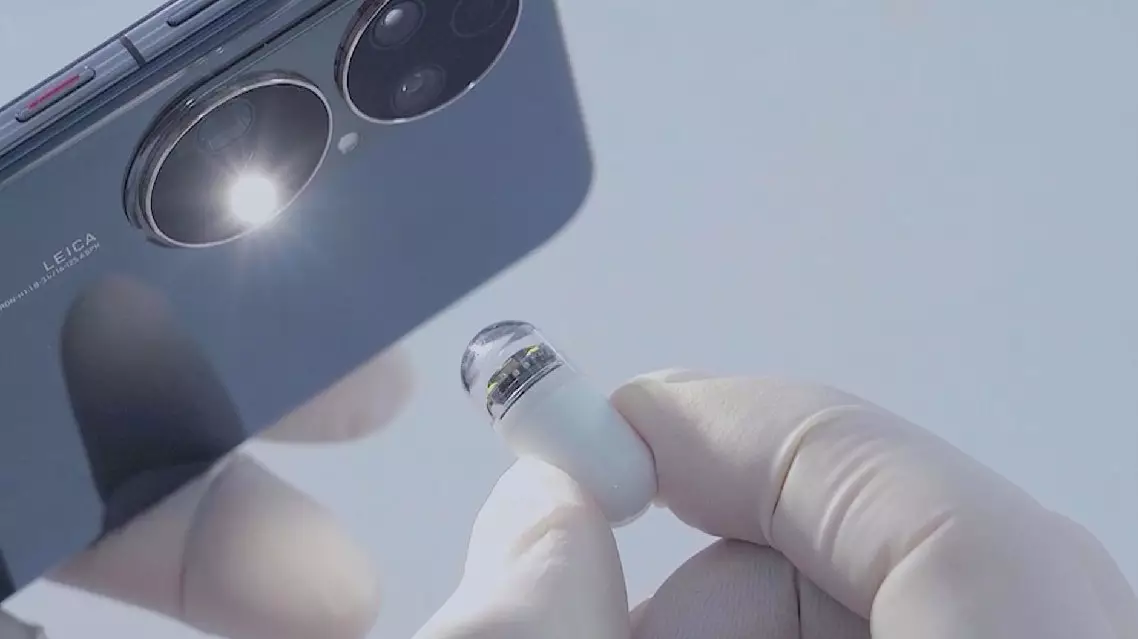
World's first home-use intelligent capsule endoscopy system approved for clinical use
Civil Defense teams in the Gaza Strip are struggling to carry out a major operation to recover the remains of hundreds of people still believed to be buried underneath, but a severe shortage of heavy equipment is making the task extremely difficult.
Israel acknowledged earlier this year that at least 70,000 people were killed during its two-year bombardment of Gaza, leaving the Palestinian enclave in ruins.
Sabra, one of Gaza City's hardest-hit neighborhoods, saw dozens of homes destroyed in Israeli airstrikes, burying many residents under the rubble.
The Abu Sharia family was among the worst affected, losing more than 200 relatives, many of whom remain trapped beneath the debris.
Ibrahim Abu Sharia lost his children, brothers, and many extended family members.
"All the families here carry the same wound. Life was already difficult, and now it has become even harder. For nearly three years we have come here every day remembering them. These recovery operations have renewed our pain. Even when remains are recovered, we cannot tell whose bones they are," he said.
Gaza Civil Defense crews face a daunting task amid the massive destruction, with a severe shortage of heavy machinery and specialized equipment.
"Every building here has victims beneath the rubble. This work requires heavy equipment, but unfortunately it is not available in Gaza. Right now, we are working with this single excavator to recover the victims and remove the debris," said Mahmoud Basal, spokesman for the Civil Defense in Gaza.
The International Committee of the Red Cross (ICRC) is supporting the operation with fuel and equipment, while Palestinian human rights groups estimate that more than 10,000 people remain missing beneath Gaza's rubble.
"We are supporting the civil defense in Gaza to continue their excavation operations to recover deceased Palestinians beneath the rubble. Thousands of families in Gaza have been in agony and uncertainty for the past two and a half years, waiting to be able to recover their loved ones, to mourn them and bury them," said Amani Al Naouq, an ICRC spokeswoman in Gaza.
According to the United Nations, more than 90 percent of Gaza's housing has been damaged or destroyed, and the Palestinian death toll has risen above 73,000.
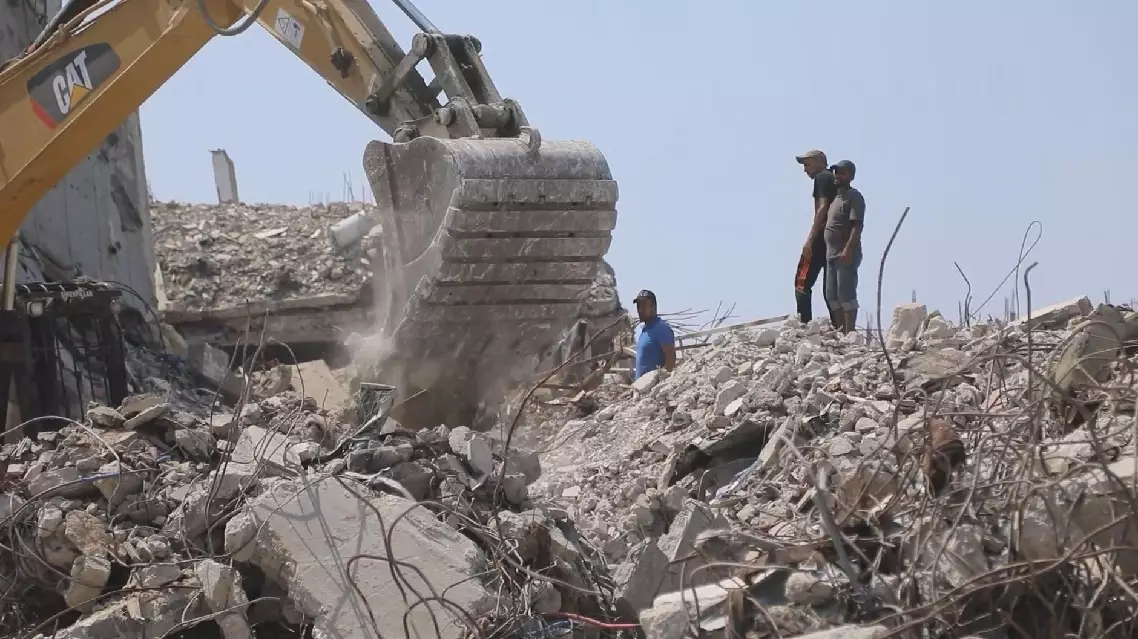
Gaza struggles to recover remains buried under rubble with few tools