Solar-powered tricycles are transforming rural transport in Zimbabwe, offering a clean and affordable solution to chronic mobility challenges.
Miles of dirt roads separate rural families in Zimbabwe from essential services, forcing many to walk long hours for basic necessities. This groundbreaking tricycle program is breaking new ground by bridging this gap.
In 2022, Pamela Kufinya broke societal stereotypes when she learned how to ride an electric tricycle. She's established a thriving business in Domboshava, a few kilometres north of the capital city Harare, delivering everything from stock feed and building materials. Occasionally, she also carried patients to the local clinic.
She said her tricycles are giving conventional modes of transport a run for their money.
"It costs more to hire a truck than it is to hire a tricycle, so people are opting for us. Before this, I used to grind quarry stones by hand for a living. Riding is less strenuous and is sustaining my family better," said Kufinya.
The three-wheelers called "Hambas", which means to move in the local language, are getting around one of the main barriers in rural development, and in a climate conscious manner.
"The Hamba is just the right answer to the rural mobility challenge. It is flexible, you don't need a very well-maintained road for it to access, which is the limitation that we have in the country. The Hamba by its size and its design is able to go through those small pathways, right into your avocado field, right into your banana plantation, right into your cabbage garden and collect and take the product to the market," said Simba Hlatshwayo, the Chief Finance Officer of the tricycle company.
Batteries of the tricycle were co-designed by the technicians of the company and an energy enterprise from China.
Emboldened by its reception and the environmental and economic benefits, the manufacturers are scaling up production. There are currently about 300 of these bikes traversing rural Zimbabwe. The plan is to increase that number to about 500 by the end of the year.
"As they improve productivity, because they have solved the mobility challenges, they have more disposable income," said the CFO.
In this case, more villagers will no longer have to walk long distances, and they can improve their livelihoods at the same time.
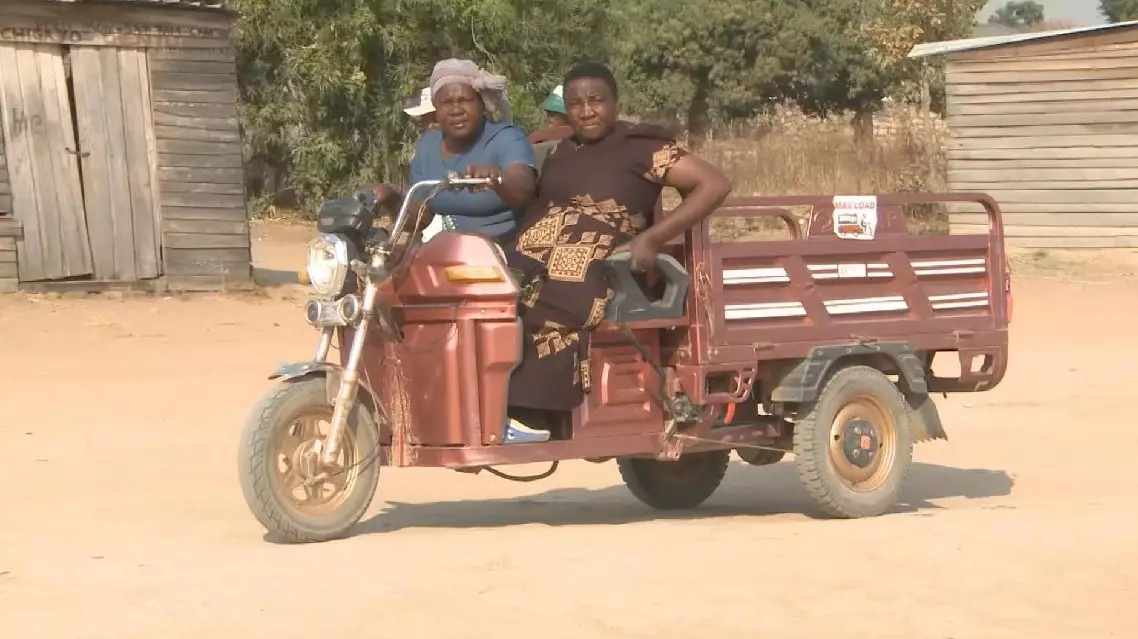
Solar-powered tricycles revolutionize rural transport in Zimbabwe
The 19th Europe-China Business and Technology Cooperation Fair concluded on Friday in Chengdu, the capital of Sichuan Province in southwest China, attracting over 600 enterprises and institutions from more than 20 countries and generating more than 160 preliminary cooperation intentions.
Co-hosted by the China Chamber of International Commerce and the European Union Chamber of Commerce in China, the fair serves as a premier platform for targeted business matchmaking between European and Chinese businesses. It aims to foster meaningful, sustainable cooperation across sectors.
During the three-day event, enterprises from China, Spain, Portugal, and other countries held nearly 400 one-on-one business matchmaking sessions across sectors such as new energy, biomedicine, agriculture and food, and artificial intelligence.
Speaking at the fair, Liu Jiannan, vice chairman of the China Council for the Promotion of International Trade, emphasized the need to explore innovative cooperation models between the two sides.
"We are ready to help enterprises from both sides fully utilize platforms like the Europe-China Business and Technology Cooperation Fair to strengthen sci-tech exchanges, deepen innovative cooperation in areas such as AI, clean energy, and digital economy, and explore new models for cooperation in third-party markets," said Liu.
Business leaders at the event stressed the evolving and deeply integrated nature of Sino-European business ties.
Luigi Gambardella, president of the ChinaEU Digital Association, urged young entrepreneurs to become more involved to deepen mutual understanding.
"I hope that young people, young entrepreneurs, and young startups will start to consider co-creation. I think such kind of cooperation would be much more profound. That's because it will allow entrepreneurs [and] employees to enrich with a different culture, understanding each other," said Gambardella.
Adam Dunnett, secretary general of the European Union Chamber of Commerce in China, underscored the Chinese market's critical importance to Europe, calling for deeper two-way investment and trade.
"China is an important market for us. It's really, really important as a source for our supply chain. [It] really doesn't matter if [European] companies are investing in China or if Chinese companies are investing in Europe, or they're finding ways to trade with each other or to make use of each other's supply chains," said Dunnett.
Since its inception, the event has attracted over 14,000 Chinese and European enterprises. To date, it has successfully facilitated nearly 30,000 business matchmaking sessions, resulting in more than 3,000 cooperation intentions and agreements.
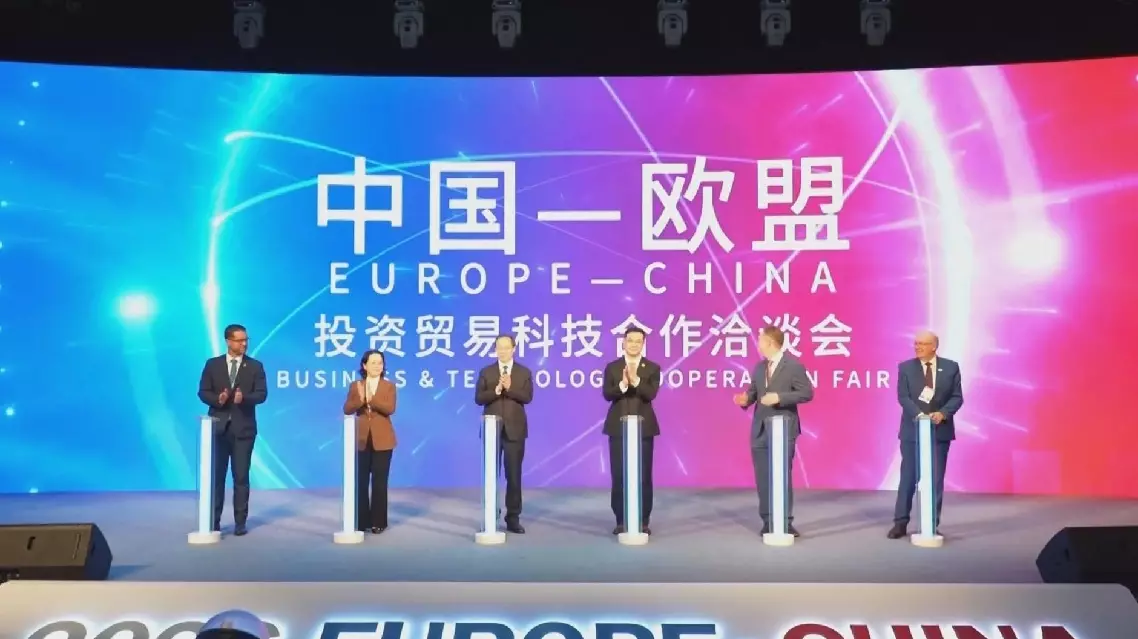
Europe-China fair wraps up in Chengdu with over 160 preliminary deals