A copper relief painting presented as a diplomatic gift from Zambia to China has shown the unique regional culture, rich resources and good relations between China and the African country, said the curator of an exhibition in Beijing which showcases more than 670 representative gifts given and received by Chinese officials in diplomatic activities since the founding of the People's Republic of China in 1949.
The painting of an eagle was presented to Chinese President Xi Jinping by then Zambian President Michael Sata when he came to China to attend the opening ceremony of the Boao Forum for Asia Annual Conference in 2013.
"At the center of the painting is a copper sculpture of a majestic eagle, poised to take flight. The eagle is Zambia's national bird, symbolizing independence and freedom, and is also a key element of the Zambian emblem. Below the eagle, a clear blue river winds its way across a vast expanse of land. Zambia is famous for the Zambezi River, the fourth-longest river in Africa. It has an extensive network of tributaries, connecting hundreds of small streams," said Hou Chunyan, curator of the Exhibition of Diplomatic Gifts Received by China's Leaders.
Zambia is known as the country of copper, with extensive, high-quality copper deposits and significant reserves. It also has a long history of copper craftsmanship, and its prestigious brass products are highly valued across the country.
"Zambia's copper relief paintings feature a wide range of themes that reflect everyday life for many of its people, as well as depictions of birds and animals, pastoral landscapes, and more. The carving techniques are exceptional. This piece on display has rich layers and intricate craftsmanship, showcasing Zambia's traditional artistry to its fullest," she said.
When talking about Zambian copper products, the curator also mentioned the Tanzania-Zambia Railway. The Tanzania-Zambia Railway Authority (TAZARA) railway line which runs between Dar es Salam in Tanzania and Kapiri Mposhi in Zambia was built with Chinese aid in the 1970s. The railway has become an important transport route for exporting Zambian copper ore. Hou said both the gift and the railway have witnessed the blossoming China-Africa relations.
This story introducing Zambia's relief painting is an episode of the "Gifts of Friendship" series presented by China Media Group's (CMG) English-language channel China Global Television Network (CGTN). The series focuses on the exquisite gifts sent to China by foreign countries which not only represent the cultural origin of their respective home countries, but also witness the historical friendship between China and these counterparts.

Zambian gift of copper relief painting showcases local culture, friendship with China

Zambian gift of copper relief painting showcases local culture, friendship with China
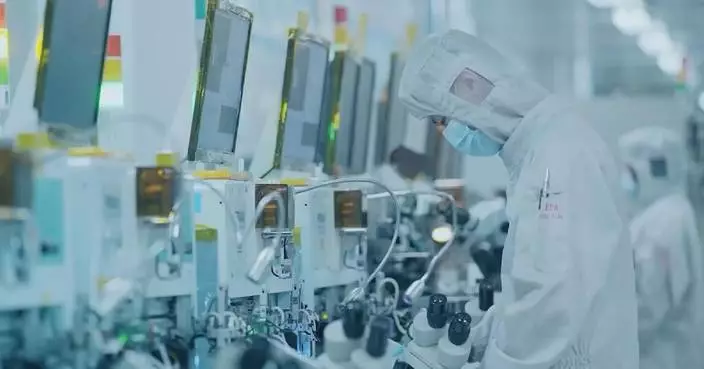
Global financial and consulting firms have expressed confidence in China's manufacturing transformation, saying the country's push toward smarter, greener and more integrated advanced manufacturing is injecting strong momentum for global growth.
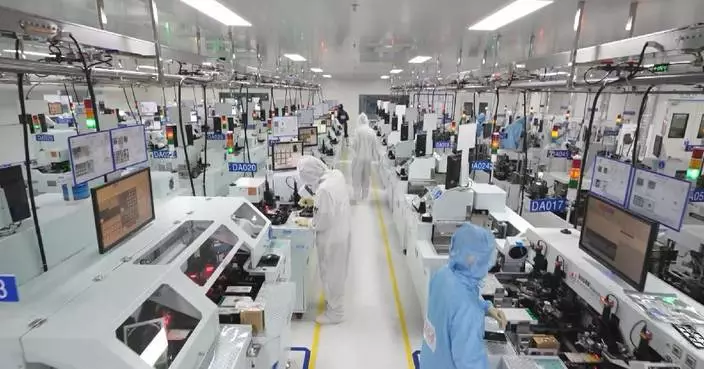
For the smart manufacturing sector, China has accelerated its adoption of digital and artificial intelligence (AI) technologies across the manufacturing industry.
Data from the Ministry of Industry and Information Technology showed that the scale of China's core AI industry exceeded 1.2 trillion yuan (about 167 billion U.S. dollars) in 2025, with the industrial internet covering all 41 major industrial categories, and over 500 excellence-level smart factories cultivated nationwide.
According to a report of Goldman Sachs, Chinese companies' overseas expansion has entered a 3.0 version in which exporters have increasingly sold AI-driven industrial capabilities, as frontier areas, such as embodied intelligence and humanoid robots, has been moving toward commercialization.
"After we visited many domestic humanoid-robot companies, one could find that on the components side, 80 percent to 90 percent have been already supplied by domestically made parts rather than relying on foreign-funded components. As a result, this industry achieved domestic substitution in many areas at a very early stage. That kind of full industrial-chain capability is uncommon. Leveraging these unique competitive advantages, Chinese companies are playing an increasingly important role on the global stage," said Du Qian, head of China Industrial Technology Research at Goldman Sachs.
In green transition, China has sped up its shift toward low-carbon manufacturing. China's new energy vehicle (NEV) output and sales have ranked first globally for 11 consecutive years, while the country has built more than 8,000 national-level green factories. Energy and water use per unit of industrial value-added companies have continued to decline, as the country has placed greater emphasis on green and low-carbon development.
"In China, we do buy into the structural growth story that is China, and China has really marked itself out as a tech innovator, a tech adopter. So, in terms of the green energy transition, EV, manufacturing processes, that is a strong structural growth driver. So, as a long-term investor, that earns a place in the global asset allocation from our perspective," said John O'Toole, global head of Solutions and chief investment officer for Asia at French asset management company Amundi.
On the industrial integration, China's manufacturing upgrade is deep cross-sector integration and brand elevation. Data from National Bureau of Statistics, in 2025, equipment manufacturing and high-tech manufacturing accounted for 36.8 percent and 17.1 percent of value-added industrial output, respectively.
The label of "Made in China" has been actively transitioning from low cost toward high-tech and high-premium brand identity.
"China is gradually transitioning from a manufacturing powerhouse to a technology and brand powerhouse. This process will bring massive growth opportunities. We have every reason to believe that in the next decade and beyond, more and more global brands will be born in China," said Zhang Yun, CEO of the U.S. consulting agency of Ries Global and chairman of Ries China.

Global institutions voice confidence in China’s manufacturing upgrades