
Skip to Content Facebook Feature Image

The West slam HK for the slightest attempts to regulate Telegram during riots, and now crack down the platform without a blink

Blog

The West slam HK for the slightest attempts to regulate Telegram during riots, and now crack down the platform without a blink
Blog

Blog

The West slam HK for the slightest attempts to regulate Telegram during riots, and now crack down the platform without a blink

2024-08-30 23:20 Last Updated At:23:20

Pavel Durov, founder of Telegram—the world's largest social media and communication platform—was recently arrested in France. The arrest was reportedly about the lack of moderation of the messaging app, its failure to cooperate with law enforcement and take steps to curb criminal uses of the platform. However, a deeper reason appears to be the platform's "unregulated" political influence, which could potentially be exploited for interference. A legal expert has noted that the arrest has torn down the façade of the hypocritic notion of "freedom of information and speech" championed by the governments in the West all the time. They fire harsh criticism on Hong Kong no matter what the situation, but are quick to turn around and impose severe restrictions when faced with an uncontrollable internet reality that threatens public order and security.

He highlighted that during the riots sparked off by anti-extradition protests in Hong Kong five years ago, Telegram had become a command centre, organizing and coordinating violent activities. Tens of thousands of radicals joined groups on the platform, leading to widespread horrible violence and chaos. Despite the time, authorities hesitated to impose strict controls, fearing accusations of suppressing internet freedom. Now we can see that the French and British governments have taken decisive action against Telegram. The Hong Kong government should take note and not be overly concerned about criticisms from these countries.

Originally a Russian citizen, Durov later obtained citizenship in France and the United Arab Emirates. Since its launch in 2013, Telegram has gained popularity in various countries due to its strong encryption, high level of anonymity, and the ability to join without registering a personal phone number. These features, combined with the platform's capacity to host groups of up to 100,000 users—far exceeding that of WhatsApp—have made it a widely used communication tool. As of July this year, Telegram's global user base had reached an astonishing 950 million.

Unlike platforms such as Google, Facebook, and X (formerly Twitter), which generally comply with government requests for user data when legally compelled, Telegram has gained a reputation for defiance, often refusing to cooperate with authorities and remaining beyond control.

Despite their frequent assertions of "defending freedom," the governments of France, the UK, and the US are highly vigilant against "external forces" using social media to interfere in politics and do not tolerate online activities that disrupt public order. Legal experts argue that while the French authorities claim that Telegram "facilitates crime," their real concern is that the platform could be used as a tool for political interference.

The British government has also accused Telegram of being the driving force behind recent anti-immigration riots, with far-right groups exploiting this "lawless space" to incite the public. The new Prime Minister, Keir Starmer, has made it clear that online offenders will not be spared, including platform management and owners, suggesting that the British government may also have played a role in the crackdown on Durov.

Hong Kong experienced the challenges posed by Telegram even earlier than the French and British governments. Legal experts recalled a shocking court case from two years ago, in which the defendant managed a Telegram group with 100,000 members. From October 2019 to June 2020, this group disseminated over 20,000 messages, some of which incited attacks on police stations, police quarters, MTR stations, the airport, and pro-establishment businesses. Many participants in the violent protests followed instructions relayed through Telegram.
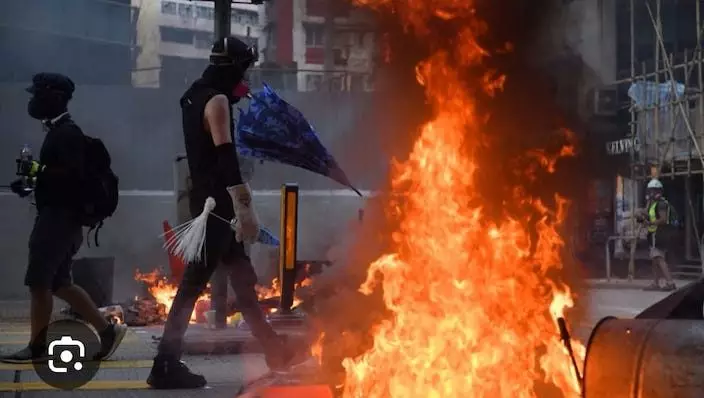
One particularly egregious case involved Telegram channels not only inciting arson but also instructing users on how to release chlorine gas at police stations and MTR stations, leading to mass casualties. Additionally,  doxing channels were built on the platform, targeting members of the disciplined services and pro-establishment figures.  Thousands of messages were posted on those channels that had attracted over 30,000 members.

At the peak of the violence, Telegram hosted various groups, the largest of which had up to 40,000 members, creating a powerful mobilization force and exacerbating the riots. While the authorities issued temporary injunctions to prohibit the spread of violent messages on Telegram and even deleted a channel spreading hate speech in March 2020, they stopped short of blocking the platform entirely, to avoid accusations of stifling freedom of information.

As legal experts have pointed out, Durov's recent arrest demonstrates that Western governments, despite their rhetoric on freedom, will act decisively when their security interests are at stake. The Hong Kong authorities should learn from this incident: whether dealing with Telegram or other social media platforms, they should not hesitate to take firm action when necessary.

Lai Ting Yiu


What Say You?

** The blog article is the sole responsibility of the author and does not represent the position of our company. **

Cheng Xianyue

 Chinese Association of Hong Kong & Macao Studies

The eighth-term Legislative Council election in the Hong Kong Special Administrative Region has drawn to a triumphant close, showcasing a landscape of benign competition that offers a vital reference point for the design of democratic institutions. For too long, certain Western narratives have framed the global order through the rigid binary of “democracy versus authoritarianism,” yet Hong Kong’s experience underscores a profound truth: democracy’s forms should be rich and pluralistic, with its true vitality measured not by ideological purity, but by governance efficacy and social consensus.

As a cornerstone of modern political civilization, Western representative democracy once exerted sweeping influence through its competitive elections and multi-party rotations. However, in an era of deepening globalization and escalating social complexity, its inherent structural tensions have grown starkly apparent—political polarization erodes consensus-building, short-term electoral gains hijack long-term national strategies, and societies fracture further amid inflamed identity politics. This “adversarial democracy,” while safeguarding formal freedoms, risks undermining the continuity and effectiveness of governance, ensnaring itself in the “democratic paradox.” In stark contrast, Hong Kong’s revamped electoral system prioritizes broad representation, political inclusivity, balanced participation, and fair competition, transforming what could devolve into a socially divisive “zero-sum game” into a “consensus-building platform” that harnesses constructive energies. Despite the disruptive shadow of a sudden fire during preparations— which briefly chilled the public mood—the overall voter turnout still climbed higher than in the previous election, signaling that societal expectations for the legislature’s performance remain undimmed by external shocks. Citizens, through their rational engagement, have voiced a clear intent to forge developmental consensus via institutionalized channels. Candidates vied for support on the strength of policy platforms and professional expertise, while diverse sectors rallied around shared imperatives like “boosting the economy, charting development, benefiting the people, and advancing reforms,” heralding the emergence of a problem-solving political culture.

Under the “patriots administering Hong Kong” principle, this election’s architecture ensures that governing authority rests firmly in the hands of those truly committed to the city’s long-term prosperity and stability—an institutional echo of the “One Country, Two Systems” doctrine and Hong Kong’s unique status. This design places the safeguarding of national sovereignty, security, and developmental interests at its unyielding core, while fully realizing the optimal equilibrium between Hong Kong’s high degree of autonomy and the rights of its citizens within that very framework. In practice, optimized mechanisms have empowered business leaders, professional groups, grassroots communities, and beyond with effective participation avenues: turnout in sectors like innovation and technology, as well as the third-tier business constituency, soared to a perfect 100%, embodying the genuine realization of “balanced participation” as a bedrock of quality democracy. This illuminates a core insight: true democratic vitality lies not in street-level confrontations or political gridlock, but in forging equilibrium between ordered competition and rational deliberation, channeling social consensus through institutionalized platforms to advance developmental agendas.

Hong Kong’s latest election represents a bold foray into governance modernization, deeply rooted in its constitutional order and social realities. It may not furnish a one-size-fits-all blueprint for global democracies, yet it charts a universally resonant pathway for reflection: effective democracy must foster social unity rather than exacerbate divisions, solve real-world problems instead of spawning fresh antagonisms, and authentically adapt to—and serve—its society’s developmental stage and core needs. Far from being a mere showcase for ideological posturing, Hong Kong’s electoral framework, through its locally grounded successes, demonstrates to the world that developmental paths can be chosen with sovereignty, governance models innovated with ingenuity, and popular welfare steadily elevated amid pragmatic, orderly institutional evolution. In this light, Hong Kong’s journey from confrontation to consensus isn’t just a local milestone—it’s a beacon for reimagining democracy’s promise in our fractious times.

Recommended Articles