Chinese Kunqu opera masterpiece "The Peony Pavilion" (the youth version) was put on stage in the country's prestigious Peking University from Saturday to Monday, to mark the 20th anniversary performance of its debut.
Kunqu Opera, one of the oldest forms of opera in China with a history of hundreds of years, was placed on the list of Masterpieces of the Oral and Intangible Heritage of Humanity by the United Nations Educational, Scientific and Cultural Organization (UNESCO) in 2001.
Written by Chinese playwright Tang Xianzu (1550-1616) of the Ming Dynasty (1368-1644), "The Peony Pavilion" tells the story of the romance between a daughter of a wealthy official and a talented but poor young scholar.
The youth version of the opera on the other hand was created by Suzhou Kunqu Opera Theater in east China's Jiangsu Province and Taiwan's famous playwright Pai Hsien-yung. It has received great reactions across Taiwan.
Debuted in Taipei, China's Taiwan region, 20 years ago, the opera has toured at home and abroad for over 500 performances, attracting about one million audience members, with most being young people.
The youth version of "The Peony Pavilion" focuses on the inheritance and innovation of traditional culture, drawing an increasing number of young audience members into the theater.
"We respect the classics but do not adhere rigidly to them, and we utilize modern elements without abusing them. Our production maintains the traditional components while carefully infusing modern stage aesthetics into the classic framework, for a successful combination of the traditional and the contemporary," Pai said.
The combination of ancient and modern arts entertain the audience greatly and receive rounds of applause.
"After I entered high school, I watched online videos of the youth version of 'The Peony Pavilion' online and immediately fell in love with it. This sparked my desire to make classical opera a primary focus of my research. Now, on the occasion of its 20th anniversary, I am deeply moved to witness the live performance of the original cast," said a Kunqu enthusiast named Ye Zi.
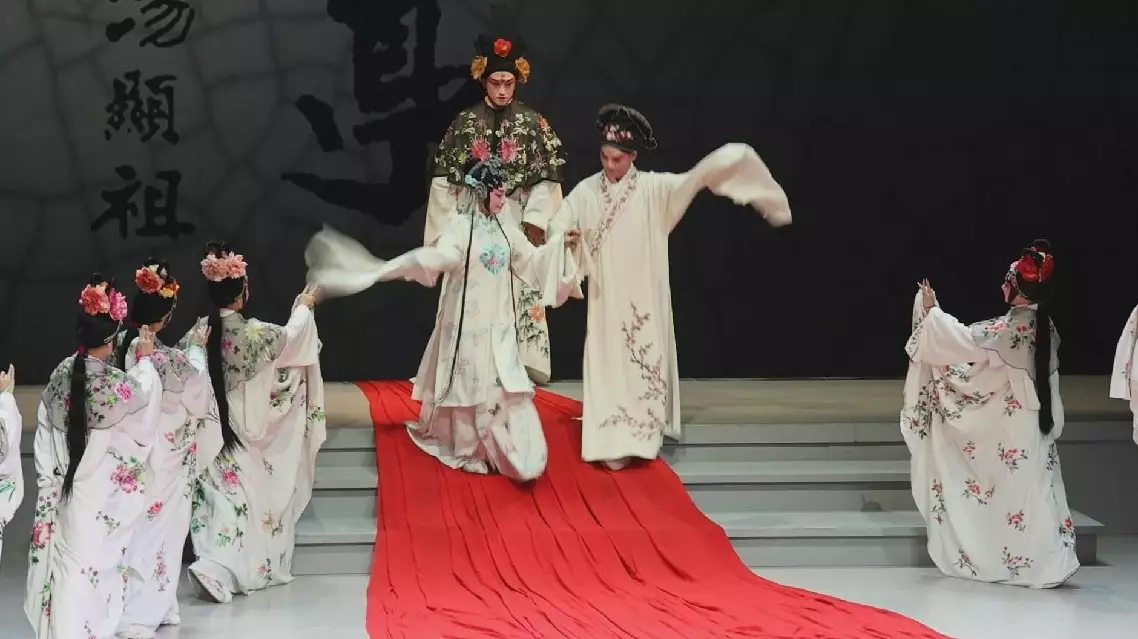
Youth version of "The Peony Pavilion" staged in Peking University to mark its 20th anniversary
China’s transport authorities mobilized rail, road, air and waterway resources on Tuesday, the final day of the five‑day May Day holiday, to manage the peak return flow as passenger volumes surged nationwide.
The national railway system expects 23 million passenger trips on the day, with operators adding 2,225 extra trains and deploying capacity on popular routes and peak hours to handle the return flow from smaller cities to major hubs.
In Zhengzhou, central China's Henan Province, 134 trains have been temporarily added for high-demand directions including the Beijing-Tianjin-Hebei region, the Yangtze River Delta, and the Guangdong-Hong Kong-Macao Greater Bay Area.
"Railway return travel peaks today. In light of short stops and high passenger volumes, we have strengthened coordination with intermediate stations and offered guidance to passengers for smooth boarding and alighting to prevent crowding and stampedes," said Ji Yudi, a conductor of China Railway Zhengzhou Group.
Regional operators in Beijing, Chengdu and other cities have also proactively coordinated with local transit authorities to extend bus and subway operating hours, increase nighttime service frequency, and boost taxi and ride-hailing availability to ensure seamless transfers for late-arriving passengers.
With respect to highways, the national highway network is projected to record approximately 61 million vehicle trips on Tuesday. The peak traffic window is between 16:00 and 18:00, with congestion and slow-moving traffic likely around major city entry and exit points, as well as airport expressways in major cities like Beijing, Shanghai, Guangzhou and Chengdu.
To ease holiday congestion, traffic police in south China's Guangdong Province have rolled out tidal lanes and flow control measures at 24 key highway sections in nine cities.
"Using a highway interconnect system, we have conducted remote flow diversion. During this morning's peak return period, traffic efficiency on the Erenhot-Guangzhou Expressway improved significantly, showing no sign of congestion," said Dai Zhouwu, a local traffic police officer.
By water, an estimated 1.035 million passenger trips are expected to be made across the country on Tuesday, marking a 1.4-percent increase year on year.
To ensure smooth strait crossing from south China's Hainan Province, the maritime authorities in Zhanjiang City, south China's Guangdong Province have urged operators to supplement fixed sailings with extra voyages and optimized crew rotations to meet surging vessel demand.
Meanwhile, China's civil aviation sector is projected to carry 2.3 million passengers on Tuesday.
The Chengdu Shuangliu International Airport, one of the country's busiest airports in southwest China's Sichuan Province, are offering free luggage pick-up and delivering services to passengers arriving from Beijing, Shanghai, Guangzhou, and Shenzhen.
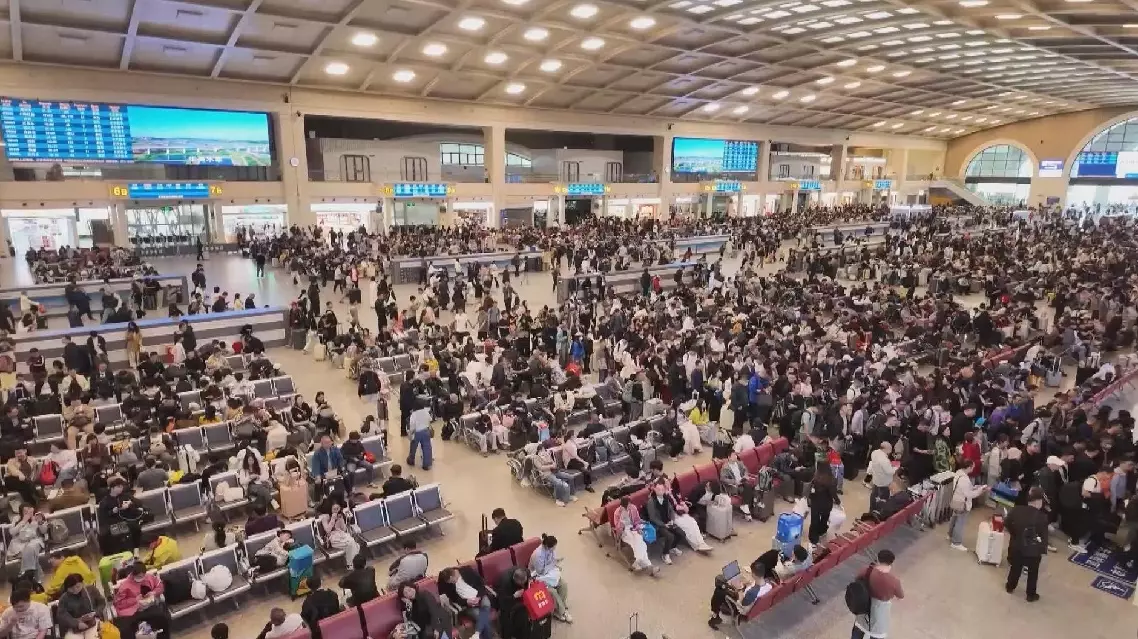
China’s transport network braces for record May Day return traffic