China's Macao Sepcial Administrative region (SAR) celebrated the Mid-Autumn Festival with meticulously organized cultural events, providing rich and joyful experiences for both locals and visitors.
The time-honored festival, celebrated annually on the 15th day of the eighth month in the Chinese lunar calendar, falls on Sept 17 this year. As one of China's most important traditional holidays, it is a joyous time when families come together, appreciate the full moon and share mooncakes, a traditional pastry, to mark the harvest season.
On Tuesday night, the vibrant region came alive with festive celebrations as the SAR government organized various cultural events for the special holiday.
Held at the historic Ruins of St. Paul's, the themed concert was undoubtedly the highlight of the evening.
"Having the chance to listen to our traditional Chinese Music, my child also loves folk music, and she also has the opportunity to wear such Hanfu. We think it is a very memorable and meaningful experience," said Li Xingyuan, a tourist from the mainland.
The concert featured classic pieces ranging from domestic to international and from traditional to modern, showcasing the distinctive allure of cultural diversity.
"The purpose of holding this concert at the Ruins of St. Paul's is to highlight the importance of Macau as a place where Chinese and Western cultures converge," said Liang Huimin, director of the Cultural Affairs Bureau of the Macao SAR government.
Macao's parks also extended their opening hours to host various activities, such as lantern displays and riddle-solving, allowing locals and visitors to fully immerse themselves in the festive atmosphere.
With the cozy night breeze, many families set up tables along the seawall, sipping tea and eating mooncakes while admiring the full moon.

Macao SAR celebrates Mid-Autumn Festival with colorful festivities
Heavy rains continued to hit central and southern China on Friday, causing multiple rivers to swell beyond warning levels and prompting rescue efforts to save stranded residents.
Shimen County in central China's Hunan Province has entered a critical period for flood control following days of persistent downpours. With a high risk of secondary disasters such as mountain torrents, landslides, and mudslides, local authorities have transferred all trapped residents to safety and imposed traffic controls on affected roads.
Torrential rains also triggered flooding across south China's Guangdong Province, Guangxi Zhuang Autonomous Region, and east China's Jiangxi Province. From Thursday to Friday, 15 rivers exceeded warning levels, with the highest water level reaching 1.51 meters above the warning line. Most of these waterways have now receded below their alert levels.
Fangchenggang City, Guangxi, saw the sudden onslaught of continuous heavy rain, which caused severe urban waterlogging across multiple regions. Rising river waters trapped 15 residents in Baisha Village of Gangkou District. Local fire rescue teams rushed to the scene immediately and successfully evacuated all the trapped people in batches to safe areas.
In Yangjiang City, Guangdong Province, the Moyang River experienced its second flood peak on Friday morning, hitting 6.82 meters, which was 0.02 meters above the warning level. By Friday noon, the water level had dropped to 6.7 meters. Large and medium-sized reservoirs in Yangjiang have cumulatively intercepted over 100 million cubic meters of floodwater, easing flood control pressure downstream.
The widespread rainfall has also extended to parts of east and north China.
On Friday, heavy to torrential rains hit parts of east China's Anhui, Jiangxi, central China's Hunan, Hubei and southwest China's Sichuan provinces, with extremely heavy rain recorded in some areas of Xiangtan and Changsha in Hunan Province.
According to China's National Meteorological Center (NMC), a new round of heavy rainfall will also start to develop from northwest China's Shaanxi, central China's Henan and Hubei provinces on Saturday.
The NMC continued to issue a blue rainstorm alert on Saturday, marking the 12th consecutive day of rainstorm warnings since May 12.
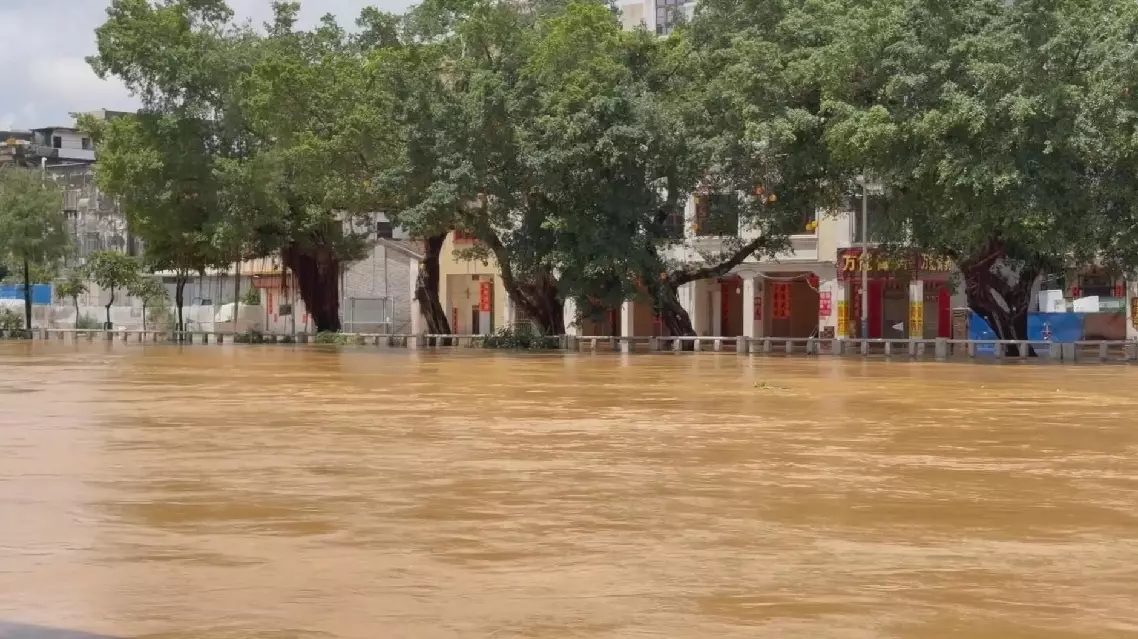
Flood rescue operations intensify as heavy rain hits multiple regions in China