The great strides made by China in rural revitalization has boosted the confidence of farmers across the country in pursuing a better life and also propped up the building of a beautiful and harmonious countryside that is pleasant to live and work in.
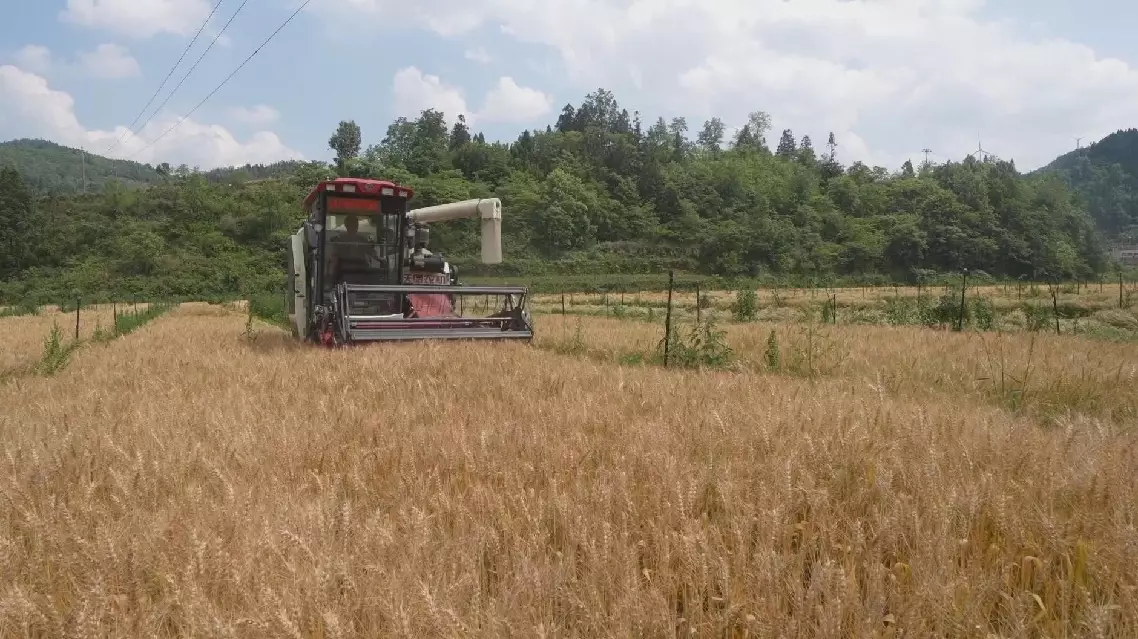
Sunday marks the seventh Chinese farmers' harvest festival. During the current golden autumn, farmers all over the country now are busy reaping crops, and harvesters are operating at full capacity across the fields.
In northeast China, 330,000 mu (about 22,000 hectares) of soybeans at the Heshan Farm of Beidahuang Group in Heilongjiang Province are embracing the harvest season, with a total of 53 high-powered harvesters operating around the clock to reap the crop.
In the Huanghuaihai region, the harvest for corn has also kicked off, while that for rice is coming to an end in southwest China.
Moreover, potato growers in Ordos City of north China's Inner Mongolia Autonomous Region are applying mechanized combine harvesters to enable the fast and convenient harvesting, as potatoes have stepped into the mature season.
Chinese president Xi Jinping, also general secretary of the Communist Party of China (CPC) Central Committee and chairman of the Central Military Commission, attaches great importance to the work relating to agriculture, rural areas, and rural residents.
He extended festive greetings to farmers and comrades working on agricultural and rural fronts across the country ahead of this year's Chinese farmers' harvest festival, stressing to make every effort to enhance the economic benefits of agriculture, increase farmers' incomes, and inject greater vitality into the countryside, so as to bring tangible benefits to farmers.
"Every year during the Chinese Farmers' Harvest Festival, General Secretary Xi sends us festive greetings, which makes us feel very warm. In recent years, our country has attached unprecedented importance to and invested in agriculture, which has greatly encouraged us. We feel more hopeful and confident in farming," said Gao Jianhua, a resident in Shengli Village in Yiyang City of central China's Hunan Province.
"This year, more than 1,000 grain growers have sought development by forming teams. More than 200,000 mu (about 13,333 hectares) of fertile land has been planted on a large scale, and the grain industrialization has developed vigorously. Grain farmers have made money and benefited from it," said Xu Congxiang, a farmer of Taihe County in China's eastern province of Anhui.
Food security is of paramount importance in China.
Xi pointed out in his festive greetings that despite the adverse impacts of relatively severe natural disasters and other challenges this year, China has increased summer grain output and ensured steady production of early rice, and is expecting another bumper grain harvest throughout the year, which will provide strong support for consolidating and strengthening economic recovery and improvement as well as for promoting high-quality development.
To further promote large-scale yield improvement and boost grain production capacity, China has focused on the planting of four major crops—corn, soybeans, wheat, and rapeseed—since the start of the year, and intensified efforts in seven key areas, including variety updating, technology integration, and agricultural machinery support.
"This year, we've conducted trial planting and screening of nearly 60 grain varieties in three major categories, and completed more than 40 tests on various aspects such as varieties, cultivation patterns, and fertilizer ratios in more than 500 plots of land," said Liu Zhaokai, an agricultural technician at Beidahuang Group.
The Green Rural Revival Program is a major project planned and promoted by Xi during his work in east China's Zhejiang Province.
Since the beginning of this year, local authorities across the country have been drawing on and applying the experience from the program to advance rural revitalization in all respects in an effective manner, making the countryside a comfortable place for people to live and work.
So far, all towns, townships, and villages where conditions permit are now connected by paved roads. Tap water coverage in rural areas has reached 90 percent. The 5G network covers over 90 percent of villages across the country.
With the continuous improvement of basic public services such as education, medical service, and elderly care, farmers have gained a greater sense of gain, happiness, and security in rural revitalization.
"I have built an ecological orchard of more than 2,000 mu (about 133 hectares). This year, more people than ever have visited our village, which has boosted the business of my vineyard," said Wang Suibing, a farmer in Haojiaqiao Village of Yulin City, northwest China's Shaanxi Province.
China has also been consolidating and building on the achievements in poverty alleviation and effectively dovetailing rural revitalization since the beginning of this year. The country has focused on 160 key counties receiving national assistance for rural revitalization, and 35,000 key resettlement areas for people relocated from inhospitable areas for poverty alleviation, as well as other key areas.
In addition, China will implement a number of projects to shore up weak links and boost development, so that areas and people that have shaken off poverty will not be left behind in comprehensive rural revitalization during the modernization process and will catch up and share the achievements of rural revitalization and modernization.
It is hoped that farmers and people from other sectors across the nation take actions to transform the rural revitalization blueprint into a reality step by step, so as to lay the foundation for the modernization of agriculture and rural areas as well as for building China into an agricultural powerhouse, said Xi in his festive greetings.
"We, the new farmers, have made use of new farm tools and planted new varieties. Now we can produce up to 3,750 kilograms of sweet potatoes per mu (about per 0.067 hectare). Without further ado, let's work hard in the future!" said Wu Longhai, head of a planting professional cooperative in Kaifeng City of central China's Henan Province.
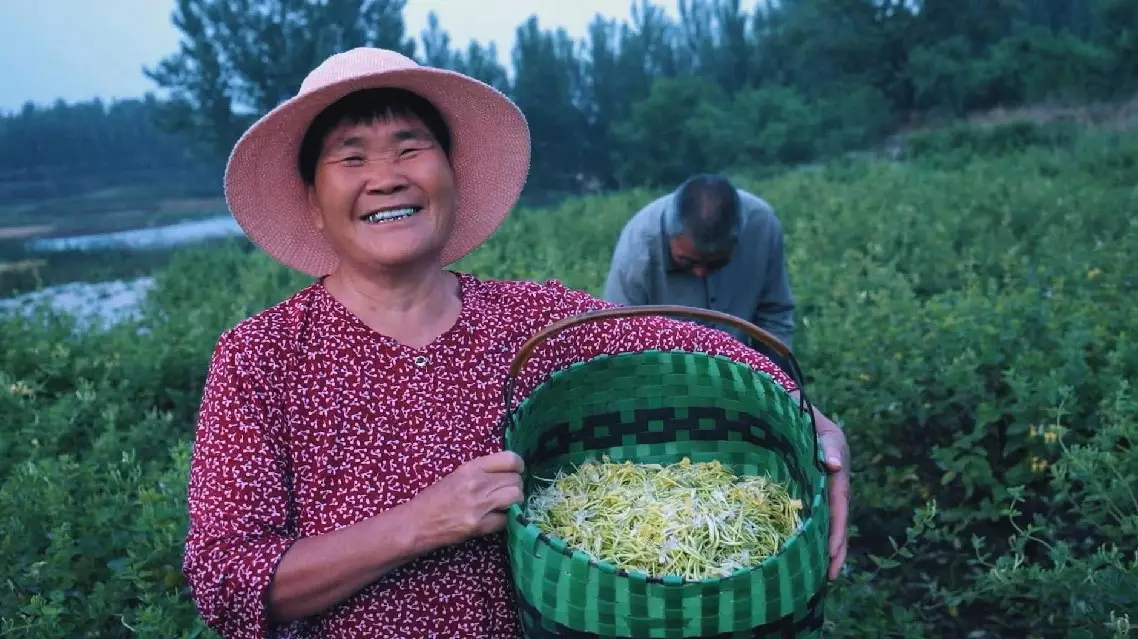
Rural revitalization boosts farmers' confidence, makes villages better