An increasing number of endangered Sichuan golden snub-nosed monkeys have been spotted at a forestry farm in Xi'an City of northwest China's Shaanxi Province, as years of concerted conservation efforts pay off.
Featuring flattened noses and golden-colored furs, the monkeys under top-level state protection live in temperate forests of mountainous highlands in the provinces of Sichuan, Gansu, Shaanxi and Hubei respectively in the southwestern, northwestern and central parts of China.
Recently, staff members of the Taiping forestry farm in Xi'an saw a rare footage of golden snub-nosed monkeys captured by infrared cameras they installed earlier in the wild. In the footage, a male Sichuan golden snub-nosed monkey was seen walking curiously towards the camera and trying to grab it with his hands.
"We have spotted Sichuan golden snub-nosed monkeys in the same area for three consecutive years. There are individual monkeys and a family of three. Our patrol workers have also found the traces of these monkeys in other places. The scope of their activity has increasingly enlarged over recent years," said Zhang Jianming, deputy director of the Taiping State-owned Ecological Forestry Farm.
Zhang said the forestry farm has placed multiple infrared cameras in the areas under its jurisdiction since 2021, which have captured images of four rare species under first-level state protection, including the golden monkey and golden takin, as well as nine species under second-level state protection, such as black bear and yellow-throated marten.
"It speaks volume for the ever-improving environment of Qinling Mountains. The eco-protection work has achieved good results. Our forest farm will continue to intensify wild animal protection, striving to make the sky of Qinling bluer, the mountains greener, and the water clearer," Zhang said.
The Qinling Mountains, mainly in Shaanxi Province, cover more than 50,000 square kilometers and are dubbed as China's "gene bank" of wild biology as it houses a huge variety of plants and wild animals.

Rare golden snub-nosed monkeys caught on camera in northwest China's Xi’an
The World Health Organisation (WHO) on Sunday determined that the Ebola outbreak in the Democratic Republic of the Congo (DRC) and Uganda constitutes a "public health emergency of international concern."
The WHO said on social media platform X that the outbreak, caused by the Bundibugyo virus, does not meet the criteria of a pandemic emergency.
The designation aims to coordinate a stronger international response to end the outbreak. The global health body has sent experts and delivered medical supplies to curb the spread of the disease.
Racing against time to stop the spread of the Ebola virus, UN agencies are scaling up the delivery of medical supplies to Ituri province in the DRC following the confirmation of the infectious disease on Friday.
More than 240 suspected cases and 80 deaths have been reported in two mining towns so far.
The WHO has prompted global partners to aid the DRC government.
"This is a local challenge needing leadership on the frontlines and we are going to have it and we are going to support it but this local challenge can go global in an instant, and those are the stakes that we are all aware of, pushing a pandemic where it belongs and ending it," said David Stevenson, a representative of the World Food Program and country director for Nigeria.
The outbreak has been reported in Uganda. Authorities have also confirmed a case in the DRC capital Kinshasa. In both cases, patients are believed to have traveled from Ituri.
International health organizations have mobilized more than 600 kilograms of medical supplies to support the DRC government to treat Ebola patients and stop the spread of the contagious disease that has occurred in a region affected by conflict.
Officials fear that displacement of populations and cross-border trade may hinder response efforts.
"I think the main challenge we are going to face in Ituri is the population because the population there is very important and they go everywhere. So, you know that there are many traders there and people are going everywhere so this is the big issue we face there," Samuel Roger Kamba, health minister of the DRC.
Countries bordering the DRC are considered high risk. The WHO has urged them to enhance surveillance and report cases. Rwanda has closed its border with the DRC in the western province of Rubavu following the announcement.
The latest Ebola outbreak is the 17th in the DRC since 1976.
Scientists say the disease spreads through contact with the bodily fluids of infected people.
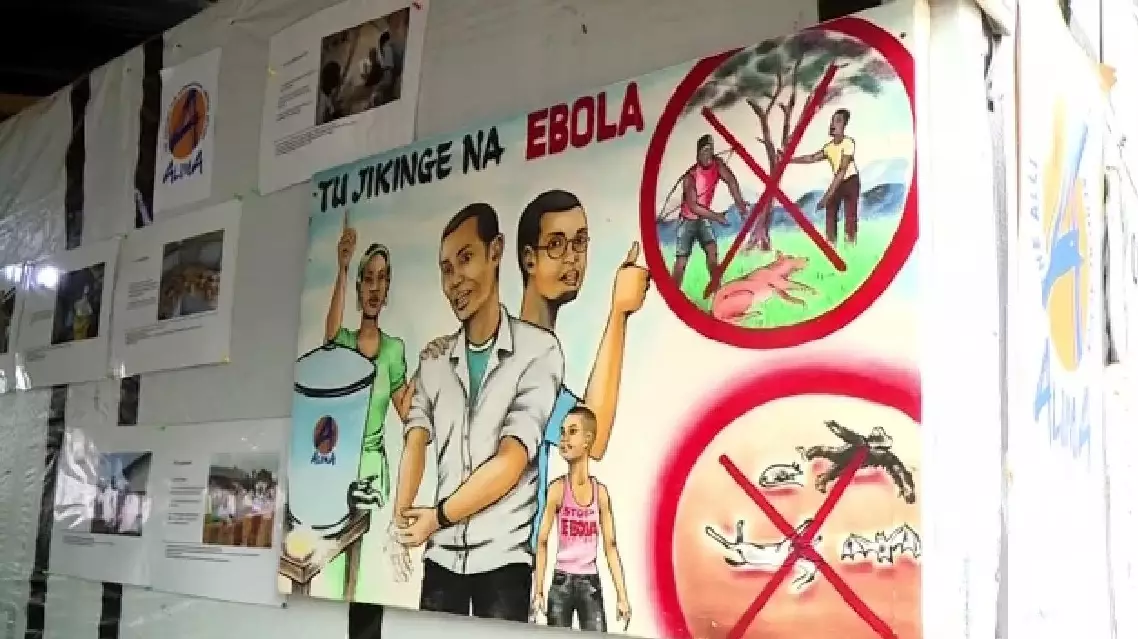
WHO declares Ebola outbreak in DR Congo, Uganda global public health emergency