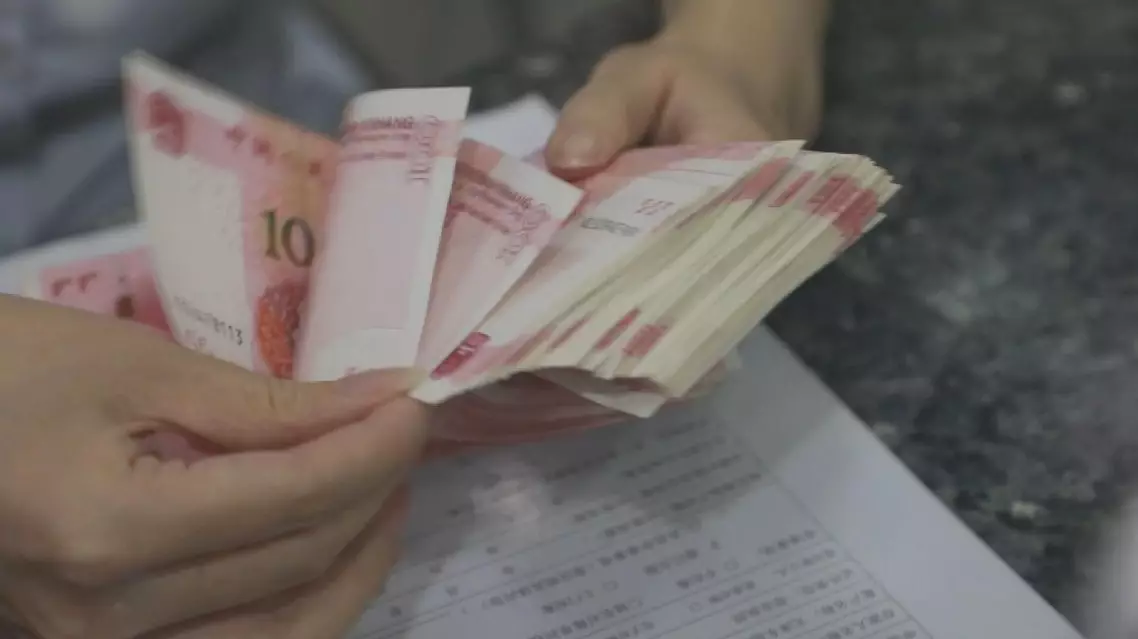
China's financial sectors have functioned steadily and are capable of coping with the current risks, the National Financial Regulatory Administration (NAFR) said on Tuesday.
Since the start of this year, authorities have stepped up financial risk prevention and control efforts, strengthen market supervision, and enhance financial services to better contribute to the real economy, NAFR director Li Yunze told a press conference in Beijing.
The administration has guided small and medium financial institutions to defuse risks through reform to avoid spillovers. Banks and insurance institutions are encouraged to help defuse risks arising from the property market and local government debt, Li said.
"At present, specific reform and risk reduction plans are in place in areas where high-risk institutions are concentrated. The tailored 'One Province, One Policy' strategy for financial risk management has been promoted in a prudent and orderly manner. We also lead banking and insurance institutions to actively assist in efforts to defuse real estate and local government debt risks. The country's financial sectors, especially large financial institutions, are functioning well with controllable risks," said the official.
The administration will guide the banking and insurance sectors to focus on their main businesses and achieve mutual complementarity. In promoting development, more financial services will be provided in key areas and to shore up weak links.
"By the end of August this year, loans to high-tech industry and medium- and long-term loans to manufacturers rose by 13.2 percent and 15.9 percent year-on-year, respectively. Inclusive finance lending to micro and small business and loans to private firms rose by 16.1 percent and 9.1 percent year-on-year, respectively," Li said.
China's financial risks controllable: regulator
Despite attempts by the Democratic Progressive Party (DPP) authorities in the Taiwan region to obstruct normal exchanges and cooperation between the two sides of the Taiwan Strait, extensive cross-Strait interactions continue to thrive.
The recent moves by the DPP authorities are sinister in intent and aimed at pursuing their secessionist goal, according to Zhang Hua, a research fellow at the Institute of Taiwan Studies, Chinese Academy of Social Sciences.
"The DPP authorities have manipulated the so-called narrative of 'anti-China and resistance against China,' which is gravely harmful as it exacerbates social rifts in Taiwan. Currently, due to factors such as 'political mobilization' and the 'political election market,' contrasting emotions among the public in Taiwan have been persistent. Furthermore, differences in words have led to a situation characterized by 'green terror,' which naturally further worsens social rifts on the island," said Zhang.
"In March 2025, the DPP authorities concocted the so-called '17 responding strategies,' and in November 2025, they again concocted two action plans to limit cross-Strait exchanges. The purpose is the same as the current revisions to the so-called 'laws.' Lai Ching-te aims to pursue secessionist goal through soliciting support from the United States and seek Taiwan secession through military build-up. So, he cannot allow the people of Taiwan to read books from the Chinese mainland, watch films from the mainland, or play games produced in the mainland. He views these as methods used by the mainland to influence the public in Taiwan through 'united front tactics.' This leads to the further strengthening of local people's identification with the Chinese nation and their consciousness as Chinese, which he is reluctant to see, " Zhang said.
On Thursday, a campus version of Chinese Kunqu opera masterpiece "The Peony Pavilion" performed by students from the mainland took to the stage in Taipei, filling the venue to capacity. The combination of ancient and modern arts received rounds of applause.
Among the audiences, young people from Taiwan comprised about half, with many university students attending in groups.
"We love it, because it helps us understand a part of our history," said an audience member in Taiwan.
"I hope that through this classical work, young people from both sides of the Taiwan Strait will develop a love for traditional culture. The Chinese nation has a glorious history spanning thousands of years. If we don't understand it, how can we comprehend the future? We must understand where our roots lie," said Pai Hsien-yung, a playwright in Taiwan.
Kunqu Opera, one of the oldest forms of opera in China with a history of hundreds of years, was placed on the list of Masterpieces of the Oral and Intangible Heritage of Humanity by the United Nations Educational, Scientific and Cultural Organization (UNESCO) in 2001.
Written by Chinese playwright Tang Xianzu (1550-1616) of the Ming Dynasty (1368-1644), "The Peony Pavilion" tells the story of the romance between a daughter of a wealthy official and a talented but poor young scholar.
Cross-Strait exchanges, cooperation go on despite DPP obstructions