The third Asia International Water Week (AIWW) opened in Beijing on Tuesday, bringing together participants from around the world to share insights on global water security amid current environmental challenges.
Officials and experts on water-related issues from 70 countries and regions have gathered for the five-day event to explore new strategies and solutions for water security challenges.
Global water security is threatened by the dual impact of climate change and human activities, putting people's wellbeing and prosperity at risk.
In a speech at the event, Li Guoying, China's minister for water resources, shared China's water management experiences in areas such as flood control and smart irrigation, and expressed the nation's commitment to deepen cooperation with the international community on water security issues.
"We are willing to work together with all countries and international organizations, under the guidance of the Global Development Initiative, Global Security Initiative, and Global Civilization Initiative, to jointly promote future water security. Together, we will make efforts in achieving water-related targets of the UN 2030 Sustainable Development Agenda," said Li in his keynote speech at the AIWW's opening ceremony.
China provides water for nearly one-fifth of the global population and generates over 18 percent of the world's total economic output with only six percent of the planet's freshwater resources.
China is also a flood-prone nation and this year was able to store or divert over 140 billion cubic meters of floodwater nationwide to protect people's lives and property.
"We are very, very interested by the Chinese experience concerning water security at a global level and river security also. And we need the experience of Chinese colleagues, Chinese experts to provide this expertise in the world, which needs a lot of innovation, governance, and financing solutions for water," said Loic Fauchon, president of the World Water Council.
A joint statement, the 'Beijing Declaration', was released at the opening ceremony calling for concerted efforts to address water issues arising from climate change, rapid urbanization, and population growth through innovation, collaboration, and knowledge-sharing.
In addition to Asian countries and regions, delegations from Europe and Saudi Arabia are also attending this year's AIWW. Participants are expected to strengthen water-related cooperation and exchanges across various sectors with China throughout the week.

Third Asia International Water Week opens in Beijing
A cold front has brought snowfall and freezing temperatures across many parts of China, disrupting transportation and prompting emergency responses. On Sunday morning, many places in Handan City of north China's Hebei Province have experienced snowfall.
The province on Sunday activated a Level-IV emergency response for major meteorological disasters in preparation for incoming heavy snowfall.
According to the provincial meteorological observatory, heavy snow is forecast to hit areas including Shijiazhuang, Cangzhou and Hengshui from day to night on Sunday. Some regions may experience blizzard conditions.
Forecasters warn that the severe weather will disrupt transportation, urban services, and greenhouse agriculture.
Local authorities have been urged to closely monitor weather conditions, enhance risk assessment, and eliminate potential safety hazards.
China has a four-tier emergency response system, with Level I being the most severe response.
Starting early Sunday morning, a new round of snowfall began in areas such as Qingyang City and Dingxi City in northwest China's Gansu Province.
In order to ensure smooth traffic and people's normal life and production, local departments have made coordinated efforts to clear snow from roads.
Local traffic police have also increased presence at key areas to direct traffic and ensure timely response to emergencies.
In addition, widespread snowfall affected the northern parts of northwest China's Xinjiang Uygur Autonomous Region, posing challenges to urban transportation and railway operations.
Traffic police and city departments are mobilizing to clear roads and ensure safe travel for residents.
Railway authorities also implemented pre-arranged snow-response plans, using equipment such as wind-powered snow blowers and de-icing equipment to clear key sections of track and prevent switches from freezing.
The current round of snowfall in the northern parts of Xinjiang is expected to end on March 2. Some areas in east China's Shandong Province also experienced heavy snow on Sunday. At 11:00, the provincial weather service issued yellow warnings for icy roads.
At the Mount Tai scenic area in Tai'an City, the weather transitioned from a mix of rain and snow to snowfall during the day. As of 15:00 on Sunday, the average precipitation had reached 18.9 millimeters, with the snowfall still ongoing. To ensure the safety of visitors, the scenic area has decided to suspend all access routes starting from 16:00. On Sunday morning, cold air prompted snowfall in many places of north China's Shanxi Province. The Shanxi Provincial Meteorological Observatory issued a yellow alert for blizzard, covering areas such as Jinzhong City, Linfen City, and Yuncheng City.
Icy road conditions led to temporary traffic restrictions on several highway sections.
Local authorities promptly activated emergency response plans, deploying crews for snow removal and traffic control.
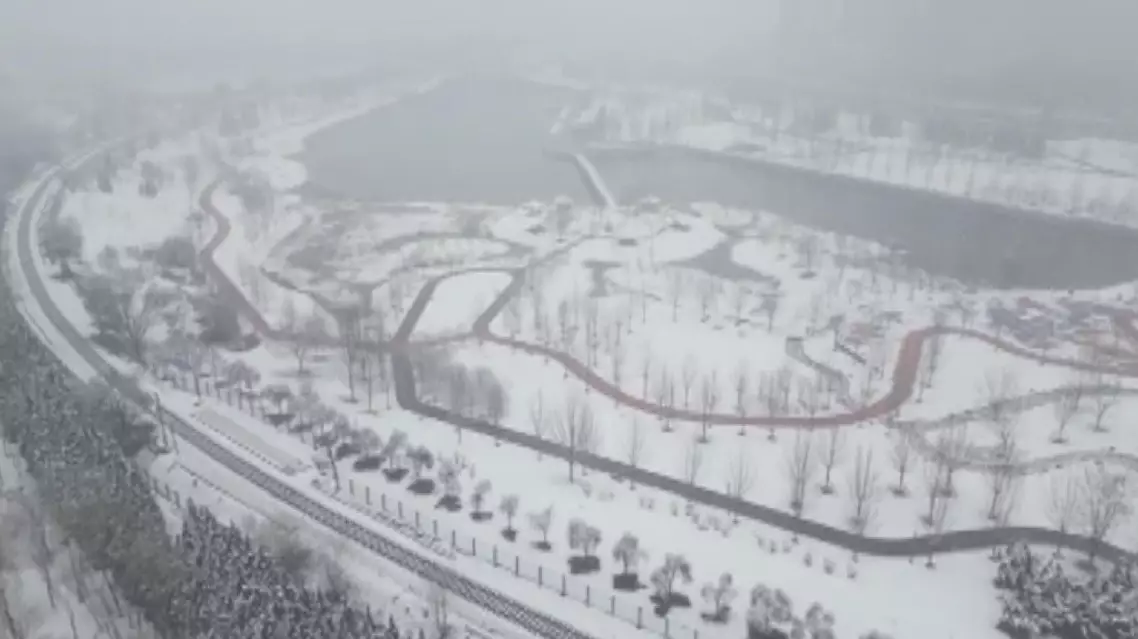
Snowfall hits many parts of China, affecting transportation