The grand Ali northern route, stretching thousands of kilometers on the high plateau in southwest China's Xizang Autonomous Region, has become a golden tourism route in the region, offering travelers a chance to experience its natural beauty and cultural richness.
Once considered a challenging and remote route, the grand Ali northern route now boasts enhanced infrastructure and witnessed improved living conditions of the local residents.
Tangra Yumco, the deepest lake in Xizang, is one of the must-see stops on this Xizang tourism route. Surrounded by snow-capped mountains, farmlands and traditional villages, it offers a unique glimpse into high-altitude wetlands, attracting tourists from far and wide.
"The tourists say that it has a good landscape, and they like to take pictures here," said Jiang Kangkang, deputy chief of Nyima County Party Committee's Publicity Department.
In 2023, Tangra Yumco was designated as a 4A-level national tourist attraction. Since 2016, Nyima County has invested over 100 million yuan to enhance tourism infrastructure in the area.
"We just drove here, and the roads are good, as well as the facilities and signs along the roads. It feels like suddenly you step into a paradise," said He, a tourist.
Leveraging the 4A scenic spot status, Nyima authorities have undertaken comprehensive renovations of villages within the scenic area.
Wenbunan Village, situated beside Tangra Yumco, is among the first batch of key rural tourism villages in China. Since the opening of its first homestay in 2003, the village has developed over 30 hostels, welcoming more than 25,000 visitors in 2023 alone.
Villager Sogxung, who owns a lake view hostel with private bathroom and 24-hour hot water, says he earned more than 200,000 yuan (about 28,500 U.S. dollars) last year from the property.
"We started to build this hostel in 2012, and since then, we have improved the facilities to make them better and better. We now get electricity and water supply. We have received more than 1,000 tourists this year, and this hostel has always been fully booked," he said.
Coqen County in Ngari Prefecture lies 400 kilometers westward is. Here, visitors can observe wildlife such as Tibetan antelopes, a first-class protected species in China, roaming freely in their natural habitat.
It used to take about 10 hours to drive from Nyima in Naqu City to Ali's Coqen County, but now the time has been halved thanks to improved road condition over the past few years.
Tourists will encounter Zhari Namco in the county, Xizang's third-largest lake, covering an area of 1,023 square kilometers.
Coqen County town, situated 60 kilometers from Zhari Namco at an altitude of 4,700 meters, has winter temperatures as low as minus 30 degrees Celsius. A central heating project has been completed recently, set to provide warmth to the local residents this winter.
"We use antifreezing solution in all the solar panels. We collect heat through our light plates to ensure the heating of houses. We have basically realized full automation," said Duan Dongming, head of Coqen County Housing Construction Bureau.
In September, 6,136 solar thermal collectors were put into operation in Coqen County, covering a heating area of over 290,000 square meters and benefiting more than 5,000 residents with clean energy central heating.
"At present, the heating equipment of the school has been put into operation. Students can live and study in the school at ease," said Ming Sheng, principal of Tsochen County Middle School.
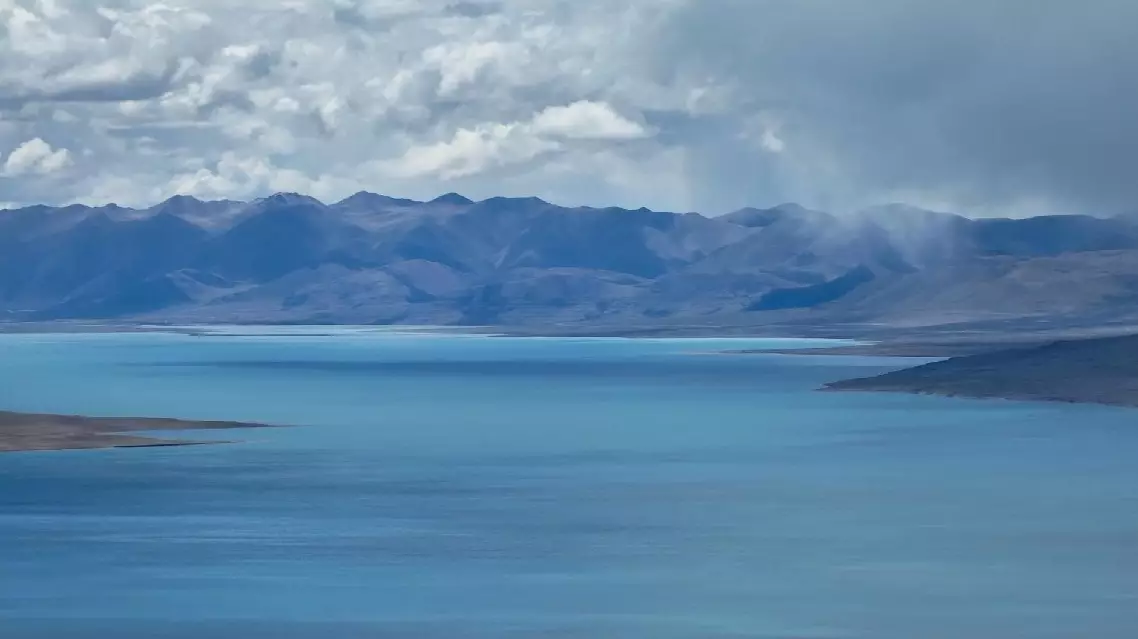
Improved infrastructure transforms grand Ali northern route from rugged path to tourism haven