The Think Tank Conference of the Euro-Asia Economic Forum took place on Wednesday in Xi'an, capital of northwest China's Shaanxi Province, aiming to promote the practical development of the forum and deepen high-quality Belt and Road cooperation by focusing on the impact of the global economy on the Eurasian region.
The conference brought together over 80 experts, scholars, university presidents, and business leaders from both home and abroad to discuss the theme, topics, and framework of the 2025 Euro-Asia Economic Forum, with the goal of facilitating the preparations for the forum next year.
During the event, experts and scholars discussed the future of the Euro-Asia Economic Forum and envisioned the framework for the 2025 edition. They also launched the establishment of the forum's think tank alliance, which aims to provide suggestions and intellectual support for the practical development of the forum.
The conference has yielded a range of research outcomes and suggestions with significant academic value and influence, providing strong intellectual backing for deepening high-quality Belt and Road cooperation and promoting higher-level opening up.
"Cities functioning as urban nodes like Xi'an have huge potential for development. I believe these cities can play more pivotal roles in areas such as think tanks, funding, technology, and business, which can facilitate mutual exchange and collaboration," said Wang Yongzhong, research fellow at the Institute of World Economics and Politics under the Chinese Academy of Social Sciences.
"Xi'an's role as a strategic hub in the Belt and Road Initiative (BRI) is increasingly important. The operation of China-Europe freight trains from Xi'an plays an exemplary role across the country. These trains, in coordination with maritime, air, and road transport, enable Xi'an and Shaanxi to make more and new contributions to the BRI," said Feng Zongxian, dean of the Institute of Belt and Road and Global Development at Xi'an Jiaotong University.
The Euro-Asia Economic Forum, primarily involving Shanghai Cooperation Organization (SCO) member states and catering to the broader Eurasian region, is a large-scale institutional international forum held biennially since 2005.
Having successfully completed 10 sessions to date, the forum has evolved into a platform for exchanges and cooperation among Eurasian countries and regions, as well as a significant gateway for Shaanxi's "opening to the West" endeavor.
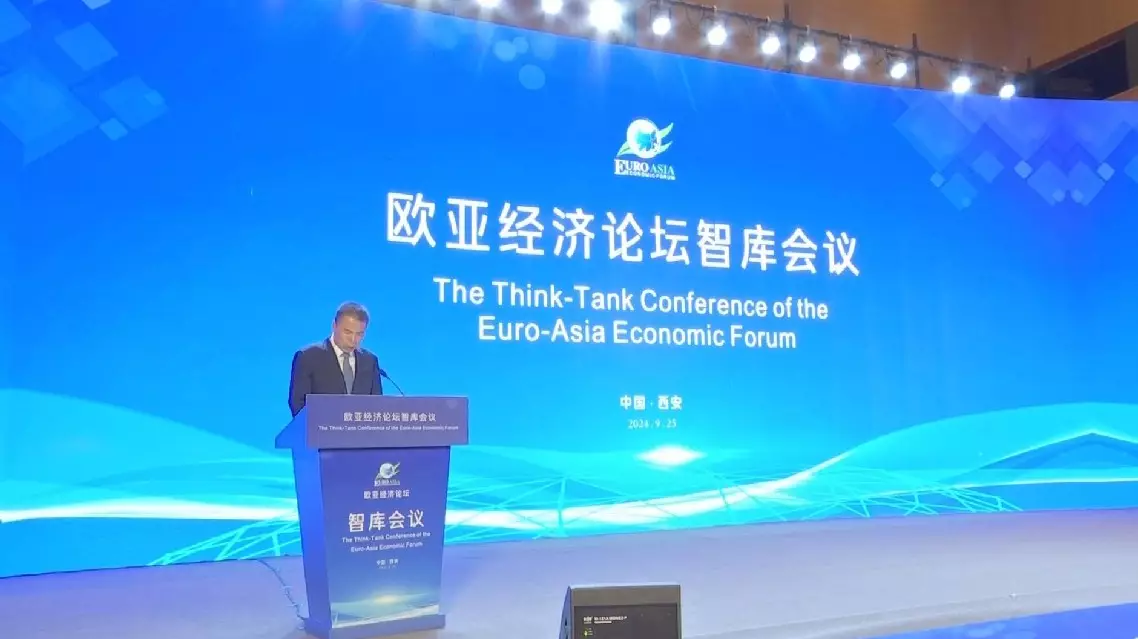
Think Tank Conference of Euro-Asia Economic Forum held in China's Xi'an