A former member of China's national table tennis team has recalled the unexpected start of "Ping-Pong diplomacy" between China and the United States in 1971, when a U.S. table tennis player mistakenly boarded the Chinese team bus, saying the exchanges that followed helped trigger a turning point in China-U.S. relations.
Liang Geliang, a six-time world championship gold medalist, is a key figure who witnessed and contributed to this unique chapter in history.
On the outskirts of Beijing, Liang Geliang has opened his home for table tennis masterclasses. He is now focused on passing on his experience to a new generation of players.
His passion for the sport began early, inspired by watching the 26th World Table Tennis Championships held in Beijing in 1961, a moment that would shape the path of his life in table tennis.
In April 1971, Liang was chosen to represent China at the World Table Tennis Championships in Nagoya, Japan.
There, Liang had a front row seat to one of the most extraordinary chapters in sporting diplomacy.
Following a practice session, Glenn Cowan, an 18-year-old table tennis player in the U.S. team, missed the team bus back to his hotel. So, he hopped on the China bus instead.
"Because he got on the wrong bus, Zhuang Zedong (another Chinese national team table tennis player) took the initiative to welcome him and invited him to go to the arena together. So that gave him the opportunity. I was right there, so I also had the chance to chat with him for a few minutes. And we all became friends through table tennis," said Liang.
Just days later, the U.S. team received an invitation to visit China. On April 10, 1971, nine American players, along with their support staff, arrived in the country, becoming the first official U.S. delegation to set foot in China since 1949.
The trip opened the door for the normalization of relations between China and the US.
A few months later, then U.S. President Richard Nixon made an official visit to China in February 1972, followed by a visit of the Chinese table tennis team to the U.S. in April 1972, with Liang as part of that team.
"The Chinese table tennis team was received by the president at the White House in the United States for the first time. We left with precious memories from that earliest visit," said Liang.
Fifty-five years on, Liang met up with another Ping Pong diplomat, former U.S. player Judy Hoarforst, at Beijing's Capital Indoor Stadium.
"Seeing old friends was very exciting. More than 50 years ago at the Capital Indoor Stadium, especially recalling the beginning of our Ping-Pong Diplomacy between China and the U.S., the gates opened between two countries," he said.
Today, the extraordinary story of "Ping-Pong diplomacy" still resonates over half a century later.
"Only through more exchanges can society progress. Without interaction, without mutual learning, positive outcomes would not be possible," said Liang.
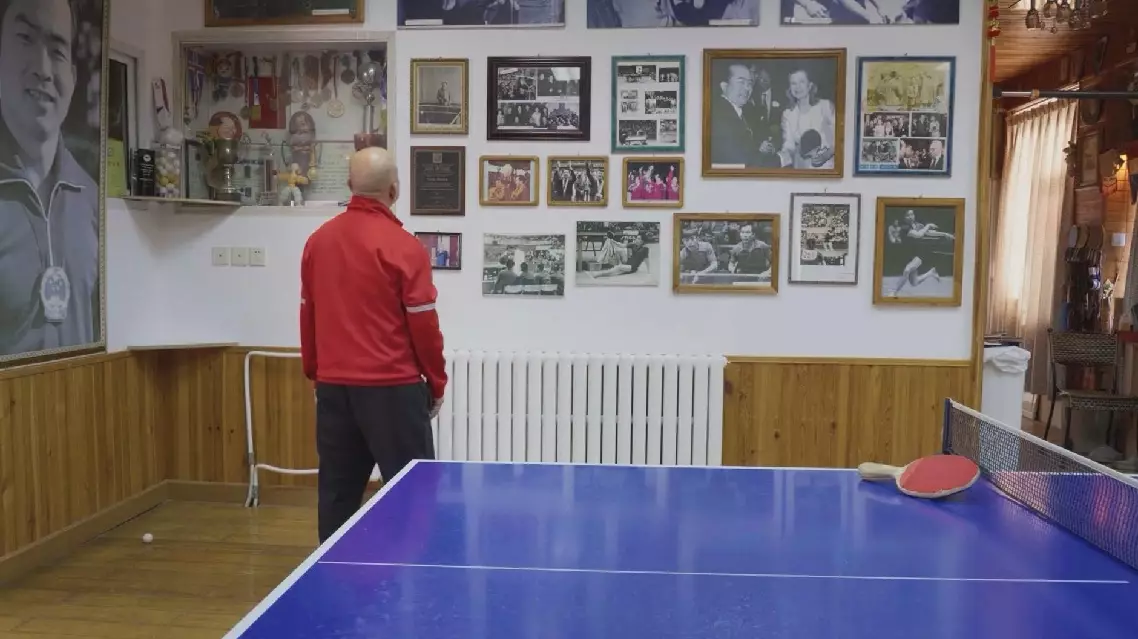
Former table tennis world champion recalls "Ping-Pong diplomacy" between China, US