As China has made remarkable achievements in space exploration, the country is determined to venture into the deep space.
A piece of special report by China Global Television Network (CGTN) outlined the growth of China's aerospace industry over the past 75 years. The third part of the report encapsulates China's monumental strides in deep space exploration and the technological advancements driving these endeavors forward.
China's deep space exploration is focused on Mars, one of Earth's closest neighboring planet that is 225 million kilometers away. While a space probe can reach the Moon in just 12 days, the vast distance takes a space probe nine months from Earth to Mars.
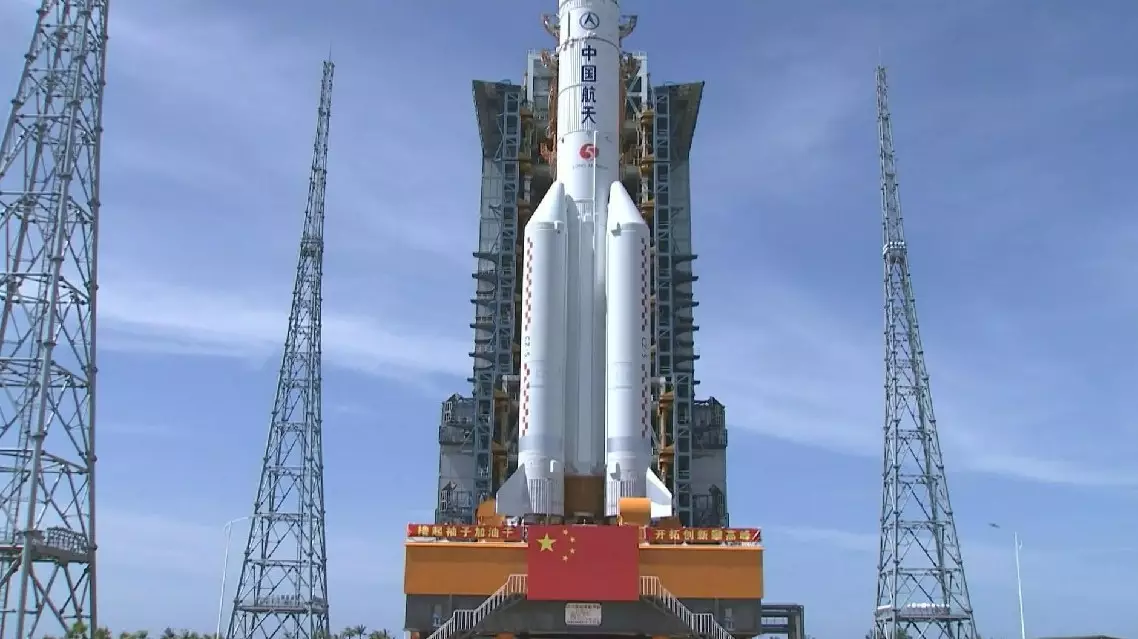
The development of the Long March-5 rocket series has been crucial to China's deep space exploration ambitions, as it bridges the gap to Mars.
In aerospace circles, there's a saying: "The launch capacity of rockets is as large as an aerospace program." But the road to building a more powerful rocket is laden with challenge and pressure.
The debut launch in 2016 of the Long March-5 rocket was successful. But the year after, the rocket failed 346 seconds after it took off.
"It was too painful, unbearable to look back on. We saw the moment when the curve went wrong. It's the hard work of 30 years. It was very stressful to see the rocket failure. We described that period as like groping in the dark, not knowing when we'd see the light," said Li Dong, chief designer of the Long March-5 rocket series.
Engineers and researchers spent over 900 days and nights proposing new designs, doing tests, improving material and resolving technical issues. In 2019, the third rocket of this series, the Long March-5 Y3, was rolled out to the launch tower.
With 90 percent of the technology of the Long March-5 series newly invented, the Long March-5 is capable of carrying a payload of 25 tons into low Earth orbit, 14 tons to geostationary transfer orbit, and eight tons to Earth-Moon transfer orbit, over twice the capacity of the main Long March series rockets. Its capacity equals other mainstream large-scale rockets in the world.
In 2020, the Long March-5 Y4 rocket was assigned to its first Mars mission--to launch the Tianwen-1 probe, which means "Questions to Heaven" in Chinese, on its voyage to the Red Planet.
China's first attempt to reach Mars is ambitious. It aims to complete orbiting, landing and roving in one mission.
"It should be the greatest in terms of technical performance and technical difficulty. It shows China's ability in the aerospace industry. This is not only a symbol of our great strength, but also a contribution to the scientific progress of the world," said Long Lehao, a senior consultant of China's Mars mission.
In May 2021, after 10 months of travel from Earth, the lander successfully touched down on Mars.
A week later, the Mars rover Zhurong, which was named after an ancient Chinese god of fire, drove off the the landing platform of the Tianwen and onto the Martian surface. The Zhurong rover's successful deployment made China the second nation to accomplish this feat.
So far, the Zhurong rover has completed explorations of the Martian surface, passing through complex terrain, detecting Martian rocks, sand dunes and impact craters, obtaining a large amount of data using its onboard scientific equipment.
These new results reveal the impact of wind and water activities on the geological evolution and environmental changes on Mars. It strongly supports the hypothesis that there was once an ocean on Mars' northern lava plain known as Utopia Planitia.
"When we go to Mars, we can gain a lot of new knowledge and new discoveries. Through this project, we have introduced many new technologies. These new technologies, in turn, can be applied into people's daily lives," said Zhang Rongqiao, a chief designer of China's first Mars exploration mission.
"The aerospace industry has high requirements for material performance, which in turn lead and drive the application of materials in other fields. For example, in high-end medical testing, BGO crystals can be used in PET-CT for early detection of malignant tumors," said Wang Dong, secretary of the Communist Party of China (CPC) Committee of Shanghai Institute of Ceramics, under the Chinese Academy of Science.
Over six decades, China has built its aerospace industry from scratch into a force for peaceful development that rivals global space standards, thanks to generations of visionary, intrepid scientists and engineers, committed to the country's aerospace development.
"I hope that comrades will carry forward the spirit of two bombs and one satellite and the spirit of manned spaceflight, face the forefront of world aerospace development and the country's major aerospace strategic needs, strengthen mission responsibilities, and have the courage to innovate and make breakthroughs," said Chinese President Xi Jinping.
With a legacy built on courage, determination, and a thirst for exploration, China's aerospace journey continues, driven by the spirit of those who dare to reach for the stars.
"What foreigners can do, why can't the Chinese do?" said Qian Xuesen, a forerunner of China's space program.
"There are definitely risks involved in scientific exploration. There are always people who seek high-risk professions. Since they have chosen this career, they should shoulder this responsibility," said Yang Liwei, China's first taikonaut in space.
"Just as with early ocean exploration, we don't know where the other shore is. We will risk our lives looking for it. The exploration will never stop, this time, next time, or many other times in the future," said Chu Yingzhi, deputy project manager of Tianwen-1's orbiter.
Chinese scientists vow to continue aerospace journey despite challenges