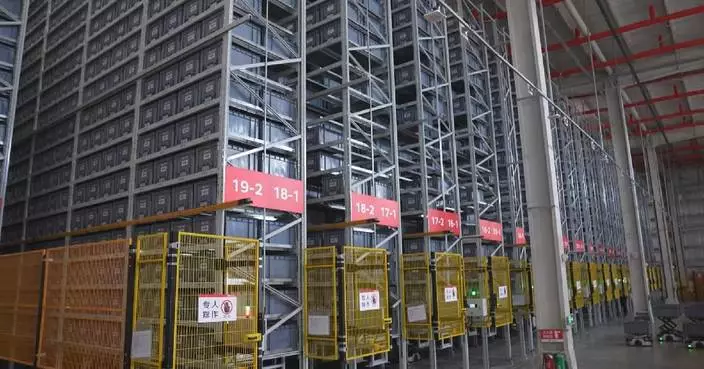
China's chip manufacturing industry has grown from being weak to becoming a significant player, earning recognition in the global market and contributing to the development of the country's supercomputers.
A special report by China Global Television Network (CGTN) highlights the growth of China's computer and semiconductor industries over the past 75 years.
The second part of the special report explores the journey of China's chips and supercomputers in gaining international recognition.
Before China released its first homegrown CPU, Loongson-1, in 2002, the country had already initiated the 'Starlight China Integrated-Circuit Project' in 1999, aiming at developing independent intellectual property rights in the chip industry.
Deng Zhonghan, who founded the start-up firm Vimicro Co. to undertake the project in 1999, said he saw great potential.
"On the one hand, I thought with the huge take-off of China's manufacturing industry, the country would certainly have a place in the international chip field. Today we've seen many breakthroughs made by China. On the other hand, there were lots of discussions and explorations on the mechanisms of innovation in China. A lot of brainstorming," said Deng, co-founder and chairman of Vimicro, also the chief executive of the "Starlight Integrated-Circuit Project."
Deng and his team set up Vimicro in Zhongguancun, known as China's Silicon Valley. Beyond government investment, the company sought market opportunities.
"We knew that it wasn't about filling the gap in technology, but the gap in the market. We had to look for opportunities at the forefront of the market," said Deng.
Multimedia and the internet were on the rise at that time, but while the industry underestimated the need for video processing and communication on PCs, Deng recognized its importance.
In 2001, Vimicro released China's first independently developed digital multimedia chip, "Starlight-1."
"The product gained instant popularity. Companies such as Samsung, Philips, and H-P all used our products. And Microsoft designated us as a global partner," said Deng.
In 2005, Deng led the initial Vimicro to its Nasdaq debut, making it the first Chinese chip design company listed on the board.
In 2010, China established a digital multimedia chip lab at Vimicro to bring together researchers and chipmakers.
For Chinese chip designer Loongson, the challenging process of marketization led to profits, market-oriented designs, and greater technological autonomy. However, its CPU did not achieve quick market acceptance.
In 2010, a key transformation occurred when the research team decided to operate Loongson as a company, pushing veteran researcher Hu Weiwu, the "father of China's first CPU," into the business world. Hu took his direction from President Xi Jinping.
"General-Secretary Xi Jinping said technological breakthoughs are hard, but what is harder is the understanding of the market. So, regarding the transformation of scientific research results, things would be workable if you followed this sentence," he said.
Hu spent three years reshaping the company. In 2013, Loongson started to make money.
But he said one thing never changes - the pursuit of technological autonomy.
"There were several foreign companies, whose names I won't mention, who wanted to cooperate with Loongson. They wanted us to follow their routes. If we did so, we would have lost the capabilities of innovation because they only derive from innovative practices," said Hu.
Now, ten years later, Loongson's latest-generation 3A6000 processor is among the fastest CPUs designed and made in China.
"Its performance, according to multiple reviews, is equivalent to that of Intel's 10th generation Core in 2020, but our CPU is cheaper. The next CPU we are working on is the 3-B-6600, which can turn the advantage of autonomy into a cost-effective advantage. So when we produce the next chip next year, Loongson's design will be one of the best in the world," said Hu.
Technological autonomy is also driving the growth of China's supercomputing industry. The country's self-developed Sunway Taihulight is among the most powerful supercomputers in the world.
"Behind me is our country's self-developed Sunway Taihulight supercomputer, which is equipped with domestic processor chips. Its peak computing capacity reaches 100 quadrillion times per second. The machine has more than 40,000 domestic processors," said Gan Lin, associate professor from the Dept. of Computer Science and Technology, Tsinghua University.
As of November 2023, the machine ranked 11th among the most powerful non-distributed computer systems in the world.
"Thanks to China's advancements in economy, science and education, we had enough technologies and talented engineers to design and build such a supercomputer. And there are many scientists in various fields who can make good use of it," said Gan.
Supercomputers have a wide range of applications across various fields, including real-time weather forecasting, advanced manufacturing, and more.
"Supercomputers can be used for things that are closely related to our daily life, such as weather forecasts, advanced manufacturing for automobiles, high-speed trains, and aircraft, as well as drug R and D, and environmental governance. All these are supported by the power of supercomputers," said Gan. Rapid computation fuels China Speed, but collaboration is essential to transform that into China Quality.
"We need computer talents as well as some researchers of basic sciences, such as earth sciences, life sciences and so on. All these people from various research backgrounds should get together to finish projects through interdisciplinary collaboration," said Gan.
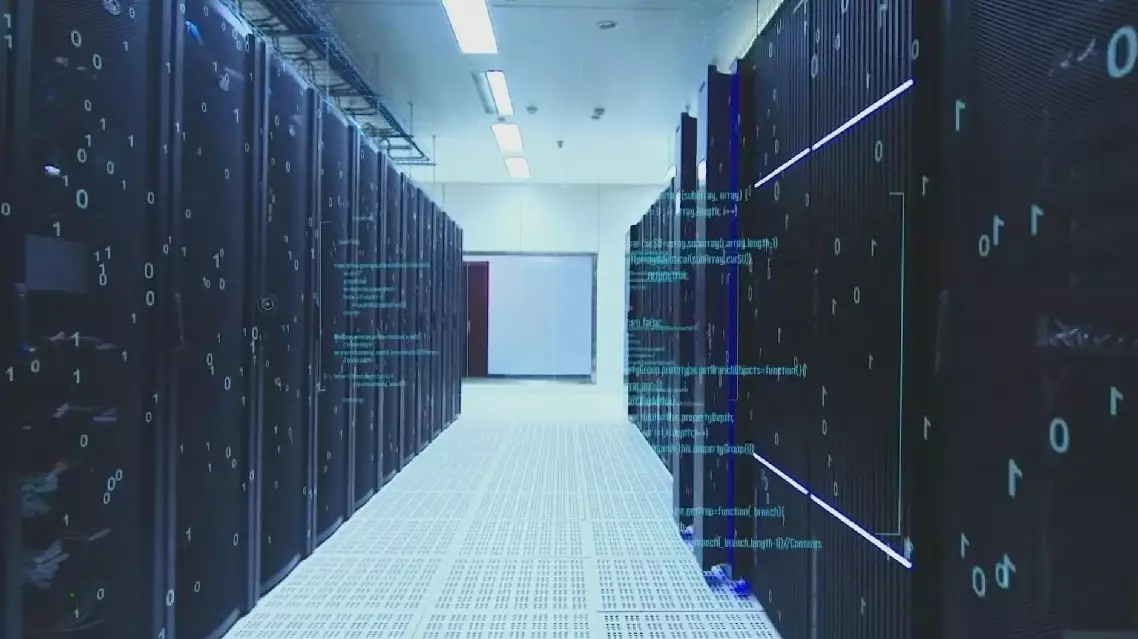
Journey of China's chips: from inception to int'l recognition