Skip to Content Facebook Feature Image

Scientists discover thickest glacier on Qinghai-Xizang Plateau

China

China

China

Scientists discover thickest glacier on Qinghai-Xizang Plateau

2024-09-30 17:49 Last Updated At:19:47

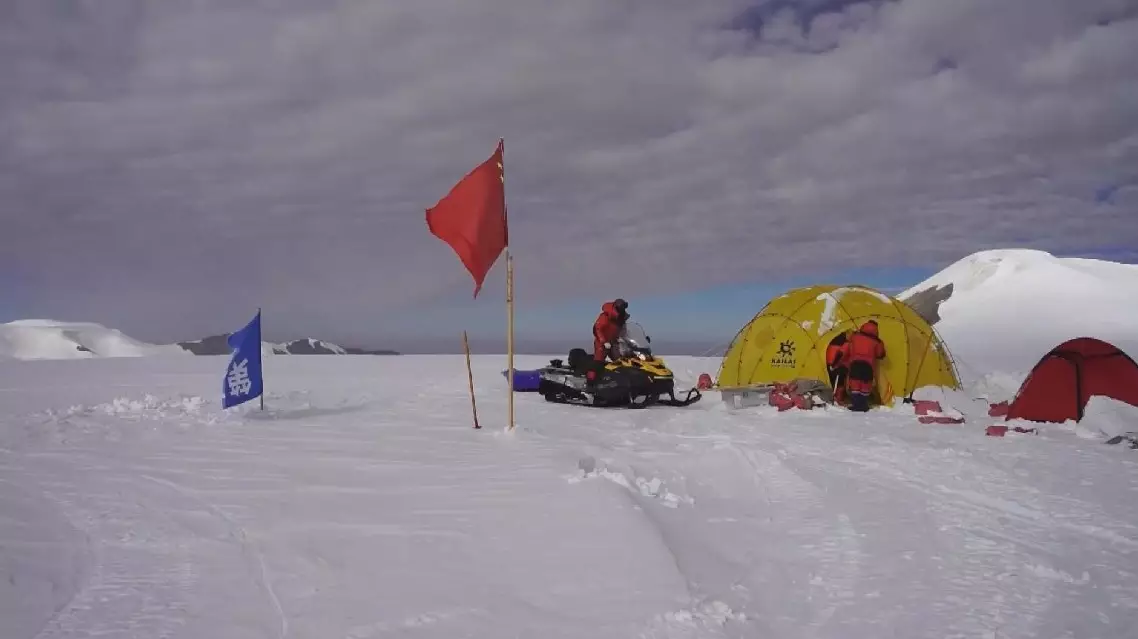
Scientists have identified the thickest glacier on the Qinghai-Xizang Plateau, known as Asia's water tower, following the discovery of a nearly 400-meter-thick ice field.

The record was obtained by researchers from the Chinese Academy of Sciences (CAS) at a glacier with an altitude of 6,100 meters on the Purog Kangri Glacier in Tsonyi County of southwest China's Xizang Autonomous Region, replacing the previous record of 308.6 meters measured in the Guliya Ice Cap in the west of the Kunlun Mountains in the Ali Prefecture of Xizang in 1992.

Drilling data showed that the average thickness of glaciers on the Qinghai-Xizang Plateau is over 100 meters, and the discovery is of great significance for studying the climate and environmental changes on the plateau.

Since ice core drilling requires low temperature conditions, most of the work is done at night, and the team will stick to the high-altitude post throughout the National Day holiday, which runs through Oct. 1 to 7, according to researchers.

China launched the scientific expedition mission on Aug. 18 to investigate the Qinghai-Xizang Plateau with a target region encompassing "one glacier, two lakes and three rivers".

The target region includes the Purog Kangri Glacier, the third-largest glacier in the world; Siling Lake and Namtso Lake, the largest and second-largest lakes in Xizang, respectively; and the source of the Yangtze River, Nujiang River, and Yarlung Zangbo River.

At present, the main scientific expedition work involving more than 400 scientific expedition members has been basically completed.
Scientists discover thickest glacier on Qinghai-Xizang Plateau
Scientists discover thickest glacier on Qinghai-Xizang Plateau
European Central Bank President Christine Lagarde sees more solid foundations of the global economy in 2026 than anticipated, expressing her confidence on the economic outlook of the year.

Speaking in an exclusive interview with the China Global Television Network (CGTN) on the sidelines of the 2026 World Economic Forum (WEF), Lagarde shared her views on global macroeconomic outlook, monetary policy direction, financial stability and the role of international cooperation amid growing uncertainty.

When asked about the expectations on the 2026 global economy, Lagarde said, "I think we are entering 2026 with more solid foundations than we had anticipated back in 2025. If I look at numbers, growth is higher than we had anticipated. The number of people employed is higher. The number of people unemployed is lower. Monetary policy for which I am responsible is in a good place. We have our target of two-percent medium term spot on, and inflation has been defeated. I'm saying that the foundations are much more solid than we had anticipated". Under the theme "A Spirit of Dialogue," the 2026 WEF meeting opened on Monday in the Swiss Alpine town of Davos and will run through Friday. About 3,000 leaders and experts worldwide are gathering to discuss five pressing global challenges, including enhancing cooperation, unlocking new sources of growth and deploying innovation at scale and responsibly.

Foundation of 2026 global economy more solid than anticipated: ECB chief

Foundation of 2026 global economy more solid than anticipated: ECB chief

Recommended Articles