Chinese scientists have long utilized cutting-edge gene technologies in crop breeding to cultivate resilient seeds with superior traits, enhancing yield in agricultural production.
A special report by China Global Television Network (CGTN) showcases how generations of Chinese scientists have overcome numerous challenges to bring this vision to fruition.
"Our breeding has shifted from the traditional way of simple selection in the field to crossbreeding and selecting offspring, and observing a plant's traits on a cellular level. The current technologies allow us to look at chromosomes and identify specific genes that control certain traits," said Li Jiayang, an academician with the Institute of Genetics and Developmental Biology of Chinese Academy of Sciences.
The selection of the desired genes in crops is called molecular breeding. Researchers mark and copy specific DNA fragments from the genome of an individual plant with a method called polymerase chain reaction, or PCR.
Cao Xiaofeng from the Institute of Genetics and Developmental Biology at the Chinese Academy of Sciences explained how it works.
"We know that a gene controls a particular trait, and we also know that hybridizing parents A and B will produce a good trait. So we can remove this specific gene from a parent to produce hybrids with the other. This procedure is efficient," said Cao.
It sounds easy, but it takes time and patience. To breed the best crops possible, researchers examine every single gene of a plant.
"Our ultimate goal is to know about all the genes of a material, so we can combine them to efficiently breed the desired rice or other plant," said Cao.
To achieve such a goal, agronomists need the support of basic science.
"The premise of molecular breeding is that basic scientific research is particularly thorough so that we can know which gene controls which trait," said Cao.
At present, this method is still being optimized, and with the advancement of research, molecular breeding has great advantages.
"To get the desired trait of a crop from its genes can save time, labor, and money," said Li.
Rice seedlings grown in the laboratory will eventually be put in the fields for further breeding. For convenience and efficiency, Chinese scientists work in the country's south.
Nanfan, which literally means "breeding in the south", is a crop breeding practice that takes advantage of the warm winter and spring climate on Hainan Island and other southern regions of China.
"We used to rent a bed in a farmer's house and conduct our research for only three or four months. Now, Nanfan Science and Technology Town has been built and we can do research here all year," said Lyu Yuping, head of biotechnology enterprise Yuan Long Ping High-Tech Agriculture.
According to statistics, the planting area of hybrid rice cultivated in Nanfan exceeds 300 million hectares, accounting for more than 60 percent of the country's rice planting area.
The base is also aiming to become the "Nanfan Silicon Valley" of agriculture, focused on technological innovation and the integration of capital, industry and innovation chains.
A more detailed plan of the construction of the Nanfan Research and Development base in Hainan's Sanya City was released in January 2024, aiming to better integrate scientific research and production, transforming research results to serve the whole country.
Scientists have also used clustered regularly interspaced short palindromic repeats (CRISPR) technology to modify genes and insert them into crops to optimize yield.
"The development of this technology and its integration into corn and soybeans has increased our production by 15 percent. It's of great national strategic importance," said Lyu.
Besides high-yield crops, land is also a factor in ensuring food security. Urbanization has destroyed much farmland, and the use of chemical fertilizer makes soil acidic. These are two common global problems.
With seven percent of the world's arable land and six percent of the global freshwater, China needs to feed nearly 18 percent of the world's population.
The country must secure enough land for grain production. The government has stipulated 1.2 million square kilometers of arable land is needed to ensure food security. What's more, Chinese scientists have been working to transform saline land into high-yield farmland.
"Scientists of the older generation, such as Mr. Li Zhensheng, turned the low-yield saline-alkali land in the Yellow Sea and Bohai Sea regions into China's main production areas. It was because they greatly improved the quality of the land," said Cao.
Cao's team is experimenting by planting forage, which are types of grasses used for animal feed, on these marginal lands.
"We have an increasing demand for meat, eggs and milk, and to have these high-protein foods on the table, we need forage to raise livestock," said Cao.
Her team is in search of alternative types of forage. Now the focus is on a legume crop called Sesbania cannabina, or commonly known as the yellow pea-bush. It is very tolerant to alkaline conditions and, when used as a green manure, substantially improves soil.
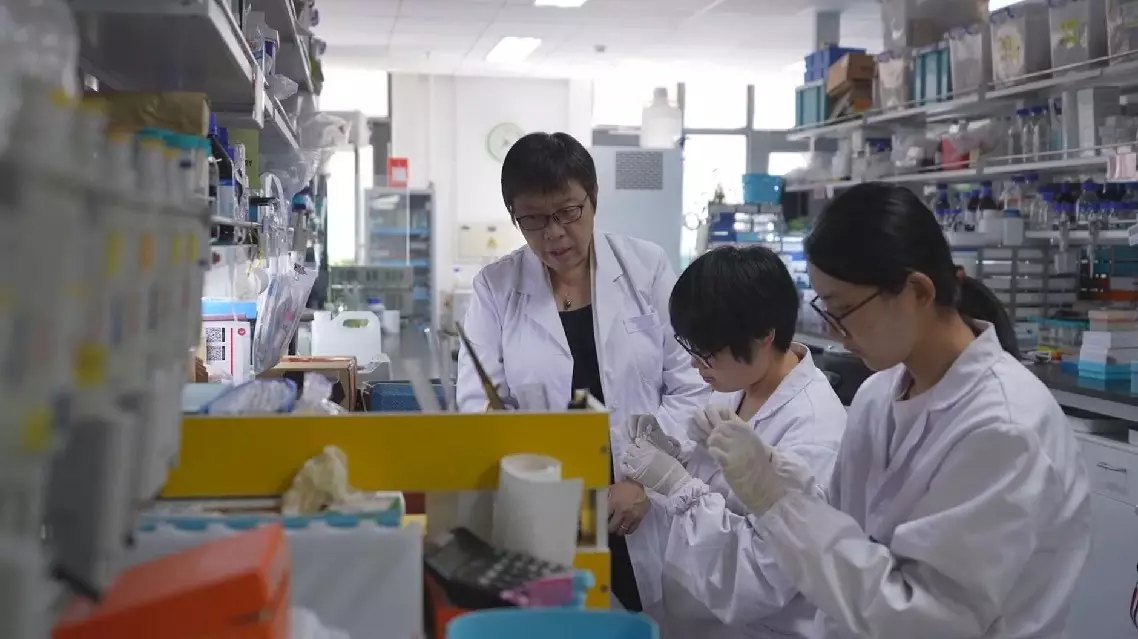
Chinese scientists perfect gene technologies in crop breeding over generations