Skip to Content Facebook Feature Image

CRRC's advanced train models reflect China's leading role in high-speed rail technology

China

China

China

CRRC's advanced train models reflect China's leading role in high-speed rail technology

2024-10-03 15:24 Last Updated At:15:37

CRRC Changchun Railway Vehicles Co., Ltd., China's state-owned train manufacturer, continues to break ground in high-speed rail technology, showcasing China's technological progress and leadership in the global railway industry.

In 2017, CRRC launched the flagship Fuxing high-speed EMU (electric multiple unit) train, which boasts a maximum speed of 350 km/h, making it the fastest commercial high-speed train in the world.

In this June, CRRC introduced the latest intelligent Fuxing high-speed trains on the Beijing-Shanghai railway line, which provides more comfort for passengers with additional seats, larger luggage racks, WiFi, and wireless charging. CRRC Changchun now is speeding up the production in its bustling workshop.

"The advent of the Fuxing high-speed trains not only represents a leap from self-manufacturing to self-innovation in China's high-speed rail industry, but also sets a new global benchmark for high-speed rail technology with Chinese standards," said Liu Junyang, vehicle chief designer at CRRC Changchun.

Over the decades, CRRC Changchun has developed more than 20 types of multiple-unit trains, which have been exported to over 20 countries with its other products, such as metro cars and maglev trains.

"We are currently focusing on developing the next generation of high-speed trains that are faster, safer, more environmentally friendly, more energy-efficient, and more intelligent, better meeting the needs of passengers and keeping China's high-speed rail at the forefront globally," said engineer Shi He at CRRC Changchun.
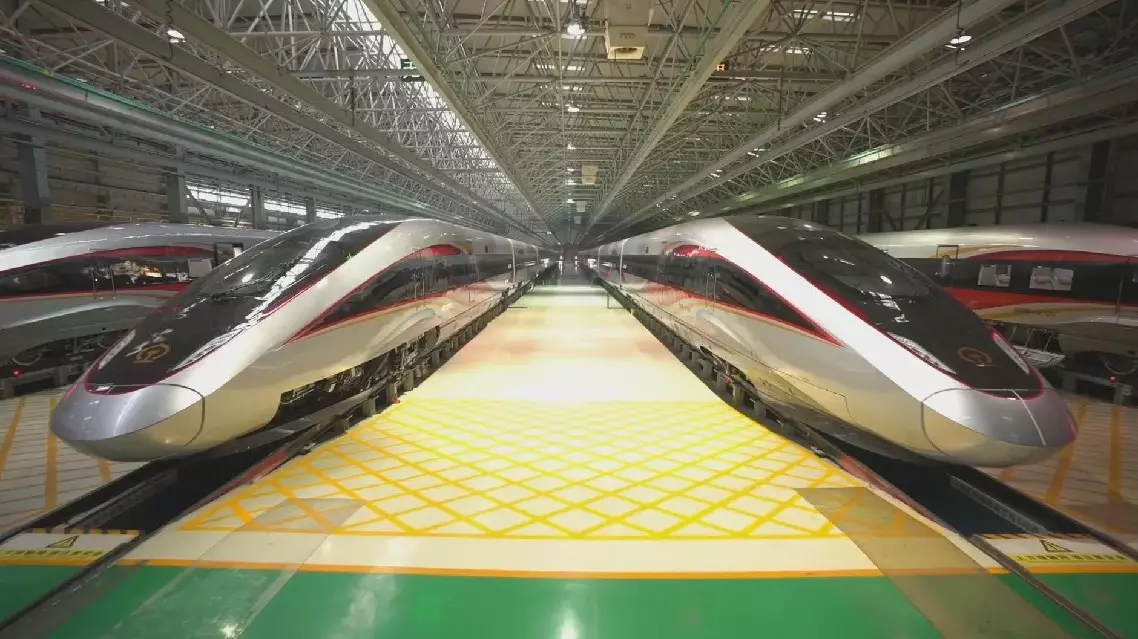
CRRC's advanced train models reflect China's leading role in high-speed rail technology

CRRC's advanced train models reflect China's leading role in high-speed rail technology

The closure of Poipet border crossing, the largest land border crossing between Thailand and Cambodia, has left large numbers of people stranded on both sides of the border and unable to return home amid continuing clashes.

At the Thai side of the border on Saturday, security personnel carried out strict checks on all vehicles and people at a distance of about 500 meters from the Poipet crossing, and only those holding Cambodian documents and relevant personnel were allowed access to the area.

"I have been in Thailand for about three to four years, working in a factory. Now the situation at the border is not good, so I want to go back to my hometown," said one of the stranded Cambodian nationals.

Another more than 20 Cambodian nationals failed to go home through the Poipet border crossing on Saturday, and were later picked up by a kind-hearted Thai local, who said that many groups of Cambodians had tried to cross the border every day but failed recently.

"They have no place to sleep, and they would be bitten by mosquitoes if sleeping outdoors, so I want to take them to my place. They just can't go through this checkpoint," said the local.

Thai Foreign Minister Sihasak Phuangketkeow said at a press conference Saturday that 6,000 to 7,000 Thai nationals were stranded on the Cambodian side of the Poipet border checkpoint.

Closure of Poipet border crossing leaves many stranded amid clashes

Closure of Poipet border crossing leaves many stranded amid clashes

Recommended Articles