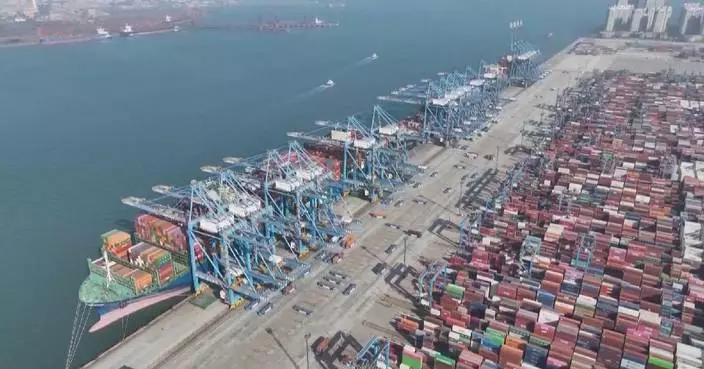
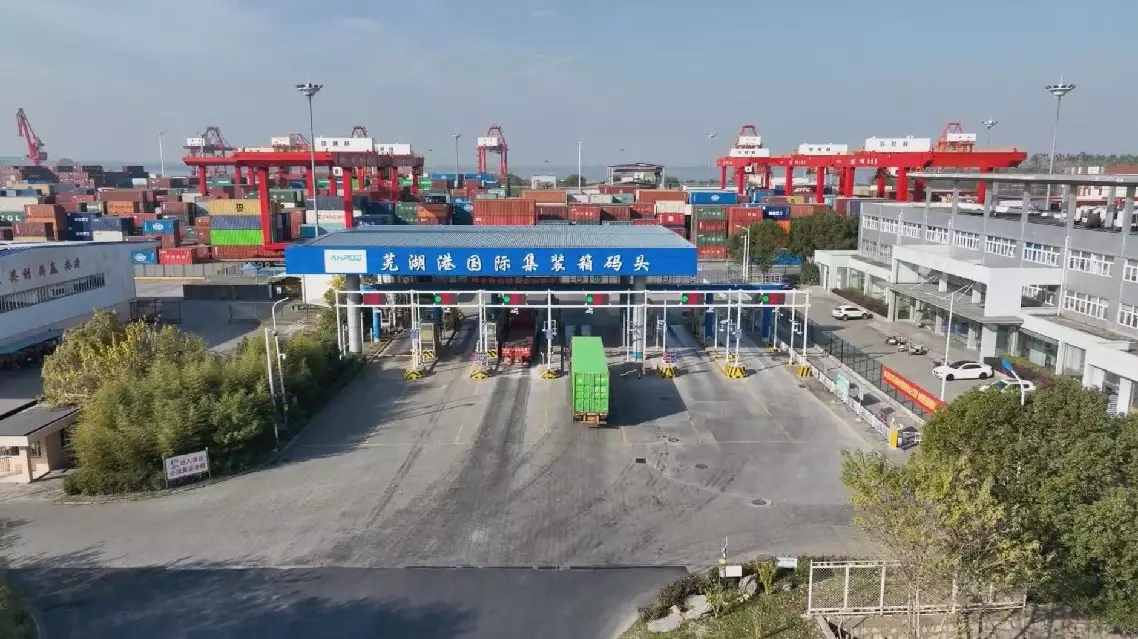
China on Wednesday unveiled a new list for the construction of 26 national-level logistics hubs, spanning provincial-level regions including Jiangsu, Anhui and Sichuan in the eastern, central and western parts of the country, aiming to streamline the country's logistics infrastructure and reduce overall logistical costs.
The latest batch of national-level logistics hubs, which was unveiled by the National Development and Reform Commission (NDRC), includes three land port-based logistics hubs, two airport-based ones, a seaport-based one, eight ones for production services, nine ones for trade service, and three land border port-based ones. The construction of the hubs is intended to further improve the country's national logistics network, according to the NDRC -- the country's top economic planner.
"A major purpose of establishing national-level logistics hubs is to integrate the scattered logistics facilities and improve logistical operations, so as to realize a large-scale organization, agglomerated development and network-based operation of logistics. By doing so, we can optimize the distribution of logistics resources and reduce the cost of logistics in the whole of society, promoting the work in all areas by drawing upon the experience gained on key points," said Wu Junyang, deputy director of the Economic and Trade Department of the National Development and Reform Commission.
So far, the NDRC has released six lists for the construction of national-level logistics hubs covering all the 31 provincial-level regions and the Xinjiang Production and Construction Corps on the Chinese mainland.
According to the newly-released list, the proportion of national-level logistics hubs for production services will further increase, with those in the list of 26 ones newly unveiled accounting for roughly one third.
The construction of national-level logistics hubs for production services is primarily in coordination with construction of the layout of large-scale factories and mines, manufacturing bases and industrial agglomeration areas. As regional logistics organization centers, they are mainly intended for raw materials supply for industrial and agricultural production, storage and distribution of intermediary products and finished products and other integrated modern supply chain services.
"We will give a full play to the pivotal and pioneering role of national logistics hubs to lead optimization of the layout of productive forces, facilitate the formation of nearly support industrial ecosystems with advantageous resources and advantageous industries, and promote the formation of a new model for coordinated development of logistics featuring 'industrial clusters plus logistics hubs', so as to enhance industrial competitiveness and the driving force for regional economic development," Wu said.
So far, there have been 151 national-level logistics hubs, reaching more than 70 percent of the planned total.
The country has also seen a steady growth in cargo throughput and an increasingly greener logistics.
In the first half of this year, the average cargo throughput of national-level logistics hubs grew by five percent over the corresponding period of the previous year.
Also in the six-month period, logistics hubs in the central region showed the highest growth rate, with a 10.5-percent year-on-year increase, while the land border port-based logistics hubs saw the fastest growth in cargo throughput at 29.3 percent.
In terms of investment, the northeastern region saw the highest growth rate in hub investments at 44.2 percent in the January-June period.
Meanwhile, the amount of renewable energy used by the logistics hubs jumped by 29.1 percent over the same period of last year.
China to build 26 new national-level logistics hubs to boost supply chain efficiency