Skip to Content Facebook Feature Image

U.S. company sees great business opportunities in China's equipment renewal program

China

China

China

U.S. company sees great business opportunities in China's equipment renewal program

2024-10-03 21:55 Last Updated At:23:27

The U.S. enterprise Otis, a world-leading elevator manufacturer, is cashing immense business opportunities arising from the China's equipment and consumer goods renewal programs particularly in the upgrading of over 40,000 residential elevators in 2024 alone.

Deeply involved in the Chinese market for 40 years, Otis has established production bases in China's Tianjin, Hangzhou, and Jiaxing, and has set up a global research and development center and a high-speed elevator center in Shanghai.

As the largest elevator market in the world where over 80 percent of the world's new elevators being produced here each year, China has already become a strategic hub in Otis' global operations.

In March of this year, China's State Council issued an action plan aimed at fostering large-scale equipment renewal and trading-in of consumer goods. Recently, detailed measures supporting the action plan have been fully rolled out. Specifically, in the field of aging elevators, plans for 2024 include the use of ultra-long special government bonds to support local governments in upgrading over 40,000 residential elevators that have been in service for more than 15 years.

Currently, China has approximately 800,000 elevators that have been in service for over 15 years, among which around 170,000 elevators have been in use for over 20 years.

This provides huge market for Otis, which is upgrading its products to better meet the increasing demand.

"We also have solutions for modernization of other buildings as technology ages. Just like you would change anything in your house, your car. As elevators hit 15 or 20 years, they're ready for technology upgrades as well," said Judy Marks, Chair and CEO of Otis Worldwide Corporation.

At one of Otis' factories in Tianjin Economic-Technological Development Area (TEDA), hundreds of elevators are manufactured every day. In 2023, the production of elevators, escalators, and lifts in China reached 1.557 million units. This massive market, combined with its advantages in the industrial supply chain, has encouraged foreign companies, including Otis, to continue expanding their operations and investments in China through technological empowering and innovation.

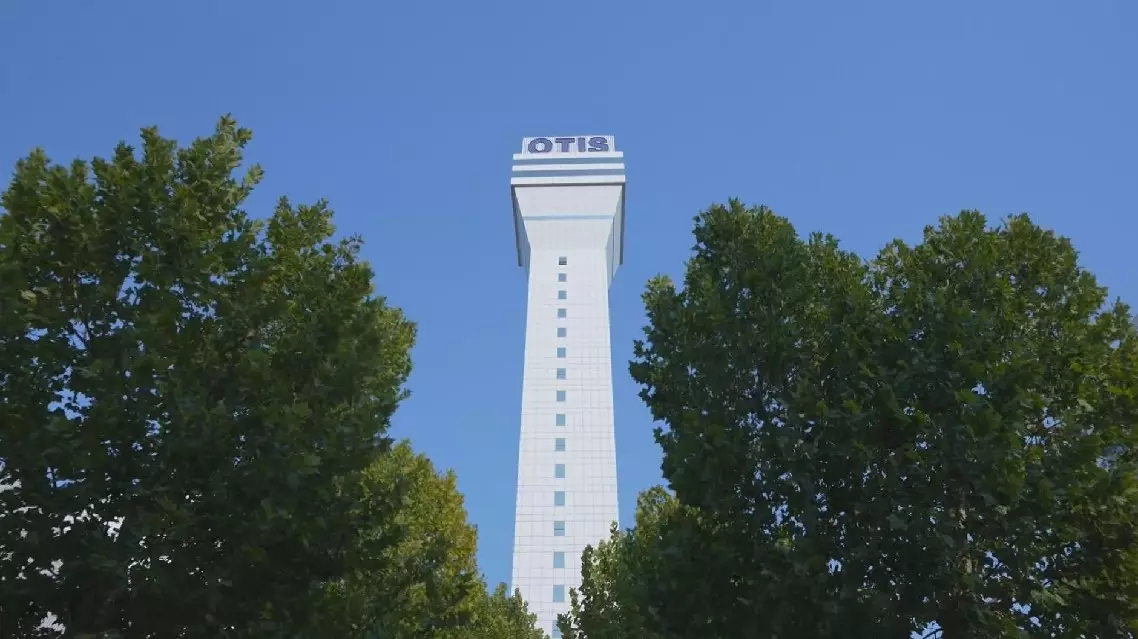
In 2019, Otis partnered with the Shanghai Oriental Pearl Radio and Television Tower to design a custom-made inclined elevator, tailored to the unique architectural features of the tower. This elevator is suspended between the tower's columns and is one of the first inclined elevators in China.

"The Otis inclined elevator has been a very distinctive sightseeing elevator introduced to the Oriental Pearl Tower in recent years. It operates on a 60-degree inclined track and transports nearly 2,000 tourists daily, greatly improving the transportation capacity of the tower," said Ao Junming, deputy general manager of Shanghai Oriental Pearl Radio and Television Tower Co., Ltd.

The President of Otis China Luo Xiaoli said China is a great market for innovations like this.

"As far as innovation and digitalization is concerned, all the indicators that China is a very open economy that enable us to continue to grow our talent, grow our business and at the same time, we have also experienced the market openness of this market. The internationalization is a very market-oriented economy which makes it very friendly for investments like Otis here in China," said .
U.S. company sees great business opportunities in China's equipment renewal program

U.S. company sees great business opportunities in China's equipment renewal program

The heartbreaking story of 96-year-old Peng Zhuying, one of the last living survivors from the Japanese military's "comfort women" system in the Chinese mainland, has been shared in a moving documentary produced by the China Global Television Network (CGTN).

Peng remains one of only seven registered survivors in the Chinese mainland of the Japanese military's "comfort women" system, a brutal a state-enforced regime of sexual slavery during World War II, victimizing over 400,000 women across Asia.

She is also the only living survivor who is officially documented as a victim of both sexual slavery and of Japan's chemical warfare during the Japanese militarists' war of aggression against China.

Eight decades on, Peng has bravely shared the story of her horrifying experiences in the CGTN original documentary "Last Daughters," which reveals the deep scars left by war and captures the quiet strength and warmth that endured, even in the darkest depths of human suffering.

Blinded by mustard gas at age nine and mutilated at 14 before being forced into a military brothel during the war, Peng was able to survive despite facing these unimaginable hardships in her young life.

Peng shared some of the artifacts and the stories behind them from those difficult days.

"This is a fortune slip, a divination note, meaning you need to be cautious in what you do. When I was 16, my father forced me to study fortune-telling. He told me if I didn't learn, I would not get any food. At that time, I wanted to care for children instead, but I could make the call myself. I had to listen to him to make a living," she said.

She memorized every incantation as part of the fortune-telling custom. For 80 years, it was her livelihood, and she has continued to show strength to overcome any challenges in her life.

"I've gone through so much hardship, and yet I'm still alive. Now, I'm only afraid of getting sick and dying from it. I was sick for most of last year, and have yet to recover until now," said Peng.

Though she survived all the tortures and survived from the atrocities conducted by the Japanese aggressors, Peng's health is never been too strong, as she suffered from severe gynecological injuries and became infertile, while also losing her sight as she fell victim to a chemical warfare attack.

"These are gallstones. She had them for several decades. But she lost her eyesight early on and never had toxic exposure. The only explanation is the mustard gas she inhaled. Life for her has been harsh, far harsher than it appears on the surface," said her nephew Peng Zifang.

Japan's "comfort women" system, a state-sponsored sexual slavery scheme by the military, was unprecedented in modern history. It enslaved at least 400,000 women across Asia and the Pacific, including Chinese, Korean, Filipino and many other victims.

Half of those who suffered were Chinese. The Japanese opened its first "comfort women station" in Shanghai and over 2,100 followed in other places they invaded. Girls, deemed "military supplies," were trafficked like weapons.

Later in life, aged 43, Peng married a fisherman 20 years older than her. Only after his death did she speak openly about what she faced.

"Before my father passed away, he told me the stories of my two aunts. I was deeply shaken. Both of my aunts revealed the truth about the 'comfort stations' only after their husbands died. The often-cited figure [of 400,000] known victims barely scratches the surface of the true scale. Many more endured in silence because of the conservative traditions of that era. To speak up meant risking scorn, oppression and even violence. So they bore it quietly," said Peng Zifang.

Documentary reveals life of Chinese survivor of Japan's sexual slavery during WWII

Documentary reveals life of Chinese survivor of Japan's sexual slavery during WWII

Recommended Articles