Visiting boundary markers seems to have become a new trend in holiday-making on frontier regions in Northeast China's Heilongjiang Province neighboring Russia so far in the week-long National Day holiday that started on October 1.
At the border gateways and boundary monuments on the 2,981-kilometer frontier in Heilongjiang, tourists from all over the country are seen stopping to have photos taken with the boundary monuments or markers, with some listening to stories told by frontier police officers about past events associated with the frontier regions.
In China, the National Day holiday is a peak travel and tourism season.
Lying in the easternmost point of China is the Wusu Town Dongji Square in Fuyuan City of Heilongjiang Province. Next to the huge sculpture bearing the Chinese character of "East" in the square, the five-star Chinese national flag is fluttering in the wind. Just beside the national flag is a boundary monument, which has become an attraction to visitors.
Many of the visitors say that having a picture taken with the boundary monument on the occasion of the National Day holiday would make them feel honored about happy powerful their motherland is.
Li Xin, a police officer with the Wusu Town Border Police Station on duty at the Dongji Square, said he has felt the enthusiasm of visitors.
Li said that the number of tourists visiting the Doingji Square so far in the National Day holiday has doubled compared to the same period of last year.
In Mohe, the northernmost city in China which is more than 2,000 kilometers away from Dongji, visitors are also seen flocking to the Beiji (North Pole) Village to have pictures taken with the local boundary marker.
Zhang Jiale, a police officer with the Arctic Border Police Station in Mohe, expressed the same feeling as Li Xin.
In Suifenhe, another frontier city in Heilongjiang, tourists also seen enthusiastically flocking to the boundary monument beside the third-generation border gateway to have pictures taken with it. The Suifenhe Gateway Scenic Spot is located at the zero point of Suifenhe Highway Port G10 Suiman Expressway, the largest land port to Russia in Heilongjiang Province. It is the only longitudinal cross-border scenic spot in China and the only one that integrates three generations of border gateways in China's gateway scenic spots.
In this scenic spot, tourists frequently ask Wang Jiaxing, a police officer with the Suifenhe Entry-Exit Border Checkpoint on duty, to help take photos or ask about how to make a tourist travel to the neighboring country.
Ke Zunlei, a tourist from Shanghai, visited the site with his wife and young daughter.
"Standing at a frontier region of my own country, I feel that this place is quite sacred," Ke said.
In Hutou Township of Jixi City in the province, the boundary marker "292-1-2014," which marks the starting point of the Wusuli River between China and Russia, also attracts many visitors to make a visit and take photos.
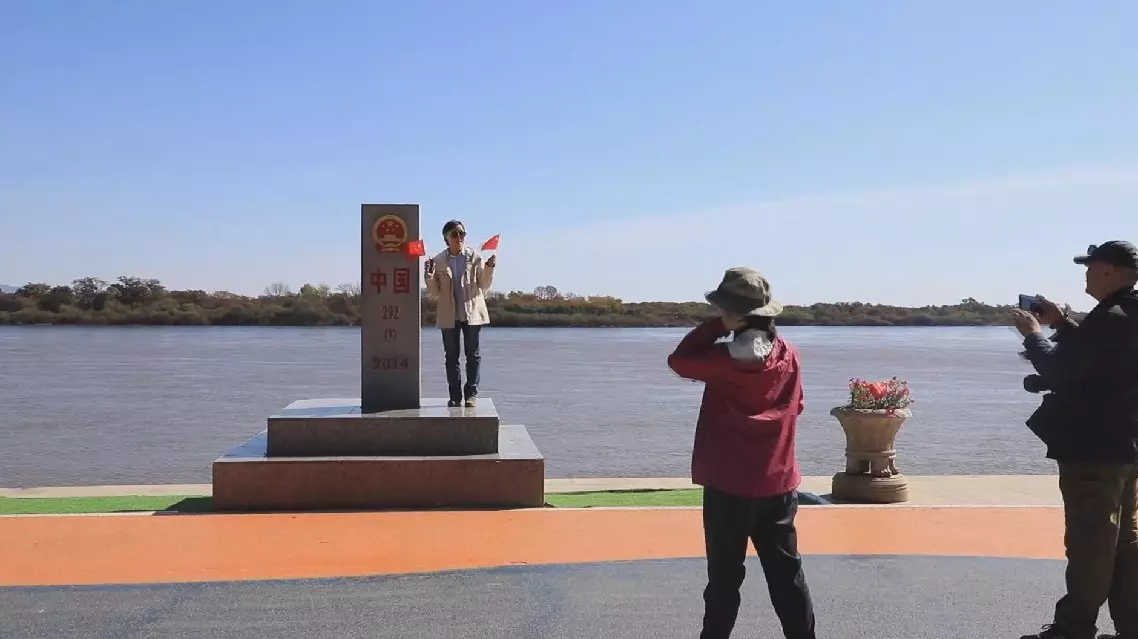
Visiting boundary markers becomes new trend in China's National Day holiday travel