As Israeli attacks continue, Lebanon is grappling with soaring inflation and stagnant food production, raising fears of an impending food crisis.
Data showed that over 1.2 million people are currently displaced, with many families seeking refuge from Israeli airstrikes. Meanwhile, inflation rates have surged beyond 40 percent, causing the prices of essential goods to skyrocket. Basic necessities have become unaffordable for many families.
Yahya is currently living in an underground basement with his family in Beirut after fleeing from the airstrikes. The room is the only place they can afford with his family stuck in a poor financial situation.
"My father lost his job. The financial situation for my family is bad. I found myself a job, so I can assist my family now,” said Yahya.
With prices skyrocketing, Yahya must work longer hours to make ends meet. What used to be manageable has become an exhausting routine of extended shifts to cover basic needs.
"Things were better back then because prices were reasonable. Now everything has doubled in price. I used to work nine hours a day, but I have to work 12 hours now to meet my family's needs. It's exhausting," he said.
Even before the outbreak of hostilities, Lebanon's economy was fragile. Despite inflation rates exceeding 35 percent, prices remained relatively stable. However, since the onset of the conflict, the situation has taken a sharp turn for the worse.
Inflation has skyrocketed, surpassing 40 percent, and the cost of necessities has doubled or even tripled, making it incredibly difficult to afford everyday items like food and fuel.
The ongoing airstrikes have driven farmers and field workers away from their lands, leaving fields untended and crops unharvested. This disruption in agricultural production has further exacerbated the situation, leading to rising food prices.
"The directly related sector to agriculture is the agro-food sector. The industrial agro-food sector in Lebanon is the largest and the most productive sector. If this sector will stop, we will be facing a food crisis in Lebanon because 60 percent of the food in Lebanon is coming from the agriculture and the agro-food sector," said Hashem Abou Jaoud, a political-economist and expert in labor, markets and socio-economic development.
Many are now deeply concerned that Lebanon could soon face a full-blown food crisis, as the nation, already ravaged by conflict, struggles to secure even the basic necessities.
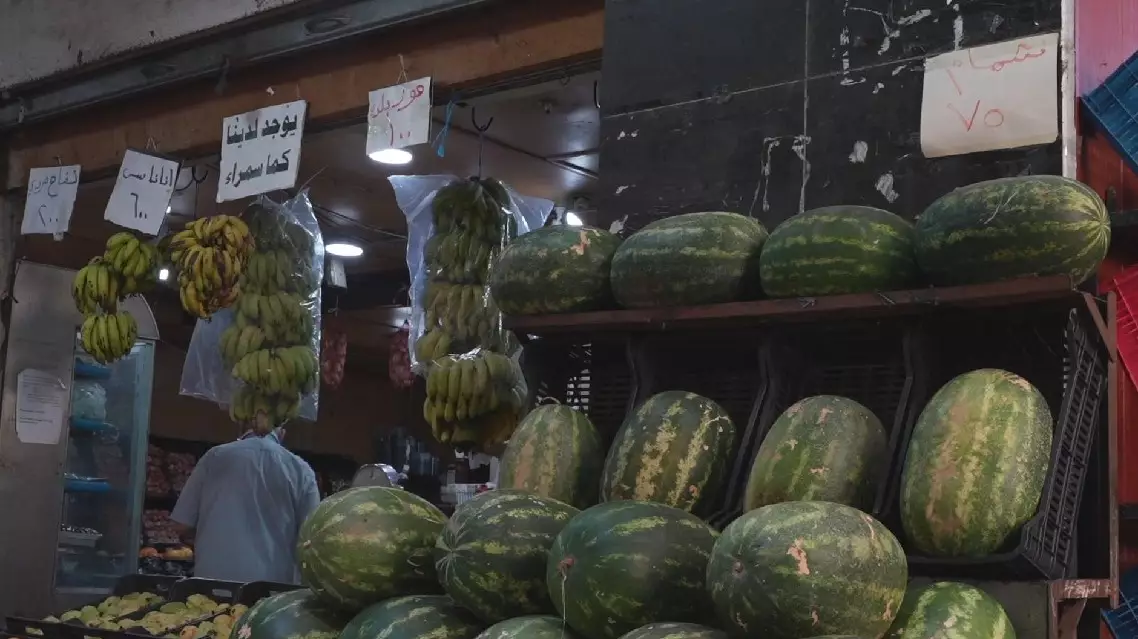
Lebanon faces rising inflation, looming food crisis as Israeli attacks continue
The Iranian Ministry of Foreign Affairs on Friday strongly condemned U.S. attacks on Iranian oil tankers and several locations along the coast of the Strait of Hormuz.
In a statement, the ministry emphasized that Iranian forces are determined to defend the country's territorial integrity, independence, and national sovereignty against any aggression.
It also said the ministry had called on the United Nations Security Council and the UN Secretary-General to uphold international peace and security in accordance with the UN Charter.
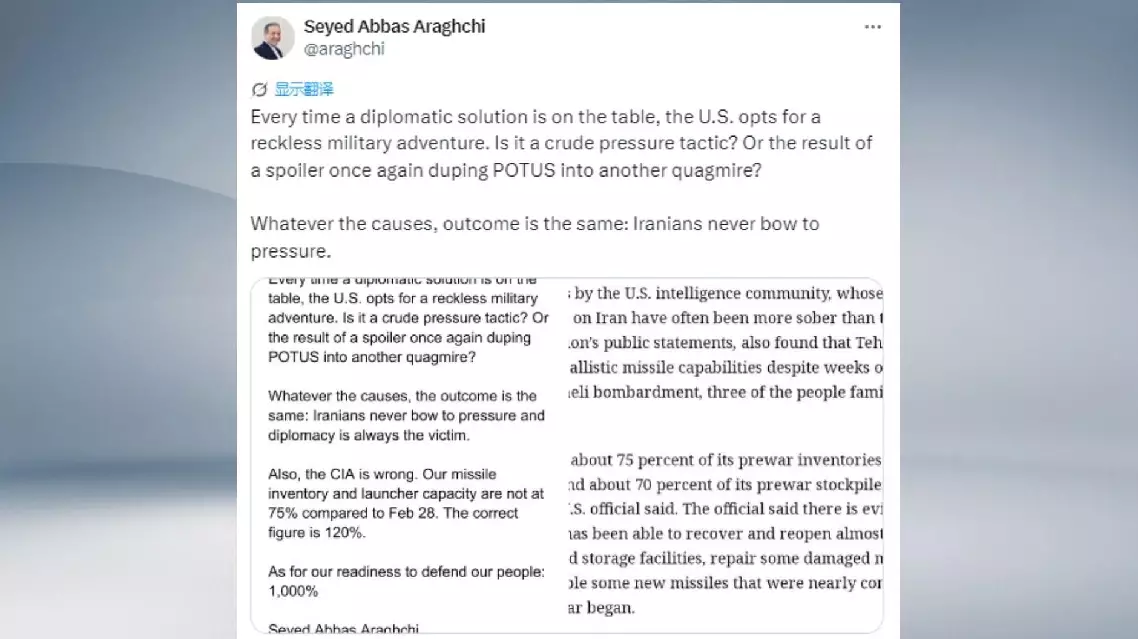
Meanwhile, Iranian Foreign Minister Seyed Abbas Araghchi on Friday slammed the U.S. for once again choosing what he called a "reckless military adventure" when "a diplomatic solution is on the table" again.
Writing on social media platform X, Araghchi said Iranians "never bow to pressure" and "diplomacy is always the victim."
He also dismissed the U.S. intelligence assessment, saying Iran's missile inventory and launch capacity were not at 75 percent of their February 28 levels, but had reached 120 percent. Iran's readiness to defend its people, he added, stood at "1,000 percent."
U.S. forces on Friday struck and disabled two more Iranian-flagged empty oil tankers before they entered an Iranian port on the Gulf of Oman amid rising tensions in the Strait of Hormuz, U.S. Central Command (CENTCOM) said.
In a post on X, CENTCOM said it had "enforced blockade measures against two Iranian-flagged empty oil tankers attempting to pull into an Iranian port on the Gulf of Oman."
A U.S. Navy F/A-18 Super Hornet from the USS George H.W. Bush disabled both tankers by firing precision munitions into their smokestacks, the command said.
On Wednesday, U.S. forces disabled another unladen Iranian-flagged oil tanker, the Hasna, as it attempted to sail to an Iranian port on the Gulf of Oman. An F/A-18 Super Hornet from the USS Abraham Lincoln fired several rounds from a 20mm cannon to disable the ship's rudder.
"All three vessels are no longer transiting to Iran," the command said.
CENTCOM commander Brad Cooper said U.S. forces would continue to fully enforce blockade measures against vessels entering and leaving Iran.
There are currently more than 70 oil tankers that U.S. forces are preventing from entering or leaving Iranian ports, CENTCOM said in another post, noting these commercial ships have the capacity to transport over 166 million barrels of Iranian oil worth an estimated 13 billion-plus U.S. dollars.
U.S. and Iranian forces traded fire on Thursday when three U.S. Navy destroyers were transiting out of the Strait of Hormuz.
CENTCOM said it was a "self-defense" action while Tehran accused Washington of violating a ceasefire which took effect on April 8.
Iran condemns U.S. attacks on tankers