China's independently developed 20-megawatt floating offshore wind turbine, the world's most powerful one so far, has rolled off the production line in Sheyang County of east China's Jiangsu Province, its developer CRRC Corporation Limited (CRRC) announced on Thursday.
With a propeller diameter of 260 meters, the wind turbine covers a sweeping area of 531,000 square meters, equivalent to seven standard soccer fields.
Capable of generating of 62 million Kwh of electricity in clean energy per year, a single unit of the wind turbine can satisfy the annual power consumption demand of around 37,000 households. This is equivalent to saving 25,000 tons of coals and cutting 62,000 tons of carbon dioxide emission each year.
Real-time monitoring of the wind turbine can be realized as it is equipped with multiple smart control and sensing technologies to ensure stable operation.
Located on a semi-submerged floating offshore wind platform, the floating offshore wind turbine could further utilize the wind power on the sea by allowing the deployment of wind turbines in larger and deeper offshore areas with higher wind potential.
"Traditional offshore wind turbines are based on structures fixed into the ocean floor, while floating wind turbines are given more leeway as they may drift with waves. Currently, floating wind power generation represents an important technological direction of the future of wind power development," said Wang Dian, deputy general manager of a CRRC's new energy technology subsidiary.
The floating wind turbine will be tested in Dongying City of east China's Bohai Sea coastal province of Shandong and will be installed later in a deep-sea area to be connected to the power grid , according to sources familiar with the project.
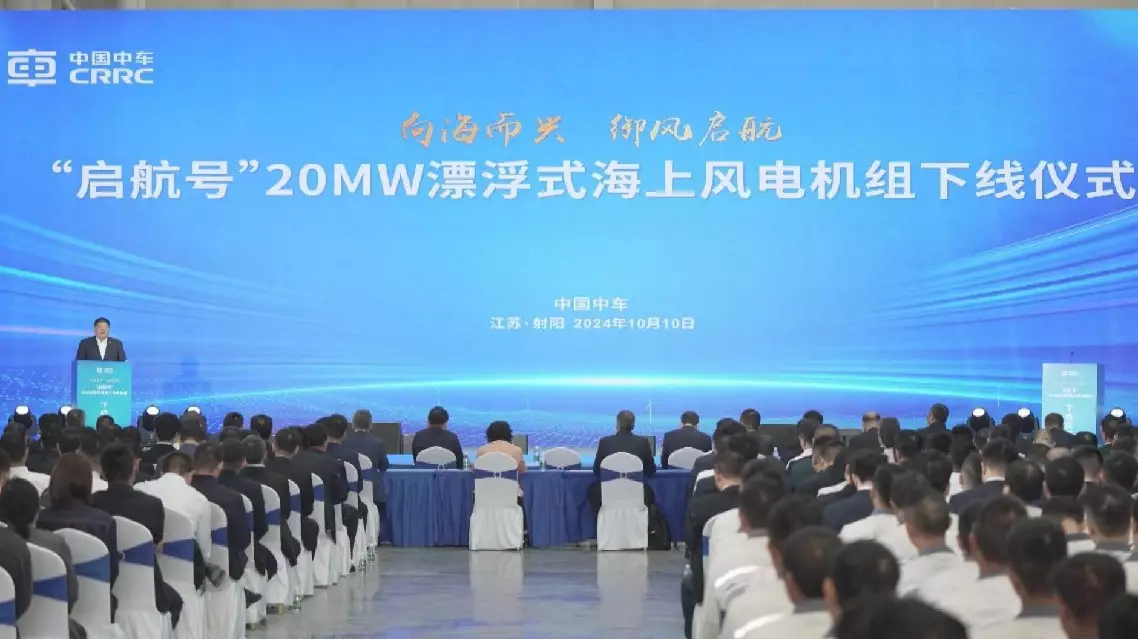
World's most powerful floating offshore wind turbine rolls off production line
U.S. President Donald Trump said on Friday that he estimates a deal with Iran will be signed "in the next day or two."
Trump said in an interview with Israel's Channel 12 News that the United States and Iran will probably meet over the weekend to finalize a deal to end the war. "The Iranians want to meet and make a deal," he said.
He said "the naval blockade on Iran is helping to make a deal. I will not lift it until we make a deal," adding that "the biggest part of this deal is that it will make Israel safer. This deal is good for Israel."
According to the channel, one component of the deal under discussion is that the United States will release 20 billion U.S. dollars in frozen Iranian funds.
In exchange, Iran would give up its stockpile of enriched uranium, and would be only allowed to have nuclear research reactors to produce medical isotopes, all above ground.
Trump also stressed that Israel must stop the strikes on Lebanon, saying, "They can't keep blowing up buildings. I'm not going to allow that."
Also on Friday, Trump said in a phone interview with Bloomberg that a deal to end the U.S.-Israeli war with Iran is mostly complete as talks over a lasting peace deal will "probably" be held this weekend in Pakistan.
Trump said in the phone interview that Iran agreed to suspend its nuclear program indefinitely, and will not receive any frozen funds from the United States.
"Most of the main points are finalized. It'll go pretty quickly," Trump said.
Asked if he would travel to Pakistan to sign the potential deal, Trump said: "I may."
Trump again denied that the moratorium on Iran's nuclear program would expire after 20 years. "No years, unlimited," Trump said.
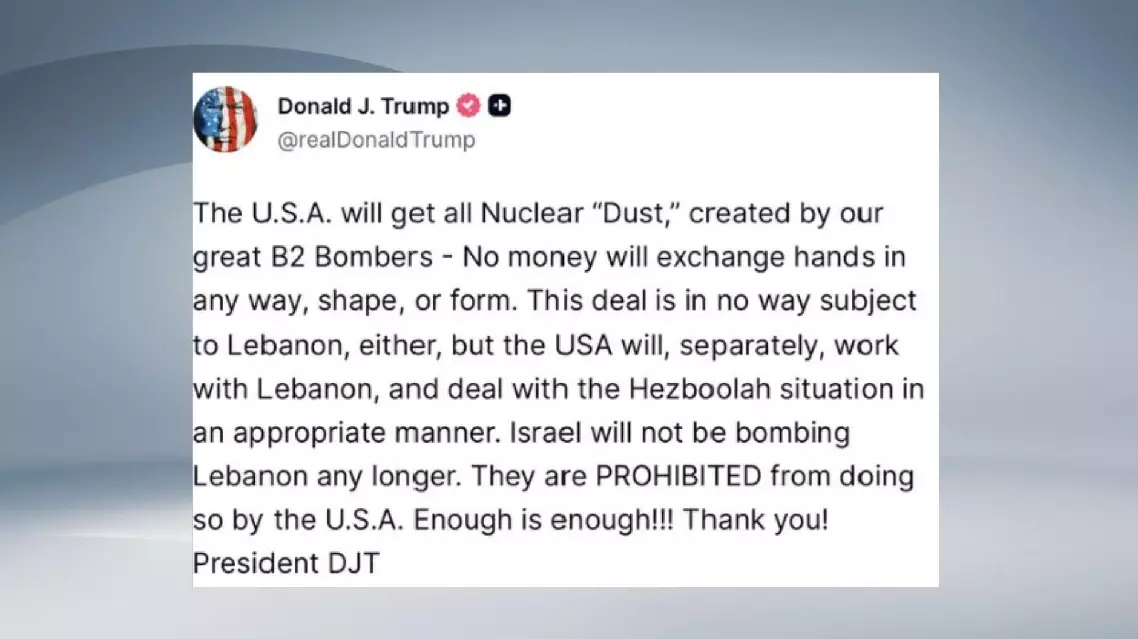
The United States will get all of Iran's nuclear "dust" with no money having exchanged hands "in any way, shape, or form," Trump wrote on social media earlier on Friday. Multiple Western media outlets have interpreted Trump's reference to nuclear "dust" as meaning Iran's stockpile of enriched uranium.
Iran has yet to comment on any deal beyond the reopening of the Strait of Hormuz, nor on claims made by Trump that Tehran had offered concessions, including over the key issue of its nuclear program.
If the United States continues its naval blockade of the Strait of Hormuz, Iran will consider it a violation of the ceasefire between the two countries and will close the waterway, the semi-official Tasnim news agency reported Friday, citing an informed source close to the Supreme National Security Council.
The Iranian side has yet to respond to the media report on the enriched uranium issue.
The United States and Iran had their first round of negotiations in Pakistan's Islamabad last weekend to ease tension in the Middle East. The talks, which failed to produce an agreement, took place after a ceasefire was announced on April 8 between Iran, the United States, and Israel, following 40 days of fighting.
Iran tightened control over the Strait of Hormuz after the United States and Israel launched joint attacks on the country on Feb. 28. The United States also imposed a naval blockade on the strait following the failed negotiations in Islamabad.
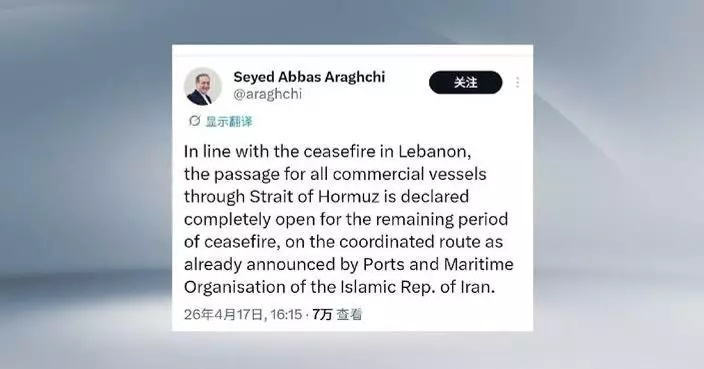
Earlier on Friday, both Washington and Tehran confirmed that the strait had been completely open for all commercial vessels. However, Trump said on Truth Social that the U.S. naval blockade would "remain in full force." In response, Iran warned of closing the waterway again if the U.S. blockade continues.
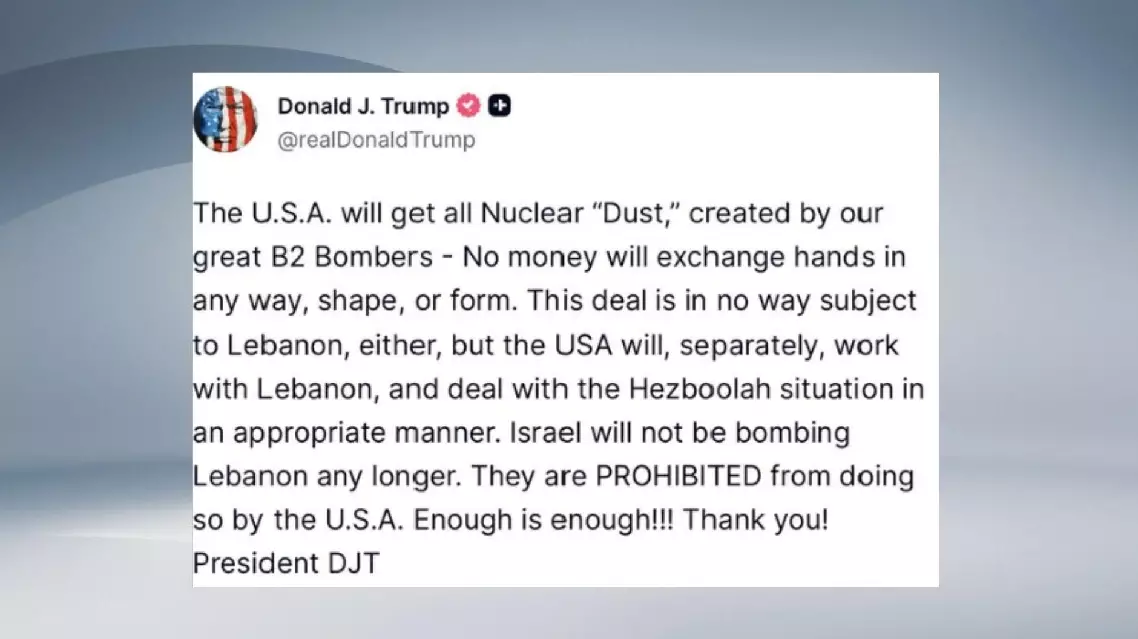
Trump says may sign deal with Iran "in the next day or two": Israeli media
Trump claims peace deal with Iran mostly complete: report