About 800 interdisciplinary experts from China and around the world convened in Beijing on Friday at the 2024 World Agrifood Innovation Conference (WAFI 2024), advocating a low-carbon transition in agrifood systems through sci-tech innovation to address climate change.
The conference, themed "Climate Change and Agrifood Systems Transformation," highlights the urgent need for innovation in the agricultural sector.
Experts at the conference acknowledged the numerous challenges facing agrifood system transformation and the need for global collaboration to share experiences and results through ongoing dialogue.
"One of the major highlights of the conference is multidisciplinary [observations]. Entrepreneurs and scientists are all on one platform. What we particularly emphasize is the dialogue among scientists, entrepreneurs, and investors, which is very crucial. How can a scientist's research results be transformed into productivity? This transformation necessitates industrialization, wherein businesses must leverage their technological innovations," said Fu Wenge, director of the MBA Education Center, at China Agricultural University.
During the conference, scientists, educators, entrepreneurs and investors from over 70 countries and regions will discuss various topics including smart agriculture, AI-driven breeding, transformations in livestock and aquatic food systems, genetic resources and germplasm innovation, as well as food nutrition and security.
David Nabarro, a World Food Prize laureate, highlighted that achieving sustainable agriculture requires not only national policy development but also international cooperation across industries, disciplines and stakeholders.
"This conference is about finding ways that innovation can help agriculture and food in China and beyond meet the needs that we're going to see now and in the decades to come. Well, this is a country that contains some of the world's brightest scientists who not only are good at doing the science, but also applying it and sharing it with others," said Nabarro.
Alongside the gathering of experts, the event is hosting the 2024 World AgriFood Technology Expo, showcasing cutting-edge achievements, advanced technologies, advanced models, high-quality projects, and innovative products in the global agricultural sector.
Initiated last year, WAFI aims to serve as a world-class platform for advancing global agrifood innovation. The conference is co-organized by the local government of Pinggu District of Beijing, the Beijing Municipal Bureau of Agriculture and Rural Affairs, China Agricultural University and the Chinese Academy of Agricultural Sciences.
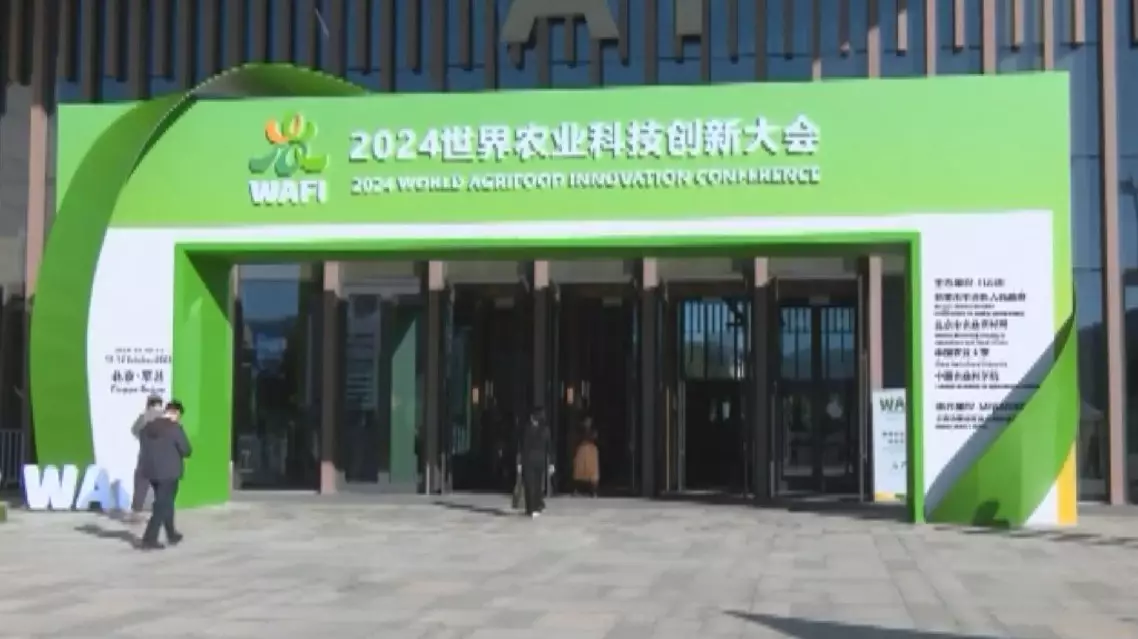
Global experts in Beijing explore strategies to realize low-carbon agrifood systems
A cold front has brought snowfall and freezing temperatures across many parts of China, disrupting transportation and prompting emergency responses. On Sunday morning, many places in Handan City of north China's Hebei Province have experienced snowfall.
The province on Sunday activated a Level-IV emergency response for major meteorological disasters in preparation for incoming heavy snowfall.
According to the provincial meteorological observatory, heavy snow is forecast to hit areas including Shijiazhuang, Cangzhou and Hengshui from day to night on Sunday. Some regions may experience blizzard conditions.
Forecasters warn that the severe weather will disrupt transportation, urban services, and greenhouse agriculture.
Local authorities have been urged to closely monitor weather conditions, enhance risk assessment, and eliminate potential safety hazards.
China has a four-tier emergency response system, with Level I being the most severe response.
Starting early Sunday morning, a new round of snowfall began in areas such as Qingyang City and Dingxi City in northwest China's Gansu Province.
In order to ensure smooth traffic and people's normal life and production, local departments have made coordinated efforts to clear snow from roads.
Local traffic police have also increased presence at key areas to direct traffic and ensure timely response to emergencies.
In addition, widespread snowfall affected the northern parts of northwest China's Xinjiang Uygur Autonomous Region, posing challenges to urban transportation and railway operations.
Traffic police and city departments are mobilizing to clear roads and ensure safe travel for residents.
Railway authorities also implemented pre-arranged snow-response plans, using equipment such as wind-powered snow blowers and de-icing equipment to clear key sections of track and prevent switches from freezing.
The current round of snowfall in the northern parts of Xinjiang is expected to end on March 2. Some areas in east China's Shandong Province also experienced heavy snow on Sunday. At 11:00, the provincial weather service issued yellow warnings for icy roads.
At the Mount Tai scenic area in Tai'an City, the weather transitioned from a mix of rain and snow to snowfall during the day. As of 15:00 on Sunday, the average precipitation had reached 18.9 millimeters, with the snowfall still ongoing. To ensure the safety of visitors, the scenic area has decided to suspend all access routes starting from 16:00. On Sunday morning, cold air prompted snowfall in many places of north China's Shanxi Province. The Shanxi Provincial Meteorological Observatory issued a yellow alert for blizzard, covering areas such as Jinzhong City, Linfen City, and Yuncheng City.
Icy road conditions led to temporary traffic restrictions on several highway sections.
Local authorities promptly activated emergency response plans, deploying crews for snow removal and traffic control.
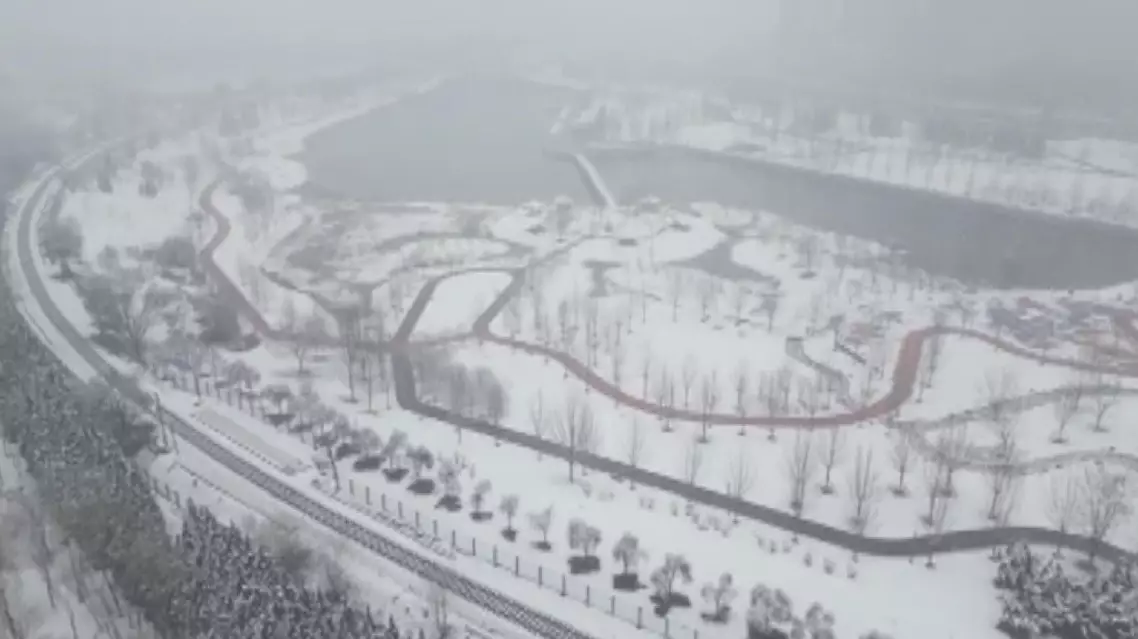
Snowfall hits many parts of China, affecting transportation