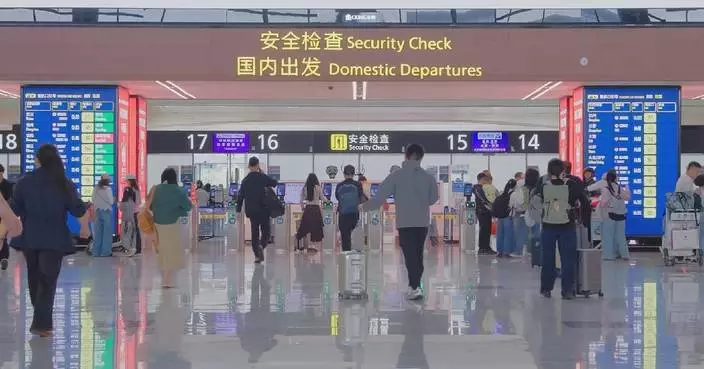
China has made significant strides in improving home and community-based care services for the elderly, while also strengthening the capacity of elderly care institutions in recent years.
By the end of 2023, China had 297 million people aged 60 and older, making up 21.1 percent of the population.
As the country advances toward modernization, it is proactively tackling the challenges of an aging population, acknowledging it as a key issue that must be addressed head-on.
The country is steadily expanding its catering network to provide convenient meal services directly to the doorsteps of more senior citizens.
Catering programs have been rolled out in many regions to help elderly people access local meal services, with community canteens being a common form of these services.
A community in Lanzhou City, northwest China's Gansu Province, has been exploring a model that combines meal assistance with diverse interest-based courses for the elderly, creating multifunctional services.
It provides discounted lunches and dinners for seniors, as well as offering university courses for the elderly.
During the 14th Five-Year Plan period (2021-2025), the central government has implemented various measures to significantly enhance home-based and community-based elderly care services.
Since 2021, central government funding has facilitated the establishment of 303,600 nursing beds in the homes of eligible elderly individuals.
During this period, 1.72 million homes of seniors with special needs were renovated to better accommodate their requirements.
"Next, we will promote the introduction of industry standards for the basic norms for the construction of beds at home care services for the elderly, driving the standardization, normalization, and professionalization of home-based elderly care," said Li Yongxin, head of the elderly care services department at the Ministry of Civil Affairs.
A report released on Tuesday stated that by the end of 2023, nursing beds accounted for 58.9 percent of all beds in elderly care institutions across China.
The achievement demonstrates that the country met its target set in the 14th Five-Year Plan (2021-2025) ahead of schedule.
"After coming here, I've become quite accustomed to life. We have plenty of activities. Every Monday we exercise. We usually sing on Tuesdays and do crafts on Wednesdays. So, I'm quite satisfied here," said Xiang Ti, a resident of a social welfare center in Wuxi City, in east China's Jiangsu Province.
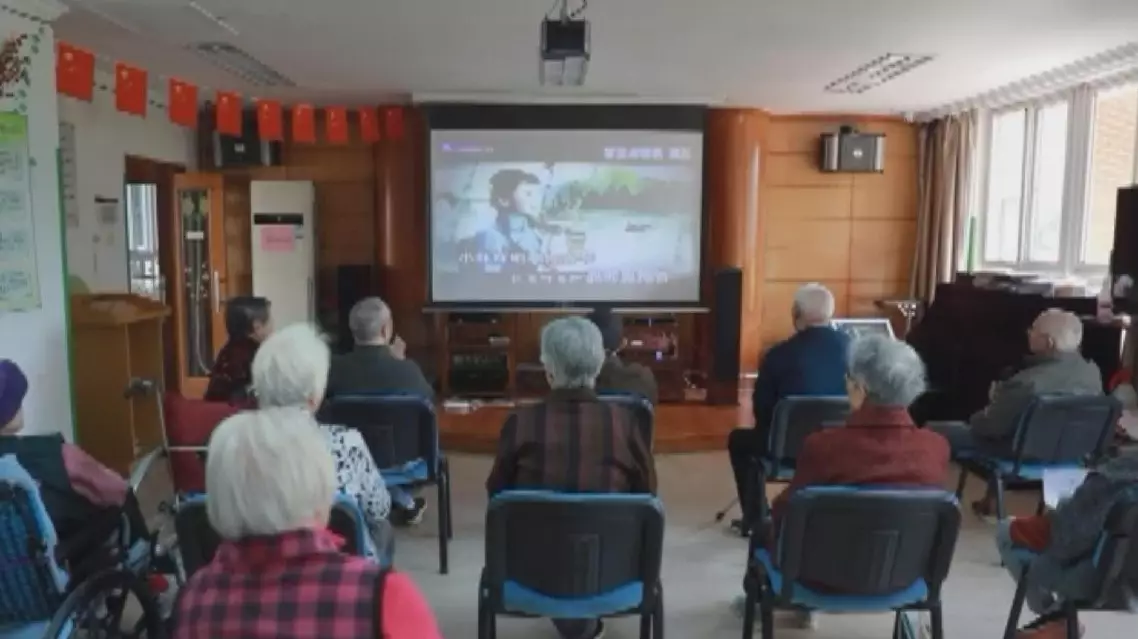
China makes significant progress in improving elderly care services
Japanese civic groups and residents held a rally Saturday in Tokyo to protest the dangerous policies pursued by the government of Prime Minister Sanae Takaichi.
Holding anti-war placards and chanting slogans, the protesters gathered outside Shinjuku Station in downtown Tokyo, calling for the pacifist Constitution to be upheld and for an end to the stoking of regional tensions.
Since Takaichi took office, Japan's remilitarization has markedly accelerated Last month, the Japanese government officially revised "the Three Principles on Transfer of Defense Equipment and Technology" at the cabinet and related meetings. It scrapped the longstanding restriction limiting weapons exports to only five categories of noncombat equipment.
Japan’s House of Representatives passed a bill in late April to establish a national intelligence council and a national intelligence bureau, in an effort to create the country’s first centralized national-level intelligence system since World War II.
Critics argue that these dangerous moves signal a shift toward a more assertive military posture, which has sparked widespread concerns among the public.
"To be honest, Takaichi neither seriously studied nor understood the history of Japan's aggression against China, Korea, and other parts of East Asia. Moreover, Japan doesn't even teach people this history. I think this is a great fault. I am also very worried and deeply concerned that such a history will repeat itself. That's why I must stand up now and oppose it," said a protester at the rally.
Another protester echoed these concerns, stating that the rallies reflect growing public anxiety and anger toward the government’s current policies.
"We feel a very strong sense of crisis [over the policies of the Takaichi government]. In Japan, more and more people are joining rallies like this. Their growing participation clearly reflects a deepening anxiety that Japan is heading towards war, along with widespread anger at the Takaichi government," said the protester.
"Japan, as China's neighbour, should have reflected deeply on its past war aggressions. Instead, it is now completely disregarding history, unilaterally expanding its military and continuously increasing armaments. Meanwhile people's livelihoods are worsening. Social security is being reduced, and education budgets are shrinking, but the government keeps pouring money into military spending. To me, this is a policy that will ultimately ruin the country," another protester said.
Notably, a growing number of young people in Japan are joining the protests, voicing dissatisfaction and concern over the government’s military expansion policy.
"The primary reason I decided to join the rally is that I believe current politics is pushing the country too far toward war. This is the fundamental reason. [The Japanese government] has many issues, and the first problem is the removal of restrictions on arms exports. This may be good for some companies, but ordinary citizens want it stopped. I see strong similarities [between the current situation and World War II period]. For instance, the push to create a national intelligence bureau, labeling certain groups as 'enemies,' and steering the country toward war -- these remind me very much of the Pacific War. If more people speak out and protest, it is possible to stop this dangerous trend. That's why I hope everyone will participate in the rally together," said a university student who took part in the rally.
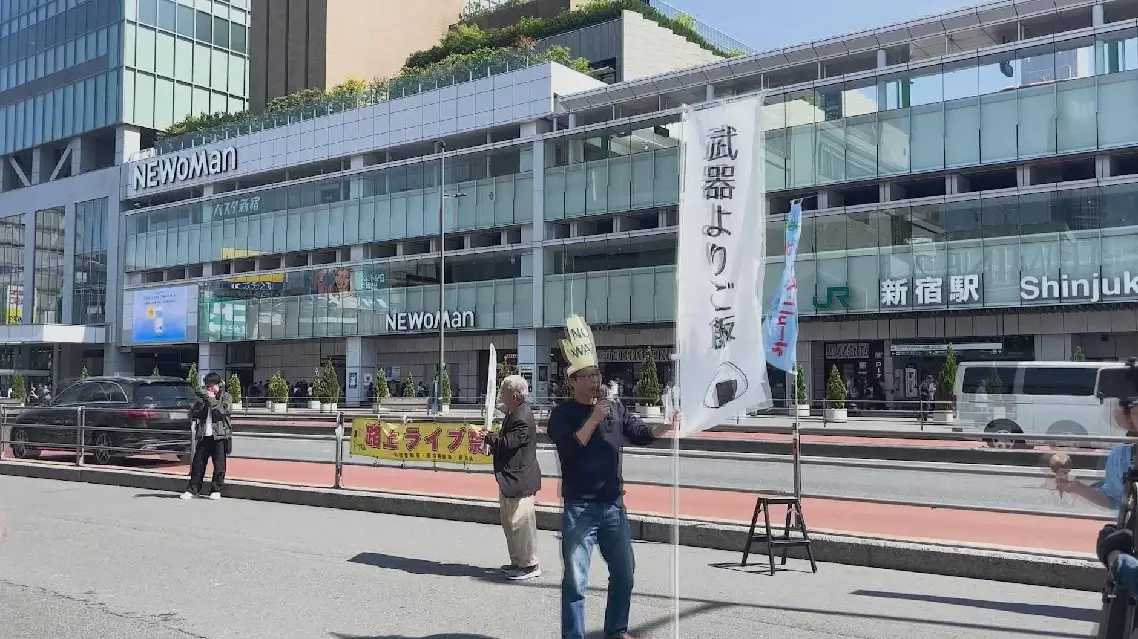
Japanese civic groups rally in Tokyo against gov’t dangerous policies